
Table of Contents: Water Heater Popping & Rumbling Noise Guide
- 1. Executive Summary: The Physics of Water Heater Popping & Rumbling
- 2. The Thermodynamic Mechanism of “Kettling”: Trapped Steam Pockets
- 3. Front Range Water Chemistry: Calcium Carbonate, GPG & Mineral Precipitation
- 4. Anatomy of Tank Degradation: Thermal Stress & Glass Lining Fractures
- 5. Step-by-Step Complete Professional Sediment Flushing Protocol
- 6. Sacrificial Anode Rod Science: Magnesium vs. Aluminum vs. Powered Titanium
- 7. Gas vs. Electric Water Heater Rumbling Nuances: Element Burndown vs. Bottom Scale
- 8. Solidified Calcite Rock vs. Flushable Slurry: When Is a Tank Beyond Saving?
- 9. Tankless Conversion as the Permanent Solution to Sediment Accumulation
- 10. Transparent Pricing Matrix: Maintenance, Flushing & Replacement Costs
- 11. Comprehensive Extended FAQ Section (12 Detailed Questions)
- 12. Schedule Professional Water Heater Diagnostic & De-Liming Service
1. Executive Summary: The Physics of Water Heater Popping & Rumbling
If you descend into your basement mechanical room or pass by your utility closet while someone is showering or running a load of laundry and hear strange sounds emanating from your water heater, you are not alone. Homeowners frequently describe these acoustic disturbances as popping popcorn, crackling grease, rhythmic thumping, deep rumbling, or even the sound of small rocks tumbling around inside the steel cylinder. While these sounds are often brushed aside as harmless mechanical quirks of an aging appliance, plumbing engineers and master technicians know that these auditory warnings indicate a severe, progressive condition known as water heater kettling.
The sounds you are hearing are not physical pebbles or loose mechanical parts bouncing against the metal. Instead, they are acoustic shockwaves generated by micro-explosions of pressurized superheated steam. When municipal water containing dissolved mineral ions enters your water heater, standard heating cycles cause calcium carbonate and magnesium compounds to precipitate out of suspension, settling onto the bottom of the tank as a dense, compacted layer of mineral sediment. As this subterranean sediment blanket thickens, it insulates the bottom of the tank from the surrounding water, trapping small pockets of liquid directly against the scorching metal heat exchanger.
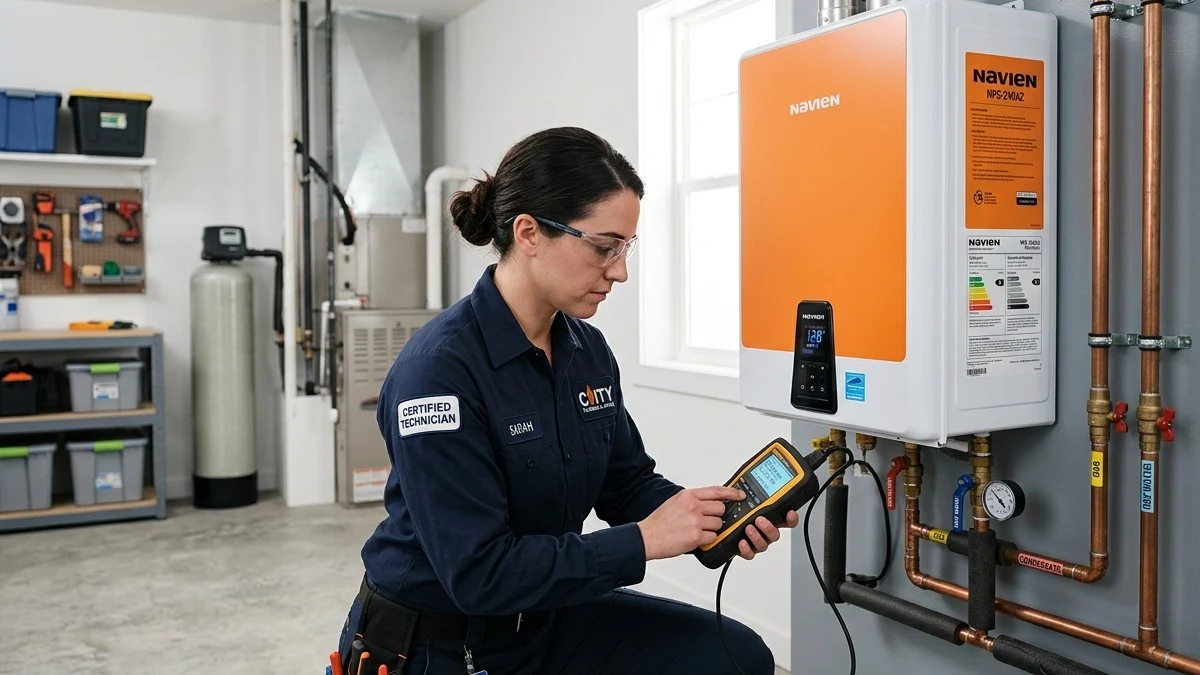
Trapped beneath pounds of rock-hard calcite scale, this water cannot circulate freely via natural convective currents. The trapped water superheats past its standard 212°F (100°C) boiling threshold until vapor pressure forces it to erupt violently through the sediment crust into the cooler water column above. As these expanding steam bubbles collapse suddenly in cooler water—a thermodynamic phenomenon identical to cavitation—they produce sharp acoustic shockwaves that resonate through the steel tank walls, producing the classic popping, gurgling, and rumbling noise.
Ignoring a rumbling water heater carries profound structural and financial consequences. Left unaddressed, compacted mineral scale creates extreme thermal hot spots that overheat the steel tank bottom, fatigue the protective porcelain glass lining, accelerate corrosive pitting, degrade energy efficiency by up to 30 to 40 percent, and ultimately cause sudden tank rupture, flooding basements with 40 to 75 gallons of scalding water. This definitive engineering guide details why water heater kettling occurs across the Colorado Front Range, how hard water accelerates tank failure, and the exact step-by-step restoration protocols required to save your water heating investment.
2. The Thermodynamic Mechanism of “Kettling”: Trapped Steam Pockets
To understand the destructive mechanics of water heater noise, one must analyze the thermodynamic laws governing heat transfer within a pressurized domestic water vessel. In an ideal, pristine water heater, heat transfer occurs through unobstructed thermal conduction and buoyant natural convection.
In a standard atmospheric gas water heater, a heavy burner assembly situated beneath the curved bottom dome of the inner tank fires natural gas flames at temperatures between 1,200°F and 1,500°F. The heat transfers directly through the carbon steel tank head into the water column. As water molecules in contact with the bottom steel absorb thermal energy, their density decreases, causing them to rise rapidly toward the top of the tank while cooler, denser water descends along the perimeter walls to replace them. This continuous, silent convective loop ensures uniform water temperature and prevents localized hot spots.
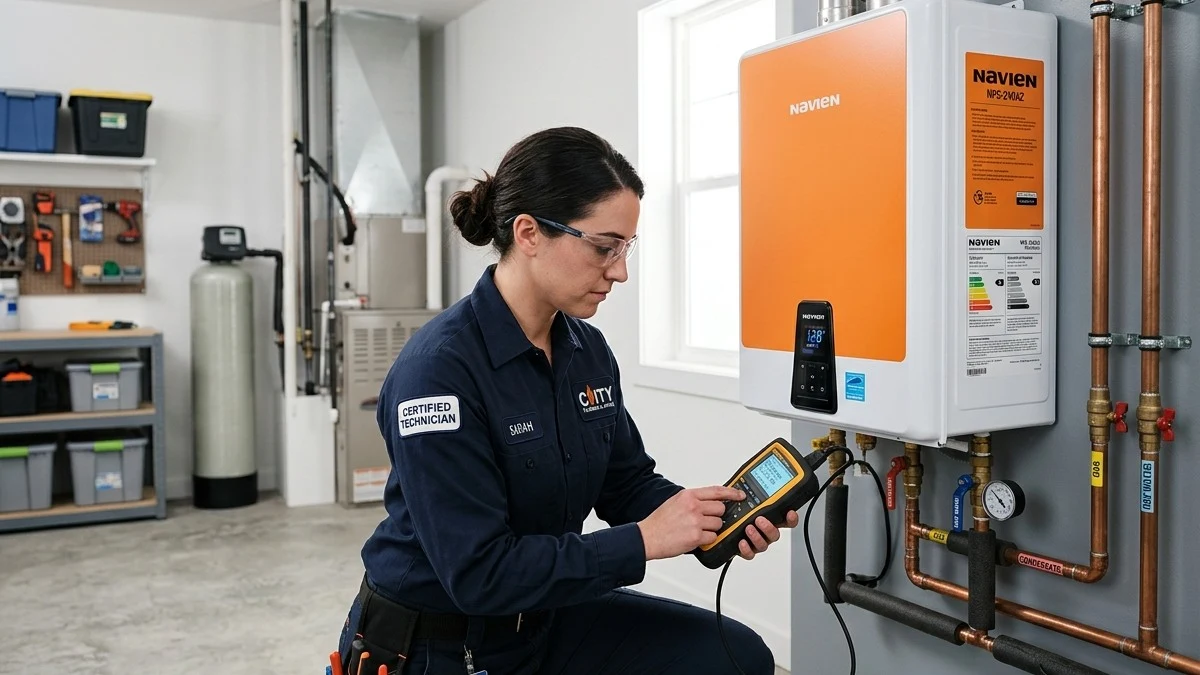
The Thermal Insulating Blanket: Disruption of Convection
When hard mineral scale precipitates out of municipal water, it forms a dense, porous bed of solid calcium carbonate ($) across the lower dome of the tank. Calcium carbonate has an exceptionally low thermal conductivity—roughly 2.2 to 2.9 W/(m·K)—compared to structural carbon steel, which has a thermal conductivity of approximately 45 to 50 W/(m·K). In practical engineering terms, mineral scale is an outstanding thermal insulator, effectively acting as an unwanted heat shield between the gas burner and the water supply.
Because the thermostat sensor is located several inches to several feet above the tank bottom immersed in relatively cool water, the gas control valve or electric upper thermostat continues calling for heat. The burner fires continuously, but the heat cannot escape efficiently into the water column. Consequently, the temperature of the steel tank bottom soars past its designed operating limit of 160°F, frequently exceeding 400°F to 600°F.
Phase Change Micro-Explosions: Cavitation & Pressure Shockwaves
Water trapped within microscopic pores and crevices between the sediment layer and the superheated steel floor cannot participate in convective circulation. As its temperature reaches and exceeds the boiling point, it transitions rapidly from liquid phase to gaseous water vapor. Because water expands volumetrically by approximately 1,600 times when converting into steam at atmospheric pressure, enormous hydrostatic pressure spikes form beneath the sediment crust.
Eventually, the expanding steam pocket ruptures the overlying calcite crust with explosive force. When the superheated steam bubble shoots upward into the cooler water layer (120°F to 130°F) above the sediment, the vapor instantly condenses back into liquid. The sudden, violent collapse of the steam bubble creates a localized hydrostatic shockwave—the exact physics that causes a tea kettle on a stovetop to whistle and rattle, which is why plumbers term this condition “kettling.” Each pop, bang, or rumble is the sound of an individual steam cavitation collapse striking the resonant steel drum of your water heater.
3. Front Range Water Chemistry: Calcium Carbonate, GPG & Mineral Precipitation
Water heater noise is intrinsically tied to geographic water chemistry. Along the Colorado Front Range—encompassing Broomfield, Westminster, Thornton, Arvada, Louisville, and surrounding communities—our municipal water supply originates from a combination of pristine Rocky Mountain snowpack runoff and deep subterranean groundwater aquifers.
As mountain runoff travels through rivers, reservoirs, and limestone geological formations, it naturally dissolves alkaline earth metals, primarily calcium (^{2+}$) and magnesium (^{2+}$). Water hardness in municipal utility reports is formally measured in milligrams per liter (mg/L) or in traditional grains per gallon (GPG), where one grain per gallon equals approximately 17.1 mg/L of dissolved calcium carbonate equivalent.
| Municipal Service Territory | Average Hardness (mg/L) | Hardness (Grains Per Gallon – GPG) | Water Classification | Annual Scale Accumulation (50-Gal Tank) |
|---|---|---|---|---|
| City of Broomfield | 110 – 155 mg/L | 6.4 – 9.1 GPG | Moderately Hard to Hard | 4.5 to 7.0 lbs of solid calcite per year |
| City of Westminster | 120 – 165 mg/L | 7.0 – 9.6 GPG | Hard | 5.2 to 8.1 lbs of solid calcite per year |
| City of Thornton | 135 – 180 mg/L | 7.9 – 10.5 GPG | Hard to Very Hard | 6.0 to 9.5 lbs of solid calcite per year |
| City of Arvada | 95 – 140 mg/L | 5.5 – 8.2 GPG | Moderately Hard | 3.8 to 6.2 lbs of solid calcite per year |
| Louisville & Superior | 100 – 150 mg/L | 5.8 – 8.8 GPG | Moderately Hard | 4.0 to 6.8 lbs of solid calcite per year |
| Private Residential Wells (East Adams/Weld) | 220 – 450+ mg/L | 12.8 – 26.3+ GPG | EXTREMELY HARD | 15.0 to 30.0+ lbs of solid calcite per year |
The Inverse Solubility Curve of Calcium Carbonate
In most chemical solutions, solids become more soluble as liquid temperature increases (for example, sugar dissolves far more easily in boiling tea than in iced water). However, calcium carbonate exhibits an unusual chemical property known as **retrograde (inverse) solubility**.
As water is heated inside your residential storage tank, the chemical equilibrium of calcium bicarbonate shifts according to Le Chatelier’s principle:
Ca(HCO3)2 + Heat → CaCO3 (solid scale) + H2O + CO2
Dissolved calcium bicarbonate breaks down under thermal energy into insoluble solid calcium carbonate precipitates, water, and carbon dioxide gas. Because calcium carbonate becomes dramatically less soluble at temperatures above 130°F, the minerals instantly fall out of aqueous suspension and crystallize onto the hottest surface available—which is the steel tank bottom or the energized electric heating element surfaces. Over months of hot water generation, this steady precipitation builds an impenetrable subterranean sediment reef.
4. Anatomy of Tank Degradation: Thermal Stress & Glass Lining Fractures
Many homeowners believe that water heater tanks are solid steel vessels immune to cracking. In reality, residential water heater tanks are constructed from carbon steel lined internally with a paper-thin vitreous porcelain enamel coating—commonly referred to as the “glass lining.”
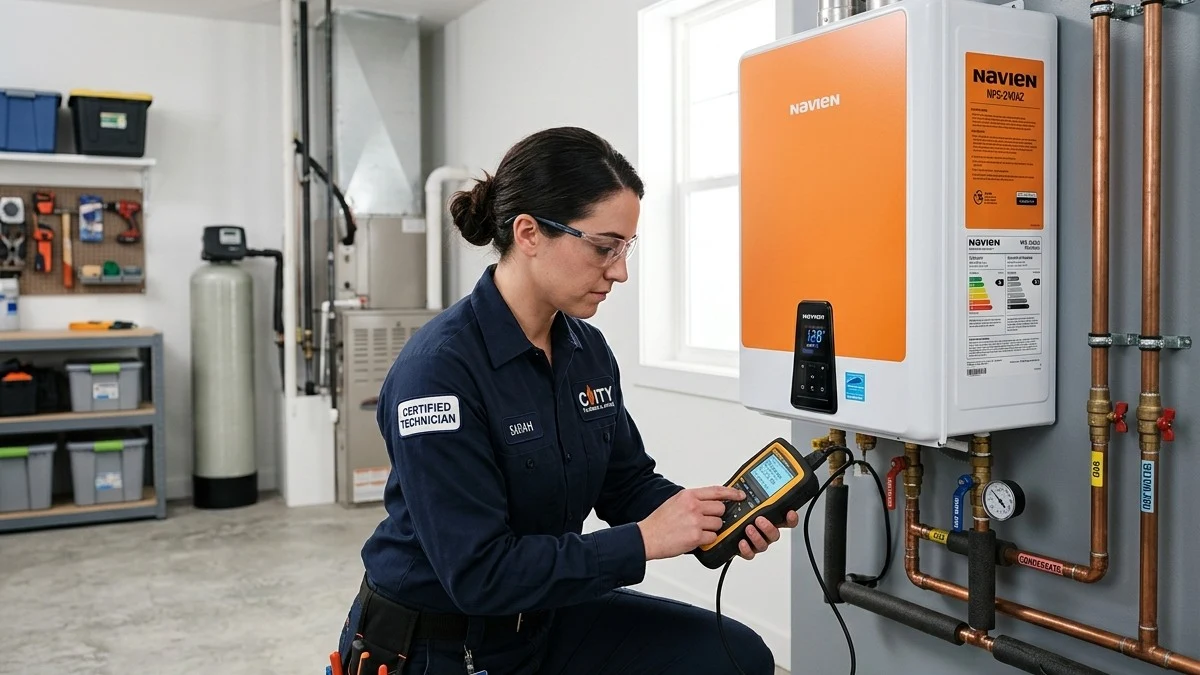
Because raw steel oxidizes rapidly when exposed to hot chlorinated municipal water, manufacturers bake a specialized liquid glass slurry onto the sandblasted interior steel tank shell at 1,600°F. When cooled, this creates an impervious molecular glass barrier that isolates water from the raw steel. However, steel and vitreous glass possess vastly different **coefficients of thermal expansion**.
Differential Thermal Expansion & Micro-Fracturing
When a pristine water heater heats and cools normally, water circulation keeps the steel substrate at modest temperatures (120°F to 140°F), allowing the steel and bonded glass to expand and contract harmoniously. But when an insulating bed of sediment blocks heat transfer, the steel dome beneath the sediment overheats to 450°F to 600°F while the upper portions of the tank remain at 120°F.
This massive thermal gradient induces severe localized mechanical stress. The overheated steel plate expands outward aggressively. Because the rigid glass lining cannot stretch to match this exaggerated steel expansion, the porcelain enamel fractures into millions of microscopic spider-web fissures—a phenomenon known as **micro-crazing**. Once the glass lining spalls and flakes away from the tank floor, bare carbon steel is directly exposed to oxygenated, hot, pressurized water.
Galvanic Acceleration & Catastrophic Tank Breach
Once hot water penetrates the compromised glass barrier, aggressive electrochemical corrosion begins instantly. High temperatures accelerate oxidation reactions exponentially: according to Svante Arrhenius’s chemical rate equation, every 18°F (10°C) increase in temperature approximately doubles the rate of electrochemical corrosion. Water trapped beneath dense, anaerobic sediment pockets forms an acidic microclimate with depleted dissolved oxygen, creating concentrated **crevice corrosion cells**.
These crevice cells eat deep pinhole pits through the 12-gauge structural steel plate. Because this corrosion takes place on the interior floor obscured beneath pounds of compacted sediment, there is zero visible exterior warning. Homeowners only discover the catastrophic structural failure when the bottom dome suddenly tears open along an oxidized seam, dumping 50 gallons of scalding water across finished basement carpets, drywall, and hardwood flooring at 3:00 AM.
5. Step-by-Step Complete Professional Sediment Flushing Protocol
To eliminate kettling noises, restore peak heating efficiency, and prevent catastrophic premature tank rupture, regular annual sediment flushing is essential. Below is the comprehensive, master-level de-liming and sediment extraction protocol executed by professional plumbing diagnosticians:
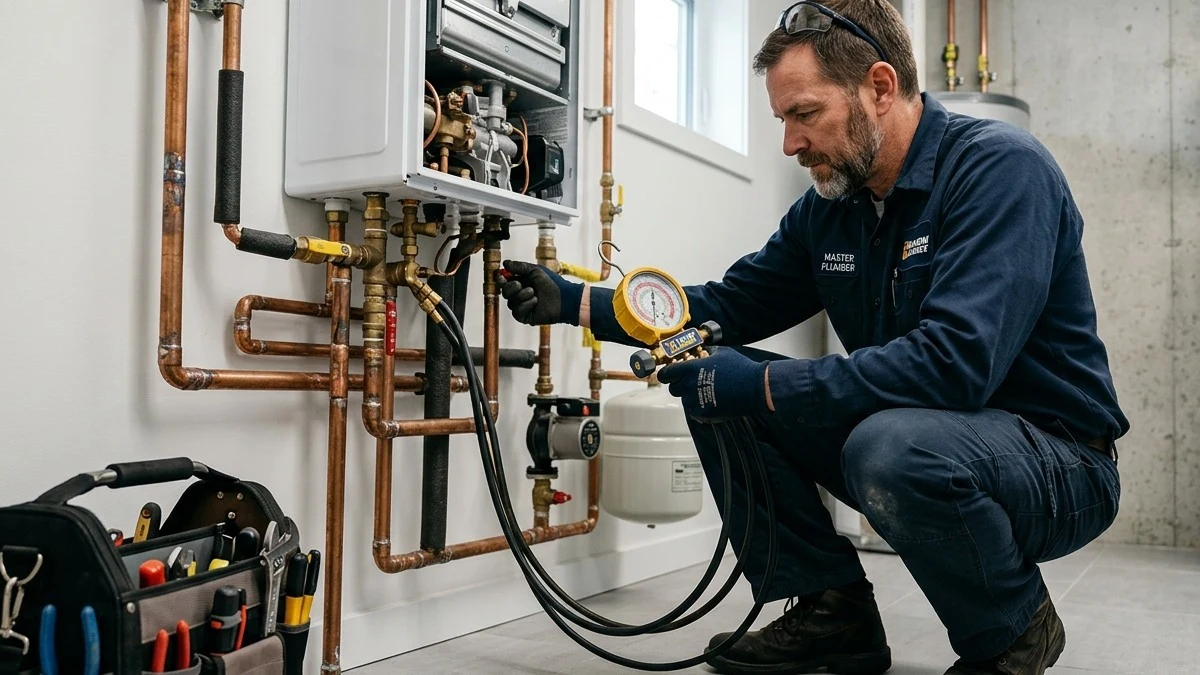
- Energy Isolation Protocol:
Before touching any plumbing valves, completely deactivate the power source. For atmospheric gas water heaters, rotate the gas control valve knob clockwise to the “VACATION” or “OFF” setting. For high-voltage electric water heaters, shut off the dedicated double-pole 30-amp circuit breaker in your main electrical service panel. Warning: Energizing an electric water heater with exposed heating elements will incinerate the upper and lower elements in under ten seconds through dry-firing.
- Cold Water Supply Assessment:
Locate the cold water inlet shutoff valve situated above the top of the water heater tank. While traditional DIY manuals suggest shutting off the water supply immediately, experienced technicians keep the incoming cold water supply valve OPEN during the initial drain phase. Municipal incoming pressure (60 to 75 PSI) creates essential hydraulic turbulence that breaks apart compacted sediment blankets.
- Heavy-Duty Commercial Flush Hose Attachment:
Attach a 3/4-inch heavy-duty commercial contractor hose or high-temperature washing machine hose to the bottom tank drain valve. Never use flimsy thin-walled garden hoses, which soften and kink when exposed to 130°F scalding water. Route the distal end of the hose to a dedicated basement floor drain, utility sump pit, or outdoor concrete apron away from delicate vegetation.
- Turbulent Pressurized Blast (The “Stirring” Cycle):
Open the bottom tank drain valve completely. With the cold water inlet valve still wide open, municipal line pressure surges through the internal dip tube directly to the bottom dome, violently churning the settled sediment bed into a fluid slurry. Allow the turbid, milky, sand-filled water to discharge under full pressure for three to five minutes until the effluent begins clearing.
- Atmospheric Depressurization & Gravity Evacuation:
Close the cold water inlet valve at the top of the tank. To break the hydraulic vacuum inside the sealed tank, open the hot water side of a second-story bathroom vanity faucet, or carefully lift the test lever on the tank’s Temperature and Pressure (T&P) Relief Valve. As atmospheric air enters the top of the tank, the entire volume of water evacuates through the drain hose via gravity, carrying suspended calcite flakes with it.
- Pulsed Mechanical Agitation (The Dip-Tube Surge Flush):
Once the tank is empty, rapid-fire cycle the incoming cold water valve open for ten seconds, then slam it shut. Repeat this pulsed valve cycle five to six times. These sudden hydraulic pressure waves create violent shearing eddies along the bottom tank dome, dislodging stubborn calcite scale plates anchored around the perimeter weld seams.
- Plastic Drain Valve Replacement (Master Plumber Upgrade):
Most budget factory water heaters ship with cheap, injection-molded plastic drain valves featuring tiny 3/8-inch internal orifices that clog the instant a pea-sized mineral flake attempts to pass. If your tank possesses a plastic drain valve that drips or fails to flow, our technicians replace it with a commercial-grade, full-port brass ball valve with a 3/4-inch unrestricted bore. This permanent upgrade allows heavy scale chunks to exit freely during future flushes.
6. Sacrificial Anode Rod Science: Magnesium vs. Aluminum vs. Powered Titanium
No discussion of water heater longevity and sediment prevention is complete without examining the primary electrochemical defense mechanism built into every storage water heater: the sacrificial anode rod.
Suspended from the top tank tapping into the core of the water column, the anode rod is a solid metal core wire clad in an electronegative metal alloy. Because dissimilar metals submerged in an electrolyte (water) establish a galvanic voltage differential, the metal with the higher standard electrochemical oxidation potential will corrode first, sacrificing its own mass to preserve the structural carbon steel tank walls.
| Anode Rod Alloy Type | Electrochemical Driving Voltage | Standard Service Lifespan | Byproduct Mineral Slurry Impact | Colorado Front Range Suitability |
|---|---|---|---|---|
| Standard Magnesium (Mg) | -2.37 V (Highest Protection) | 2 to 4 Years | Produces white fluffy magnesium hydroxide sediment; can generate hydrogen sulfide “rotten egg” odor with sulfur bacteria | Optimal for standard municipal water with non-sulfur profiles (Broomfield, Westminster) |
| Aluminum / Zinc (Al/Zn) Alloy | -1.66 V (Moderate Protection) | 3 to 5 Years | Zinc ions neutralize anaerobic sulfur bacteria, eliminating sulfur gas odors; produces gelatinous aluminum oxide sediment | Recommended for residential well systems in Adams, Weld, and Boulder counties |
| Powered Titanium Impressed Current Anode | Continuous Microprocessor Regulated | 20+ Years (Permanent) | ZERO sediment byproduct generated; non-sacrificial inert titanium rod | PREMIUM UPGRADE: Eliminates tank corrosion and odor forever without sediment generation |
As standard magnesium or aluminum anode rods perform their sacrificial duty, they do not simply vanish into thin air. The oxidized metal sloughs off the central core wire and settles onto the bottom tank floor as an unctuous, chalky mineral sediment. In fact, in homes with water softeners, the increased sodium ion concentration accelerates anode rod decomposition, generating pounds of anode sludge within 18 months! Inspecting your anode rod every two to three years and replacing it before the core steel wire is bare is mandatory to maintain corrosion protection.
7. Gas vs. Electric Water Heater Rumbling Nuances: Element Burndown vs. Bottom Scale
While the root cause of rumbling in both gas and electric water heaters is mineral precipitation, the failure modes manifest differently depending on the energy source utilized:
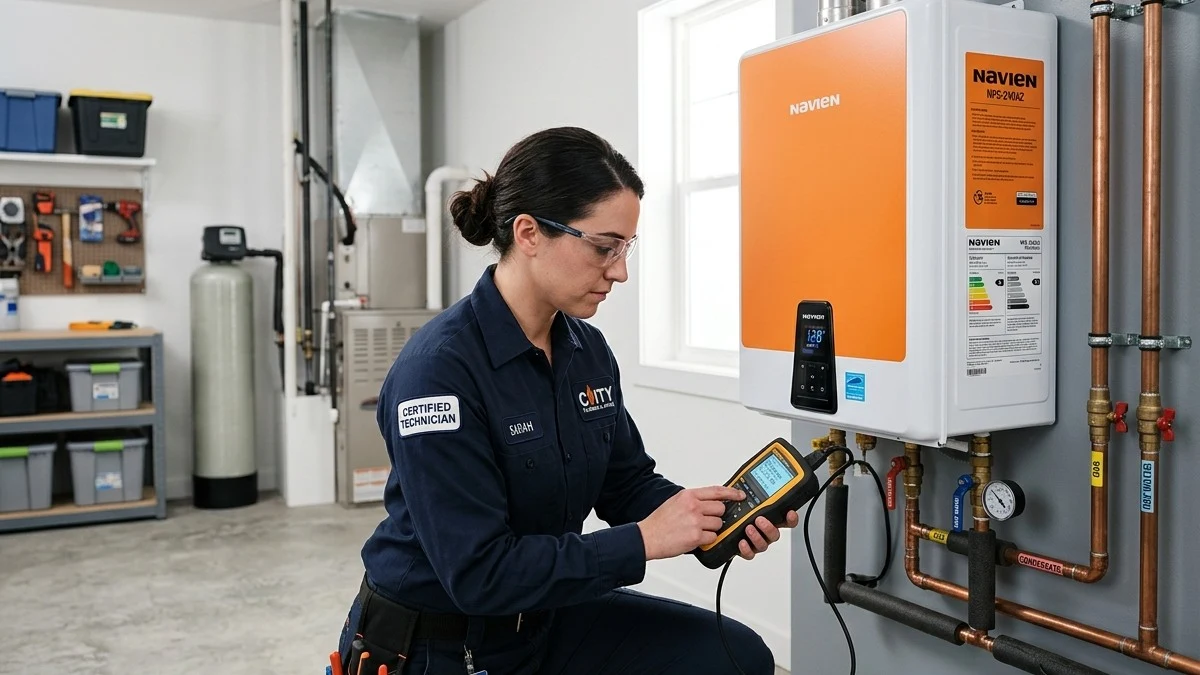
Atmospheric Gas Water Heaters: The Resonant Sound Chamber
In a gas-fired unit, the heat source is concentrated on the bottom carbon steel dish. As kettling steam micro-explosions erupt, the curved concave steel head acts like a tympani drum, amplifying the acoustic frequencies into loud, rhythmic thumping and deep bowling-ball rumblings. Furthermore, as the burner runs continuously to overcome the insulating sediment layer, high-temperature combustion gases overheat the central flue baffle, resulting in excessive carbon monoxide generation, warped burner brackets, and scorched lower control panels.
Electric Water Heaters: Element Encrustation & Thermal Hissing
In an electric water heater, heating is accomplished by two high-wattage Incoloy or copper immersion elements protruding horizontally into the water column. When mineral scale precipitates, it forms an insulating calcite sleeve wrapped directly around the bare metal heating coils.
Because electric elements dissipate between 4,500 and 5,500 watts of electrical resistance heat over a compact surface area, the encased coil reaches astronomical temperatures. Instead of a deep bass rumble, electric water heaters produce a high-pitched, tea-kettle shrieking, aggressive buzzing, and rapid crackling hiss. Over time, the trapped heat melts the inner magnesium oxide electrical insulator, burning out the element coil and causing total loss of hot water.
8. Solidified Calcite Rock vs. Flushable Slurry: When Is a Tank Beyond Saving?
A critical question every homeowner asks when their water heater begins rumbling is: Can my water heater still be flushed clean, or is it too late?
The answer depends on the chemical transition from loose mineral slurry to cemented calcite rock. When mineral sediment first precipitates, it exists as a loose, sandy, flocculent sediment composed of microscopic calcite crystals and magnesium flakes. At this stage (typically within the first two to four years of service), a high-pressure turbulent flush effortlessly sweeps 90% of the sediment out through the drain valve.
However, if a water heater goes five, seven, or ten years without maintenance in hard Front Range water, the extreme heat cycles act like a kilning furnace. The intense thermal energy bakes the loose sediment, fusing individual calcium carbonate crystals into solid, monolithic calcite rock resembling hard concrete. At this stage, attempting a standard hose flush yields nothing—the water running out of the hose runs crystal clear because the solid rock slab cannot fit through the valve orifice, yet the tank continues to roar and pop whenever the burner fires.
Diagnostic Indicators of Solidified Sediment Failure
- Zero Flow Through Drain Valve: Opening the drain valve produces only a weak trickle or nothing at all, even with 70 PSI municipal water pressure applied.
- The Coat-Hanger Poke Test: Probing through an opened drain valve with a stiff wire reveals a solid, impenetrable concrete-like wall across the bottom three to six inches of the tank.
- Lukewarm Water Degradation: A 50-gallon water heater that formerly provided 45 minutes of continuous hot showers now exhausts its hot water reserve in 15 minutes because five to ten gallons of tank volume are physically occupied by solid stone.
- Rumbling Persists Post-Flush: If a thorough professional flush has been executed and the tank continues rumbling loudly, the scale has permanently bonded to the tank substrate. Replacing the aging unit before an catastrophic flood occurs is the only prudent financial decision.
9. Tankless Conversion as the Permanent Solution to Sediment Accumulation
For Colorado homeowners exhausted by relentless water heater sediment battles, anode rod replacements, and basement flood anxieties, upgrading to a Navien or Rinnai High-Efficiency Condensing Tankless Water Heater represents the ultimate engineering solution.
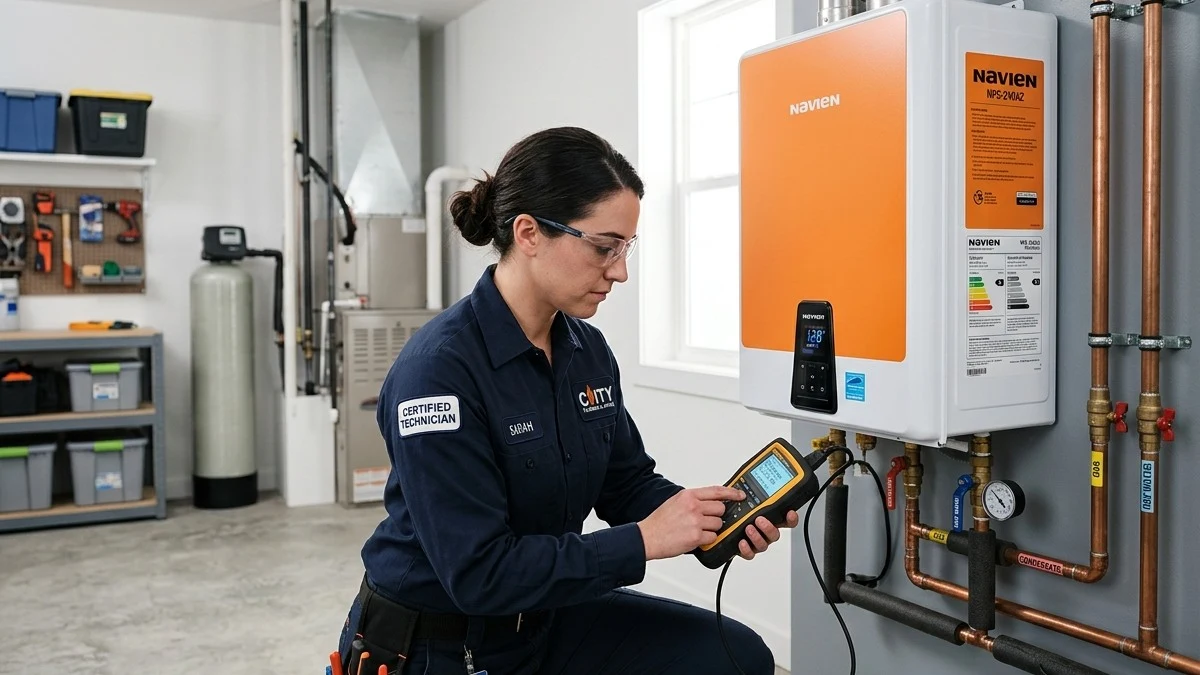
A tankless water heater eliminates the massive 50-gallon storage reservoir where sediment settles and hardens. Instead, when a hot water fixture is opened anywhere in your home, water flows through ultra-compact commercial-grade dual stainless steel heat exchangers, heating water on demand with up to 96% thermal efficiency (0.96 UEF). Key benefits include:
- Immunity to Sediment Reservoir Kettling: Because there is no stationary reservoir holding stagnant water under continuous heat, sediment cannot settle or form destructive insulating rock slabs.
- Dual Commercial Stainless Steel Exchangers: Premium stainless steel heat exchangers resist scale adherence far better than raw copper coils found in older models.
- Simple Isolation Valve De-Liming: Tankless units are installed with dedicated brass service isolation flush valves. Once a year, a technician circulates food-grade virgin citric acid or white vinegar through the heat exchanger for 45 minutes using a submersible pump, instantly dissolving all mineral scale and returning the unit to factory performance.
- Endless Hot Water on Demand: Enjoy unlimited hot water for high-demand master tubs and multi-shower households without running out or waiting for recovery cycles.
- Massive Basement Space Reclamation: Wall-mounted units free up valuable floor space in mechanical rooms while eliminating the catastrophic flood risk of 50 gallons of standing water.
10. Transparent Pricing Matrix: Maintenance, Flushing & Replacement Costs
Below is a transparent overview of industry standard investments for water heater diagnostic, de-liming, and replacement services across Broomfield, Westminster, and the Denver North Metro area:
| Service Type | Typical Investment Range | Scope of Work Included | Expected Return on Investment |
|---|---|---|---|
| Professional High-Pressure Flush & Tune-Up | $185 – $295 | Pressurized sediment flush, T&P valve safety test, burner clean, thermal expansion check | Restores 15-25% heating efficiency; eliminates kettling noises |
| Sacrificial Anode Rod Replacement | $250 – $425 | High-torque impact removal of depleted rod, installation of premium magnesium or Al/Zn rod | Extends tank lifespan by 4 to 8 additional years |
| Full-Port Brass Drain Valve Upgrade | $175 – $275 | Removal of leaking/clogged plastic valve; installation of 3/4-inch brass ball valve with cap | Enables rapid, clog-free DIY flushing for the lifetime of the unit |
| Standard 50-Gal Atmospheric Gas Water Heater Replacement | $1,800 – $2,800 | Removal/haul-away of old tank, new professional-grade Bradford White/Rheem unit, new gas flex, thermal expansion tank, city permit & inspection | 10-12 year reliable service life; full warranty coverage |
| Whole-Home Tankless Conversion (Navien / Rinnai) | $3,800 – $5,800 | Removal of tank, new high-output gas supply line, concentric PVC/polypropylene venting, dedicated isolation valves, electrical outlet setup, city permits | 20+ year lifespan, endless hot water, up to $300-$500 annual energy savings, Xcel Energy rebates |
11. Comprehensive Extended FAQ Section
Q1: Will a noisy, rumbling water heater explode?
Modern water heaters will not explode like a bomb because they are equipped with critical mechanical safety devices, most notably the Temperature and Pressure (T&P) Relief Valve, which automatically discharges water if internal temperature exceeds 210°F or pressure exceeds 150 PSI. However, a rumbling water heater is in severe danger of catastrophic tank rupture: the bottom seam can tear open suddenly, flooding your home with 50 gallons of scalding water within seconds.
Q2: Can I flush a water heater that has never been flushed in 8 years?
Caution is warranted. If a water heater has never been flushed in over seven to eight years, heavy sediment buildup may actually be sealing microscopic corrosion pits along the tank bottom. Flushing the tank can dislodge these calcified plugs, precipitating an immediate leak. Have a master plumber inspect the unit first to evaluate tank integrity before attempting an aggressive flush on an unmaintained older heater.
Q3: How often should I flush my water heater in the Denver Front Range?
Given the moderately hard to hard municipal water in Broomfield, Westminster, and Thornton (averaging 7 to 10 grains per gallon), we strongly recommend performing a complete pressurized sediment flush at least once every 12 months. If your home has a private residential well or lacks a water softener, semi-annual flushing every six months is recommended.
Q4: Does adding a water softener stop sediment from forming?
Yes. An ion-exchange water softener replaces hard calcium and magnesium ions with soluble sodium or potassium ions, virtually eliminating the precipitation of hard calcite scale inside your water heater. However, softened water is more electrically conductive, which causes standard magnesium sacrificial anode rods to dissolve faster. When using a water softener, inspect your anode rod every two years.
Q5: What is the average lifespan of a residential water heater in Colorado?
In Colorado Front Range municipal water conditions, the average lifespan of an atmospheric storage water heater is 8 to 12 years. Units that receive annual flushing, timely anode rod replacements, and proper thermal expansion tank maintenance can routinely exceed 14 to 16 years of reliable service.
Q6: Why is my hot water running out much faster than before?
Rapid hot water depletion is a classic hallmark of severe sediment accumulation. As mineral scale occupies the bottom five to ten gallons of your tank volume, the actual volume of water available to be heated is significantly reduced. Furthermore, the sediment acts as an insulating barrier, doubling the recovery time required to reheat incoming cold winter water.
Q7: Why does my water heater make a sizzling sound when it turns on?
A sizzling sound in a gas water heater is caused by condensation dripping onto the hot burner plate or outer flue tube. When cold incoming winter water (often 40°F in Colorado) fills an empty tank, high-temperature combustion flue gases condense against the cold steel tank skin, forming water droplets that sizzle as they hit the flame. This is normal during initial heavy recovery cycles, but continuous sizzling may indicate a weeping tank seam.
Q8: How does a thermal expansion tank protect against sediment damage?
When municipal water is heated from 45°F to 130°F, it expands by approximately 2% in volume. Because modern Front Range municipal water meters incorporate backflow check valves, your plumbing system is a closed loop. Without a functioning thermal expansion tank, this expanded volume causes water pressure to spike from 60 PSI up to 120+ PSI during every heating cycle, accelerating mechanical fatigue and micro-cracking of the brittle porcelain glass lining.
Q9: Can vinegar or chemical de-limers be used in a storage water heater?
While food-grade white vinegar is routinely pumped through compact tankless water heaters, dissolving 40 pounds of solidified calcite in a 50-gallon tank requires astronomical volumes of acid (20+ gallons) and extended soak times. Furthermore, aggressive acids can strip the protective passivation layer from bare steel where the glass lining has crazed. Mechanical pressurized flushing and preventive maintenance are vastly superior for storage tanks.
Q10: Why does my hot water smell like rotten eggs?
A rotten egg odor in your hot water is caused by harmless sulfate-reducing bacteria reacting electrochemically with a standard magnesium anode rod to generate hydrogen sulfide ($) gas. Replacing the magnesium anode rod with an aluminum/zinc alloy rod or a powered non-sacrificial titanium anode completely eliminates the reaction and eradicates the odor.
Q11: How do I know if my T&P relief valve is bad?
If the discharge pipe connected to the side or top of your water heater is steadily dripping warm water, discharging bursts of steam, or crusting with white mineral deposits, the valve seat is compromised or the tank is experiencing unsafe thermal expansion pressures. The T&P valve should be tested annually and replaced immediately if leaking.
Q12: Is it worth replacing the heating elements on an old rumbling electric water heater?
If an electric water heater is under eight years old and the steel tank shows zero signs of exterior corrosion or leaks, replacing calcified elements with premium high-watt-density stainless steel elements is highly cost-effective ($200 to $350). However, if the tank floor is packed with solidified sediment and the unit is over ten years old, investing in new elements is usually a temporary patch on an appliance nearing terminal failure.
12. Schedule Professional Water Heater Diagnostic & De-Liming Service
Is Your Water Heater Popping, Rumbling, or Running Out of Hot Water?
Do not wait for sediment-induced hot spots to rupture your tank and flood your basement. Our licensed master plumbing technicians provide comprehensive pressurized de-liming flushes, anode rod replacements, and high-efficiency tankless upgrades across Broomfield, Westminster, Thornton, and Denver Metro.