
Table of Contents: Residential Water Heating Engineering & Colorado Climate Analysis
- 1. Executive Summary: The Front Range Cold Groundwater Thermodynamic Challenge
- 2. Thermodynamics of Water Heating: BTU Equations, Flow Rates, LMTD & Latent Heat Recovery
- 3. Gas Infrastructure & Altitude Derating: 5,400-Foot Combustion Dynamics & Fluid Flow
- 4. Front Range Water Hardness: Calcium Carbonate Scaling, LSI Chemistry & Efficiency Decay
- 5. Comprehensive Engineering Comparison Matrix: Atmospheric vs. Power-Vent vs. Tankless vs. Hybrid
- 6. Recirculation Systems & Legionella Thermal Sanitization: ASSE 1017 Mixing Valves
- 7. Step-by-Step Tank-to-Tankless Conversion Protocol: Gas, Venting, Combustion Analysis & Acid Condensate
- 8. Colorado Front Range Submarket Analysis: Municipal Water Sources & Utility Rebates
- 9. 15-Year Life Cycle Financial Analysis: Initial Capital vs. Operating Expenditure
- 10. Comprehensive Extended FAQ Section (12 Detailed Engineering Questions)
- 11. Schedule Water Heater Replacement & Efficiency Consultation
1. Executive Summary: The Front Range Cold Groundwater Thermodynamic Challenge
Domestic hot water represents the second largest energy expenditure in residential Colorado homes, accounting for approximately 18% to 22% of total utility consumption. When an aging water heater begins rumbling with calcified sediment, leaking from rusted bottom seams, or failing to satisfy morning shower demands, homeowners face a pivotal architectural and financial decision: replace the failing unit with a conventional storage tank water heater or invest in an ultra-high-efficiency condensing tankless water heating system.
While national marketing brochures advertise tankless water heaters delivering “endless hot water at 98% thermal efficiency,” applying these claims across the Colorado Front Range without engineering scrutiny is a costly mistake. Unlike southern states where municipal groundwater arrives at a balmy 65°F to 75°F, subterranean water mains in Broomfield, Westminster, Thornton, and Arvada are fed by high-alpine snowpack and mountain reservoirs (Carter Lake, Standley Lake, and Gross Reservoir). In the depths of January and February, incoming municipal water temperatures plummet to a bone-chilling 35°F to 40°F.
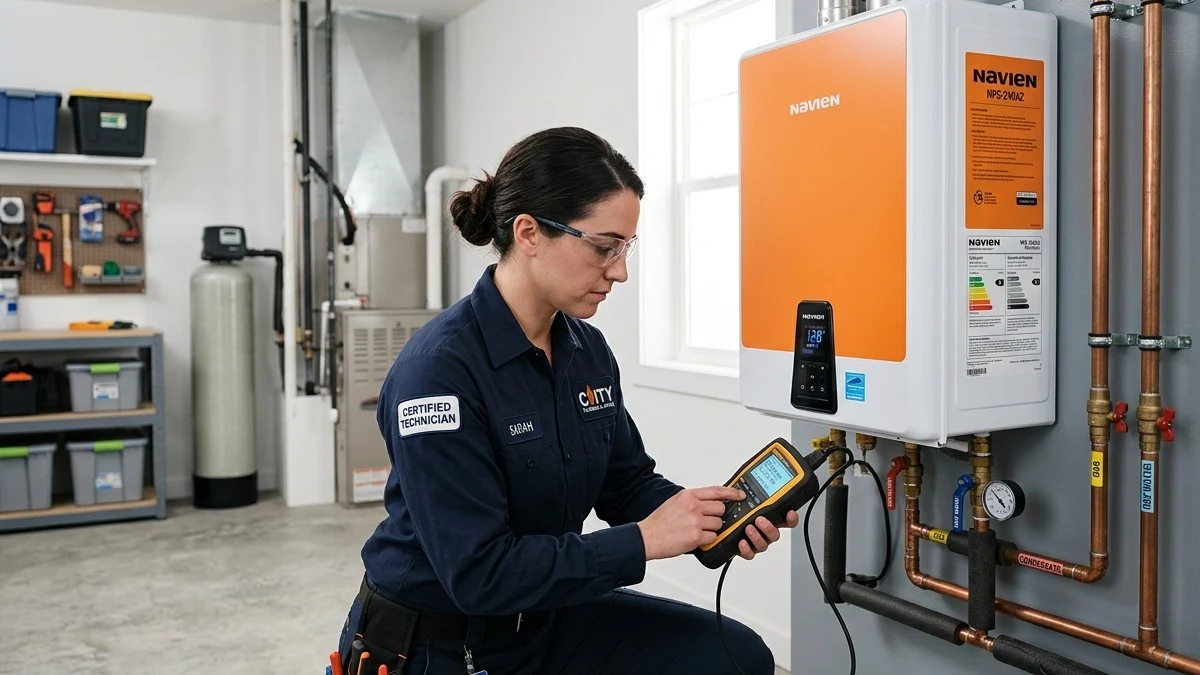
To elevate 38°F municipal supply water to the industry-standard domestic delivery temperature of 120°F to 125°F requires a staggering temperature rise ($\Delta T$) of 82°F to 87°F. This severe thermal delta places extreme stress on heating systems, cutting tankless flow rates by more than half and causing conventional storage tanks to deplete their hot reserve in under fifteen minutes.
Furthermore, residential plumbing systems along the Front Range operate at an elevation of 5,280 to 5,800 feet above sea level. At this altitude, atmospheric barometric pressure is 17% lower than sea level, reducing available combustion oxygen and requiring specialized burner derating and high-altitude gas manifold adjustments. This comprehensive engineering guide examines the thermodynamic equations, gas delivery dynamics, mineral descaling realities, and 15-year return on investment (ROI) comparing conventional storage tanks against modern tankless technology across northern Denver Metro.
2. Thermodynamics of Water Heating: BTU Equations, Flow Rates, LMTD & Latent Heat Recovery
Evaluating water heater performance begins with fundamental thermal physics. The sensible heat required to raise the temperature of a fluid is governed by the Thermal Energy Equation:
Where:
- Q: Heat transfer rate (BTU per hour)
- \dot{m}: Mass flow rate of water (pounds per hour)
- c_p: Specific heat capacity of liquid water (1.0 BTU / lb · °F)
- \Delta T: Temperature differential between incoming cold supply and delivered hot water (°F)
Because one gallon of water weighs approximately 8.33 pounds, and there are 60 minutes in an hour ($8.33 \times 60 \approx 500$), plumbing engineers express this thermodynamic relationship for instantaneous tankless sizing as:
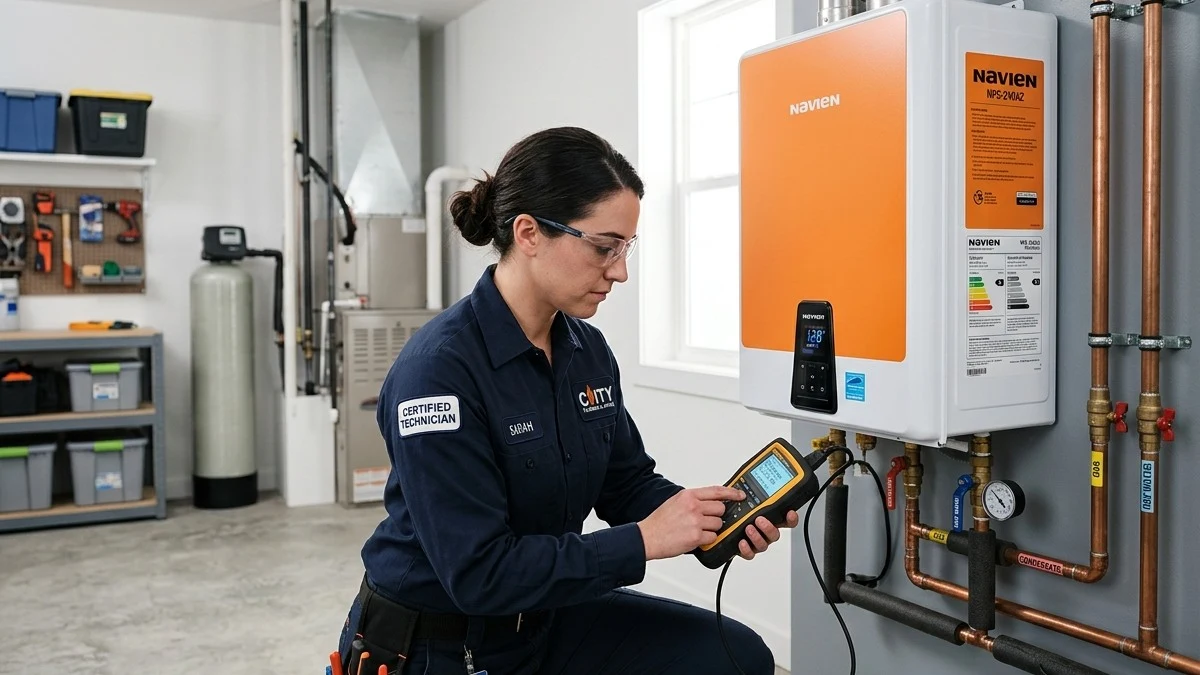
Logarithmic Mean Temperature Difference (LMTD) & Heat Exchanger Physics
The rate of heat transfer through the internal finned tube heat exchanger is governed by the Logarithmic Mean Temperature Difference (LMTD):
Where $U$ represents the overall heat transfer coefficient, $A$ is the total surface area of the finned copper or stainless steel tubing, and $\Delta T_1, \Delta T_2$ represent the temperature differences between the combustion flue gas stream and the domestic water stream at exchanger entry and exit boundaries. In premium condensing systems, dual heat exchangers operate in series: a primary oxygen-free copper heat exchanger absorbs direct radiant heat from the burner, while a secondary 316L austenitic stainless steel heat exchanger captures the latent heat of vaporization ($970.3\text{ BTU/lb}$ of water vapor) from the cooling exhaust gases, driving total thermal efficiency up to an astonishing 96% to 98%.
The Front Range Winter Flow Rate Reality
Let us compare the real-world performance of a premier 199,000 BTU/hr condensing tankless unit operating at 95% thermal efficiency ($0.95$):
- Florida Summer Scenario: Incoming water temperature = 72°F. Target delivery = 120°F ($\Delta T = 48^\circ\text{F}$).
Maximum Flow Rate = $(199,000 \times 0.95) / (500 \times 48) = \mathbf{7.88\text{ GPM}}$. Homeowners can comfortably run three showers (2.5 GPM each) and a dishwasher simultaneously without experiencing any temperature drop. - Broomfield, Colorado Winter Scenario: Incoming water temperature = 38°F. Target delivery = 122°F ($\Delta T = 84^\circ\text{F}$).
Maximum Flow Rate = $(199,000 \times 0.95) / (500 \times 84) = \mathbf{4.50\text{ GPM}}$. In winter, that exact same high-end unit can only support one shower (2.5 GPM) plus a laundry wash or kitchen sink (1.8 GPM). If a third fixture is opened, the unit’s computer modulates the flow control servo valve downward, noticeably restricting water pressure to protect output temperature!
Understanding this mathematical boundary is why master plumbers frequently specify dual-unit cascading tankless setups or high-output commercial-residential hybrid units for Front Range homes with luxury multi-head walk-in showers or large soaking tubs.
3. Gas Infrastructure & Altitude Derating: 5,400-Foot Combustion Dynamics & Fluid Flow
Replacing a conventional 40-gallon atmospheric storage tank with an instantaneous tankless water heater requires a massive tenfold increase in instantaneous thermal input. A standard 40-gallon tank fires at 36,000 to 40,000 BTU/hr. In contrast, an instantaneous tankless water heater requires up to 199,000 BTU/hr the instant a hot water tap is opened.
Fluid Mechanics of Natural Gas Flow in Supply Piping
The volumetric delivery capacity of natural gas through rigid metallic piping is governed by the Pole’s Formula or Spitzglass Equation for low-pressure fuel systems:
Where $Q_{gas}$ is gas flow in cubic feet per hour (CFH), $\Delta H$ is pressure drop across the pipe in inches of water column (typically limited to 0.5″ w.c.), $D$ is internal pipe diameter, $S_g$ is specific gravity of natural gas (0.60 relative to air), and $L$ is equivalent developed length in feet. Because flow capacity scales with the fifth power of internal diameter ($D^5$), a 3/4-inch pipe ($D=0.824″$) delivers nearly three times the gas volume of a 1/2-inch pipe ($D=0.622″$) over identical lengths!
In older Front Range homes built before 2000, water heaters were typically plumbed with a 1/2-inch branch line that maxes out at approximately 90 to 110 CFH. Firing a 199,000 BTU burner (requiring 200 CFH) on that line causes an immediate pressure collapse, triggering burner rumble, soot buildup, and error lockouts. Professional conversions often require a dedicated 3/4-inch or 1-inch gas feeder directly from the gas manifold.
Combustion Air Oxygen Depletion at High Altitude
At 5,400 feet above sea level (Denver/Broomfield baseline elevation), atmospheric density is only 0.062 lb/cu ft compared to 0.075 lb/cu ft at sea level. Because air contains 17% less oxygen by volume, fuel-to-air ratios must be calibrated carefully. Standard atmospheric water heaters suffer an automatic 4% capacity derating per 1,000 feet above sea level above 2,000 feet, effectively reducing a 40,000 BTU burner to merely 34,500 BTUs of actual heat transfer.
Modern condensing tankless water heaters incorporate electronic combustion blowers with variable-speed ECM motors and micro-processor controlled gas valves. When the high-altitude DIP switches are toggled by the technician during commissioning, the fan speed increases to force additional air into the premix burner chamber, maintaining stoichiometric combustion and pristine 95%+ efficiency even at 6,000+ feet.
4. Front Range Water Hardness: Calcium Carbonate Scaling, LSI Chemistry & Efficiency Decay
Water hardness across Broomfield, Westminster, and Thornton averages between 7 and 12 grains per gallon (GPG), categorizing municipal water supplies as “moderately hard” to “very hard.” When hard water containing dissolved calcium bicarbonate ($Ca(HCO_3)_2$) is heated past 120°F, an endothermic chemical precipitation occurs:
The Langelier Saturation Index (LSI) Equilibrium Shift
The tendency of Front Range water to deposit rock-hard scale or attack metallic piping is calculated via the Langelier Saturation Index (LSI):
Where $A$ is total dissolved solids factor, $B$ is temperature factor, $C$ is calcium hardness factor, and $D$ is total alkalinity factor. In Front Range municipal tap water at 40°F, the LSI is typically balanced at $-0.10$ to $+0.05$ (near equilibrium). However, when water passes through a high-heat exchanger at 140°F, the temperature factor ($B$) jumps from $0.35$ to $0.95$, swinging the LSI to a severe $+0.70$ to $+0.95$ (Heavy Scale Forming). This chemical shift forces calcium carbonate crystals to plate out instantly against hot copper and stainless steel surfaces.
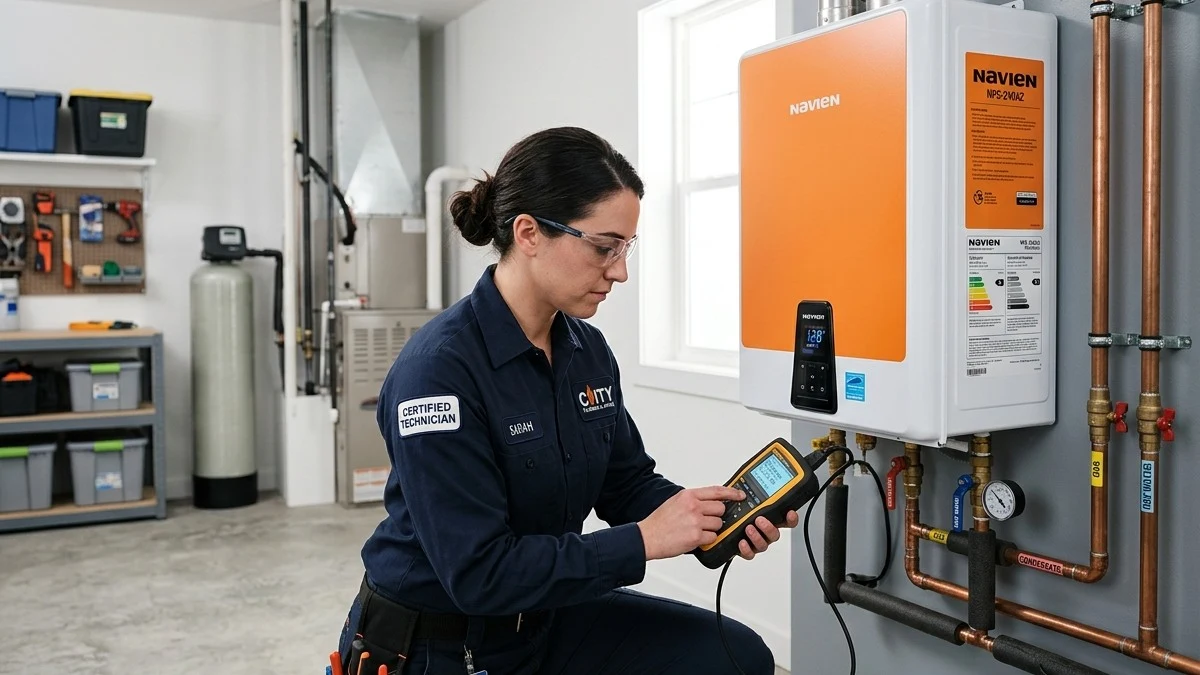
Impact on Storage Tank Water Heaters
In conventional storage tanks, heavy calcium carbonate crystals precipitate out of solution and settle onto the convex steel bottom directly above the gas burner. This sediment layer acts as a thermal blanket: calcium carbonate has a thermal conductivity ($k = 1.3\text{ W/m}\cdot\text{K}$) that is forty times lower than structural steel ($k = 50\text{ W/m}\cdot\text{K}$).
Just 1/4-inch of accumulated scale reduces thermal transfer efficiency by 28% to 35%, forcing the gas burner to fire longer to heat the water. More critically, the steel tank bottom, unable to transfer heat to the water, overheats past 500°F. The glass porcelain lining fractures under thermal stress, allowing corrosive water to contact raw steel and causing premature tank rupture within 6 to 8 years.
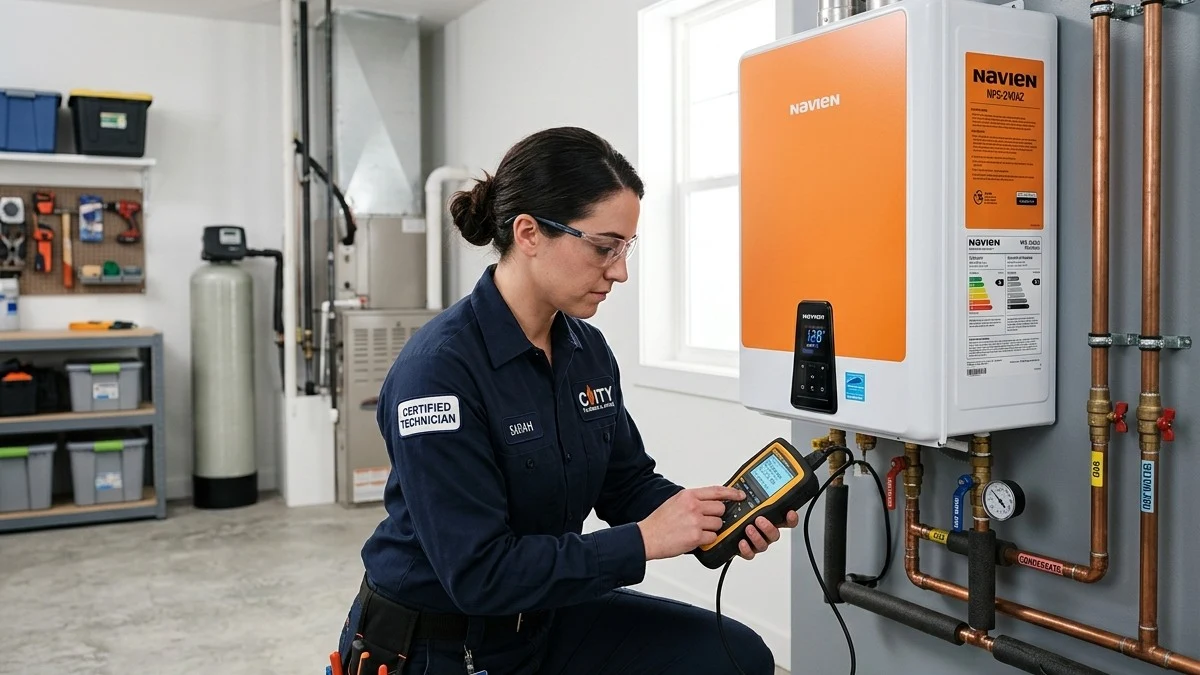
Impact on Tankless Heat Exchangers & Descaling Mandate
In tankless units, cold water flows through narrow copper or 316L stainless steel heat exchanger tubing with internal diameters as narrow as 3/8-inch. Rapid boiling along the tube walls causes calcium scale to plate directly onto the heat exchanger surface. If left unserviced, this scale restricts water flow, triggers overheat sensor errors (Error Code 11 or 12), and causes localized heat exchanger burn-through.
To preserve warranty coverage and thermal efficiency, Front Range homeowners with tankless systems must perform an annual chemical descaling flush using food-grade virgin citric acid or specialized scale-break solutions pumped through dedicated service isolation valves for 45 to 60 minutes.
5. Comprehensive Engineering Comparison Matrix: Atmospheric vs. Power-Vent vs. Tankless vs. Hybrid
To assist homeowners in making informed equipment selections, the technical matrix below details operational specifications across all four major residential water heating categories:
| Engineering Metric | Atmospheric Gas Tank | Power-Vent Gas Tank | Condensing Gas Tankless | Hybrid Heat Pump (Electric) |
|---|---|---|---|---|
| Uniform Energy Factor (UEF) | 0.58 – 0.64 | 0.68 – 0.72 | 0.93 – 0.97 | 3.45 – 3.85 COP |
| Peak Fuel Burn Input | 36,000 – 40,000 BTU/hr | 40,000 – 50,000 BTU/hr | 160,000 – 199,000 BTU/hr | 4,500W Electric (30A 240V) |
| Continuous Delivery Capacity | Limited to 40-50 Gallons (~15 min run) | Limited to 50 Gallons (~18 min run) | Continuous Endless Delivery (4.5 GPM in winter) | Limited to 50-80 Gal Storage |
| Venting System Requirements | Vertical B-vent metal chimney (Gravity) | Sidewall PVC / CPVC (Electric fan) | Direct-Vent 2″ or 3″ Polypropylene / PVC | Zero venting (Requires 700+ cu ft ambient air space) |
| Electrical Power Requirement | None (Millivolt thermocouple pilot) | Standard 120V 15A outlet | Standard 120V 15A outlet (Controls + freeze heaters) | Dedicated 240V 30A electrical breaker |
| Physical Footprint & Wall Mount | Floor footprint: 22″ dia x 60″ tall (15 sq ft) | Floor footprint: 24″ dia x 62″ tall | Zero Floor Space: Wall-mounted cabinet (18″x28″x10″) | Very large: 27″ dia x 74″ tall floor unit |
| Expected Design Lifespan | 8 to 12 Years | 8 to 12 Years | 20 to 25+ Years (Replaceable heat exchanger) | 10 to 15 Years |
| Average Annual Operating Cost | $280 – $360 (Natural gas) | $240 – $310 (Natural gas) | $160 – $210 (Natural gas) | $120 – $160 (Electric heat pump) |
6. Recirculation Systems & Legionella Thermal Sanitization: ASSE 1017 Mixing Valves
In large two-story or walkout basement homes in Broomfield and Arvada, the physical distance between the water heater and the master bathroom can exceed 60 to 80 feet of plumbing pipe. Homeowners often wait 60 to 90 seconds for hot water to arrive, wasting up to 12,000 gallons of potable water annually down the drain.
Dedicated Return Loop vs. Under-Sink Crossover Bypass
Modern tankless water heaters resolve this delay through two distinct hydraulic recirculation topologies:
- Dedicated Recirculation Loop: A third 1/2-inch or 3/4-inch insulated PEX return pipe runs from the furthest fixture back to the cold inlet of the tankless heater. An internal ECM pump continuously or intermittently circulates water through the loop, keeping water piping primed at 115°F to 120°F at every faucet.
- Thermal Crossover Bypass Valves (Retrofit Applications): In existing homes without a dedicated return line, a thermal bypass valve is installed beneath the furthest bathroom vanity. The cold water supply line acts as the temporary return conduit. When water in the hot line cools below 100°F, the bi-metal bypass valve opens, pushing cool water into the cold pipe until 105°F water reaches the vanity.
The Legionella Thermal Disinfection Protocol
Water heating systems must navigate a critical medical safety conflict: Legionella pneumophila bacteria thrive in warm water between 95°F and 115°F. Storing water at 120°F allows biofilm proliferation. To achieve complete thermal sanitization, water must be stored at 140°F (which eradicates 99.9% of Legionella bacteria in under 2 minutes). However, domestic water at 140°F causes third-degree scalding burns on human skin in less than 5 seconds!
Master plumbing engineers solve this paradox by installing an ASSE 1017 Certified Thermostatic Point-of-Source Mixing Valve immediately downstream of the water heater. The tank or tankless unit is configured to heat water to 140°F for sanitary disinfection, while the mechanical mixing valve blends a precise stream of incoming cold water into the discharge, delivering a completely safe, non-scalding 120°F stream to household fixtures.
Furthermore, under International Plumbing Code (IPC) and Uniform Plumbing Code (UPC) regulations, individual high-risk fixtures such as Roman bathtubs, public handwashing lavatories, and bidet sprayers must incorporate secondary ASSE 1070 Point-of-Use Temperature Limiting Devices. These localized mechanical valves provide redundant fail-safe anti-scald protection, instantly shutting off water flow if thermal spikes exceed 110°F to 115°F, safeguarding small children, elderly family members, and individuals with sensory neuropathy.
7. Step-by-Step Tank-to-Tankless Conversion Protocol: Gas, Venting, Combustion Analysis & Acid Condensate
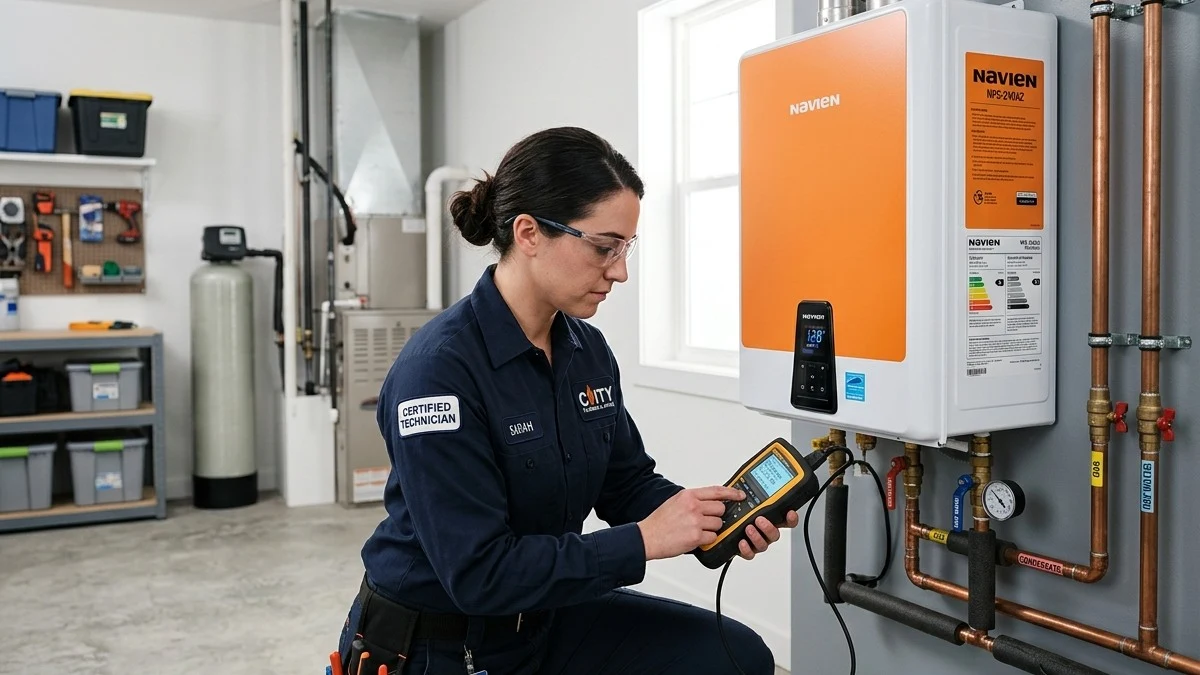
Upgrading a Colorado home from a standard storage tank to a condensing tankless system requires master-level plumbing, mechanical, and electrical commissioning:
- Demolition & Environmental Recycling:
Isolate fuel supply, shut off cold water inlet valve, and attach a commercial transfer pump to drain existing sediment and water. Disconnect flue piping and transport the old steel vessel to a certified metal recycling facility.
- Structural Backer Board & Wall Mounting:
Secure a 3/4-inch fire-rated birch plywood backer board to basement concrete foundation walls or 2×4 framing studs using heavy-duty Tapcon masonry anchors. Bolt the tankless mounting bracket level to support the 75-pound unit securely.
- Gas Supply Line Upsizing:
Run a dedicated 3/4-inch or 1-inch black malleable iron or CSST (Corrugated Stainless Steel Tubing) gas line from the manifold to the tankless unit. Install a full-port brass gas cock, a dedicated sediment trap (drip leg) measuring at least 3 inches, and perform a 15-minute 20 PSI pneumatic pressure test on the gas piping.
- Direct-Vent Concentric Flue Penetration:
Core drill two 3-inch penetrations through the exterior foundation rim joist. Install twin Schedule 40 PVC, CPVC, or Centrotherm polypropylene vent pipes (one for combustion air intake, one for flue gas exhaust). Ensure the exhaust maintains a continuous 1/4-inch per foot slope back toward the heater to drain condensate safely into the unit’s internal trap.
- Acidic Condensate Neutralization Trap:
Condensing water heaters extract latent heat from water vapor in exhaust gases, producing condensate that is highly acidic (pH 3.0 to 4.0—comparable to vinegar or beer). Dumping raw condensate into household cast iron DWV pipes or public sewers causes rapid pipe rot. Technicians route condensate through an inline calcium carbonate marble chip neutralizer cartridge to raise pH above 7.0 before discharging into a floor drain or condensate pump.
- Thermal Expansion Tank & Isolation Valves:
Install brass service isolation valves with integrated garden hose flush ports on both hot and cold water connections. Connect a pre-pressurized diaphragm thermal expansion tank, charging its internal air bladder to match incoming static house water pressure (typically 55 to 65 PSI) to absorb closed-loop thermal expansion shock.
- Electronic High-Altitude Commissioning & Combustion Gas Analysis:
Energize the 120V electrical circuit. Access the unit’s motherboard control panel and configure the high-altitude DIP switches for Colorado elevation (5,000 – 7,500 ft bracket). Insert a calibrated digital combustion gas analyzer probe into the exhaust test port. Verify that carbon monoxide (CO) remains under 50 PPM air-free, carbon dioxide ($CO_2$) measures between 8.8% and 9.5%, and stack temperature remains below 130°F under high-fire full load.
8. Colorado Front Range Submarket Analysis: Municipal Water Sources & Utility Rebates
Water heating operating conditions vary significantly across Front Range municipal boundaries:
- City and County of Broomfield: Broomfield receives municipal water from the Northern Colorado Water Conservancy District (Colorado-Big Thompson Project) and Denver Water. Winter water temperatures in Anthem and Broadlands often hit 37°F. Xcel Energy offers substantial residential rebates (typically $400 to $600) for qualifying ENERGY STAR condensing natural gas tankless water heaters (UEF $\ge 0.90$).
- City of Westminster: Westminster draws water primarily from Standley Lake and Clear Creek. Hardness levels range from 8 to 11 GPG. Installing a whole-home anti-scale water conditioner or ion-exchange water softener ahead of a tankless heater is highly recommended in Westminster to protect thin heat exchanger walls from scale buildup.
- City of Thornton: Thornton’s water utility draws from multiple sources, including the South Platte River and historic farm ditch rights. High seasonal mineral fluctuations make annual citric acid descaling flushes essential for all tankless installations. Thornton homeowners served by United Power can leverage additional electric heat pump water heater incentives.
- Arvada & Wheat Ridge: Older housing stock near Olde Town Arvada frequently features undersized 1/2-inch gas lines that must be upsized during tankless retrofits. Arvada’s proximity to foothill water flows means incoming winter temperatures stay cold well into late May, requiring careful sizing to prevent winter shower flow restrictions.
- Louisville & Lafayette: Following post-Marshall Fire rebuilding codes, many homes in Louisville and Superior are constructed to high-efficiency net-zero standards. In these developments, electric hybrid heat pump water heaters with UEF ratings exceeding 3.5 are widely installed to maximize rooftop solar panel utilization.
9. 15-Year Life Cycle Financial Analysis: Initial Capital vs. Operating Expenditure
While a conventional atmospheric storage tank costs less upfront, modern tankless systems last twice as long and consume significantly less fuel:
| Financial Metric over 15 Years | Conventional Atmospheric Tank | Condensing Tankless System | Net Financial Difference |
|---|---|---|---|
| Initial Installed Equipment Cost | $2,100 – $2,800 | $4,200 – $5,800 (Includes gas & venting upgrade) | +$2,100 to +$3,000 for Tankless |
| Utility Rebates & Federal Tax Credits | $0 (Standard tanks do not qualify) | -$400 (Xcel Energy) + -$600 (Inflation Reduction Act 25C) | -$1,000 Upfront Savings |
| Mid-Life Replacement at Year 8–10 | $2,600 (Tanks fail after 8-10 yrs; must be replaced!) | $0 (Tankless design life is 20-25 years) | -$2,600 Savings |
| 15-Year Cumulative Natural Gas Cost | $4,800 ($320/yr average) | $2,700 ($180/yr average; 40% efficiency gain) | -$2,100 Fuel Savings |
| 15-Year Scheduled Maintenance | $300 (Occasional anode rod replacement) | $1,200 (DIY or pro annual citric acid descaling) | +$900 for Tankless |
| Total 15-Year Cost of Ownership | $9,800 – $10,500 | $7,100 – $8,100 | NET SAVINGS: $2,400 to $3,400! |
10. Comprehensive Extended FAQ Section
Q1: Will a tankless water heater give me instant hot water at the faucet?
No. “Tankless” means endless hot water, not instant hot water. The time it takes for hot water to reach a distant bathroom is dictated by the physical length of the plumbing pipe between the heater and the faucet, known as the “delivery transit time.” Every 10 feet of 3/4-inch copper pipe holds approximately 0.23 gallons of ambient cold water that must be completely purged before heated water arrives. To achieve truly instantaneous hot water at every tap, install a tankless unit with an integrated internal recirculation pump and dedicated return loop or thermal crossover valve.
Q2: What causes the infamous “cold water sandwich” effect in tankless systems?
A “cold water sandwich” occurs when a shower is briefly turned off (such as while lathering) and quickly turned back on. The residual hot water trapped in the pipe flows first, followed by a brief 5-to-10-second blast of cold water that passed through the heat exchanger before the electronic flow sensor ignited the burner, followed by steady hot water. Modern units solve this with small internal 1-to-2-liter buffer tanks.
Q3: How often must a tankless water heater be descaled in Colorado?
In communities across Broomfield, Westminster, and Thornton with water hardness levels of 8 to 12 grains per gallon, tankless units must undergo an annual chemical descaling flush. Circulating a food-grade citric acid solution through the heat exchanger removes calcium carbonate deposits, restoring thermal transfer efficiency and preventing burner overheating.
Q4: Can a tankless water heater freeze during a Colorado winter power outage?
Tankless heaters feature internal electric ceramic freeze-protection heating blocks that operate automatically whenever temperatures drop near freezing. However, if a severe winter storm causes a power outage, these electric heaters disable. If the home loses electrical power in freezing weather, technicians recommend draining the tankless heat exchanger via its bottom drain plugs.
Q5: Do I have to upgrade my gas meter when installing a tankless water heater?
In most residential Front Range homes, standard residential gas meters (such as Sensus or American Meter 250 CFH models) can handle a 199,000 BTU tankless unit provided the furnace and stove do not fire simultaneously at peak capacity. If your total household connected load exceeds 250 CFH, Xcel Energy will upgrade your meter to a 400 CFH model (often for free or a minimal nominal fee).
Q6: Why is my conventional storage water heater making a popping or rumbling sound?
That rumbling or boiling “kettle” sound is caused by boiling steam trapped under a heavy blanket of calcium carbonate scale at the bottom of the tank. As the burner fires, water trapped beneath the sediment turns to steam and bursts violently upward through the crust. This is a clear indicator of impending tank failure requiring prompt replacement.
Q7: What is the purpose of the sacrificial anode rod in a storage tank?
The sacrificial anode rod (made of magnesium or aluminum/zinc) is designed to corrode sacrificially to protect the tank’s steel shell via galvanic cathodic protection. Because magnesium is electrochemically more active than steel, corrosive ions attack the rod first. Once the rod is fully dissolved (typically after 3 to 5 years in Colorado water), rust attacks the tank walls.
Q8: Can I vent a condensing tankless heater through my existing metal chimney?
No. Atmospheric tanks vent hot, buoyant exhaust gases up a metal B-vent chimney via natural gravity convection. Condensing tankless heaters extract so much heat that flue gases are cool (100°F – 120°F) and acidic, causing severe moisture condensation that rots metal chimneys. Condensing units require dedicated, airtight Schedule 40 PVC or polypropylene venting routed out a sidewall.
Q9: Are heat pump hybrid water heaters effective in unheated Colorado basements?
Hybrid heat pump water heaters extract ambient heat from surrounding air to heat water at 350%+ efficiency. However, in an unheated Colorado basement where ambient winter air drops below 50°F, heat pump efficiency drops, and the unit blows cold air into the basement. They are best suited for large mechanical rooms or homes with excess ambient geothermal basement warmth.
Q10: What size thermal expansion tank do I need for my water heater?
In closed plumbing systems with a backflow preventer or pressure-reducing valve (PRV), thermal expansion generates dangerous hydraulic pressure spikes up to 150 PSI. A 50-gallon tank requires a 2.0-gallon expansion tank (such as Amtrol Therm-X-Trol ST-5). Tankless systems with high flow require a 2.0-gallon expansion tank pre-charged with air to match incoming static pressure.
Q11: How do utility rebates offset the cost of a high-efficiency tankless heater?
Colorado homeowners can combine local and federal incentives: Xcel Energy offers rebates of $400 to $600 for qualifying ENERGY STAR tankless water heaters (UEF 0.90+), while the Federal Inflation Reduction Act (Section 25C Energy Efficient Home Improvement Credit) provides a 30% tax credit up to $600, reducing upfront costs by over $1,000.
Q12: Can a single tankless water heater fill a large Roman soaking tub in winter?
Filling an 80-gallon soaking tub in winter requires 80 gallons of hot water delivered within 15 to 20 minutes. A single 199,000 BTU unit delivering 4.5 GPM in Colorado winter will take approximately 18 minutes to fill the tub. For homeowners who frequently use luxury soaking tubs while running other fixtures, installing dual cascading tankless units is strongly recommended.
11. Schedule Water Heater Replacement & Efficiency Consultation
Is Your Water Heater Leaking, Rumbling, or Running Out of Hot Water?
Do not wake up to a freezing cold shower or a flooded basement mechanical room. Our licensed master plumbers provide same-day emergency water heater replacement, tankless conversions, and high-altitude efficiency tuning across Broomfield, Westminster, Thornton, and Denver Metro.