Hydro Jetting vs Sewer Snaking: In-Depth Comparison for Clearing Severe Drain & Sewer Line Clogs
Executive Comparison Summary:
When confronting a stubborn, recurring, or emergency sewer backup in your home, choosing between mechanical sewer snaking and high-pressure hydro jetting comes down to the fundamental difference between punching a temporary hole through an obstruction versus completely restoring a pipe to 100% of its original interior diameter. A mechanical drain snake (auger) utilizes a rotating steel cable and cutting head to bore a localized 2-to-3-inch pilot hole through dense obstructions (such as foreign objects or root balls) to relieve standing water emergencies quickly. However, snaking leaves up to 70% of grease, mineral scale, and root tendrils adhering to the pipe walls. In contrast, commercial hydro jetting utilizes 3,500 to 4,000 PSI water pressure delivered through specialized 360-degree rotating nozzles to scour the pipe walls down to bare metal or PVC, completely emulsifying grease, pulverizing root intrusion flush to the joints, and flushing all debris out to the municipal main. For acute, sudden single-fixture clogs, snaking is fast and economical; for chronic, recurring main line backups, heavy kitchen grease accumulation, or invasive tree root networks, hydro jetting is the undisputed professional gold standard. Call Broomfield Emergency Plumber at (303) 647-3363 for certified sewer camera inspection and high-pressure jetting services.
1. The Evolution of Drain & Sewer Line Cleaning Technology
For nearly a century, mechanical drain snaking (often referred to generically as “Rooter” service) stood as the uncontested champion of the drain cleaning industry. Patented in the 1930s by Samuel Blanc, who famously rigged a washing machine motor, a roller skate wheel, and a piece of coiled clock spring steel to clear tree roots from a sewer pipe, mechanical cabling transformed residential plumbing diagnostics. Prior to the drain snake, clearing a blocked underground sewer line almost universally required excavators to dig up the homeowner’s front lawn with shovels.
For decades, electric drain snakes served homeowners admirably. However, as residential plumbing infrastructure evolved—incorporating longer lateral runs, complex multi-bathroom floor plans, modern low-flow fixtures (which carry less water volume to push solids downstream), and the proliferation of synthetic personal wipes—the inherent mechanical limitations of steel cables became painfully evident. Homeowners found themselves trapped in a frustrating cycle: pay a plumber to snake the main line, enjoy free-flowing drains for six to twelve weeks, and then suffer another catastrophic sewage backup the moment a holiday gathering placed extra demand on the plumbing system.
The introduction of commercial high-pressure hydro jetting technology permanently broke this recurring cycle. Adapting heavy industrial hydrodynamic principles to municipal and residential plumbing, hydro jetting does not merely puncture an obstruction; it completely cleanses and rejuvenates the conduit. Understanding the mechanical capabilities, physical physics, safety parameters, and economic trade-offs of both methods allows homeowners across Broomfield, Westminster, Louisville, and surrounding Colorado communities to make informed, long-term decisions regarding their subterranean plumbing infrastructure.
2. How Mechanical Sewer Snaking Works (The Mechanics of the Cable)
To understand what a drain snake can and cannot accomplish, one must understand the mechanical physics of cable rotation. A professional main-line drain machine consists of a high-torque electric motor driving an enclosed steel drum housing between 75 and 150 feet of continuous heavy-duty cable:
In main sewer applications (3-inch to 6-inch lines), professional plumbers utilize a 5/8-inch or 3/4-inch diameter inner-core aircraft-grade steel cable. Inside the outer spring-wound steel coil sits a solid high-tensile steel wire core or nylon core that provides stiffness, preventing the cable from kinking or twisting back on itself inside the pipe when it encounters severe resistance.
The Action at the Cable Head
At the leading tip of the cable, the technician attaches specialized interchangeable tooling heads tailored to the suspected obstruction:
- Straight & Bulb Augers: Flexible wire corkscrews designed to snag, entangle, and retrieve soft blockages such as wads of toilet paper, washcloths, or plastic toys.
- C-Cutters & Grease Cutters: Curved steel blades designed to scrape along the bottom invert of the pipe, cutting through soft sludge.
- Expanding Root-Saw Blades: Opposing spring-steel curved blades with razor-sharp serrated teeth. As the machine spins the cable at 200 to 300 RPM, centrifugal force expands the blades outward against the pipe walls, sawing through fibrous tree roots like a high-speed subterranean circular saw.
The Inherent Limitation of Snaking: “The Pencil Through the Apple”
While a heavy-duty sewer machine is an indispensable first-response tool to relieve emergency hydrostatic pressure, homeowners must recognize its physical limitations: a rotating snake blade cannot contact 100% of the pipe wall circumference.
In a 4-inch sewer line, a 3-inch cutting head cuts a path directly through the center of the obstruction, leaving thick layers of solidified grease, scale, and root bark adhering to the top and sides of the pipe. Think of pushing a sharp pencil through the center of a solid apple: you have created an opening through which water can trickle, but the vast majority of the apple remains completely intact! The moment waste paper or cooking fats enter the line, they snag on the jagged root stumps left behind by the blade, causing the clog to reform in a matter of weeks.

Figure 5.2: Industrial Hydrodynamic Power — Our commercial trailer-mounted hydro jetter delivering up to 4000 PSI at 15 GPM to scour sewer lines clean down to the original structural pipe wall.
3. How High-Pressure Hydro Jetting Works (Physics & Nozzle Dynamics)
High-pressure hydro jetting represents the pinnacle of modern drain and sewer restoration. Rather than relying on a rigid metal cable that can whip and damage older pipes, hydro jetting harnesses the extraordinary kinetic energy of high-velocity water under extreme pressure:
A commercial hydro jetting machine features an industrial ceramic-plunger triplex pump powered by a dedicated high-horsepower gas engine. The pump draws water from an on-board reservoir tank and pressurizes it to between 3,500 and 4,000 PSI (pounds per square inch) at a high-volume flow rate of 12 to 18 gallons per minute (GPM).
This pressurized water is delivered through an ultra-slick, thermoplastic high-pressure hose capable of traversing over 300 feet of underground piping. At the business end of the hose sits an engineered stainless steel nozzle containing precision-machined laser orifices drilled at micro-angles.
The Rocket Propulsion & 360-Degree Scouring Mechanism
- Rear-Facing Thrust Jets (Propulsion & Flushing): Between four and eight rearward-facing jets spray water backward at a 20-to-45-degree angle. The immense jet propulsion pulls the hose rapidly forward into the sewer line under its own power, pulling itself around 90-degree bends without manual shoving. Simultaneously, this massive backward wall of rushing water washes all dislodged debris, gravel, grease, and severed roots out of the pipe behind the nozzle.
- Forward-Facing Penetrating Jets (Boring): One or two forward-facing laser jets fire directly ahead of the nozzle, blasting through solid fatbergs, mud plugs, and paper dams like a liquid laser.
- Rotating Laser Nozzles (Warthog / Reaper Technology): For severe roots and mineral scale, our technicians deploy rotating nozzles (such as StoneAge Warthog heads). These nozzles feature internal viscous fluid governors that rotate the high-pressure water streams 360 degrees around the pipe circumference at controlled speeds, acting as an impenetrable water-blade that shears tree roots flush with the pipe wall and polishes the interior bore smooth.

Figure 5.3: Hydrodynamic Nozzle Dynamics — Close-up view of a specialized rotating hydro jetter head illustrating 360-degree high-velocity water blades designed to shear tree roots flush against pipe joints.
4. Head-to-Head Comparison: Hydro Jetting vs. Snaking
To provide absolute clarity on how these two drain cleaning technologies compare across real-world residential plumbing challenges, examine the side-by-side engineering evaluation below:
| Performance Metric |
Mechanical Drain Snaking |
High-Pressure Hydro Jetting |
| Primary Action |
Punches a narrow hole through the core of the clog to relieve standing head pressure. |
Complete surface scouring: Emulsifies and flushes 100% of debris down to bare pipe. |
| Effectiveness on Grease (FOG) |
Poor: Cable spins through soft grease, merely pushing it aside. Grease settles back immediately. |
Superior (100%): 4000 PSI water shears grease off pipe walls, turning it into fine liquid slurry. |
| Effectiveness on Tree Roots |
Moderate: Cuts a tunnel through the root mass; leaves root stubs inside joints to regrow. |
Exceptional: Rotating nozzles shave roots flush with the pipe wall, delaying regrowth for years. |
| Cast Iron Descaling |
Negligible: Cannot scrape heavy rust tuberculation or scale blisters off cast iron. |
Outstanding: Specialized descaling heads strip decades of rust, restoring a smooth invert. |
| Duration of Results |
Short to Medium: Roots regrow in 30–90 days; grease re-accumulates within weeks. |
Long-Term: Keeps lines crystal clear for 12 to 36+ months under normal domestic usage. |
| Initial Upfront Cost |
Lower: Standard mechanical snaking typically ranges from $175 to $350. |
Moderate to Higher: Hydro jetting typically ranges from $450 to $850 (includes camera sweep). |
| Long-Term Cost Value |
Low: Paying $250 four times a year for repeated snaking costs $1,000+ annually without a cure. |
High: One comprehensive jetting service eliminates repeat emergency callouts completely. |

Figure 5.4: Optical Proof of Restoration — Side-by-side CCTV sewer camera comparison documenting a severe 80% grease and root blockage (left) versus the same pipe completely rejuvenated down to the bare PVC wall following hydro jetting (right).
5. Pipe Safety & Condition: When Is Hydro Jetting Safe vs. Dangerous?
A critical technical question frequently raised by homeowners is whether 4,000 PSI water pressure can damage older underground sewer pipes. In the hands of an untrained amateur, any powerful industrial tool can cause harm; however, in the hands of a licensed, certified plumbing specialist, hydro jetting is extraordinarily safe. The key lies in executing a mandatory Pre-Jetting Closed-Circuit Video Inspection (CCTV):
Why Sewer Camera Inspection MUST Precede Hydro Jetting
At Broomfield Emergency Plumber, our master technicians never deploy high-pressure hydro jetting blind. Before a jetter hose ever enters your cleanout, we feed an optical color camera down the pipe to evaluate structural pipe material, joint alignment, and structural integrity:
- Safe Pipe Materials for Hydro Jetting: Modern Schedule 40 PVC, ABS plastic, sound vitrified clay tile, ductile iron, and structurally intact cast iron easily withstand 4,000 PSI jetting. The water pressure acts across the smooth pipe surface, removing foreign debris without eroding the pipe wall.
- Pipes Requiring Caution or Pressure Reduction: Older cast iron with severe bottom channel rot or thin wall thickness is safely cleaned using reduced pressure (2,500 PSI) combined with specialized descaling chain knockers.
- Unsafe Pipe Conditions (Do NOT Hydro Jet): If the camera inspection reveals a pipe that has already physically collapsed, broken sections with missing pipe crowns, severe lateral joint displacements with exposed dirt, or degraded Orangeburg (wood-pulp pitch fiber) pipe, hydro jetting is strictly contraindicated. Firing 4,000 PSI water into an already broken pipe can blow out surrounding soil, create a surface sinkhole, and cause total structural collapse. In these scenarios, trenchless CIPP lining or structural excavation is the only ethical, code-compliant recommendation.

Figure 5.5: Root Penetration Vector — A classic vitrified clay sewer line joint where mortar degradation allows fine root hairs to penetrate, expanding into massive flow-stopping root balls.
6. Advanced Fluid Mechanics: Why Gallons Per Minute (GPM) Matters More Than PSI
In consumer pressure washers and retail marketing, manufacturers heavily emphasize PSI (Pounds per Square Inch). However, in professional municipal and commercial sewer cleaning engineering, master plumbers understand an indispensable hydraulic truth: Pressure (PSI) cuts, but Volume (GPM) cleans and moves.
A budget electric pressure washer generating 3,000 PSI at only 2.0 gallons per minute cannot clean a 4-inch sewer line. While 3,000 PSI can cut through soft toilet paper, 2.0 GPM possesses virtually zero mass momentum. Once water exits the nozzle, it dissipates rapidly into fine mist. It cannot push heavy grease boulders, gravel, broken tile shards, or dense root clumps up a sewer gradient out of the pipe.
In contrast, commercial hydro jetters deployed by Broomfield Emergency Plumber operate at high flow volumes of 12 to 18 GPM at 3,500 to 4,000 PSI. The immense mass of 15 gallons of water per minute creates a continuous, high-velocity tidal wave inside the pipe. This fluid volume creates a hydrodynamic vacuum behind the nozzle (a venturi effect) that scours the invert of the pipe and carries hundreds of pounds of emulsified sludge downstream into the city main.
Specialized Nozzle Engineering: The Arsenal of the Master Jetter
Hydro jetting is not a one-size-fits-all operation. Our service trucks carry a dedicated vault of engineered CNC-machined stainless steel nozzles, each designed to resolve a specific subterranean failure mode:
- The Penetrator (Boring Nozzle): Features one ultra-narrow forward laser orifice (15-degree cone) with three 30-degree rear thrust jets. Used as an initial strike weapon to blast through complete ice blockages, packed toilet paper plugs, or solid mud dams.
- The Flusher (Sand & Sludge Nozzle): Engineered with six to eight low-angle rear jets (15 degrees) that produce maximum thrust and maximum bottom-scouring power. Used to wash heavy gravel, sediment, and dense clay out of low-grade or bellied sewer pipes.
- The Warthog Rotary Cutter (Root Annihilator): Features a controlled-speed rotating head driven by internal viscous fluid governors. It fires twin radial water blades perpendicular to the pipe wall, shearing fibrous tap roots flush with the pipe joint like a laser lawnmower.
- Vibrator & Pulsator Heads (Grease Emulsifiers): Incorporates an eccentric rotating cam that induces rapid high-frequency hydraulic shockwaves into the water stream. These micro-vibrations shatter hard mineral scale, urine salts, and calcified fatbergs that standard smooth water streams cannot penetrate.
7. Real-World Case Study: The 5-Year Cost Reality (Snaking vs. Jetting)
To illustrate the true financial comparison between snaking and hydro jetting, consider an actual field scenario documented from a mid-1970s residential property in Broomfield featuring a 75-foot vitrified clay sewer lateral with mature silver maple trees:
| Year |
Homeowner A: “Budget” Cable Snaking Approach |
Homeowner B: Hydro Jetting + Camera Strategy |
| Year 1 |
2 Emergency snaking service calls ($275 ea = $550). Recurring slow drainage returns in 4 months. |
Comprehensive CCTV camera survey + 4000 PSI hydro jetting ($650). Line cleared 100% to bare clay. |
| Year 2 |
3 Emergency snaking calls, including 1 holiday weekend overtime emergency ($350 + $275 + $275 = $900). |
$0 spent. Zero backups. Drainage remains rapid, quiet, and completely free-flowing. |
| Year 3 |
Severe backup during Thanksgiving; basement carpet damaged ($350 snake + $1,800 water extraction = $2,150). |
Preventative maintenance camera sweep ($150). Minimal hairline root regrowth noted; line running smooth. |
| Year 4 & 5 |
4 Additional snaking calls over 24 months ($1,100). Total frustration; recurring sewer odors. |
1 Scheduled maintenance hydro jetting pass in Year 4 ($450). Line restored for another 3 years. |
| 5-Year Total Cost |
$4,700+ Spent (Plus flood damage & chronic stress) |
$1,250 Total Spent (Zero floods, pristine pipe records) |
As the empirical data proves, the perceived “savings” of mechanical snaking is an expensive illusion. Over a five-year period, relying on temporary snaking cost the homeowner nearly four times more money, subjected the family to a traumatic basement sewage flood, and left the sewer pipe in progressively worse structural decay. Hydro jetting provided predictable, permanent peace of mind while saving thousands of dollars in aggregate expenditures.
8. Cast Iron Pipe Descaling: Rejuvenating Aging Colorado Homes
Thousands of established residential homes throughout Broomfield, Westminster, and historic Front Range subdivisions feature underground drainage systems installed in the 1950s, 60s, and 70s manufactured from cast iron. Cast iron is exceptionally durable, but over half a century of exposure to hot water, detergents, and acidic sewer gases, it develops an aggressive interior disease known as tuberculation.
Tuberculation occurs when iron bacteria and electrochemical oxidation create thick, jagged rust mounds, flakes, and mineral scabs that protrude into the interior pipe channel. The once-smooth 4-inch pipe becomes an irregular, rough conduit measuring barely 2.5 inches in diameter, acting like heavy-grit sandpaper that snags toilet paper and solids on every single flush.
The High-Speed Mechanical Descaling Process
Snaking over tuberculated cast iron does nothing—the cable simply slides over the hard rust mounds. To permanently restore cast iron pipes, our technicians utilize specialized pneumatic and high-speed mechanical descaling chain knockers paired with low-pressure flushing:
A high-speed flexible drive shaft spins circular carbide-tipped or stainless steel chain links inside the pipe at 1,500 to 2,000 RPM. As the centrifugal force flings the chain links against the interior pipe walls, they chip and hammer away decades of brittle rust scale, scale blisters, and calcium deposits without gouging the sound structural cast iron underneath.
Simultaneously, a trailing water jet washes the heavy iron rust flakes downstream, polishing the interior bore smooth and restoring the pipe to its original 4-inch carrying capacity. Following descaling, the pipe can be coated with an epoxy brush barrier or fitted with a trenchless CIPP liner, giving an old 1965 cast iron line another 50 years of leak-free service life!
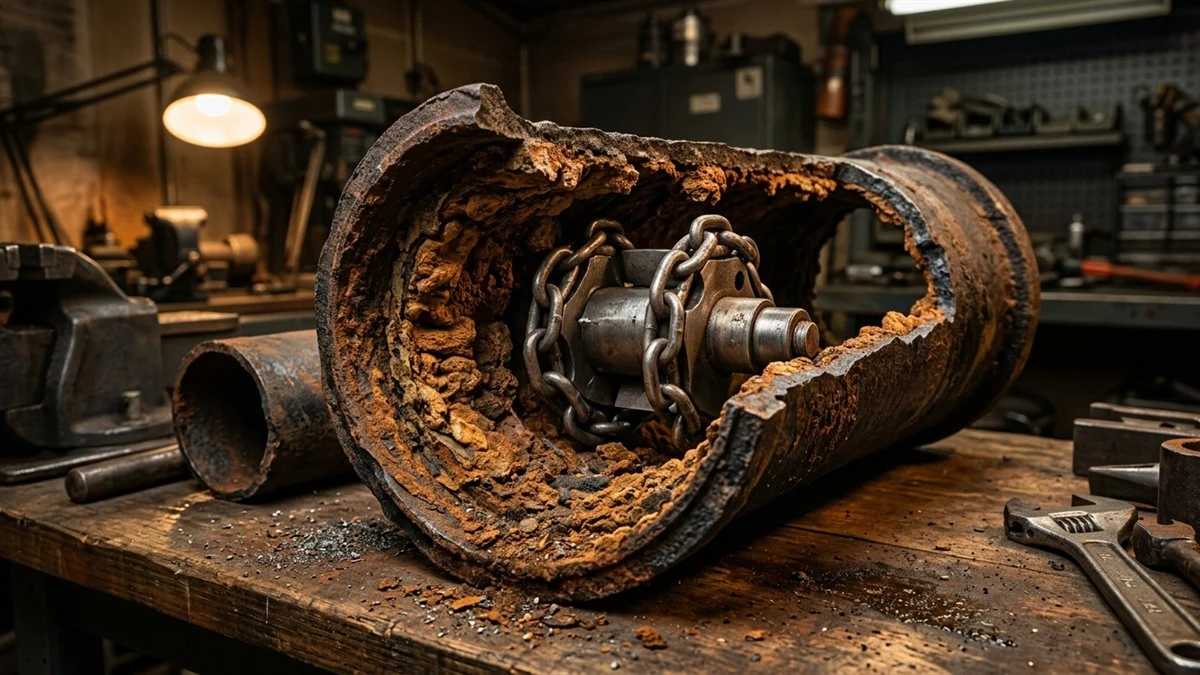
Figure 5.6: Mechanical Descaling in Action — High-speed rotary chain knocker attachments stripping decades of hardened iron tuberculation from the interior walls of a residential cast iron main drain.
7. Commercial & Residential Maintenance Schedules: Preventive vs. Emergency
One of the greatest financial errors property owners make is treating drain cleaning strictly as an emergency event: waiting until raw sewage is literally spilling over the basement toilet rim before calling a plumber. Implementing a proactive, scheduled drain maintenance program completely eliminates these catastrophic surprises:
Residential Properties with Mature Trees
If your property features large trees (such as cottonwoods, elms, or maples) planted within 30 feet of your sewer lateral path, roots will penetrate clay or cast iron joints. Because tree roots grow continuously during the warm Colorado growing season (April through October), waiting for a backup guarantees an emergency disaster.
Scheduling an annual or biennial hydro jetting service every spring cleans the lateral completely, shearing root tendrils before they have the opportunity to expand into solid dams. You avoid emergency weekend dispatch premiums, eliminate sewage flood contamination, and maintain complete peace of mind.
Commercial Kitchens, Restaurants & Multi-Family Properties
For commercial facilities—such as restaurants, bakeries, coffee shops, and apartment complexes in Broomfield—drain lines are subjected to relentless daily loading of fats, oils, grease, food particles, and heavy multi-tenant paper usage.
A commercial sewer backup forces an immediate health department closure, costing thousands of dollars in lost daily revenue and brand damage. Commercial establishments should establish a quarterly or semi-annual hydro jetting maintenance contract, scouring grease lines and grease trap influent/effluent pipes to ensure continuous, uninterrupted code compliance.
Colorado International Plumbing Code (IPC) Cleanout & Backwater Valve Mandates
Along the Colorado Front Range, municipal jurisdictions (including Broomfield and Adams/Boulder Counties) enforce strict amendments to the International Plumbing Code regarding sewer cleanout access and backwater flood prevention:
Under local building codes, an accessible two-way exterior sewer cleanout riser is mandatory for all sewer laterals exceeding 100 feet in developed length, or where directional changes exceed 135 degrees. If an older home lacks an exterior yard cleanout, executing high-pressure hydro jetting through an indoor basement cleanout or pulled toilet flange increases labor time and containment requirements. Installing an exterior dual-sweep cleanout provides a permanent, ground-level access port that allows our 4,000 PSI jetter hoses to enter directly toward the street or back toward the house without ever bringing heavy industrial machinery inside finished living spaces.
Furthermore, homes where the lowest plumbing drain fixture is located below the elevation of the next upstream municipal manhole cover are legally required to install an approved normally closed backwater prevention valve. A backwater valve features a counterbalanced mechanical flapper that allows household wastewater to flow freely out toward the street, but instantly snaps shut under reverse hydrostatic pressure if the city sewer main surcharges. Combining an annual hydro jetting maintenance flush with a functional backwater valve creates an impenetrable defense against municipal and private sewer flooding.
9. “What We Inspect on a Sewer Cleaning Diagnostic Call”
When you schedule a sewer cleaning appointment with Broomfield Emergency Plumber, our certified technicians execute a thorough, transparent diagnostic field protocol:
- Full-Length Closed-Circuit Camera Pre-Inspection: We televise your entire sewer lateral from the cleanout to the city connection, recording digital footage of all roots, grease, bellies, and cracks.
- Obstruction Categorization: We identify whether the blockage is organic grease/scale, invasive tree roots, physical foreign objects (toys, wipes), or a structural pipe failure.
- Custom Method Selection: If the pipe is sound, we recommend commercial hydro jetting; if the pipe is fragile or collapsed, we outline safe mechanical cabling or trenchless repair options.
- Execution with Live Telemetry: We deploy commercial-grade jetters or continuous augers, operating through exterior cleanouts to keep heavy machinery outside your clean home.
- Post-Clearing Optical Proof: We perform a second complete CCTV camera sweep after cleaning, walking you through the crystal-clear video showing pristine pipe walls and free-flowing water.
- Comprehensive Video Archiving: We provide you with a permanent digital copy of your post-cleaning sewer camera footage for your home records or real estate disclosure documentation.
9. Frequently Asked Questions (FAQ)
Q1: Can hydro jetting break an old sewer line?
Answer: Hydro jetting will not damage or break a structurally sound pipe, regardless of age. Modern PVC, ABS, clay, and sound cast iron easily withstand 4,000 PSI water pressure. However, if a pipe is already severely cracked, fractured, or partially collapsed, the high-pressure water stream can wash away the supporting soil around the breach. This is precisely why Broomfield Emergency Plumber enforces a strict mandatory policy: we always perform a closed-circuit video camera inspection prior to hydro jetting to verify structural integrity before any high-pressure water is introduced into the line.
Q2: How long does a hydro jetting service take?
Answer: A standard residential hydro jetting service—including the initial camera inspection, setting up the trailer-mounted jetting rig, executing multiple scouring passes along the 50-to-100-foot lateral, and performing the final verification camera sweep—typically takes between 1.5 and 3 hours. For severe grease build-up or heavy cast iron descaling, additional passes may be required to ensure 100% of the pipe diameter is restored.
Q3: Why is hydro jetting more expensive than snaking?
Answer: The difference in cost reflects the vast difference in equipment, labor, and results. A standard drain snake is a basic mechanical tool costing around $1,500 that merely pokes a hole through a clog. A commercial hydro jetting rig is a heavy industrial trailer unit costing between $45,000 and $75,000, requiring high-pressure safety training, specialized laser nozzles, commercial water capacity, and high-definition sewer camera systems. While the upfront investment is higher, hydro jetting saves hundreds of dollars in the long run by eliminating repeat service calls and extending pipe life by decades.
Q4: Can hydro jetting remove chemical drain cleaner from my pipes?
Answer: Yes. If a homeowner has mistakenly poured caustic liquid drain chemicals (such as Drano or sulfuric acid) down a blocked drain, the massive volume of high-pressure water delivered during hydro jetting thoroughly dilutes and flushes all corrosive chemical residue completely out of your home’s pipes and safely into the municipal main, neutralizing acid damage to your plumbing infrastructure.
Q5: Will tree roots come back after hydro jetting?
Answer: Hydro jetting with rotating cutter nozzles shears tree roots flush with the inner pipe wall, providing dramatically longer-lasting flow than mechanical snaking (which merely tears a hole through the root center). However, because hydro jetting cleans the pipe but does not physically seal the microscopic crack in the joint where the root entered, roots will eventually seek the water source again over 1 to 2 years. To permanently prevent roots from ever returning, our team can install a seamless trenchless CIPP (Cured-In-Place Pipe) epoxy liner directly inside the cleaned pipe, creating a jointless barrier that roots cannot penetrate.
Q6: Does hydro jetting make a mess inside the house?
Answer: Under professional execution, no. Our technicians almost always operate the hydro jetter through an exterior yard cleanout riser pipe, keeping all heavy hoses, water pressure, and waste slurry outside your living areas. In rare situations where work must be performed through an interior basement cleanout, we deploy drop cloths, containment shields, and high-volume wet vacuum extractors to guarantee your home remains spotless and sanitary.
Q7: When should I choose snaking over hydro jetting?
Answer: Mechanical snaking is the ideal choice when dealing with: (1) An isolated clog in an individual small branch line (such as a single clogged toilet, bathroom sink, or tub trap); (2) Retrieving a specific hard foreign object (such as a child’s toy, hairbrush, or hand towel accidentally flushed down a drain); or (3) In an emergency situation to quickly relieve hydraulic standing sewage head pressure before a scheduled hydro jetting or camera inspection service can be conducted.
10. Related Services & Main Sewer Cleaning Hubs
To explore our full suite of residential and commercial drain cleaning, camera inspection, and sewer line restoration services, explore our dedicated technical service centers:
Stubborn or Recurring Sewer Clogs? Restore 100% Flow With Hydro Jetting!
Don’t settle for temporary snaking that leaves your pipes choked with grease and roots. Our commercial 4,000 PSI hydro jetters scrub your sewer lines down to bare pipe, eliminating recurring backups for good. Includes high-definition sewer camera inspection and our full customer satisfaction guarantee across Broomfield and surrounding communities.
