
Master Plumber Diagnostic Advisory: Aggressive Botanical Sewer Encroachment
Throughout mature residential neighborhoods across the Colorado Front Range — including Broomfield, Boulder, Louisville, Lafayette, Westminster, and Arvada — thousands of subterranean building sewer laterals constructed of vitrified clay tile (VCT), cast iron, and early-generation plastic are under continuous, aggressive assault by massive tree root systems. In our semi-arid high-plains climate where annual precipitation averages just 14 to 16 inches, mature canopy shade trees like Plains Cottonwoods, Silver Maples, and Siberian Elms develop aggressive hydrotropic root structures capable of sensing subterranean warm moisture vapor escaping through microscopic pipe joints from distances exceeding 30 feet. Microscopic hair roots penetrate through mortar joints, rubber slip rings, and mechanical hubs, rapidly expanding into dense, impassable fibrous root balls that choke the pipe lumen, snag toilet paper, and trigger catastrophic raw sewage basement backups. This comprehensive technical guide provides an exhaustive engineering comparison of high-RPM carbide chain knockers, 4,000 PSI high-velocity hydrodynamic jetting nozzles, chemical foaming root barriers, and trenchless pipe rehabilitation protocols.
1. The Botanical Physics of Tree Root Intrusion in Colorado Front Range Soils
Tree root systems do not randomly burrow through solid earth in search of nourishment; their growth morphology is governed by strict physiological tropisms: hydrotropism (growth directed toward moisture gradients) and chemotropism (growth toward nutrient concentrations such as nitrates, phosphates, and potassium present in domestic wastewater).
During cold Colorado winter months and arid high-altitude summer spells, domestic sewer laterals function as subterranean thermal chimneys. Warm, nutrient-rich wastewater flowing through the pipe emits a continuous plume of warm water vapor. This warm vapor condenses on the cold exterior of the pipe wall and escapes into the surrounding soil through hairline fractures, mortar deterioration in clay pipe hubs, or failing rubber gaskets.
Root systems from thirsty trees locate these moisture halos. A single microscopic root hair — measuring less than 0.05 millimeters in diameter — slips effortlessly through an imperceptible void in a clay tile bell-and-spigot joint. Once inside the moist, oxygen-rich, highly fertile internal atmosphere of the sewer pipe, the root experiences explosive cellular division. What began as a hair-thin feeder root expands into a thick, woody “taproot” collar. As secondary and tertiary fibrous root masses proliferate, they form a dense, intertwined biological filter mat that spans the entire 4-inch or 6-inch pipe diameter, completely capturing toilet paper, wet wipes, and grease solids discharged from household drains.
2. Colorado Front Range Tree Species: The Worst Sewer Offenders
Different botanical species exhibit distinct root aggressiveness, tensile strength, and growth rates within urban plumbing corridors:
| Tree Species | Root Spread Radius | Tensile Strength & Growth Rate | Sewer Lateral Risk Profile |
|---|---|---|---|
| Plains Cottonwood (Populus deltoides) | Up to 3 times tree height (Over 100+ feet lateral spread) | Massive woody roots; radial expansion pressure > 65 PSI | Extreme risk. Native riparian species capable of shattering clay hubs and crushing PVC. |
| Silver Maple (Acer saccharinum) | 50 to 80 feet radial root zone; shallow, aggressive root mats | Extremely dense fibrous hair mats that create impermeable sludge dams | High risk in 1960s-1980s subdivisions across Broomfield and Boulder. |
| Siberian Elm (Ulmus pumila) | Deep, tenacious taproots branching into aggressive lateral seekers | High drought tolerance; aggressively seeks sewer vapor during hot summers | Severe risk along alleyways, utility easements, and older property fence lines. |
| Weeping Willow (Salix babylonica) | Extensive surface and deep root networks; voracious water consumer | Fastest growth rate; can refill a cleared 4″ pipe in less than 90 days | Extreme risk near ditches, ponds, or unlined Front Range irrigation canals. |
3. Why Traditional Mechanical Cable Snaking Fails as a Long-Term Solution
For decades, the standard response of drain cleaning handymen to a sewer backup has been running an electric mechanical snake (rotary cable machine) equipped with a small C-cutter or spearhead blade. While an auger cable can poke a temporary 1.5 to 2.0-inch hole through the center of a root obstruction to allow standing water to drain, it is fundamentally incapable of solving the root problem:
- The “Tunneling” Effect: A spinning steel cable naturally follows the path of least resistance. It corkscrews through the soft core of the root mass, leaving 75 to 85 percent of the root structure anchored firmly to the pipe walls and joints.
- Stimulating Secondary Growth (Pruning Response): Cutting the tips of tree roots inside a sewer pipe acts exactly like pruning a garden hedge. The tree responds to the mechanical trauma by releasing plant hormones (auxins and cytokinins) that stimulate rapid, dense budding. Within 60 to 90 days, the root mass regrows thicker, bushier, and more resilient than before the snaking service call.
- Joint Damage Risk: Heavy, stiff mechanical steel cables thrashing inside fragile vitrified clay or corroded thin-wall cast iron can crack the pipe bell or knock pipe offsets out of alignment, transforming a routine clearing into an expensive excavation emergency.
4. Modern Precision Milling: High-RPM Carbide Chain Knockers
Over the past five years, high-speed mechanical milling utilizing carbide-tipped chain knockers has revolutionized modern sewer rehabilitation. Unlike slow-speed rotational snaking cables (which turn at 200 to 400 RPM with low torque), chain knockers are powered by specialized flexible high-tensile steel drive shafts rotating at staggering speeds between 1,500 and 2,500 RPM.
The physics governing chain knocker operation is based on centrifugal flail dynamics:
- The tool features a precision machined hub equipped with two or three heavy-duty stainless steel circular chain loops tipped with brazed industrial-grade tungsten carbide cutting teeth.
- At low insertion speeds, the chains remain collapsed, allowing the tool to navigate 4-inch 90-degree sweep bends and cleanout risers without binding.
- Once positioned inside the sewer lateral, the technician activates the high-speed motor. Centrifugal force instantly expands the chain loops outward until they match the exact internal diameter of the pipe.
- The spinning tungsten carbide teeth mill the root collars completely flush with the pipe wall, beveling off the woody root stumps and grinding mineralized scale, tuberculation, and calcium buildup into fine, non-clogging dust. Because the chain loops expand dynamically, they clean the entire 360-degree circumference of the pipe without gouging into sound clay or PVC substrate.

5. 4,000 PSI Hydro-Jetting with Spinning Ceramic Warjet Nozzles
When root intrusions are heavily interlaced with solidified fats, oils, grease (FOG), and domestic sludge, mechanical milling is paired with commercial hydro-dynamic water jetting. Commercial hydro-jetting machines operate on an entirely different scale than homeowner pressure washers:
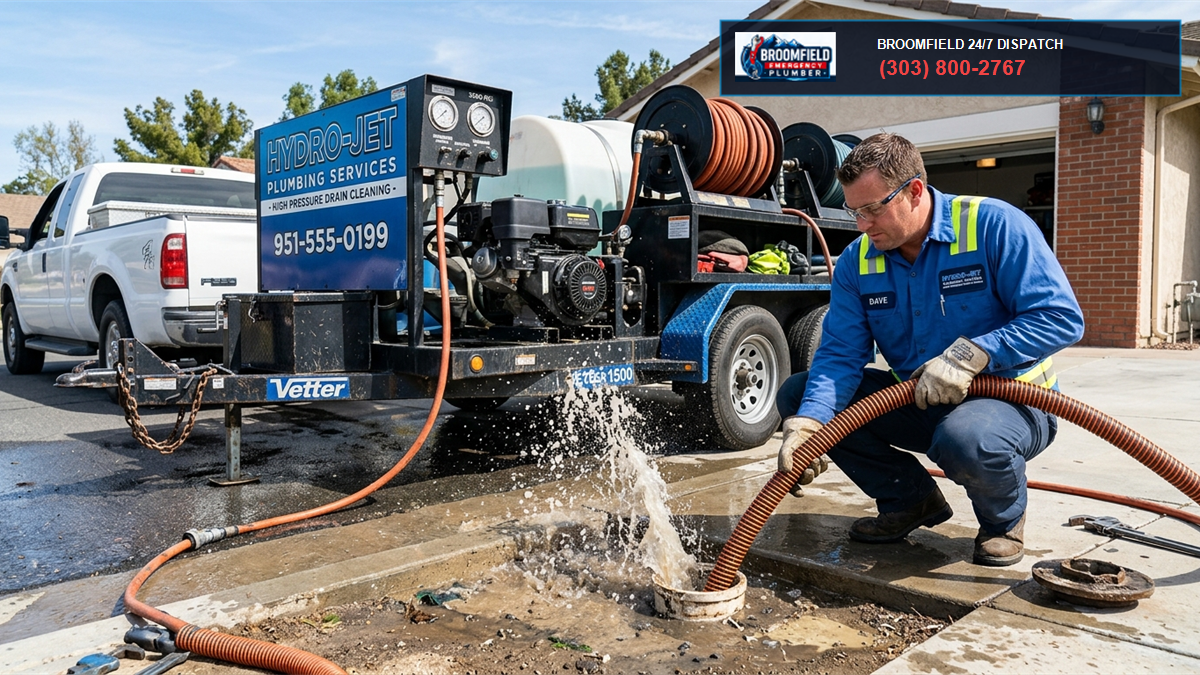
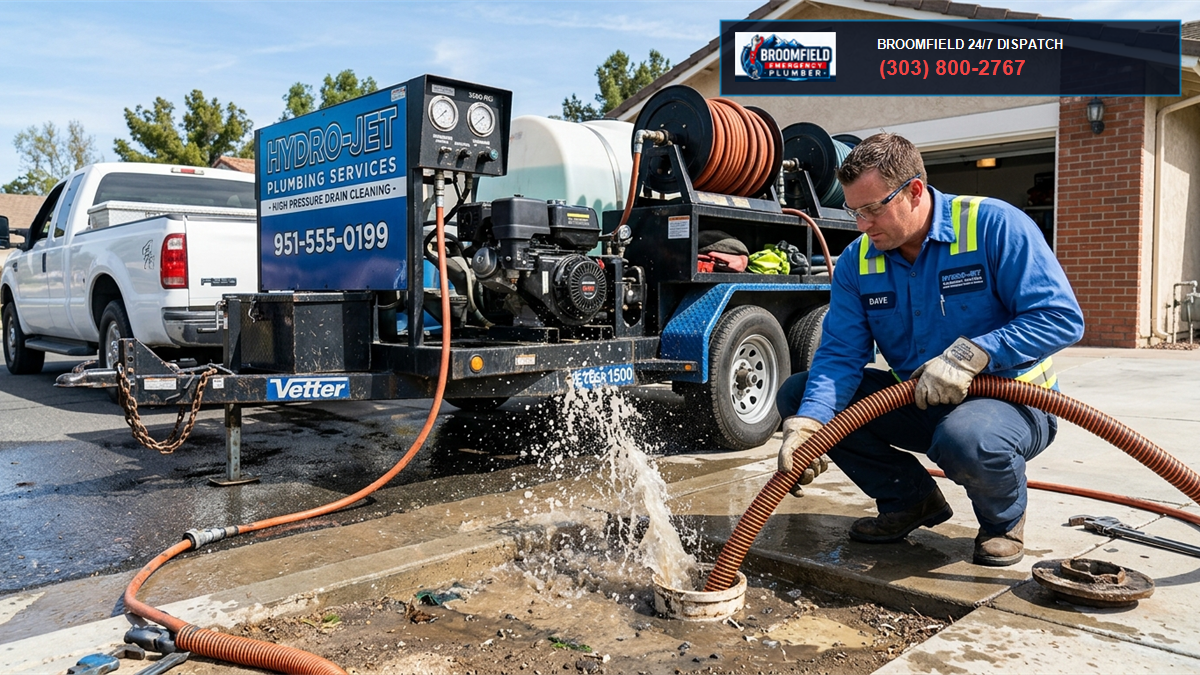
- Hydraulic Power Rating: Our commercial trailer-mounted Harben and Spartan jetter units generate continuous operating pressures of 3,500 to 4,000 PSI at flow rates of 12 to 18 gallons per minute (GPM), driven by industrial diesel engines.
- Spinning Ceramic Warjet Technology: The jetter hose is tipped with a precision engineered rotating nozzle (such as a Warthog or StoneAge warjet) featuring micro-machined ceramic orifice inserts. Ceramic orifices maintain cohesive, non-turbulent needle-sharp water streams that do not diffuse or atomize in air.
- Hydrodynamic Cutting Action: The nozzle incorporates two high-velocity forward-facing cutting jets spinning at 2,000 RPM, which act as high-speed rotating water blades that slice through thick fibrous root taproots like a razor. Simultaneously, four to six high-flow rear-facing propulsion jets drive the nozzle forward down the sewer lateral while scouring the pipe walls and flushing all severed root debris backward out of the line into the municipal sewer main.
6. Chemical Root Barrier Treatments: Vapor-Phase Cellular Inhibition
Even after a sewer pipe has been milled 100 percent clean by chain knockers and hydro-jetters, microscopic root tissue remains alive within the exterior soil matrix directly outside the pipe joint. Within months, these exterior roots will sense the moisture gradient and attempt re-entry.
To break this biological cycle permanently, master plumbers apply an EPA-registered chemical foaming root barrier containing Dichlobenil and Metam-Sodium:
- Vapor-Phase Foaming Generation: The chemical formulation is mixed with water and a high-expansion surfactant foaming agent inside a dedicated pressurized applicator tank. When injected down the sewer cleanout, it expands into a dense, thick foam that fills the entire 360-degree pipe volume from invert to crown.
- Cellular Dehydration & Tip Necrosis: As the foam contacts the freshly severed root ends, the active ingredients penetrate the root cell walls, halting cellular division and causing rapid necrosis (cell death) of the root tips inside the joint.
- Residual Barrier Impregnation: The Dichlobenil chemical compound clings to the pipe walls and permeates the exterior joint mortar, creating an invisible, non-translocating barrier that inhibits root regrowth for up to 24 to 36 months. Because the chemical does not translocate through the tree vascular system, it causes absolutely zero damage to the tree, canopy foliage, or surrounding lawn above ground.
7. Step-by-Step Master Plumber Root Eradication Field Protocol
Eliminating heavy root intrusion requires systematic engineering discipline. Our certified technicians follow an exacting 6-phase field workflow:
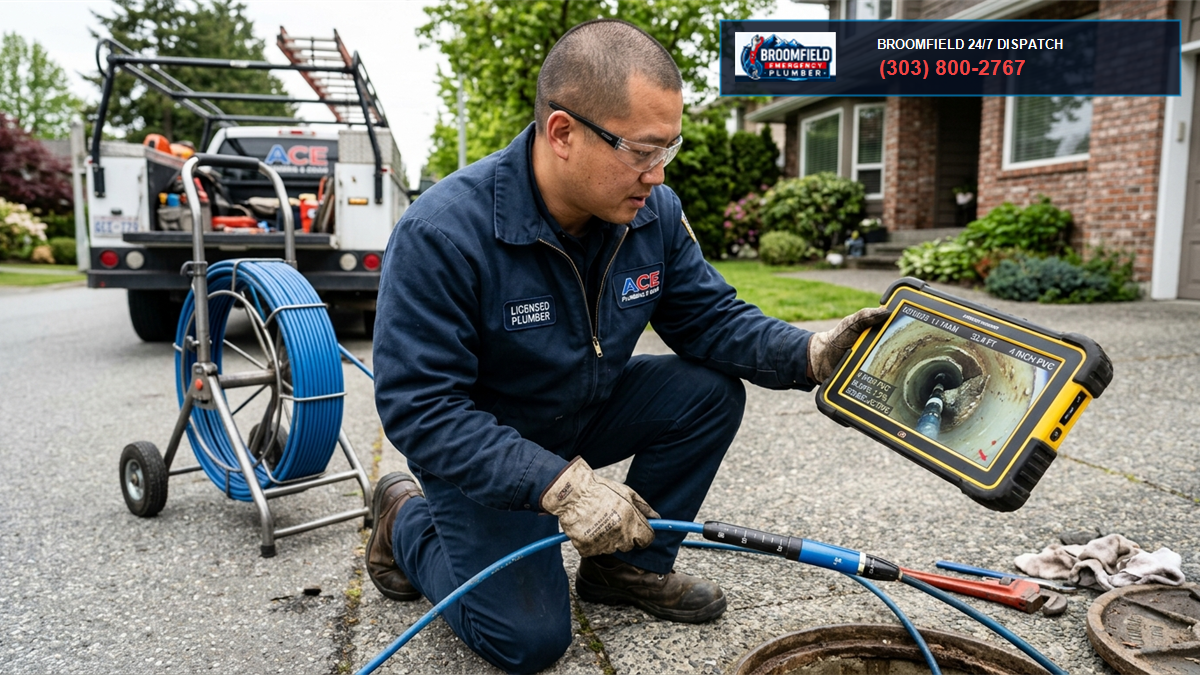
- Phase 1: Pre-Clearing HD Video CCTV Inspection: A high-definition self-leveling sewer camera is deployed through the exterior cleanout riser to record baseline conditions. The technician maps the exact linear footage of every root penetration, measures percentage of pipe diameter restriction, and evaluates pipe wall structural integrity to verify the pipe can safely withstand high-torque milling.
- Phase 2: Hydro-Jetting Primary Penetration: If the pipe is completely blocked with standing sewage, our trailer-mounted hydro-jetter is deployed with a penetrating root nozzle to bore an initial channel, evacuating all blackwater and debris toward the city main.
- Phase 3: High-RPM Carbide Chain Knocker Milling: The flexible-shaft high-speed chain knocker is inserted into the line. The technician systematically mills each root intrusion zone, grinding root collars flush to the pipe circumference and restoring the pipe to 100 percent original inside diameter.
- Phase 4: High-Pressure Warjet Polishing & Scour: A secondary hydro-jetting pass utilizing a rotating 4,000 PSI ceramic warjet nozzle is executed at a controlled pull-back rate of 1.0 foot per second, scouring away all microscopic root fibers, grease residues, and dislodged scale.
- Phase 5: Post-Milling Video Proof & Grade Verification: The sewer camera is re-inserted to record a full-color verification video with the homeowner present. The footage documents that every joint is 100 percent clear and confirms zero structural fractures exist in the pipe wall.
- Phase 6: Chemical Foaming Root Barrier Application: Within 48 hours of mechanical clearing (while the freshly cut root ends are open and highly receptive to chemical absorption), our team applies an EPA-registered Dichlobenil root foam treatment to seal all joints and prevent regrowth.
8. Comparative Engineering Matrix: Diagnostic & Clearing Methodologies
Evaluating the performance and economics of different sewer clearing and rehabilitation technologies:
| Clearing Methodology | Root Removal Efficiency | Pipe Wall Restoration | Average Recurrence Window |
|---|---|---|---|
| Rotary Cable Snake | 20% — 35% (Punches narrow center hole) | Zero scale removal; leaves stumps | 30 to 90 Days (Pruning effect accelerates growth) |
| 4,000 PSI Hydro-Jetting | 85% — 95% (Slices fibrous roots flush) | Flushes 100% of grease, sludge, and debris | 9 to 18 Months without chemical treatment |
| Carbide Chain Knocker Milling | 98% — 100% (Grinds woody collars flush) | Completely descales rust, tuberculation, and scale | 12 to 24 Months without chemical treatment |
| Chain Knocker + Chemical Foaming | 100% mechanical removal + chemical necrosis | Full original diameter restored and chemically sealed | 24 to 36+ Months of verified protection |
| Trenchless HDPE Pipe Bursting | Permanent eradication (New continuous pipe) | Brand-new seamless HDPE DR-17 line (Zero joints) | 50+ Years (Zero joint entry points exist forever) |
9. Fluid Dynamic Shear Stress & Jetter Thrust Mechanics
The extraordinary cutting efficacy of high-pressure hydro-jetting is grounded in the laws of fluid mechanics and hydrodynamic momentum transfer. When 4,000 PSI water accelerates through micro-machined ceramic nozzle orifices, the potential energy of hydrostatic pressure is converted entirely into kinetic energy:
v_{jet} = \sqrt{\frac{2 \times \Delta P}{\rho}} \approx \sqrt{\frac{2 \times 4000 \times 144}{1.94}} \approx 770\text{ feet per second (525 MPH)}
At a fluid exit velocity exceeding 525 miles per hour, the water stream acts as a non-metallic hydraulic saw. The impact stagnation pressure ($) delivered against woody root tissue is calculated via the momentum equation:
P_i = \frac{1}{2} \rho v_{jet}^2
When directed at a 45-degree angle of impingement by a rotating warjet head, this hydraulic shear stress effortlessly exceeds the tensile yield strength of tree root lignocellulose (typically 4,000 to 6,500 PSI), cleanly severing fibrous bundles at the microscopic cellular level without imparting blunt impact shocks to the surrounding clay pipe wall.
10. Tree Root Cellular Anatomy & Wound Compartmentalization Biology
To effectively halt root recurrence, plumbers must understand the biological defenses of mature trees. The anatomy of a woody seeker root consists of three distinct layers:
- The Outer Periderm & Bark: A protective corky outer layer impregnated with suberin, a hydrophobic waxy biopolymer that seals water and protects against environmental pathogens.
- The Vascular Cambium: The microscopic layer of rapidly dividing undifferentiated meristematic cells that generates secondary xylem (wood) toward the interior and secondary phloem (nutrient transport) toward the exterior.
- The CODIT Response (Compartmentalization of Decay in Trees): When a mechanical snake shears a root tip, the tree activates natural chemical defense walls, synthesizing polyphenols and antimicrobial terpenoids to wall off the injury while activating adventitious dormant buds directly behind the wound. This biological mechanism explains why blunt mechanical cutting invariably accelerates root branching. In contrast, vapor-phase Dichlobenil chemical foaming penetrates the cut cambium before suberin walling can occur, binding permanently to cellular cellulose synthases and arresting adventitious budding at the DNA transcription level.
11. Municipal Tree Protection Ordinances vs. Private Utility Rights in Colorado
Property owners frequently grapple with legal and environmental questions when dealing with root intrusion: “Can the city make me keep a tree that is destroying my sewer? Am I legally allowed to cut tree roots belonging to a neighbor or city park tree?”
In Colorado jurisprudence, underground property boundaries and utility rights are defined by several key principles:
- The Massachusetts Rule (Common Law Self-Help): Under Colorado common law, a landowner has the absolute legal right to trim, sever, or chemically treat tree branches and tree roots that encroach across property boundaries into their land or utility easements, provided the action does not recklessly cause the immediate death or instability of a landmark public tree.
- Municipal Canopy Preservation in Boulder & Broomfield: Both the City of Boulder (Urban Forestry Division) and the City and County of Broomfield maintain strict municipal tree protection ordinances for trees situated within public street planting strips (the tree lawn between the sidewalk and curb). Property owners cannot cut down a public street tree without a forestry permit. However, property owners possess the right to maintain their private sewer lateral beneath the public right-of-way, provided non-destructive trenchless rehabilitation methods (such as chain knocker milling or pipe bursting) are utilized.
- The Private Sewer Lateral Responsibility Boundary: Under Broomfield Municipal Code Section 13-04-080, the individual property owner owns and is 100 percent legally and financially responsible for the entire length of the private sewer lateral from the building foundation all the way to the physical connection at the municipal sewer main, including the portion beneath public sidewalks and streets. If a private lateral backs up due to root intrusion, all cleanup and repair costs rest squarely with the homeowner.
12. Detailed Mechanical Anatomy of Commercial Hydro-Jetters
Industrial hydro-jetters are marvels of mechanical and hydraulic engineering designed for continuous duty under extreme hydrostatic loads:
- Industrial Triplex Plunger Pumps: High-pressure generation relies on a positive displacement triplex ceramic plunger pump. Solid ceramic plungers running inside forged nickel-aluminum bronze manifolds eliminate thermal expansion and resist abrasive wear from suspended mineral particles, pumping up to 18 GPM at 4,000 PSI with zero pressure cavitation.
- Unloader Regulating Valves: When the technician closes the high-pressure foot control valve, an engineered trapped-pressure unloader valve instantly bypasses the fluid stream back to the water reservoir at zero PSI, preventing hydraulic line shock and protecting the pump motor from over-pressurization.
- Thermoplastic High-Pressure Hoses: The jetting hose must combine ultra-high tensile strength with extreme flexibility. Our machines utilize bonded thermoplastic hoses reinforced with dual braids of high-tensile aramid (Kevlar) fibers with a minimum burst pressure rating of 16,000 PSI (a 4:1 safety factor). The ultra-smooth polymer cover minimizes frictional drag against wet pipe walls, allowing the hose to advance 200+ feet down the lateral.
13. Complete Equipment & Operational Cost Comparison
Understanding the long-term financial lifecycle of sewer root management:
| Service Level | Initial Service Cost | 5-Year Projected Maintenance Cost | Long-Term Reliability Score |
|---|---|---|---|
| Emergency Cable Snaking | — | ,500 — ,500 (Requires service every 4 to 6 months) | Very Low (High risk of unannounced midnight basement floods) |
| High-RPM Chain Knocker Milling | — | ,800 — ,500 (Full 360-degree pipe wall descaling) | High (Restores 100% hydraulic capacity) |
| Chain Milling + 4,000 PSI Warjet Flush | — ,350 | ,500 — ,200 (Flushes 100% of debris and sludge) | Very High (Completely cleans invert and joint crevices) |
| Precision Milling + Chemical Foaming Barrier | ,200 — ,750 | ,200 — ,750 (Zero maintenance required for 2 to 3 years) | Superior (Mechanical eradication plus chemical prevention) |
| Trenchless HDPE Pipe Bursting | ,500 — ,500 | .00 (Zero root service needed for the rest of your life) | Permanent Benchmark (100-year seamless pipe warranty) |
14. Comprehensive Field Case Study: Old Town Broomfield Clay Lateral Restoration
In January 2026, our master plumbing emergency crew responded to a chronic mainline backup at a historic 1954 bungalow in the Old Town neighborhood of Broomfield. The front yard featured a magnificent 70-foot mature Plains Cottonwood tree situated just 12 feet from the sewer lateral pathway. The homeowner had endured six sewer backups over the previous three years, paying various drain cleaners over ,200 for repeated cable snaking services that failed every 4 to 6 months.
Our initial color sewer video camera inspection revealed that the 4-inch vitrified clay sewer line was 95 percent obstructed at three distinct joint locations: 28 feet, 42 feet, and 61 feet from the foundation cleanout. Massive, woody root bundles resembling tangled rope had completely choked the pipe, trapping decomposing toilet paper and thick grease layers.
Our team deployed our high-performance dual-technology rehabilitation protocol:
- Mechanical Milling: We operated our high-speed flexible-shaft machine equipped with double-chain carbide knockers at 2,000 RPM. In less than 45 minutes of precision milling, the carbide teeth ground through the dense woody root collars, cutting them flush to the clay hub circumferences.
- High-Flow Hydro-Scrubbing: We followed immediately with our 4,000 PSI trailer jetter utilizing a spinning ceramic warjet nozzle, pumping 16 GPM to flush out more than 40 pounds of pulverized root mulch, grease cakes, and settled silt into the city main.
- Chemical Root Barrier Application: We injected high-expansion Dichlobenil root barrier foam throughout the entire 75-foot lateral run, completely coating the interior pipe walls and saturating the clay joint crevices.
- The Result: A final post-service CCTV video inspection confirmed the 1954 clay pipe was restored to 100 percent of its original internal diameter with perfectly smooth invert flow. Twelve months later, a follow-up complimentary camera inspection confirmed zero root regrowth. By investing in precision milling and chemical barrier protection, the homeowner avoided a costly ,000 yard excavation while permanently ending their recurring backup nightmare.
15. Hydro-Jetting Nozzle Engineering: Penetrator vs. Flail vs. Warjet Heads
Selecting the precise jetting nozzle geometry dictates field clearing success. Different nozzle heads deliver specialized fluid mechanics:
- Penetrator / Chisel Point Nozzles: Equipped with one heavy forward-facing center jet and three or four rear thrust jets. The forward jet delivers an intense 4,000 PSI concentrated hydraulic punch, boring through total solid blockages to re-establish flow in standing blackwater lines.
- Spinner / Rotary Descaling Nozzles: Feature an offset internal rotor mechanism that spins the body at 3,000 to 5,000 RPM. The radial water streams hit the pipe wall perpendicularly, polishing away grease films, scale, and soft fibrous roots.
- Controlled-Rotation Warjet (Ceramic Fluidic Brakes): Unlike free-spinning nozzles that rotate too quickly to maintain solid water streams, engineered warjets utilize internal viscous fluidic brakes to limit rotational speed to 200 to 500 RPM. This controlled rotation prevents water jet atomization, delivering thick, cohesive hydraulic water chisels capable of cutting 2-inch hardwood root trunks cleanly.
16. Front Range Commercial Strip Mall & Restaurant Root Intrusion Dynamics
Commercial properties across Broomfield and Boulder face compounding risks when tree roots encroach upon food service sewer laterals. When commercial kitchen lines discharge effluent laden with warm animal fats and cooking oils, the grease flows past tree root intrusions. The fibrous root curtains act as high-efficiency mechanical grease strainers.
As fats cool below their 115-degree Fahrenheit solidification threshold, they coat the tree roots, forming petrified grease-root aggregates known in municipal sanitation as fatbergs. Standard cable snaking cannot penetrate these concrete-hard masses. Master plumbers deploy combination high-temperature hydro-jetters operating at 180 degrees Fahrenheit and 4,000 PSI, melting the lipid matrix while high-RPM carbide chain knockers pulverize the root framework simultaneously.
17. Orangeburg Pipe & Tar-Paper Sewer Failure Dynamics in Colorado
In certain post-WWII residential enclaves in Adams and Boulder Counties constructed between 1945 and 1970, plumbers occasionally uncover Orangeburg pipe — also known as bituminous fiber pipe. Fabricated from wood cellulose fibers impregnated with coal tar pitch, Orangeburg pipe was used as a cheap wartime alternative to cast iron.
When mature tree roots encounter aging Orangeburg pipe, the results are catastrophic. The acidic wood fibers of Orangeburg provide ideal organic sustenance for fungal decay and root penetration. Tree roots easily puncture the soft bituminous walls, causing the pipe to delaminate, blister, and ovalize under soil overburden. Critical Warning: High-speed chain knockers and 4,000 PSI hydro-jetters must never be used on Orangeburg pipe, as the aggressive cutting forces will instantly shred the fragile tar-paper walls. In Orangeburg systems, gentle low-pressure snaking followed immediately by trenchless pipe bursting or open-trench replacement is the only viable engineering remedy.
18. Frequently Asked Questions: Master Plumber Insights on Tree Roots
Q: Will pouring rock salt or copper sulfate down my toilet clear sewer roots?
A: Copper sulfate and rock salt are caustic, ineffective, and environmentally hazardous. While copper crystals can burn microscopic root tips that touch the very bottom invert of the pipe, they quickly wash away with the next toilet flush, completely missing 90 percent of the root mass hanging from the pipe crown and upper joints. Furthermore, excessive copper discharges into municipal wastewater violate Colorado environmental water standards and poison aquatic ecosystems in the South Platte River basin.
Q: If I cut down the tree, will my sewer line stop backing up?
A: Surprisingly, no! When a mature shade tree is cut down, the subterranean root system does not die immediately. Large root structures remain physiologically active for two to three years, continuing to send root shoots into moist sewer pipes. Even after the tree root system eventually dies and rots, the physical void left behind in the clay joint remains wide open. Soil, silt, and roots from neighboring trees will immediately infiltrate the vacant joint. Structural joint repair or seamless pipe bursting is always required.
Q: How often should I schedule preventative hydro-jetting if I have clay pipes?
A: In mature Front Range properties with clay tile sewer laterals and large trees within 30 feet, we recommend a preventative hydro-scrubbing service every 18 to 24 months, combined with an EPA-registered chemical foaming root barrier. This completely prevents catastrophic basement sewage backups, extends the operational life of the clay pipe by decades, and costs a fraction of emergency weekend flood remediation.
Q: Can tree roots penetrate modern Schedule 40 PVC or SDR-35 plastic sewer pipes?
A: Tree roots cannot penetrate through the solid, impermeable sidewalls of properly solvent-welded Schedule 40 PVC. However, roots can and do penetrate gasketed SDR-35 joints if expansive Colorado bentonite clay soils heave or settle, pulling the rubber bell-and-spigot gasket out of axial alignment. Furthermore, roots frequently invade through cracked plastic cleanout caps, abandoned test tees, or unglued transition fittings. High-definition camera scoping is essential to pinpoint the exact failure point.
19. 24/7 Emergency Master Plumber Root Clearing in Broomfield & Boulder County
When tree roots cause raw sewage to back up into your home, you cannot afford to wait. Our mobile emergency service fleet is fully outfitted with commercial 4,000 PSI hydro-jetters, high-speed carbide chain knockers, and digital CCTV camera systems ready for immediate dispatch across Broomfield, Westminster, and Boulder County.
24/7 Heavy Sewer Root Clearing & Hydro-Jetting in Broomfield
Are stubborn tree roots causing recurring sewer backups in your home? Stop paying for temporary snaking that leaves the roots behind. Contact our certified master plumbers today for high-speed carbide chain knocker milling, 4,000 PSI hydro-jetting, and permanent root barrier protection.