
Table of Contents: Sewer Camera Inspection Guide
- 1. Executive Summary: The Diagnostic Revolution of Subterranean Video Scopes
- 2. Optical & Electronic Engineering: Self-Leveling Cameras, LEDs & Transmitters
- 3. Comprehensive Pipe Defect Catalog: Identifying Underground Failures
- 4. 512 Hz Radio Sonde Locating: Pinpointing Depth & Trajectory from Above Ground
- 5. Step-by-Step Professional Sewer Scope Inspection Protocol
- 6. Sewer Scopes in Colorado Real Estate: The $15,000 Buyer Protection Survey
- 7. Rental Hardware Store Cameras vs. Commercial Diagnostic Systems
- 8. Colorado Front Range Submarket Profiles: Clay, Cast Iron & PVC Eras
- 9. Transparent Pricing & Cost Factors: Standalone Scopes vs. Camera Packages
- 10. Comprehensive Extended FAQ Section (12 Detailed Questions)
- 11. Schedule High-Definition Fiber-Optic Sewer Camera Inspection
1. Executive Summary: The Diagnostic Revolution of Subterranean Video Scopes
For most of modern plumbing history, diagnosing an underground sewer failure was an exercise in educated guesswork and destructive speculation. When a residential sewer line backed up repeatedly, plumbers had no optical method to peer inside the buried pipe. They would insert a mechanical steel cable down a cleanout, rotate the blade until they felt resistance, and guess whether the blockage was a soft paper wad, a massive tree root infestation, a collapsed pipe crown, or a crushed clay section. If cabling failed to clear the line, homeowners were frequently told that their entire lawn, driveway, or finished basement floor had to be excavated with heavy backhoes at a staggering cost of $10,000 to $25,000—just to find out where the pipe had broken.
The introduction of High-Definition Fiber-Optic Sewer Diagnostic Cameras revolutionized sanitary engineering. Today, licensed master plumbing diagnosticians can feed an ultra-compact, high-resolution color video camera directly into a residential sewer lateral, transmitting continuous real-time video footage to an optical command monitor above ground. Every inch of your home’s subterranean piping—from foundation wall exit penetrations out to the municipal street tap—is documented in crystal-clear digital clarity.

A professional sewer camera inspection eliminates all guesswork. It reveals the exact physical condition of your pipe walls, pinpoints the precise footage distance to any blockage, identifies underlying structural defects (including fractures, offset joints, channel rot, and reverse-slope bellies), and utilizes onboard electromagnetic radio locating sondes to trace the pipe’s precise surface location and burial depth within fractions of an inch.
For homeowners and prospective real estate purchasers across the Colorado Front Range—spanning Broomfield, Westminster, Thornton, Louisville, Superior, and Arvada—a sewer camera inspection is the single most valuable preventive diagnostic investment you can make. With older housing stock resting on shifting bentonite clay soils and mature tree canopies aggressively seeking subterranean moisture, a 45-minute sewer scope can save you from devastating unexpected basement floods and prevent tens of thousands of dollars in surprise utility reconstruction costs.
2. Optical & Electronic Engineering: Self-Leveling Cameras, LEDs & Transmitters
A professional sewer inspection camera is a sophisticated marvel of optical, electronic, and robotic engineering designed to operate in extreme, pitch-black, highly corrosive subterranean environments:

- Self-Leveling High-Definition Optical Sensor: Inside the camera head sits a precision color CMOS optical sensor mounted on a frictionless, weighted internal gimbal mechanism. As the push-rod navigates bends and turns inside the pipe, the gimbal rotates automatically, ensuring that the camera image remains perpetually upright on the technician’s monitor. The bottom invert of the pipe always appears at the bottom of the screen, allowing accurate assessment of gravitational slope, water flow depth, and sediment deposition.
- Ultra-High-Output LED Lighting Arrays: Because a buried sewer lateral is pitch-black, the camera head is encircled by a ring of high-efficiency, multi-lumen daylight LEDs. These lights illuminate up to 15 to 20 feet ahead inside 4-inch, 6-inch, and 8-inch pipes, revealing microscopic hairline fractures, spider cracks, and pipe material transitions that would be invisible under standard lighting.
- Scratch-Resistant Sapphire Crystal Lens: The camera lens is protected by a thick synthetic sapphire crystal window—second in hardness only to diamond. It resists scratching, etching, and abrasion as the camera pushes through sharp sand, broken glass, heavy rust scale, and dense gravel.
- Reinforced Fiberglass Inner-Core Push Rod: The camera head is connected to a heavy reel housing 150 to 200 feet of specialized push rod. The rod features a rigid fiberglass structural core wrapped in high-tensile Kevlar braided fibers and coated in smooth polypropylene. This engineering provides the optimal balance of rigidity (allowing the technician to push the camera up to 200 feet horizontally) and flexibility (enabling it to navigate multiple 45-degree and 90-degree pipe bends).
- Digital On-Screen Footage Counter: The reel incorporates an optical rotary encoder that measures push-rod deployment down to the tenth of an inch. As the camera travels down the pipe, the exact distance from the cleanout entry point is displayed in real time directly on the video screen and recorded into the digital video file.
3. Comprehensive Pipe Defect Catalog: Identifying Underground Failures
During a professional video sewer scope, master diagnostic technicians analyze the optical feed to identify and classify six primary subterranean structural defects:

| Defect Classification | Camera Visual Appearance | Structural Mechanical Cause | Impact on Flow & Drainage | Recommended Permanent Repair |
|---|---|---|---|---|
| Invasive Tree Root Intrusion | Feathery hair-like nets or dense woody tree root masses hanging from pipe joints | Degraded cement mortar collars in older vitrified clay pipe sections | Traps toilet tissue, wet wipes, and grease; causes total recurring backups | Commercial hydro jetting paired with trenchless CIPP epoxy relining. |
| Offset / Displaced Joint | A sharp lip or ledge visible at a joint seam where two pipe sections no longer align | Sub-surface ground shifting, soil settlement, or tree root leverage | Solids collide with exposed pipe lip and dam up; wastewater leaks into soil | Minor offsets: CIPP relining; severe offsets (>1.5″): sectional pipe excavation. |
| Sewer Pipe Belly (Sag / Low Spot) | The camera lens submerges completely underwater while no fixtures are running | Improper bedding compaction or expansive bentonite clay soil settlement | Water velocity decelerates to zero; heavy solids and grease drop out of suspension | Structural pipe re-grading via trenchless pipe bursting or open-cut trenching. |
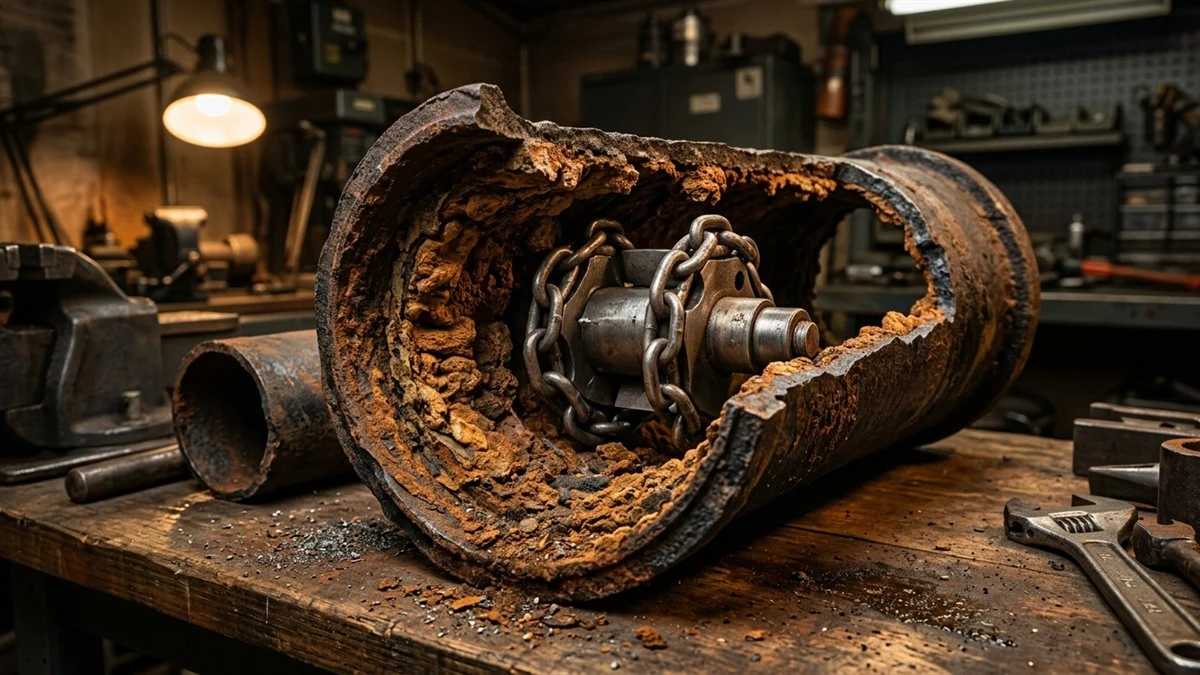
| Cast Iron Tuberculation & Channel Rot | Jagged, crusty rust scale nodules lining pipe walls; missing bottom channel | Long-term electrochemical oxidation and hydrogen sulfide acid corrosion | Restricts effective diameter by 50%; wastewater drains directly into soil beneath slab | Mechanical chain-flail descaling followed by trenchless CIPP epoxy inversion liner. |
| Structural Fractures & Radial Cracks | Visible hairline cracks, jagged diagonal fractures, or missing pipe crown pieces | Excessive surface vehicle load, soil compaction, or seismic ground settling | Allows soil and gravel to cave into pipe; structural collapse imminent | Trenchless pipe bursting or targeted excavation replacement. |
4. 512 Hz Radio Sonde Locating: Pinpointing Depth & Trajectory from Above Ground
Capturing video footage inside a pipe is only half the diagnostic equation. If a severe structural collapse or un-snakeable blockage is discovered 48 feet down the line, a plumber must know its exact geographic location above ground. Does that defect sit under the front lawn, beneath a mature $10,000 blue spruce tree, or directly underneath the poured concrete driveway?
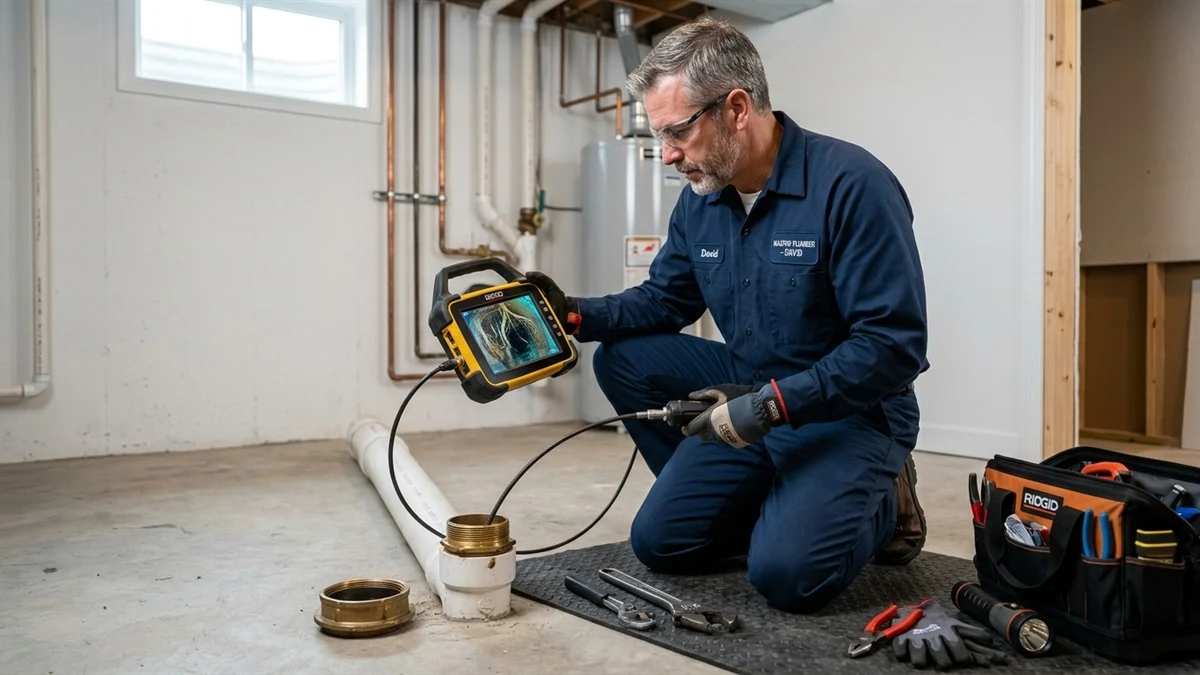
Professional sewer cameras incorporate an onboard **512 Hz Electromagnetic Radio Transmitter Sonde** built directly into the stainless steel camera housing. When activated, the sonde broadcasts an omnidirectional low-frequency electromagnetic signal that penetrates solid earth, crushed gravel, asphalt, and concrete slabs.
Above ground, the technician operates an ergonomic electronic receiver wand (such as a Ridgid NaviTrack or Vivax-Metrotech locator). By sweeping the locator across the surface, the technician maps the electromagnetic signal, pinpointing three critical coordinates:
- Exact Geographic Position: The locator screen displays graphic crosshairs that guide the technician directly above the subterranean camera head, marking the spot with spray paint within an accuracy radius of two inches.
- Digital Depth Measurement: The receiver calculates the precise vertical distance between the surface grade and the top of the buried pipe (e.g., “Depth: 6 feet, 4 inches”), eliminating guesswork before excavation.
- Line Trajectory & Pitch: By walking the line from the cleanout to the street tap, the technician maps the exact path and gravitational pitch of your sewer lateral, identifying whether it crosses property boundaries or conflicts with other buried utilities (gas, electrical, fiber optic).
5. Step-by-Step Professional Sewer Scope Inspection Protocol
A comprehensive residential sewer camera survey follows a rigorous, standardized six-phase engineering protocol:
- Phase 1: Access Point Verification & Prep: The technician locates the primary cleanout access (exterior yard riser or basement cleanout). If the line is actively backed up with standing water, a preliminary cable clearing or gentle pumping is performed to drain the standing water; cameras cannot see through opaque, murky blackwater.
- Phase 2: Continuous In-Line Video Traverse: The self-leveling camera is fed slowly into the pipe. The technician monitors the optical feed in real time, pausing at every joint collar, bend, and pipe material transition to record high-resolution stills and note exact footage distances.
- Phase 3: The City Main Tap Verification: The inspection continues down the entire length of the private lateral until the camera head drops into the large municipal sewer collector main (or enters the on-site septic tank). Documenting the condition of the physical municipal tap connection is critical for establishing jurisdictional property boundaries.
- Phase 4: Running Water Flush & Slope Verification: A household tap is turned on to run clean water down the line while the camera is in place. This allows the technician to evaluate water flow velocity, verify gravitational slope, and confirm whether low spots (bellies) are holding standing water.
- Phase 5: Sonde Locating & Surface Marking: If any structural fractures, bellies, or severe root intrusions are identified, the 512 Hz radio transmitter is energized, and the technician marks the exact location and burial depth on the surface lawn or driveway.
- Phase 6: Digital Video Delivery & Written Report: The homeowner receives a comprehensive, narrated MP4 digital video recording of the entire inspection along with an itemized written engineering assessment outlining pipe materials, documented defects, and prioritized remediation recommendations.
6. Sewer Scopes in Colorado Real Estate: The $15,000 Buyer Protection Survey
In Colorado’s competitive residential real estate market across the Denver metropolitan area, ordering a professional **Sewer Scope Inspection** during the standard inspection contingency period is one of the most critical financial protections a home buyer can secure.
A standard residential home inspector inspects visible elements: the roof shingles, furnace, electrical panel, and foundation walls. Home inspectors do **not** inspect buried underground sewer laterals. Yet, under Colorado municipal codes, the moment a buyer closes on a property, they inherit complete financial and legal responsibility for the entire sewer lateral from the foundation all the way to the street tap.
If an older home built in the 1960s or 1970s has an undetected root-infested clay lateral with crushed joints or a reverse-slope belly under the driveway, repairing or replacing that sewer line post-closing will cost between **$7,000 and $20,000+**. Ordering a $250 sewer scope prior to closing allows buyers to:
- Discover hidden structural collapses, clay fractures, or Orangeburg pipes before signing final loan documents.
- Request that the seller completely repair, replace, or reline the sewer lateral as an inspection resolution contingency.
- Negotiate a substantial price reduction or escrow repair credit to cover future trenchless pipe replacement.
- Walk away safely from a property that exhibits catastrophic under-slab plumbing structural failure.
7. Rental Hardware Store Cameras vs. Commercial Diagnostic Systems
Homeowners often ask whether they can rent a sewer inspection camera from a local big-box hardware store and inspect their own sewer line for a lower cost. While consumer rental cameras exist, they suffer from severe technological limitations compared to commercial master plumbing diagnostic systems:
- Optical Resolution and Lighting: Rental cameras typically feature low-resolution standard-definition sensors and weak, narrow-beam LED lights that produce dark, grainy footage inside 4-inch pipes, easily missing hairline fractures and joint separations.
- Lack of Self-Leveling Gimbals: In consumer cameras, the image rotates wildly as the push-rod twists, making it nearly impossible to determine whether you are looking at the top crown, side wall, or bottom invert of the pipe.
- Absence of Radio Locating Sondes: Rental cameras lack 512 Hz radio transmitters and precision receiver wands. Even if you spot a blockage on screen, you will have zero ability to determine where that defect sits in your yard or how deep it is buried.
- Expertise & Defect Interpretation: A video feed is only as valuable as the technician interpreting it. Master plumbers can instantly distinguish between harmless superficial grease and a structural pipe shear, ensuring you don’t misdiagnose an expensive non-issue or overlook an imminent collapse.
8. Colorado Front Range Submarket Profiles: Clay, Cast Iron & PVC Eras
Subterranean sewer pipe vulnerabilities across the Denver metropolitan area correlate directly with municipal development eras:
- Broomfield (Anthem, Broadlands, Country Vista): Subdivisions built during the 1990s and 2000s utilize Schedule 40 PVC and SDR-35 piping. While immune to tree roots, sewer scopes in northern Broomfield frequently reveal 1-inch to 3-inch pipe bellies caused by shifting bentonite clay soils that settled after home construction.
- Westminster (Shaw Heights, Trendwood, Skyline): Homes built between 1955 and 1975 feature original vitrified clay tile laterals. Camera surveys in Westminster almost universally reveal massive root intrusion through mortar collars, offset joints, and localized channel shearing.
- Thornton & Northglenn (Woodglen, Grange Creek): Mid-century slab-on-grade homes feature centrifugally spun cast iron building drains beneath the foundation. Sewer scopes commonly reveal severe internal rust tuberculation, missing bottom inverts (channel rot), and scale that restricts drainage flow.
- Louisville & Lafayette (Old Town Louisville): Historic properties frequently reveal complex shared party laterals (where two adjacent homes drain through a single pipe to the street main) or fragile Orangeburg bituminized fiber pipes that require complete trenchless replacement.
9. Transparent Pricing & Cost Factors: Standalone Scopes vs. Camera Packages
Below is a transparent breakdown of baseline industry investments for professional sewer camera inspections across the Colorado Front Range:
- Standard Residential Sewer Camera Inspection: $225 – $350 (Includes complete video traverse up to 150 feet, digital MP4 video file, narrated report, and cleanout access).
- Real Estate Buyer Pre-Purchase Sewer Scope: $250 – $400 (Includes official written real estate inspection report, high-definition video link, and defect repair cost estimates).
- Sewer Camera Inspection Paired with Main Line Cabling: $375 – $550 (Includes emergency cabling to clear standing water, followed by immediate full-length video camera verification).
- Precision 512 Hz Radio Sonde Locating & Surface Marking: Included in comprehensive inspection packages; standalone utility locate: $200 – $350.
- Post-Hydro Jetting Quality Verification Camera Survey: Free / Included with all commercial hydro jetting services to verify 100% bore restoration.
10. NASSCO PACP Diagnostic Standards: National Pipe Grading & Defect Indexing
In municipal and civil infrastructure engineering, analyzing sewer camera footage is governed by rigorous national technical criteria established by the National Association of Sewer Service Companies (NASSCO) under its Pipeline Assessment Certification Program (PACP). Our master diagnostic technicians apply these standardized engineering criteria to every residential inspection.
Under NASSCO PACP standards, pipe defects are cataloged into two distinct structural classifications:
- Structural Defects: Physical degradation of the host pipe material, including longitudinal cracks, circumferential fractures, broken pipe crowns, collapsed sections, and missing wall inverts.
- Operation and Maintenance (O&M) Defects: Obstructions that restrict hydraulic flow but have not yet caused structural failure of the pipe wall, including tree root intrusions, grease deposits, settled sediment, scale, and foreign flushed objects.
Every identified defect is assigned an engineering severity grade from 1 to 5, determining the urgency of repair:
| PACP Grade | Structural Severity Rating | Observed Pipe Defect Characteristics | Timeline to Failure & Recommended Action |
|---|---|---|---|
| Grade 1: Minor | Superficial cosmetic wear | Hairline crazing on PVC, light mineral scaling, superficial rust | Failure unlikely in foreseeable future; schedule routine monitoring in 5 years. |
| Grade 2: Minor to Moderate | Early stage degradation | Fine root tendrils entering mortar joint; joint offset under 1/2 inch | Preventive maintenance required within 12 to 24 months (hydro jetting/chemical treatment). |
| Grade 3: Moderate | Active defect impacting capacity | Medium root mass occupying 25-50% of bore; pipe belly holding 1 inch of water | Repair recommended within 6 to 12 months to prevent backup events. |
| Grade 4: Significant | Severe defect nearing collapse | Longitudinal fractures along pipe crown; roots blocking 75% of bore; severe offset joint | Imminent risk of total collapse; schedule trenchless CIPP relining or pipe bursting immediately. |
| Grade 5: Critical | Active or complete failure | Collapsed crown, completely crushed pipe, missing bottom invert, exposed soil cavern | CRITICAL EMERGENCY; immediate excavation and structural replacement required. |
11. Real-World Field Case Studies: What Our Cameras Found
To demonstrate the real-world value of professional fiber-optic video surveys, review these three actual case studies from our service calls across the Colorado Front Range:
Case Study 1: The $18,000 Real Estate Escape in The Broadlands, Broomfield
The Situation: A couple placed an offer on a beautiful 1998 custom home in The Broadlands. The general home inspection reported the plumbing fixtures were in excellent operating condition. The buyers wisely ordered a standalone sewer scope through our diagnostic division.
The Camera Discovery: The camera traveled smoothly for 32 feet through Schedule 40 PVC before submerging completely underwater in an elongated 28-foot-long reverse-slope pipe belly. At the 60-foot mark, the video captured a catastrophic longitudinal shear where shifting bentonite clay soils had fractured the PVC fitting directly beneath the home’s poured aggregate concrete driveway. Soil was actively eroding into the pipe, creating a hollow cavern beneath the driveway slab.
The Outcome: Armed with our video footage and itemized engineering estimate of $18,400 to replace the driveway pipe run, the buyers requested a full escrow repair credit from the seller. The seller agreed, completely protecting the buyers from an unexpected financial disaster shortly after closing.
Case Study 2: The Phantom Clog in Shaw Heights, Westminster
The Situation: A homeowner experienced recurring basement drain backups every three months. Two different discount rooter companies had repeatedly cabled the line, pulled out minor grease, and charged $300 each time, claiming “the line is clear.”
The Camera Discovery: Our technicians deployed a high-definition color camera paired with a 512 Hz radio sonde. At 44 feet from the exterior cleanout, the camera hit an immovable obstruction. The high-lumen LED lights revealed that a previous contractor’s broken, sheared-off 3/4-inch steel drain cleaning cable had wrapped into an impenetrable bird’s nest inside a cracked clay collar, catching toilet paper like a strainer. Cable machines had simply been bouncing off the buried steel snake.
The Outcome: Using our radio locator wand, we marked the exact spot in the front lawn—pinpointed to an accuracy of 1 inch at a depth of 5 feet, 2 inches. We excavated a minimal 3×3 foot target pit, removed the shattered clay section and coiled steel cable, and spliced in new SDR-35 PVC with heavy-duty mission bands. The line has remained trouble-free ever since.
Case Study 3: The Deteriorating Orangeburg Line in Louisville
The Situation: An older home in historic Louisville suffered sluggish drainage throughout the property. The homeowner planned an expensive kitchen and bathroom remodel.
The Camera Discovery: The camera revealed that the original sewer lateral was not cast iron or clay, but bituminized fiber pipe (Orangeburg)—manufactured from compressed wood pulp fibers and coal tar. The pipe had ovaled under ground pressure, with inner layers delaminating like wet cardboard. Had a plumber attempted to clear the line with a heavy cutting snake, the cable would have completely obliterated the fragile pipe walls.
The Outcome: We performed a seamless trenchless pipe burst, pulling a continuous 4-inch High-Density Polyethylene (HDPE) pipe through the path of the old Orangeburg line in a single day without trenching the front yard, giving the homeowner a 100-year sewer solution before their remodel began.
9. NASSCO PACP Pipe Condition Indexing & Engineering Grading
To ensure sewer lateral assessments remain objective, scientifically standardized, and universally accepted by civil engineers, municipal public works departments, and real estate attorneys, our master diagnosticians apply the National Association of Sewer Service Companies (NASSCO) Pipeline Assessment Certification Program (PACP) standards.
Rather than relying on vague descriptions like “moderate damage” or “bad pipe,” NASSCO PACP establishes a rigorous numerical defect coding system that evaluates two distinct categories of underground pipe degradation:
- Structural Defects (Grade 1 to 5): Measures permanent mechanical degradation of the pipe wall integrity, including longitudinal fractures, circumferential breaks, missing pipe crowns, hole voids with soil exposure, and joint displacement offsets.
- Operation and Maintenance (O&M) Defects (Grade 1 to 5): Evaluates flow-restricting obstructions that can be remediated without structural trenchless lining, including biological root masses, accumulated fat-oil-grease (FOG) blankets, encrusted calcium scale, and construction debris.
| PACP Grade | Defect Severity | Structural Timeline | Engineering Remediation Action |
|---|---|---|---|
| Grade 1 (Minor) | Surface hairline crazing, light scale deposition | Failure unlikely in next 10-20 years | Routine preventative maintenance; re-scope in 3 to 5 years. |
| Grade 2 (Minor/Moderate) | Minor joint displacement (<10%), root fibers entering joint | Pipe may degrade in 5-10 years | Mechanical cabling, foaming root-inhibitor herbicide treatment. |
| Grade 3 (Moderate) | Medium crack, root ball occupying 25-50% pipe cross-section | Failure potential within 3 to 5 years | High-pressure hydro-jetting, sectional CIPP patch repair. |
| Grade 4 (Significant) | Broken pipe wall, multiple fractures, pipe deformed >10% | Structural collapse likely within 12 months | Continuous CIPP epoxy lining or pipe bursting rehabilitation. |
| Grade 5 (Critical) | Collapsed crown, soil cavitating into pipe, complete loss of bore | Imminent total structural failure / active collapse | Emergency open-trench excavation and spot utility replacement. |
By attaching formal PACP grades to our real estate video sewer scope reports, prospective buyers obtain unassailable diagnostic leverage when requesting seller repair concessions or price adjustments during transaction contingency periods across Colorado Front Range municipalities.
10. Comprehensive Extended FAQ Section
Q1: Can a sewer camera see through standing dirty water during a backup?
No. Sewer cameras utilize optical video lenses that require clear liquid or open air to transmit an image. If a sewer lateral is completely backed up with dark, opaque blackwater, the camera will only see murky black liquid. A technician must first perform an initial cable pass or gentle pump-out to drain standing water before conducting the video survey.
Q2: How long does a typical sewer camera inspection take?
A standard residential sewer camera inspection typically takes between 45 and 90 minutes. This includes locating the cleanout, conducting the video traverse out to the municipal main, running water to verify slope, marking any defects above ground, and generating the written report.
Q3: Do I get a copy of the sewer inspection video recording?
Yes, absolutely. Our technicians provide homeowners with a digital high-definition MP4 video file (via cloud download link or USB drive) accompanied by a detailed, narrated written report documenting pipe materials, footage markers, and identified defects.
Q4: What is the difference between a sewer scope and a home inspection?
A general home inspection examines visible building systems (roof, electrical, plumbing fixtures, HVAC) but does not inspect buried subterranean infrastructure. A sewer scope is a specialized diagnostic survey that feeds a fiber-optic camera through the underground lateral pipe out to the city street main.
Q5: How does the camera pinpoint the exact location and depth of a pipe break above ground?
The camera head houses an onboard 512 Hz electromagnetic radio transmitter (sonde). Above ground, the technician sweeps an electronic receiver wand across the surface. The receiver detects the radio frequency, pinpointing the camera’s position and displaying the burial depth down to the inch.
Q6: What is a sewer pipe belly, and how does the camera detect it?
A sewer pipe belly is a sag or low spot where the pipe has lost its downward gravitational slope due to soil settlement. The camera detects a belly when the lens suddenly submerges completely underwater while no fixtures are running, re-emerging into open air once the sag ends.
Q7: Can a sewer camera find leaks under a concrete foundation slab?
While a camera cannot directly detect pinhole water spray in pressurized supply lines, it excels at detecting cracked, separated, or heavily corroded under-slab drain pipes, channel rot, and areas where wastewater is draining into the soil beneath the slab.
Q8: How often should older clay sewer laterals be camera inspected?
If your home features an older vitrified clay or cast iron lateral with documented tree root intrusion or joint shifting, we recommend a preventive sewer camera survey **every 18 to 24 months** to verify pipe stability before backups occur.
Q9: Can a sewer camera clear or unclog the pipe?
No. A sewer camera is strictly a diagnostic optical tool, not a cleaning device. Attempting to force a camera head through a solid blockage can damage the expensive optical sensor. Clearing requires mechanical cables or high-pressure hydro jetting.
Q10: What is an offset joint, and is it a severe plumbing defect?
An offset joint occurs when two adjoining pipe sections separate and shift out of alignment due to soil movement. Minor offsets (<1/2 inch) can often be managed or lined; severe offsets (>1.5 inches) create a physical ledge that catches solid waste and requires structural repair.
Q11: Can a sewer camera survey determine if the city main or private lateral is blocked?
Yes. The camera travels all the way to the physical connection (tap) at the municipal street main. If the private lateral is clear but the camera captures standing sewage surging inside the city main, the backup is definitively a municipal utility responsibility.
Q12: Can trenchless pipe relining be performed without a sewer camera inspection?
No, absolutely not. A thorough pre-lining camera survey is legally and technically mandatory to verify that the host pipe possesses sufficient circular geometry to receive an epoxy CIPP liner, and a post-lining camera survey confirms the liner cured perfectly.
11. Schedule High-Definition Fiber-Optic Sewer Camera Inspection
Need to Know What is Happening Inside Your Sewer Line?
Eliminate guesswork and avoid unnecessary excavation. Our certified master plumbing specialists provide high-definition color sewer camera surveys with digital video recording and radio sonde locating across Broomfield, Westminster, Thornton, and Denver Metro.