
You wake up at two in the morning to the violent gurgle of your basement bathroom toilet. Outside, a late-spring Front Range cloudburst is dumping three inches of rain an hour onto the saturated clay of Broomfield County. Within sixty seconds, the bubbling turns into an eruption. Viscous, slate-gray municipal sewage—loaded with human waste, industrial grease, and storm runoff—blows straight past your wax ring, floods the shower basin, and surges out of your basement floor drain. Within minutes, your finished carpet, drywall, and mechanical room are submerged under three inches of toxic Category 3 blackwater.
Your city sewer main didn’t care about your finished basement. It surcharged.
When municipal mains get overwhelmed by sudden stormwater infiltration, gravity works in reverse. The hydraulic grade line rises above your basement floor elevation. Without a mechanical barrier standing guard on your building lateral, that pressurized municipal sewage seeks the lowest point of relief in the neighborhood. Far too often, that point of relief is your basement floor drain.
That is where a professionally engineered, code-compliant main sewer backwater valve comes in. It is not an optional luxury for Front Range basements. In modern plumbing, it is your lateral’s only physical defense against municipal system failure. Let’s get into the trench, inspect the physics, break down IPC and UPC plumbing codes, and show you exactly how these critical valves operate, fail, and save your home from five-figure environmental disasters.
1. The Fluid Dynamics of a Municipal Sewer Surcharge: Why Gravity Reverses
Most homeowners believe residential sewer systems operate as closed, infinite vacuums that whisk waste away into the earth without consequence. In reality, gravity drainage is an open, delicate balance of fluid friction, pipe slope, and atmospheric pressure.
Under normal conditions, wastewater exits your home via your 3-inch or 4-inch building drain, joins your 4-inch Schedule 40 PVC or vitrified clay sewer lateral at a 2% slope (a 1/4-inch drop per linear foot), and discharges into the municipal collection main running under your street. The municipal main is sized to flow at roughly one-half to three-quarters pipe capacity under peak residential loads.
Then comes an intense Colorado weather event.
Between seasonal Rocky Mountain snowmelt saturation, frozen ground thaw, and sudden high-intensity Front Range convective downpours, municipal storm drains and sanitary sewers become hydraulically overwhelmed. In older neighborhoods across Broomfield, Westminster, and Boulder County, storm runoff enters sanitary sewers through illegal perimeter drain tie-ins, unsealed manhole pick holes, fractured clay pipe joints, and submerged street manholes. Plumbers call this **I&I: Inflow and Infiltration**.
When the volume of water entering the main exceeds its hydraulic carrying capacity, the pipe enters a surcharge condition. The pipe cross-section transitions instantly from open-channel gravity flow to pressurized pipe flow.
The Hydraulic Grade Line (HGL) Reality
Once a sewer main surcharges, water rises within every connected vertical column—including public manholes and your private building lateral. The water level in the collection system establishes an artificial water table known as the Hydraulic Grade Line (HGL). If that HGL climbs even two inches higher than the flood rim of your basement toilet, shower pan, or washing machine standpipe, municipal sewage will flow backward into your home under steady hydrostatic head pressure.
Calculating Surcharge Hydrostatic Pressure
Hydrostatic pressure in an open fluid column depends entirely on fluid density and vertical head height. The basic formula is:
\( P = \rho \cdot g \cdot h \)
Where:
- \( P \) = Hydrostatic pressure exerted at the basement fixture (Pascals or PSI)
- \( \rho \) = Fluid density of wastewater (roughly \( 1,020 \text{ to } 1,050 \text{ kg/m}^3 \) due to suspended solids)
- \( g \) = Acceleration due to gravity (\( 9.81 \text{ m/s}^2 \))
- \( h \) = Vertical head difference between the public manhole surcharge crest and your basement floor (meters or feet)
In standard imperial units, pure water exerts 0.433 PSI per linear foot of vertical head. Heavy sewage laden with particulate solids pushes this closer to 0.45 PSI per foot.
If the municipal manhole rim out on your Broomfield street sits 8 feet higher than your basement floor slab, a fully surcharged main exerts:
\( 8 \text{ ft} \times 0.45 \text{ PSI/ft} = 3.60 \text{ PSI} \)
Three point six PSI sounds tiny on paper. It sounds harmless compared to a 60 PSI domestic water supply. Don’t be fooled.
Apply 3.6 PSI across the surface of a standard 4-inch sewer pipe cross-section (\( A = \pi r^2 \approx 12.57 \text{ sq inches} \)). That represents over 45 pounds of continuous thrust pushing against a basement floor drain plug, toilet wax ring, or rubber mechanical cleanout cap. A wax ring is rated for near-zero dynamic pressure; it instantly blows out, jetting raw fecal sludge into the room like an open garden hose.
2. Plumbing Code Mandates: IPC Section 715 & UPC Section 710
Building codes are written in the aftermath of structural disasters. In both the International Plumbing Code (IPC) and the Uniform Plumbing Code (UPC), the installation of backwater valves is not treated as a suggestion. It is legally mandated whenever fixture elevations sit below public sewer infrastructure.
IPC Section 715.1: Sewage Backflow Protection
“Where the flood level rims of plumbing fixtures are located below the elevation of the next upstream manhole cover of the public sewer system, but are above the elevation of the public sewer, such fixtures shall be protected by a backwater valve installed in the building drain, or in the branch of the building drain serving only those fixtures.”
UPC Section 710.1: Drainage Below Manhole Cover Elevation
“Drainage piping serving fixtures that are located below the crown level of the main sewer, or below the top of the nearest upstream manhole on a public sewer system, shall discharge into an approved water-tight sump or receiving tank… or shall be protected from backflow by an approved backwater valve.”
Read those code sections carefully. The critical benchmark is the elevation of the next upstream manhole cover, not the bottom of the pipe in the street.
If a municipal crew or utility truck drives down your road, pops the manhole lid, and you can see that the street grade sits higher than your basement bathroom sink, bathtub, or laundry tub—your home is legally and structurally vulnerable.
The “Branch” vs. “Full-Main” Code Controversy
Plumbing engineers and inspectors frequently debate between two installation strategies:
- Whole-House Main Drain Installation: Placing a single 4-inch backwater valve on the main building drain right before it penetrates the foundation wall, protecting every single drain in the house simultaneously.
- Sub-Grade Branch Installation (Code Preferred): Running separate lines for upper-level fixtures and sub-grade fixtures, installing the backwater valve only on the branch line serving the basement fixtures.
Why does the IPC explicitly prefer branch protection?
Think about what happens when the backwater flapper snaps shut during a storm. Your home is now isolated from the street. If someone on your home’s second floor runs a bath, flushes an upstairs toilet, or runs the washing machine while the flapper is closed against municipal pressure, that water has nowhere to go. It cannot exit into the municipal main. It backs up inside your own internal piping and erupts right out of your basement floor drain!
By isolating only the basement branch behind the backwater valve, upstairs wastewater continues to drain freely by gravity over the top of the municipal surcharge, while the basement fixtures remain hermetically sealed behind the closed flapper.
3. Anatomical Breakdown: How an Automatic Backwater Valve Operates
A modern sewer backwater valve is a masterpiece of passive mechanical engineering. It requires zero electrical power, zero WiFi sensors, and zero manual human intervention to trigger. It relies strictly on buoyancy, gravity, and back-pressure.
| Component | Material Construction | Primary Engineering Function | Common Field Failure Modes |
|---|---|---|---|
| Valve Body | Injection-Molded PVC / ABS (ASTM D2665) | Housing integrated into 3″ or 4″ DWV pipe with smooth, laminar flow transitions. | Shear cracks from differential expansive bentonite clay soil settlement. |
| Internal Flapper Gate | Neoprene / Polypropylene with EPDM Gasket | Normally hangs open at a slight downward angle; swings shut instantly upon reverse flow. | Sanitary wipe entanglement, hair stranding, feminine hygiene product snagging. |
| Buoyant Float Chamber | Closed-Cell Foam or Hollow Poly Chamber | Catches rising reverse wastewater, utilizing buoyant lift to force the gate upward into the sealing seat. | Grease crust accumulation weighting down the float; paper pulp entrapment. |
| Machined Valve Seat | Precision Smooth ABS / Santoprene Ring | Provides a continuous 360-degree airtight and watertight sealing surface for the flapper. | Mineral scale scratching, sediment buildup preventing 100% airtight closure. |
| Threaded Access Collar | Heavy-Wall PVC with Neoprene O-Ring | Allows technicians to inspect, pull, clean, or replace the internal flapper assembly from grade. | Cross-threaded caps, dried out or pinched O-rings permitting sewer gas escape. |
Under normal everyday flow, the flapper gate rests open at a precise 15-to-20-degree incline inside the housing. Solid waste, toilet tissue, and greywater pass under and through the valve body without obstruction. The smooth internal raceway prevents paper snagging and maintains self-scouring velocity (minimum 2 feet per second under standard drainage conditions).
The instant wastewater begins to reverse direction from the street, water flows backward into the valve body. That reverse flow immediately lifts the buoyant float chamber built into the flapper. As water levels climb, the flapper swings shut against the precision seat.
The greater the municipal pressure pushing back against the flapper, the tighter the elastomeric gasket seals against the machined seat. It creates a bulletproof mechanical bulkhead against municipal sewage.

4. The Major Valve Types: Normally Open vs. Normally Closed vs. Terminal Valves
Not all backwater valves are engineered identically. Choosing the wrong style for your specific foundation depth and venting setup will create endless clogs or violate local municipal building codes.
Type A: Normally Closed Flapper Valves
Normally closed valves utilize a weighted flapper that rests permanently shut against the seat. Wastewater exiting the home must exert enough kinetic push to shove the flapper open. As soon as the flow stops, gravity pulls the flapper closed again.
- The Advantage: Superior sewer gas and rodent deterrence. Nothing can crawl up into your building drain from the street.
- The Fatal Flaw: They restrict vent circulation. They also tend to snag solid waste and toilet paper on the lip because the flapper constantly drags across outgoing solids. Over time, paper buildup creates chronic, frustrating basement toilet clogs.
Type B: Normally Open Flapper Valves (The Trade Standard)
This is the gold standard for residential sewer installations (such as the Oatey Clean Check or Mainline Full-Port Backwater Valve). The flapper hangs completely suspended above the normal flow channel. You get an unrestricted, full-bore 4-inch opening that matches the interior diameter of your pipe.
- The Advantage: Zero resistance to outgoing solid waste. No snags, no friction drag, and 100% unobstructed two-way sewer vent air circulation.
- Activation: Only closes when true reverse flow enters the buoyant float pocket.
Type C: Exterior Terminal Flap Gates (Outfall Valves)
Installed at daylight discharge outlets, stormwater retention ponds, or exterior gravity discharge points. These are cast iron or heavy vulcanized rubber “duckbill” or flap gates designed to prevent creek floodwaters or wildlife from entering storm outfall pipes. They are strictly for gravity outfalls and are never installed directly on residential sanitary lines inside basements.
5. Front Range Colorado Geology: How Expansive Soils Destroy Improperly Installed Valves
Here is where local Front Range plumbing experience separates licensed master craftsmen from out-of-state handymen. You cannot install a backwater valve in Broomfield, Arvada, or Highlands Ranch the same way you install one in sandy Florida or rocky New England.
Colorado’s Front Range sits directly on the Pierre Shale and Denver Formations. These geological formations are notoriously rich in smectite and sodium bentonite clays. Bentonite has an extreme volumetric swell potential. When moisture saturates our clay subsoils during spring runoff, the soil swells with upward forces exceeding 10,000 to 15,000 pounds per square foot. When summer heat dries the soil out, it shrinks dramatically.
What Expansive Soil Does to Backwater Valves
If an exterior backwater valve is buried in expansive clay without an engineered pea-gravel bedding envelope, soil heave will tilt the valve body. If a backwater valve body shifts out of level by even 2 to 3 degrees:
- The internal flapper loses its natural gravitational hanging balance.
- The flapper can hang partially closed, catching toilet paper and causing immediate main line stoppages.
- Or worse: the flapper can bind against the sidewall of the housing, preventing it from swinging shut when the street surcharges!
Whenever we trench or excavate to install an exterior backwater valve in Broomfield County, we never backfill with native excavated clay. We excavate a minimum of 6 inches below the pipe invert, lay down compacted 3/8-inch washed crushed pea gravel, set the valve dead-level using digital slope levels, and envelope the entire valve assembly in gravel before placing structural geotechnical fabric and backfilling. That gravel cushion absorbs soil heave and guarantees the valve stays permanently plumb and level.
6. Step-by-Step Master Installation Protocol: Indoor Slab Cut vs. Outdoor Clean Check
There are two primary locations where our technicians retrofit backwater valves into existing Front Range residential plumbing systems: inside the basement concrete slab or outside in the yard.
Method 1: Interior Sub-Slab Retrofit
Best suited for homes where finished basements have a single consolidated branch drain serving all lower-level fixtures before tying into the main lateral.
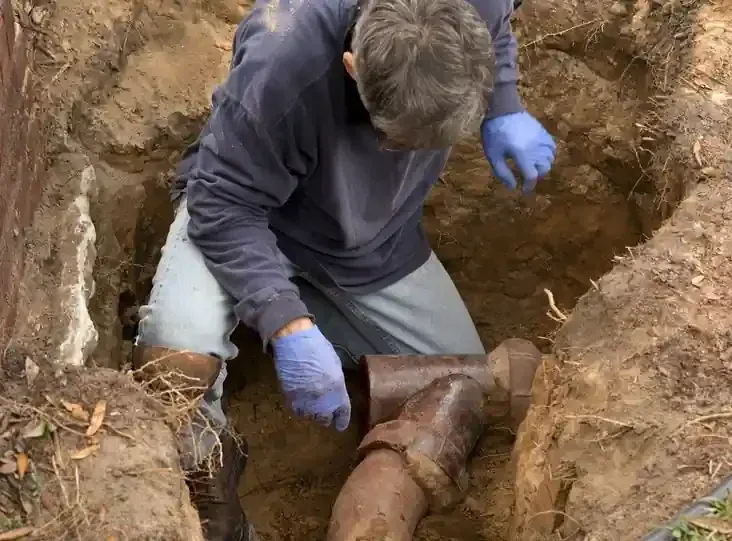
- Acoustic & Camera Line Tracing: We insert a 512 Hz transmitting sonde camera through the basement cleanout to map the exact trajectory, depth, and branch connections of the sub-slab drain piping.
- Concrete Slab Sawcutting: Using an electric diamond-blade wet saw with HEPA slurry vacuuming, we cut a clean 30-inch by 48-inch rectangle in the basement concrete floor, isolating the slab from the home’s structural perimeter footings.
- Trench Evacuation & Bedding: We hand-excavate native clay down to the sub-base, supporting the existing pipe with crushed stone.
- Precision Pipe Sectioning: We cut out a measured section of the building drain using heavy-duty ratcheting pipe cutters or cast iron snap cutters, deburring and beveling every pipe edge to an exact 15-degree taper.
- Valve Integration: We install the full-port backwater valve using heavy-duty, shielded, four-band stainless steel transition couplings (such as Fernco Proflex or Mission couplings) torqued precisely to 60 inch-pounds. Rigid shielded bands are mandatory—they prevent pipe shear if sub-slab soils shift.
- Access Sleeve Extension: A vertical 6-inch or 8-inch PVC sleeve is extended from the threaded valve inspection collar up through the finished concrete floor, capped with a flush-mount brass or stainless steel cleanout lid.
Method 2: Exterior Yard Installation (Oatey Clean Check System)
When basement slabs are heavily finished with high-end tile, radiant heating tubes, or inaccessible structural obstructions, we install an exterior double-flapper backwater system in the front yard.
The system features a deep vertical riser that extends from the deeply buried sewer lateral (typically 5 to 7 feet deep in Colorado to sit below our 36-to-48-inch frost line) directly up to grade.
Inside this riser lives a removable carriage assembly holding the flapper gate and sealing gaskets. Using a lightweight tee-handle extraction pole, a technician or homeowner can pull the entire flapper carriage up to ground level in thirty seconds, wash it off with a garden hose, inspect the neoprene seals, and slide it back down into the locking seat—all without ever entering the basement or swinging a hammer.
7. The Fatal Traps: Why Backwater Valves Fail When Neglected
A backwater valve is not a “set it and forget it” pipe fitting. It is an active mechanical device operating in one of the most hostile, corrosive environments imaginable: raw residential sewage.
If you ignore your valve for three years, don’t be surprised when it fails during a 100-year storm. Here are the four primary failure modes we discover on emergency calls:
Trap 1: The “Flushable” Wipe Scourge
Let’s be blunt: there is no such thing as a flushable wipe. Wipes do not dissolve in water like wood-pulp toilet paper. They are synthetic non-woven polyester cloths. When they pass through a backwater valve, the fibers catch on the hinge pin or snag along the perimeter of the flapper seat. When the municipal sewer backs up, that trapped wipe acts as a wedge, holding the flapper open 1/2 inch. Pressurized sewage sprays right past the unsealed gate.
Trap 2: Solidified Fat, Oil, and Grease (FOG)
Warm cooking grease poured down a kitchen sink liquefies momentarily, travels through your pipes, and rapidly cools as it hits underground lateral temperatures (around 45°F to 50°F in Colorado subsoils). It hardens into a waxy, concrete-like scale. If grease coats the buoyancy float chamber, the float loses its lifting capability. When sewage reverses, the heavy, grease-caked float stays sunken, and the flapper fails to swing shut.
Trap 3: Calcification and Struvite Encrustation
Broomfield municipal water is moderately hard, carrying dissolved calcium and magnesium carbonates. Combined with ammonia, phosphates, and urine salts, sewer piping frequently develops rock-hard mineral deposits called struvite. If struvite crystals precipitate along the machined sealing lip of your valve seat, the flapper cannot form an airtight seal.
Trap 4: Sump Pump Discharge Cross-Connections
Here is a severe plumbing violation we see constantly: homeowners or amateur contractors who tie their basement sump pump discharge line directly into their sanitary sewer drain upstream of a backwater valve.
During a severe rainstorm, the backwater valve slams shut to block street flooding. At the exact same time, your sump pump triggers to clear foundation water. It pumps 40 gallons of groundwater a minute straight into your closed sewer drain! With nowhere to go, your sump pump floods your own basement from the inside out. Sump pumps must always discharge to the exterior daylight grade—never into sanitary sewer lines.
8. Semi-Annual Maintenance Protocol: The 6-Step Checklist
To maintain absolute reliability, every Front Range homeowner with a backwater valve should execute this straightforward maintenance protocol twice a year (we recommend doing it once in the spring before thunderstorm season and once in late autumn before the winter deep freeze):
The Veteran Plumber’s 6-Step Inspection Routine
- Isolate Water Fixtures: Warn everyone in the household to refrain from running showers, laundry, or flushing toilets while the valve is open for inspection.
- Unthread the Inspection Collar: Slowly unscrew the cleanout plug on top of the access sleeve. If you detect pressure or foul bubbling, stop immediately; the lateral may already be partially surcharged.
- Visual & Mirror Inspection: Shine a high-lumen inspection flashlight down the chamber. Inspect the valve body for standing water, toilet paper debris, or grease deposits.
- Manual Flapper Articulation: Using a gloved hand or a cleanout retrieval hook, manually swing the flapper open and closed. It should move effortlessly with zero mechanical friction or binding.
- Seat & Seal Cleaning: Use a long-handled nylon brush and a spray bottle of warm water and biodegradable degreaser to scrub the perimeter of the rubber gasket and the machined seat. Wash away any trapped grit or struvite crust.
- Seal Reassembly & Thread Lubrication: Apply a light film of non-petroleum silicone grease to the threaded access cap’s neoprene O-ring before threading it back in. Tighten it hand-tight plus a 1/4-turn with channel locks. Never overtighten PVC threads, which can split the housing collar.
9. Comprehensive Technical Comparison: Backwater Valves vs. Other Defense Systems
How does a main sewer backwater valve compare to secondary containment strategies like sewer cleanout poppers, overhead sewers, and sewage ejector sump pits?
| System Type | Average Cost Range | Primary Protective Function | Power Needed? | Key Limitations |
|---|---|---|---|---|
| Mainline Backwater Valve | $1,800 – $3,800 | Full positive-seal mechanical flapper barrier against municipal sewer backflow. | No (100% Passive) | Requires semi-annual debris cleaning; restricts upstairs drainage if closed. |
| Overhead Sewer Conversion | $8,500 – $16,000 | Raises all basement drainage to an elevated ceiling pipe, discharging via pump. | Yes (Ejector Pump) | Extremely expensive retrofit; requires concrete breaking across entire floor. |
| Exterior Relief Cleanout (Popper Cap) | $350 – $750 | Spring-loaded cap in the lawn that pops open during surcharge, flooding yard instead of basement. | No (100% Passive) | Only works if yard grade sits lower than basement floor; leaves raw sewage in lawn. |
| Sub-Slab Sewage Ejector Pit | $3,200 – $5,500 | Collects basement bathroom/laundry waste in sealed basin and pumps it up into main stack. | Yes (Submersible Pump) | Pump can burn out during power outages; requires mechanical check valve maintenance. |
10. Insurance Implications: Category 3 Blackwater Coverage in Colorado
Homeowners insurance policies in Colorado do not automatically cover municipal sewer backups.
Standard homeowner policies (HO-3) cover water damage from “sudden and accidental plumbing discharge”—such as a ruptured copper pipe or an exploded water heater tank. However, municipal sewer surcharges entering through drains are universally classified as Category 3 Blackwater Water Ingress. They are excluded from basic policies unless you purchase an explicit Water Backup and Sump Discharge Endorsement (often called an HO-208 rider).
Worse yet, many insurance carriers in Colorado will refuse to issue sewer backup endorsements for homes that sit in known municipal flood zones or low-elevation drainage basins unless you provide proof of a permitted, code-compliant backwater valve installed on the property.
A Category 3 blackwater flood remediation in a finished 1,200-square-foot basement averages $15,000 to $40,000. It requires certified IICRC biohazard mitigation crews, chemical anti-microbial treatments, tearing out all drywall two feet above the water line, removing all porous flooring, and throwing away mechanical appliances.
Spending $2,500 to install an engineered backwater valve is not an expense. It is an insurance policy that pays for itself ten times over during a single 15-minute municipal main surcharge.
Frequently Asked Questions (FAQs)
How do I know if my house already has a sewer backwater valve installed?
Inspect your basement floor slab, utility room, or crawlspace. Look for a round 6-inch or 8-inch threaded cap, or a rectangular plastic or brass access box set flush into the concrete floor, usually located near the foundation wall where your sewer line exits. If you see a raised cleanout with an arrow pointing toward the street stamped “BACKWATER VALVE” or “CLEAN CHECK,” you have one. You can also hire a licensed plumber to run an HD sewer inspection camera down your line; the camera will visibly show the flapper gate and housing within seconds.
Can I still use my plumbing fixtures while the backwater valve is closed during a storm?
If your backwater valve is installed on your main building drain (protecting the whole house), you must not run heavy water or flush toilets while the valve is closed against municipal pressure. Any water you discharge from sinks, showers, or washing machines will not be able to exit into the street and will back up into your lowest basement floor drain. However, if your valve is installed strictly on a sub-grade basement branch (the code-preferred method), you can freely use all main-level and upper-level bathrooms without any issue.
Does a backwater valve protect my basement from sump pump flooding?
No. A backwater valve protects exclusively against sanitary sewer reverse flow from the street collection system. Groundwater entering your foundation perimeter drainage is handled separately by your sump basin and sump pump. However, both systems work together: your backwater valve keeps municipal sewer sewage out, while your sump pump discharges rising groundwater safely out to exterior grade.
How long does an automatic sewer backwater valve last?
The high-grade PVC or ABS housing of an ASTM-certified backwater valve will easily last 40 to 50 years buried in the ground. However, the moving internal parts—specifically the elastomeric flapper seal, stainless steel hinge pins, and buoyancy foam floats—have a typical operational service life of 7 to 12 years. Periodic cleaning and replacing the internal flapper assembly every decade ensures the system performs flawlessly whenever disaster strikes.
Does the City of Broomfield or the municipal utility pay for damages if their main backs up into my home?
Almost never. Under Colorado governmental immunity statutes and standard municipal utility tariffs, cities and sanitation districts are generally exempt from liability for sewer backups caused by extreme weather, sudden clogs, tree roots, or third-party grease discharges unless a homeowner can prove gross negligence or documented failure to perform scheduled line maintenance. Municipalities view building laterals and backflow protection as the private homeowner’s legal responsibility.