
Outside, an arctic cold front has clamped down on the Colorado Front Range. Snow has piled ten inches deep, and the overnight mercury has plunged to twelve below zero. Inside your warm Broomfield home, something is deeply wrong. You flush the upstairs master toilet, and downstairs in the powder room, the sink makes a violent, hollow glug-glug-glug sucking sound. Five minutes later, a pungent, nauseating odor of rotten eggs and raw sewage drifts into your hallway and bedrooms.
You run water in all the sinks. You pour bleach down the shower drain. But every time someone flushes or drains a bathtub, the gurgling returns, and the sewer stench grows stronger.
Your drains aren’t clogged with hair or paper. Your main sewer line isn’t backed up.
The issue is sitting thirty feet above your head on your snow-covered roof. Your primary plumbing vent stack has frozen solid into an airtight plug of solid rime ice.
In high-altitude Colorado winters, **vent stack frost capping** is one of the most common, yet least understood, winter plumbing emergencies. When your plumbing vents freeze shut, your entire drainage system loses its ability to breathe. Drainage flow turns into a hydraulic vacuum pump, siphoning the protective water seal right out of your fixture P-traps and opening a direct highway for toxic sewer gases into your living space.
Let’s examine the thermodynamic physics of vent pipe ice damming, review International Plumbing Code (IPC) frost closure rules, expose dangerous DIY thawing myths, and explain the permanent, engineered solutions master plumbers install to bulletproof your roof vents against sub-zero freezes.

1. The Thermodynamics of Vent Frost Closure: How Warm Drain Air Freezes Pipes
To understand how an open roof pipe freezes shut, you have to realize that plumbing vents do not carry dry outdoor air. They vent the Drain-Waste-Vent (DWV) piping system.
Inside your drain lines, thousands of gallons of warm water pass daily from dishwashers, hot showers, and laundry cycles. The air inside your drainage stacks is warm (typically 65°F to 75°F) and completely saturated with moisture—maintaining a relative humidity near 100%.
The Stack Effect & Sublimation Thermodynamics
Warm, humid air is lighter than cold air. By natural stack effect (buoyancy-driven convection), this warm, moisture-laden air continuously rises through your vertical plumbing stacks toward the roof.
Then it reaches the roof penetration:
| Zone | Temperature | Relative Humidity | Thermal Dynamics |
|---|---|---|---|
| Inside Drain Stack | 68°F (20°C) | 95% – 100% RH | Warm vapor rising via natural buoyancy |
| Roof Ambient Air | -10°F (-23.3°C) | Dry Arctic Air | Extreme thermal heat sink |
| Vent Pipe Rim (Penetration) | Below 0°F | Condensation Zone | Instant desublimation of moisture into solid ice |
When warm, saturated vapor contacts the sub-zero interior rim of the PVC or cast-iron pipe extending above the roofline, the water vapor skips the liquid phase entirely or instantly freezes upon condensation.
This process is known as hoarfrost deposition.
Layer upon layer of crystalline rime ice builds along the inner circumference of the pipe. On a standard 2-inch vent pipe, hoarfrost will choke the opening down to a pencil-sized hole in twelve hours. By forty-eight hours of sustained sub-zero temperatures, the vent is capped with a rock-solid dome of ice.
2. The Hydraulic Consequence: Trap Siphonage & Toxic Sewer Gas Infiltration
Why does a frozen roof vent make your bathroom smell like raw sewage?
Every plumbing fixture in your home—toilets, sinks, bathtubs, floor drains—is protected by a curved pipe fitting called a **P-trap**. The P-trap holds a shallow column of standing water (typically 2 to 4 inches of water seal governed by IPC Section 1002.4).

This water seal is your home’s only defense against toxic gases produced inside municipal sewer mains:
- Hydrogen Sulfide ($H_2S$): Highly toxic gas that smells like rotten eggs; causes headaches, nausea, eye irritation, and respiratory paralysis at elevated concentrations.
- Methane ($CH_4$): Colorless, odorless, highly flammable gas that poses severe asphyxiation and explosive fire hazards.
- Volatile Organic Compounds (VOCs) & Sewer Pathogens: Airborne bacterial vectors that spread illness.
The Piston Effect (Sucking Traps Bone Dry)
When your roof vent is open, air flows freely down the pipe to equalize pressure whenever large slugs of water rush down the drain. Think of taking a straw full of liquid: if you lift your thumb off the top, the liquid pours out smoothly.
When the roof vent freezes solid, it’s like putting your thumb over the straw.
When an upstairs toilet flushes, 1.6 gallons of water drops down the vertical drain stack like a solid hydraulic piston. Behind that falling water, a powerful negative vacuum is created ($P_{\text{pipe}} < P_{\text{atmosphere}}$).
Because the roof vent cannot supply air, the vacuum desperately pulls air from wherever it can find it. It reaches backward through the nearest bathroom sink or shower drain and literally sucks the standing water out of the P-trap with a loud gurgle.
With the trap sucked bone dry, the hydraulic seal is broken. The vent stack functions as a chimney in reverse, dumping raw, concentrated sewer gases directly into your master bathroom.
3. Building Codes: IPC Section 904.2 & Front Range Frost Closure Mandates
The authors of the International Plumbing Code (IPC) and Uniform Plumbing Code (UPC) are well aware of sub-zero ice damming. That is why strict regional frost closure mandates exist:
📜 IPC Section 904.2 (Frost Closure Regulations)
“Where the 97.5-percent value for outside design temperature is 0°F (-18°C) or less, vent extensions through a roof shall be increased one pipe size, but not less than 3 inches in diameter. Any increase in the size of the vent shall be made at least 1 foot inside the thermal envelope of the building prior to penetrating through the roof.”
Why Builders Cut Corners (The 2-Inch Violation)
In many subdivisions across Broomfield, Thornton, and Adams County built during high-speed housing booms, non-union subcontractors took shortcuts.
Instead of transitioning to a 3-inch or 4-inch pipe inside the warm attic before penetrating the roof, they ran a small 1.5-inch or 2-inch PVC pipe straight through the shingles!
A 2-inch pipe has a cross-sectional area of just 3.14 square inches:
$$A_{2\text{-inch}} = \pi r^2 = 3.1416 \times (1.0)^2 = 3.14\text{ sq. in.}$$
$$A_{4\text{-inch}} = \pi r^2 = 3.1416 \times (2.0)^2 = 12.57\text{ sq. in.}$$
A 4-inch pipe provides four times more cross-sectional area than a 2-inch pipe! While a 2-inch pipe freezes solid in a 48-hour cold snap, a properly enlarged 4-inch pipe allows frost to coat the walls while maintaining a wide, unobstructed central airflow channel throughout the harshest Colorado blizzard.
4. Lethal DIY Mistakes: How Homeowners Damage Roofs and Trigger Explosions
When sewer gas fills a home during a winter freeze, panicked homeowners often attempt terrifyingly dangerous DIY fixes:
| Dangerous DIY Method | Hidden Hazard & Physical Consequence | Master Plumber Verdict |
|---|---|---|
| Pouring Rock Salt down vent | Salt creates corrosive brine that chemically pits and destroys cast iron stacks, copper DWV, and municipal metal joints. | DESTRUCTIVE |
| Climbing snowy roof with hot water | Extreme slip-and-fall hazard on 8/12 pitch icy roofs; boiling water creates thermal shock that shatters frozen PVC fittings. | LETHAL RISK |
| Propane Blowtorch on roof pipe | Open flames ignite methane gas pockets inside vents, triggering flash fires; melts PVC and ignites roof decking. | EXPLOSION HAZARD |
| Bashing ice with a steel crowbar | Shatters brittle sub-zero PVC pipe collars beneath the flashing, creating massive attic roof leaks during the spring thaw. | HIGH DAMAGE |
5. Professional Emergency Thawing & Permanent Engineering Solutions
When our emergency master plumbers respond to a frozen vent stack call in Broomfield, we don’t risk lives on icy roofs with open torches. We utilize controlled thermodynamic procedures:
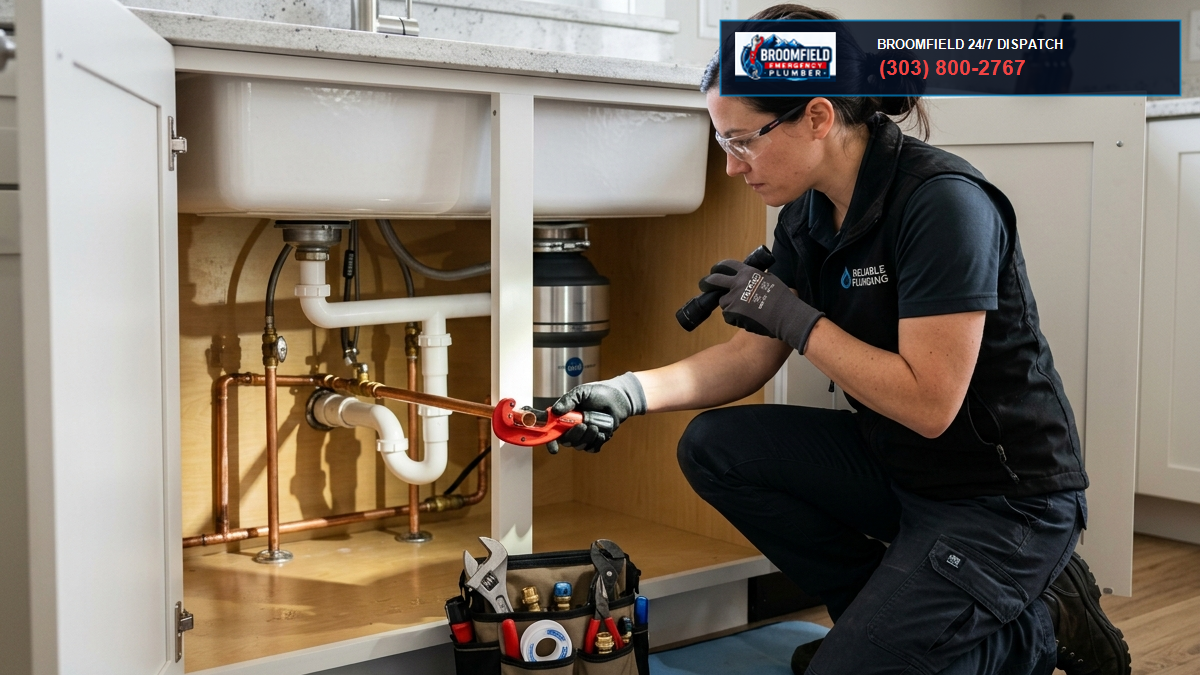
Emergency Thawing: Low-Pressure Hot-Water Wand
From an interior attic access point or via safety harness roof tie-off, technicians insert a flexible non-metallic hose equipped with a forward-facing 360-degree radial hot-water jet. Delivering controlled 140°F water directly against the core of the ice plug melts the frost blockage in minutes without subjecting sub-zero plastic to thermal fracture.
Permanent Solution 1: Attic Vent Enlargement to 4-Inch
We access the unconditioned attic space at least eighteen inches below the roofline. We cut the undersized 2-inch DWV pipe, install an eccentric PVC increaser fitting, and transition the pipe to a heavy-gauge 4-inch schedule 40 PVC stack before it penetrates the roof decking.
Permanent Solution 2: Self-Regulating Low-Wattage Heat Trace
For homes with flat roofs or architectural roof valleys prone to massive snow drifts, we install commercial-grade, self-regulating 120V heat trace cables (rated at 6 to 8 watts per foot). The cable drops 24 inches down inside the vent stack throat and wraps around the exterior flashing, automatically sensing temperature drops and maintaining the pipe rim at a frost-free 45°F.
Permanent Solution 3: Insulated Roof Vent Flashings
We replace standard sheet-metal roof flashings with double-walled insulated neoprene or molded polyurethane vent collars. The thermal insulation prevents the freezing ambient temperature of the roof plywood from conducting directly into the plastic pipe wall.
Plumbing Vent Stack FAQs
How can I temporarily stop sewer odors while waiting for a plumber?
If your P-traps are getting sucked dry, immediately run one quart of water down every sink, shower, and floor drain in the house to re-establish the protective hydraulic trap seal. To prevent the water from evaporating or siphoning again immediately, you can pour two tablespoons of mineral oil or vegetable oil into rarely used drains; the oil forms a floating barrier that slows evaporation. Keep bathroom exhaust fans running to pull sewer air outside.
Will a frozen vent stack fix itself when the weather warms up?
Yes, once ambient outdoor temperatures rise well above freezing (typically 35°F to 40°F with direct Colorado sunshine), the ice plug will eventually melt and drain down the stack. However, waiting for the weather to warm up leaves your family exposed to toxic hydrogen sulfide and explosive methane gas for days. Furthermore, recurrent ice damming can split vent fittings inside your unheated attic, causing hidden water leaks when snow melts.
Can I put an Air Admittance Valve (AAV / Magic Vent) on the roof?
No. Air Admittance Valves (such as Studor Vents) are strictly prohibited outdoors or on unconditioned roofs under IPC Section 918.8. The delicate internal silicone diaphragms inside AAVs freeze rigid and fail instantly in sub-freezing temperatures. AAVs are engineered solely for indoor, temperature-conditioned applications (such as kitchen island sinks).
How far above the roof should a plumbing vent extend in Colorado?
Under local Colorado Front Range building codes and IPC Section 904.1, plumbing vent pipes must extend at least 12 inches (and often 18 to 24 inches in designated high-snow zones) above the roof surface, measured from the high side of the pipe penetration. Extending the vent too high (e.g., 36 inches uninsulated) actually accelerates frost capping because cold winter wind robs heat from the exposed pipe walls before vapor can escape.