
Table of Contents: Outdoor Spigot Freeze Rupture & Frost-Proof Sillcock Engineering Guide
- 1. Executive Summary: The Hidden Danger of Colorado Winter Hose Bibb Freezes
- 2. Mechanical Anatomy & Fluid Mechanics of Frost-Proof Sillcocks (Woodford Model 17/19)
- 3. The Garden Hose Trap: The Physics of Hydraulic Confinement & Vacuum Breaker Lock
- 4. Structural Failure Mechanics: Ice Crystallization Expansion, Hydraulic Pressure Spike & Copper Splitting
- 5. Hidden Leak Diagnostics: The Spring Thaw Catastrophe & Concealed Rim Joist Flooding
- 6. Step-by-Step Master Plumber Sillcock Replacement & Retrofit Protocol
- 7. Comprehensive Outdoor Hydrant & Spigot Comparison Matrix
- 8. Colorado Front Range Submarket Profiles: Frost Depths, Chinook Winds & Elevation Nuances
- 9. Financial Cost-Benefit Analysis: $280 Winterization / Repair vs. $22,000 Finished Basement Flood
- 10. Comprehensive Extended FAQ Section (12 Detailed Engineering Questions)
- 11. 24/7 Emergency Frozen Pipe & Outdoor Spigot Dispatch
1. Executive Summary: The Hidden Danger of Colorado Winter Hose Bibb Freezes
Every autumn and winter across the Colorado Front Range, thousands of homeowners fall victim to one of the most deceptive, financially devastating plumbing failures in modern residential construction: the ruptured outdoor hose spigot. In communities like Broomfield, Westminster, Thornton, Arvada, and Boulder County, winter temperatures routinely plunge below zero degrees Fahrenheit (-18°C), accompanied by ferocious Arctic gusts sweeping down from the Continental Divide. While homeowners diligently set their indoor thermostats and insulate exposed garage pipes, an insidious physical process takes place inside exterior building envelopes.
Most modern residential homes constructed after 1980 feature what builders market as “frost-proof” or “freeze-less” sillcocks. This terminology creates a dangerously false sense of security. Homeowners assume that because the fixture is labeled “frost-proof,” it is immune to sub-freezing Colorado temperatures regardless of how it is operated. In reality, a frost-proof spigot is only frost-proof when operated under strict thermodynamic conditions. The single most common homeowner oversight—leaving a standard garden hose, quick-connect fitting, or brass splitter attached to the spigot during the first hard freeze—instantly bypasses the engineered drainage mechanism, converting the brass fixture into a hydraulic ticking time bomb.
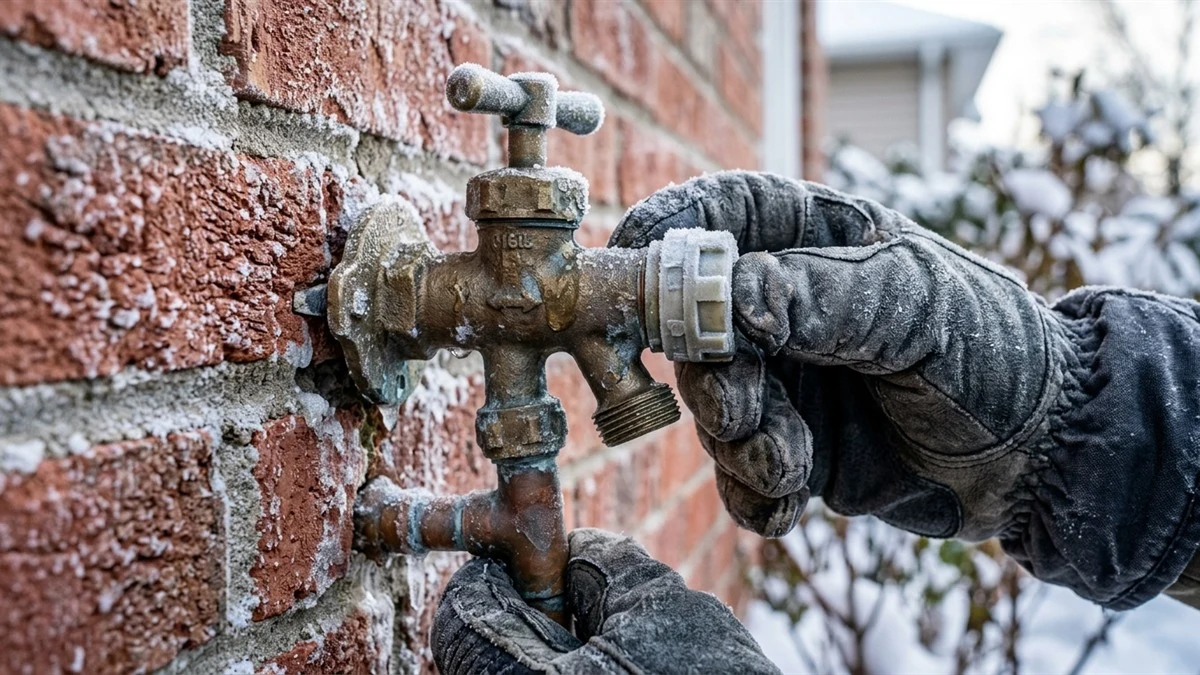
Even more catastrophic is the delayed nature of the damage. When an exterior sillcock bursts during an Arctic freeze in December or January, the rupture occurs inside the exterior wall cavity, behind the siding, foam insulation, and structural rim joist. Because the shutoff seat remains closed within the heated perimeter of the basement, not a single drop of water leaks during the dead of winter! The homeowner remains completely oblivious to the fact that the copper tube inside their wall is split wide open.
It is not until the first warm spring afternoon in April or May—when the homeowner heads outside, attaches a spray nozzle, and turns on the faucet to wash the car or water the lawn—that the disaster manifests. Opening the valve releases full municipal line pressure (60 to 90 PSI) directly into the cracked copper tube behind the finished basement drywall. Hundreds of gallons of pressurized water cascade down interior framing, saturating fiberglass batt insulation, ruining hardwood floors, destroying finished basement drywall, and sparking dangerous black mold colonies. This engineering guide provides the definitive analysis of sillcock fluid dynamics, ice expansion physics, code-compliant replacement protocols, and winter mitigation strategies across Broomfield and Denver Metro.
In Colorado’s semi-arid high-altitude climate, sudden temperature drops of 40°F to 50°F within a single 6-hour window are common during polar cold fronts. When temperatures drop from a sunny 65°F afternoon to a bone-chilling 12°F overnight, water residing in exterior building penetrations freezes with rapid crystalline velocity. Without an air path to relieve volumetric growth, copper and brass components cannot withstand the kinetic loads generated during phase changes. Understanding the true fluid dynamics of exterior water supplies is the only dependable barrier against multi-thousand-dollar structural restoration bills.
2. Mechanical Anatomy & Fluid Mechanics of Frost-Proof Sillcocks (Woodford Model 17/19)
To understand why frost-proof sillcocks fail, one must examine their mechanical architecture. Standard utility hose bibbs feature a valve seat located directly beneath the external handle, placing water mere millimeters from outdoor freezing air. In contrast, a certified frost-proof sillcock (such as the industry-standard Woodford Model 17 or Model 19) is engineered to relocate the physical valve seat deep inside the heated thermal envelope of the structure.
The Extended Operating Stem & Internal Valve Seat
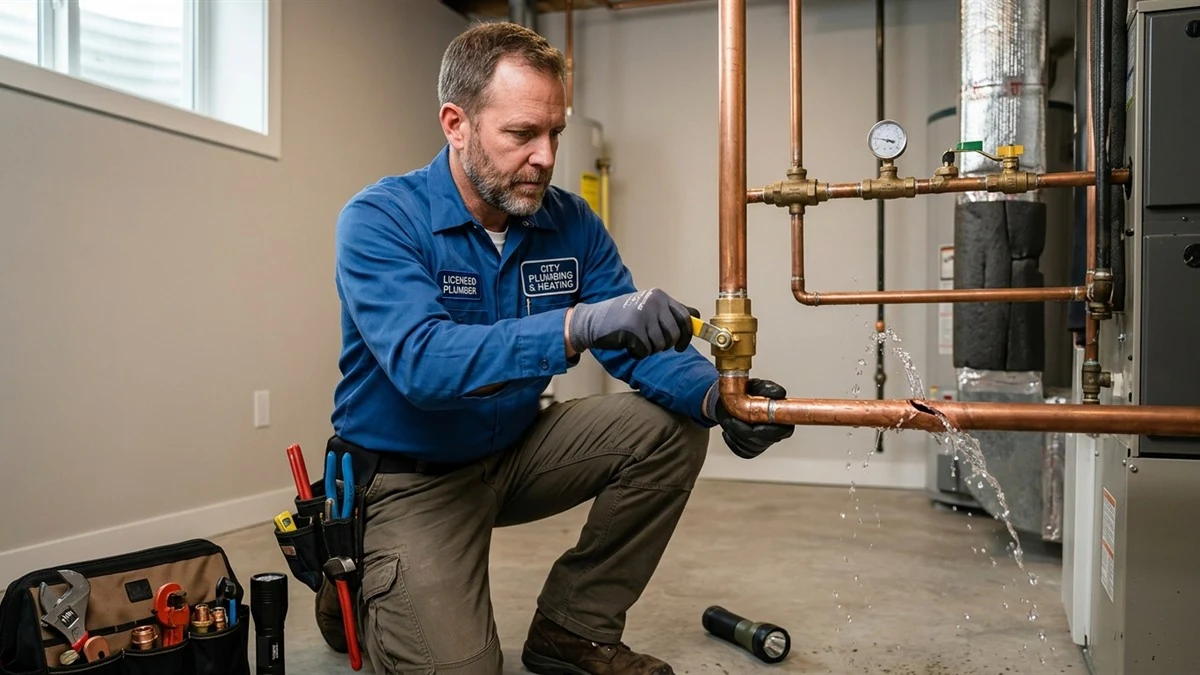
A frost-proof sillcock consists of a long, heavy-gauge copper or brass barrel measuring 4, 6, 8, 10, 12, or even 14 inches in overall length. When properly installed through an exterior wall, the threaded or soldered connection and the internal valve seat reside entirely within the home’s conditioned interior space—typically the basement floor joist cavity or mechanical utility room.
The external handle does not connect directly to the rubber washer. Instead, it turns an elongated operating stem made of solid brass or stainless steel that traverses the entire length of the barrel. At the far interior end of this rod sits a machined brass check plunger fitted with a resilient EPDM rubber bevel washer. When the homeowner turns the external handle clockwise to shut off the spigot, the stem drives the washer against the valve seat located 8 to 12 inches deep inside the warm house. Consequently, all static municipal water pressure is halted on the warm side of the wall!
Gravity Drainage & Downward Pitch Mechanics
The entire operational safety of a frost-proof sillcock hinges on gravity-fed automatic drain-down. When the valve is closed, the water remaining inside the long barrel between the valve seat and the outdoor spout must drain out completely. For this drain-down to occur, International Residential Code (IRC Section P2903.10) mandates that the sillcock must be installed with a continuous downward pitch toward the exterior:
If the sillcock is installed level, or worse, back-pitched toward the interior of the house, water cannot escape. It remains pooled inside the copper barrel, directly exposing the metal to exterior temperatures. Over several cold nights, this standing pool freezes into an icy dam, anchoring itself to the metal sidewalls and preventing subsequent drainage.
Atmospheric Vacuum Breakers (Anti-Siphon Backflow Prevention)
Under IRC and UPC plumbing regulations, all outdoor sillcocks must include an integrated atmospheric vacuum breaker (AVB) or backflow preventer. Positioned on top of the spout, this component contains a light plastic float and rubber diaphragm. When water flows forward, hydraulic pressure pushes the float up to seal the air vents. When the faucet is shut off, the float drops, opening the chamber to atmospheric pressure to break any siphonage that could draw contaminated lawn fertilizers or pesticides into the home’s drinking supply. Furthermore, this atmospheric air entry is vital to allow water in the barrel to drain freely without being held in place by a vacuum lock.
3. The Garden Hose Trap: The Physics of Hydraulic Confinement & Vacuum Breaker Lock
Despite the ingenious engineering of frost-proof hydrants, one simple homeowner habit causes over 90% of all winter sillcock failures: leaving a garden hose attached during sub-freezing weather.
When a hose, brass quick-connect coupling, multi-port splitter, or pistol-grip spray nozzle remains attached to the exterior spout, physics defeats the frost-proof design:
- Capillary Water Retention: A garden hose filled with water creates continuous surface tension and hydraulic head pressure at the spout. Atmospheric air cannot enter through the vacuum breaker because the water column inside the hose blocks air entry.
- Loss of Gravity Drainage: Because air cannot enter to break the vacuum, water remains completely trapped inside the 8-to-12-inch copper barrel between the outdoor spout and the internal valve seat.
- The Double-Ended Hydraulic Seal: The closed internal valve seat seals the back end of the barrel. The closed spray nozzle or frozen water column inside the garden hose seals the front end. The copper tube is now a 100% sealed, water-filled pressure vessel spanning the exact temperature gradient between indoor warmth and sub-zero Arctic freeze.
- Thermal Bridging Along the Metal Stem: Solid brass and copper possess exceptionally high thermal conductivity ($k \approx 400 \text{ W/m}\cdot\text{K}$). The solid brass operating rod running through the center of the sillcock acts as a thermal superhighway, rapidly conducting sub-zero exterior temperatures directly into the interior core of the fixture and accelerating the freeze timeline by hours.
4. Structural Failure Mechanics: Ice Crystallization Expansion, Hydraulic Pressure Spike & Copper Splitting
A widespread misconception among homeowners is that freezing water bursts pipes because the expanding ice physically cuts or grinds through the metal. As mechanical forensic engineers know, the actual rupture mechanism is far more violent and purely hydraulic.
Phase Change Volumetric Expansion
When liquid water cools below 39.2°F (4°C), it reaches its maximum thermal density. As it transitions into solid crystalline ice at 32°F (0°C), its molecular lattice reorganizes into a hexagonal open crystalline structure. This physical phase change forces the water to expand by exactly 9.05% in total volume:
Directional Ice Propagation & Trapped Hydraulic Pressure
Freezing does not occur instantaneously throughout the sillcock. It begins at the outdoor spout, where exposure to frigid ambient air is greatest. An ice plug forms at the exterior faucet mouth, completely sealing the exit. As the freezing front migrates inward through the wall cavity, another ice plug forms near the exterior wall penetration.
Now, a pocket of unfrozen liquid water is trapped inside the copper barrel between the advancing exterior ice front and the closed brass valve seat on the warm interior side. Because liquid water is nearly incompressible, the expanding ice acts like a hydraulic ram, compressing the trapped liquid water against the closed valve:
Circumferential Hoop Stress & Copper Rupture
Residential Type L and Type M copper tubing has an engineered ultimate tensile burst strength of approximately 1,800 to 2,200 PSI. When trapped hydraulic pressure between the ice plug and the valve seat exceeds 4,000 PSI, the circumferential hoop stress ($\sigma_\theta = \frac{P \cdot r}{t}$) vastly exceeds the tensile yield strength of the copper wall.
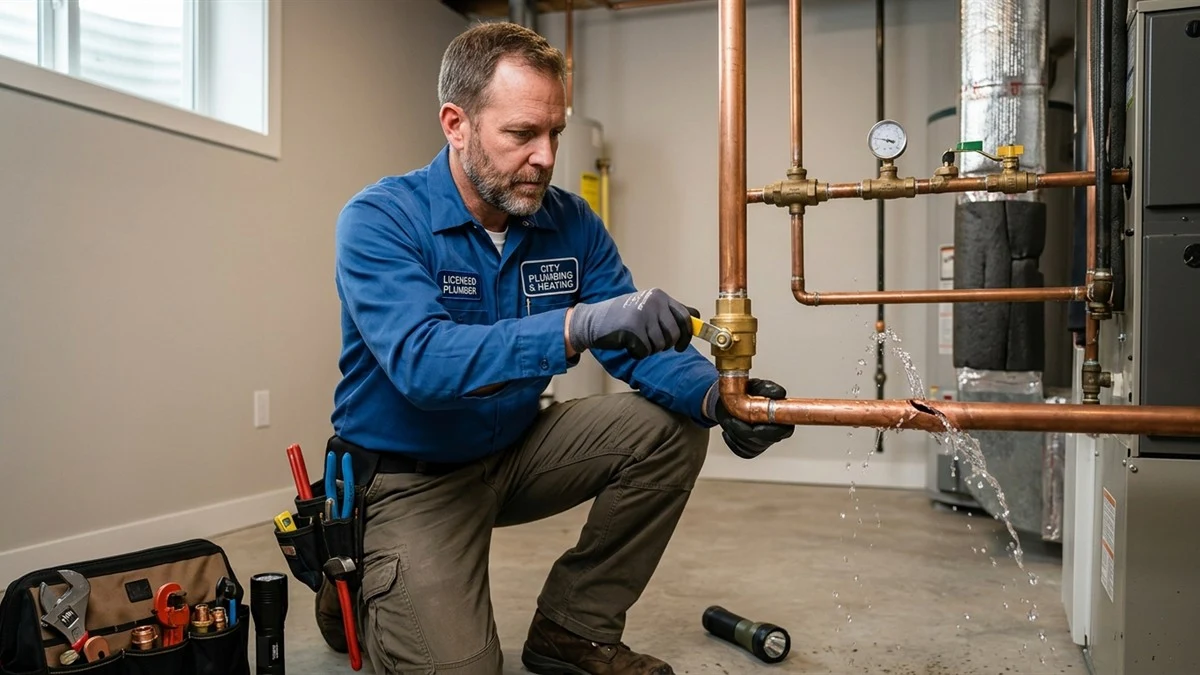
The copper barrel bulges outward like a snake swallowing an egg, yields, and tears open in a clean, razor-sharp longitudinal seam 1 to 3 inches long. In many cases, the internal brass operating rod also deforms or the brass check valve housing cracks. Because this entire zone sits inside the building insulation or floor joist space, the structural rupture is completely hidden from view.
Forensic examination of burst sillcock barrels reveals distinct metallurgic thinning along the tear boundaries, demonstrating that the failure occurred under catastrophic plastic deformation from intense hydrostatic pressure rather than slow abrasion. The copper literally stretches beyond its elastic limit until the atomic lattice shears apart.
5. Hidden Leak Diagnostics: The Spring Thaw Catastrophe & Concealed Rim Joist Flooding
Because the rupture occurs behind the valve seat, no water leaks while the spigot remains turned off. The internal shutoff washer continues to hold municipal line pressure safely back in the warm interior piping. The damage only triggers when the faucet is operated in spring:

Symptom 1: Severe Loss of Outdoor Water Pressure
When the homeowner opens the faucet handle, water begins flowing out of the hose nozzle, but the stream is noticeably weak, sputtering, and lacks normal 60+ PSI force. This occurs because the split copper barrel offers a path of lower hydraulic resistance. A significant percentage of the water volume is dumping directly inside the wall framing rather than traveling to the hose!
Symptom 2: Hissing Sounds Inside the Basement Wall
When someone is outside spraying water, an observer inside the basement or mechanical room will hear a loud rushing, hissing sound of pressurized water escaping behind the drywall or fiberglass ceiling insulation. As soon as the outdoor handle is shut off, the hissing abruptly ceases.
Symptom 3: Water Pooling on Finished Basement Floors & Foundation Walls
Water flowing through the split barrel cascades down the concrete foundation stem wall, saturates the sill plate, and spreads across basement subfloors. In finished basements, water wicks up through drywall panels, warps luxury vinyl tile (LVT) or engineered hardwood, and saturates carpets before anyone realizes the outdoor spigot was the source.

Symptom 4: Structural Mold & Musty Basement Odors
In cases where the spigot is used only occasionally for brief lawn watering sessions, the leak may not immediately puddle on the floor. Instead, water repeatedly soaks fiberglass batt insulation and OSB rim joists. Within 48 to 72 hours under warm spring conditions, toxic black mold (Stachybotrys chartarum) begins colonizing damp organic wood fibers, emitting pungent earthy odors into the basement living environment.
6. Step-by-Step Master Plumber Sillcock Replacement & Retrofit Protocol
Replacing a freeze-ruptured sillcock requires precision plumbing techniques to guarantee code compliance and prevent recurrence:
- Main Supply Isolation & Depressurization:
Shut off the home’s main water supply valve and open indoor faucets to completely drain system pressure. If the outdoor spigot is equipped with a dedicated interior isolation ball valve with a bleeder drain, close that valve.
- Access & Interior Demolition:
Locate the sillcock barrel entry point inside the basement, crawl space, or ceiling joist cavity. In finished spaces, carefully cut a precise 6×6-inch drywall inspection opening or use a spring-loaded access panel location to expose the interior plumbing connection.
- Extracting the Damaged Fixture:
Unthread the interior adapter or cut the copper/PEX connection with an orbital tubing cutter. On the exterior of the house, remove the two structural mounting screws securing the sillcock flange to the masonry or siding. Pull the entire 8-to-12-inch ruptured assembly outward through the exterior wall.
- Sizing the Replacement Fixture:
Measure the wall thickness from the exterior siding face to the interior heated air space. Select a commercial-grade, anti-siphon frost-proof sillcock (such as the Woodford Model 19 Freezeless Anti-Burst Hydrant) with sufficient barrel length (typically 10 to 12 inches) so that the valve seat sits at least 2 to 4 inches inside the conditioned thermal envelope.
- Pitched Wall Penetration & Flange Angling:
Inspect the wall penetration hole. If necessary, ream the opening using a heavy-duty rotary hammer or spade bit to guarantee a downward pitch toward the exterior of at least 1/4 inch per foot. Use an angled sillcock wedge or beveled trim spacer on lap siding so the mounting flange sits flush while forcing the downward drainage angle.
- Transition to Freeze-Resilient PEX-a (Uponor ProPEX):
Connect the interior end of the sillcock to the domestic water supply using PEX-a (cross-linked polyethylene) with cold-expansion fittings (ASTM F1960). Unlike rigid copper, PEX-a can expand up to 300% of its diameter without rupturing, providing an essential secondary buffer against unexpected freezing events.
- Interior Dedicated Ball Valve with Bleeder Installation:
Install a full-port brass isolation ball valve with a knurled brass bleeder drain port upstream of the sillcock. This allows the homeowner to completely isolate and drain the exterior line before winter arrives.
- Exterior Sealing & Hydrostatic Commissioning:
Secure the external flange with heavy-gauge stainless steel wood screws or masonry Tapcons. Seal the perimeter flange with premium polyurethane elastomeric sealant (such as Sikaflex-1a) to prevent cold air and rain infiltration into the wall cavity. Repressurize the system, verify zero leakage under static pressure, and perform flow and vacuum breaker tests.
- Thermal Enclosure & Rim Joist Air Sealing:
Around the interior penetration through the rim joist, inject expanding closed-cell polyurethane foam to eliminate cold air drafts. Never pack unsealed fiberglass batt tightly around the copper barrel, as unsealed fiberglass allows convective air loops that draw sub-zero winter drafts across the metal tube.
7. Comprehensive Outdoor Hydrant & Spigot Comparison Matrix
The technical engineering matrix below contrasts the performance, freeze resilience, and code compliance of common residential outdoor water fixtures:
| Fixture Category | Valve Seat Location | Freeze Vulnerability Level | Anti-Burst Technology | Colorado Code Status |
|---|---|---|---|---|
| Standard Brass Hose Bibb | Exterior (at handle) | EXTREME: Freezes at 31°F within 2 hours. | None. Rigid brass body ruptures instantly. | ILLEGAL for exterior walls in Colorado IRC. |
| Standard Frost-Proof Sillcock (Woodford 17) | Interior (4 to 12 inches deep) | MODERATE: Immune if hose detached; 100% burst risk if hose attached. | Standard gravity drain; no internal expansion relief. | Code-compliant with vacuum breaker. |
| Anti-Burst Frost-Proof Hydrant (Woodford 19 / 22) | Interior (4 to 14 inches deep) | LOW: Patented internal pressure relief disc prevents burst even with hose attached! | EPDM pressure-relief disc vents expanding ice pressure. | Recommended standard for Front Range retrofits. |
| Sanitary Freezeless Yard Hydrant | Sub-grade below frost line (48 to 60 inches underground) | LOW: Drains completely into gravel sump below frost line when shut. | Self-draining bottom drain valve beneath frost depth. | Approved for acreage, barns, and detached landscape areas. |
8. Colorado Front Range Submarket Profiles: Frost Depths, Chinook Winds & Elevation Nuances
Environmental conditions across the northern Denver metropolitan area require tailored winterization strategies:
- City and County of Broomfield (Anthem, Broadlands, Country Vista): Broomfield’s high-elevation plateau (5,420 feet) experiences rapid Arctic temperature plummets. Homes situated on open ridge lines face severe 50+ MPH wind chills that penetrate uninsulated exterior cantilevers, freezing 8-inch sillcocks from the inside out. Upgrading to 12-inch anti-burst hydrants with spray-foam rim joist insulation is critical.
- City of Westminster (Standley Lake, Countryside, Shaw Heights): Older subdivisions in Westminster constructed in the 1970s and 1980s often feature original brass hose bibbs or short 4-inch sillcocks installed without downward pitch. In many split-level and ranch-style homes, sillcocks penetrate cold crawl spaces rather than heated basements, leaving the valve seat exposed to 10°F crawl space air.
- City of Thornton (Grange Creek, Woodglen, Eastlake): Thornton enforces IRC plumbing codes requiring dual-check backflow prevention. Expansive bentonite soils common in Thornton can cause foundation settling, which inadvertently tilts exterior walls outward and reverses the sillcock drainage slope, creating an invisible freeze trap inside the barrel.
- Arvada & West Denver (Leyden Rock, Candelas): Located in the immediate shadow of the Rocky Mountain foothills, northwest Arvada is famous for extreme Chinook wind cycles. Temperatures can swing from -5°F at 6:00 AM to 55°F by 2:00 PM. This rapid thermal cycling subjects copper sillcocks to intense expansion and contraction cycles, accelerating metal fatigue along solder joints.
- Louisville & Lafayette (Coal Creek, Indian Peaks): Following historic wildfires and subsequent building code updates, rebuilding standards in Louisville emphasize high-efficiency exterior continuous insulation. Sillcocks penetrating 2-inch exterior rigid foam boards require specialized 12-to-14-inch extended barrels to reach heated interior framing.
9. Financial Cost-Benefit Analysis: $280 Winterization / Repair vs. $22,000 Finished Basement Flood
Proactive winterization and timely frost-proof upgrades represent an exceptional return on investment when compared to the devastating costs of interior water remediation:
| Service / Disaster Scenario | Estimated Out-of-Pocket Cost | Property Impact & Structural Reality | Financial Protection Factor |
|---|---|---|---|
| Professional Frost-Proof Hydrant Upgrade (Woodford 19) | $280 – $480 | Installs anti-burst 12-inch hydrant, proper pitch, PEX-a line, and interior shutoff bleeder valve. | MAXIMUM: Complete permanent freeze protection. |
| Concealed Spring Rim Joist Water Leak (Caught Early) | $2,500 – $6,500 | Emergency plumbing repair, minor drywall cutout, commercial dehumidification, and mold sanitization. | Moderate loss; insurance deductible applies. |
| Catastrophic Finished Basement Flood (Unattended 4 Hours) | $18,000 – $45,000+ | Over 1,500 gallons flood home theater, bedrooms, and custom cabinetry; complete drywall tear-out. | DEVASTATING: Major insurance claim, loss of personal property. |
10. Comprehensive Extended FAQ Section
Q1: Why did my frost-proof outdoor spigot burst when it is supposed to be freeze-proof?
A frost-proof spigot only protects against freezing if water can drain out of its long barrel when shut off. If a garden hose, quick-connect fitting, brass splitter, or spray nozzle is left attached, capillary suction and the vacuum breaker lock trap water inside the copper barrel. When temperatures drop below freezing, this trapped water freezes, spikes internal hydraulic pressure to over 4,000 PSI, and splits the copper pipe wide open inside your wall framing.
Q2: How do I know if my outdoor spigot froze and split during the winter?
Because the valve seat is on the warm inside of your house, a split sillcock will not leak while the handle is closed during winter. You will only discover the rupture in spring when you turn the spigot on. Watch for: (1) weak or sputtering water flow at the hose nozzle; (2) a loud rushing or hissing sound inside your basement wall when the water is running; or (3) water pooling on the floor or dripping from the basement ceiling beneath the spigot.
Q3: When should I disconnect my garden hoses in Colorado?
In the Colorado Front Range (Broomfield, Denver, Westminster, Thornton), all garden hoses must be disconnected, drained, and stored by mid-October or immediately before the first forecasted hard freeze (temperatures dropping below 30°F). Never leave hoses connected overnight between October and April, even during warm mid-winter Chinook spells.
Q4: Do foam outdoor faucet covers actually work?
Foam faucet covers provide a small thermal barrier against outdoor wind chill, but they do not generate heat. On an unheated exterior wall or standard non-frost-proof hose bibb, a foam cover will only delay freezing by a few hours during an Arctic cold snap. On a frost-proof sillcock, a foam cover is helpful extra insurance, but it will not prevent a burst if you leave a garden hose connected.
Q5: What is the proper pitch or slope for installing a frost-proof sillcock?
Under international plumbing codes (IRC P2903.10), a frost-proof sillcock must be installed with a continuous downward pitch toward the outside of at least 1/4 inch per foot. This downward slope ensures that every drop of residual water drains completely out of the barrel by gravity the moment the valve is closed, preventing any standing pool of ice inside.
Q6: What is the difference between a Woodford Model 17 and Model 19 sillcock?
The Woodford Model 17 is a standard, highly reliable frost-proof sillcock that drains by gravity when hoses are disconnected. The Woodford Model 19 is an upgraded anti-burst sillcock equipped with a patented internal pressure-relief disc. Even if a homeowner accidentally forgets to remove a garden hose during a hard freeze, the Model 19’s internal disc relieves excessive hydraulic pressure, preventing the copper barrel from splitting.
Q7: How do I winterize my outdoor spigots if I have an interior shutoff valve?
To winterize a spigot with an interior shutoff valve: (1) Disconnect all exterior hoses; (2) Close the interior isolation ball valve inside the basement; (3) Go outside and open the exterior spigot handle completely to drain residual water; (4) Return to the basement and place a small cup beneath the brass bleeder cap on the side of the interior valve; (5) Unscrew the bleeder cap to drain the remaining water trapped in the wall pipe; (6) Retighten the bleeder cap and leave the exterior spigot handle slightly open for the winter.
Q8: Can I replace an 8-inch sillcock with a 12-inch sillcock?
Yes, and in Colorado, installing a longer sillcock is often strongly recommended. A 12-inch or 14-inch sillcock places the shutoff valve seat deeper into the warm, heated interior floor joist cavity, far away from the cold exterior rim joist, providing superior freeze protection during severe -15°F Arctic vortexes.
Q9: Why is water leaking out of the top plastic cap of my outdoor spigot?
Water leaking from the top cap indicates that the internal atmospheric vacuum breaker (backflow preventer) has worn out, cracked from freezing, or become fouled with mineral sediment. In most major brands like Woodford or Arrowhead, the vacuum breaker components can be rebuilt with an inexpensive repair kit without replacing the entire faucet.
Q10: Why is PEX piping better than copper for outdoor spigot connections?
PEX-a tubing (cross-linked polyethylene) is highly elastic. If water freezes inside a PEX-a line, the material can expand up to 300% of its normal diameter without splitting, then shrink back to size upon thawing. Rigid copper, by contrast, has zero elasticity and splits open longitudinally under 2,000 PSI of freezing hydraulic pressure.
Q11: Can a frost-proof sillcock freeze if my home is heated to 70°F inside?
Yes. If the sillcock is installed without proper pitch, or if cold drafts penetrate unsealed rim joists around the pipe penetration, the metal barrel can drop below 32°F even when the center of the basement is 70°F. Proper exterior silicone sealing and interior thermal batt or spray-foam insulation around the rim joist are essential to prevent localized freeze zones.
Q12: Does homeowner’s insurance cover water damage from a burst outdoor hose spigot?
Most standard homeowner’s insurance policies cover sudden and accidental water damage resulting from burst frozen pipes. However, coverage can be complicated or denied if the insurer determines that the heat was turned off, the property was unoccupied without winterization, or that chronic neglected leakage caused prolonged structural rot.
11. 24/7 Emergency Frozen Pipe & Outdoor Spigot Dispatch
Suspect a Frozen or Burst Outdoor Spigot in Your Wall?
Do not risk catastrophic flooding in your finished basement. Our licensed master plumbers provide rapid emergency freeze response, precision leak detection, anti-burst sillcock retrofits, and comprehensive winterization across Broomfield, Westminster, Thornton, and Denver Metro.