
Immediate Diagnostic Summary:
When multiple plumbing fixtures back up simultaneously in your home—such as a toilet bubbling when the shower drains, water rising in the basement floor drain when the washing machine empties, or multiple sinks refusing to empty at once—the problem is NOT located in any individual fixture trap or branch drain line. Simultaneous multi-fixture drainage failure is the definitive diagnostic hallmark of a severe restriction, partial obstruction, or complete blockage inside your home’s main building drain or underground sewer lateral pipe. Because all waste lines throughout your house converge into a single exit channel, wastewater unable to bypass the downstream obstruction is forced by basic hydraulic physics to seek the path of least resistance, rising into the lowest plumbing fixtures in your home. Continued water usage will rapidly trigger catastrophic category-3 contaminated sewage flooding. Shut off your main water supply immediately and call Broomfield Emergency Plumber at (303) 647-3363 for immediate 24/7 diagnostic dispatch.
1. What Simultaneous Multi-Drain Backups Actually Mean
Few plumbing emergencies trigger as much immediate dread and confusion for a homeowner as walking into a main-floor bathroom or basement and discovering dirty, foul-smelling water boiling up through a shower stall floor or bubbling out of a toilet bowl while another fixture across the house is in use. A standard drain stoppage—such as a clump of hair lodged in a bathroom sink pop-up assembly or cooking grease congealing within a kitchen sink P-trap—is an isolated, localized event. When a single fixture clogs, water simply fills that fixture’s basin and remains stationary. It does not affect neighboring rooms, it does not cause adjacent toilets to burp sewer gases, and it certainly does not push dirty laundry rinse water up into a master bathroom shower pan.
However, when two or more fixtures demonstrate compromised drainage simultaneously, or when running water in one location actively causes water to rise in a completely separate location, the diagnostic parameters shift entirely. In residential plumbing architecture, this is known as a systemic convergence failure. It signifies that the isolated tributary pipes serving your sinks, tubs, and commodes are functioning properly, but the shared collector artery responsible for carrying that combined volume away from your foundation has been compromised.
In technical terms, the volume of wastewater being introduced into your drain-waste-vent (DWV) system exceeds the discharge capacity of the main sewer pipe. Because water is an incompressible fluid governed by gravity and atmospheric pressure, the backed-up effluent has no option but to accumulate within the pipe network. As the pipe fills, water rises vertically through the interior drainage network until it reaches the first atmospheric opening located above the clog. In almost every residential structure, that first opening is the lowest plumbing fixture in the building—typically a basement floor drain, a lower-level shower drain, or a garden-level toilet.
2. The Hydraulic Physics of Residential Drain-Waste-Vent (DWV) Systems
To understand why multiple drains back up at once, one must examine the precise engineering principles governing modern residential drainage networks. A residential DWV system relies exclusively on gravity-fed flow, specific slope gradients, atmospheric pressure balancing, and unobstructed downstream discharge. Unlike your home’s pressurized potable water supply lines—which deliver fresh water at 45 to 75 pounds per square inch (PSI) regardless of pipe direction—waste drainage operates under strictly neutral or atmospheric pressures.
Every fixture in your home is equipped with a P-trap: a curved section of pipe that holds a stationary barrier of water designed to prevent lethal sewer gases (methane, hydrogen sulfide) from entering living spaces. Downstream of each P-trap, the fixture drain connects to a vertical or horizontal branch line, which in turn vents upward through the roof to equalize atmospheric pressure. This vent allows air to enter behind draining water, preventing negative pressure siphoning that would otherwise suck the water out of the traps.
All branch lines ultimately empty into a primary central pipe known as the soil stack or main building drain. In homes across Broomfield, Colorado, this main drain is typically constructed of 3-inch or 4-inch diameter pipe made of cast iron (in homes constructed prior to the mid-1970s), ABS (acrylonitrile butadiene styrene) black plastic, or modern white PVC (polyvinyl chloride). The main building drain slopes downward at a precise code-mandated gradient of 1/4 inch of vertical drop per linear foot of pipe run.
Once the pipe passes through your foundation wall or concrete footer, it becomes the private sewer lateral, extending through your front yard to the municipal sewer main or private septic tank. Under standard operating conditions, a 4-inch sewer lateral can easily accommodate between 35 and 60 fixture units of simultaneous drainage without restriction. However, when an obstruction blocks even 60% to 75% of the cross-sectional area of that 4-inch pipe, hydraulic resistance skyrockets exponentially. When high-volume appliances—such as a washing machine dumping 20 to 30 gallons of water in a 90-second pump cycle—discharge into the system, the partially restricted pipe cannot evacuate the volume fast enough. The pipe becomes pressurized from behind, backing wastewater up into connected branches and forcing foul odors, air bubbles, and contaminated water backward through trap seals.
3. The Diagnostic Hierarchy: 6 Primary Causes of Simultaneous Backups
When our master plumbers respond to multi-drain backup emergency calls throughout the Broomfield and North Denver metro area, our diagnostic protocols systematically evaluate six primary failure modes, ranked here from most prevalent to most structurally severe:
Cause 1: Invasive Tree Root Infiltration in the Sewer Lateral
Tree root intrusion is unequivocally the leading cause of main sewer line failures in established Colorado neighborhoods. Mature deciduous trees—such as cottonwoods, silver maples, willows, and elms—possess expansive, hyper-aggressive root networks that seek moisture, warmth, and nutrient-rich organic waste. Older residential sewer laterals constructed of vitrified clay pipe (VCP) or bitumen fiber (Orangeburg pipe) were joined in 3-foot to 5-foot sections using concrete mortar or mechanical slip joints.
Over decades of freeze-thaw cycles and ground movement in Colorado’s expansive bentonite clay soils, these joints shift, opening micro-fissures. Water vapor escaping from these joints attracts hairline root tendrils. Once inside the moist, nutrient-rich interior of the sewer pipe, roots expand rapidly, dividing into thick, impenetrable mesh balls that act as natural strainers. While water may initially trickle through the root mass, solid waste, toilet paper, and kitchen grease quickly catch on the fibers, transforming the root ball into a complete hydraulic dam that causes every drain in the home to halt simultaneously.
Cause 2: Massive FOG (Fats, Oils, and Grease) Accumulation & Fatbergs
In kitchens across America, homeowners mistakenly assume that running hot tap water while pouring cooking oils, bacon grease, pan drippings, or butter down the disposal will safely carry the liquid away into the city system. In reality, modern underground sewer pipes sit below the frost line in ground temperatures that remain consistently between 45°F and 55°F year-round.
The moment molten fats hit this cold underground conduit, they undergo rapid saponification and thermal congealing, adhering tenaciously to the pipe walls. Over months and years, layer upon layer of grease coats the interior diameter, reducing a 4-inch pipe down to a pencil-thin aperture. When combined with wet wipes, paper towels, and sanitary products, this creates dense solid masses known in municipal engineering as “fatbergs.” Because grease accumulation occurs along the entire length of the building drain, multiple branch entries become choked simultaneously.
Cause 3: The “Flushable” Wipe Deception & Foreign Object Obstructions
Plumbing systems are engineered to transport exactly three substances: human waste, water, and standard toilet paper formulated from short cellulose fibers designed to dissolve within seconds of water submersion. In recent years, the aggressive consumer marketing of so-called “flushable” personal wet wipes has created a national plumbing crisis.
Independent laboratory testing and municipal utility studies consistently prove that “flushable” wipes are composed of woven synthetic fibers, plastics, and spunlace fabrics that do not break down in residential drain lines. When flushed, these wipes travel down the soil stack until they snag on a rough pipe seam, a rusted cast iron burr, or a slight root hair. Subsequent wipes entangle with the first, forming an impenetrable, rope-like textile plug that completely blocks the main lateral, triggering violent multi-fixture backups within hours of use.

Cause 4: Severe Pipe Corrosion, Scale & Tuberculation (Cast Iron Aging)
If your home was constructed between the 1940s and the mid-1970s, your underground drainage infrastructure is almost certainly manufactured from heavy cast iron pipe. While cast iron is robust and acoustically dampening, it suffers from a degenerative chemical degradation process known as tuberculation and channel rot.
Over decades of contact with acidic household wastewater, hydrogen sulfide sewer gases, and dissolved minerals, the smooth interior bore of cast iron oxidizes, forming jagged, razor-sharp rust mounds, scale blisters, and deep pitting. The effective internal diameter shrinks dramatically, and the bottom of the pipe (the invert) corrodes into a rough, sandpaper-like surface that constantly catches waste solids. Furthermore, the invert of aging cast iron can eventually rot out completely, allowing wastewater to seep directly into the soil underneath your foundation while loose dirt and gravel cave inward, blocking the channel.
Cause 5: Sewer Line Bellies, Sags & Offset Pipe Joints
A sewer line belly represents a severe structural failure where a section of underground pipe loses its mandatory positive slope gradient and sags downward, creating an artificial U-shaped trap in your yard. In Colorado, pipe bellies frequently develop due to soil settlement around foundation backfill, shifting expansive clay soils, or soil erosion caused by historic groundwater variations.
In a bellied pipe, a permanent pool of stagnant water sits inside the sag. While individual flushes of clear water may pass over the belly, solid waste and paper settle to the bottom of the depression due to loss of velocity. Over time, these settled solids compress into a dense, gelatinous sediment dam that chokes off the pipe’s carrying capacity, leading to chronic, recurring multi-drain backups that return weeks after standard cable snaking.
Cause 6: Municipal Sewer Main Surcharging vs. Private Lateral Blockage
In rare circumstances, the blockage does not reside within your private sewer lateral at all, but rather within the city or municipal sanitary sewer district main buried under the public street. When a municipal sewer main becomes overwhelmed by torrential storm runoff, torrential snowmelt infiltration, or a catastrophic municipal main line blockage, wastewater cannot travel downstream to the regional treatment facility.
Instead, the municipal sewer pipe surcharges and fills under hydrostatic pressure, backing sewage upward through private lateral connections into connected homes. If your basement floor drain is backing up continuously even though nobody in your house is using water, or if your next-door neighbors are experiencing the exact same sewer backup crisis at the exact same moment, you are dealing with a municipal main surcharge. In this scenario, shutting off your internal water will not stop the rising tide—only an operational backwater prevention valve or municipal emergency intervention can halt the ingress.
4. The Danger of Untreated Sewer Backups: Category 3 “Blackwater” Risks
Many homeowners attempt to clean up or tolerate sluggish, gurgling multi-drain symptoms for days before contacting a licensed professional, viewing the issue merely as an inconvenient domestic annoyance. In the plumbing and environmental restoration industry, this delay represents an extraordinary hazard.
Wastewater originating from a main sewer lateral backup is classified under IICRC (Institute of Inspection Cleaning and Restoration Certification) S500 standards as Category 3: Black Water. Blackwater is unsanitary water containing raw fecal matter, pathogenic bacteria, viral agents, dissolved chemicals, heavy metals, and parasitic cysts. Specific biological pathogens present in residential sewage backups include:
- Escherichia coli (E. coli): Severe gastrointestinal illness, hemolytic uremic syndrome, and internal bleeding.
- Salmonella & Shigella: Rapid dehydration, dysentery, bacterial fever, and septic shock.
- Hepatitis A Virus: Infectious liver inflammation that can survive for months on porous building materials.
- Endotoxins & Mycotoxins: Potent cellular toxins that become aerosolized as contaminated water dries, causing acute respiratory distress, skin infections, and toxic mold proliferation.
When blackwater overflows through a basement floor drain or shower pan, it immediately saturates subflooring, drywall, structural sill plates, and carpet padding. Within 24 to 48 hours, toxic molds such as Stachybotrys chartarum (black mold) colonize the wet cellulose materials, transforming a relatively simple plumbing repair into a tens-of-thousands-of-dollars structural biohazard remediation claim. Immediate containment and rapid professional resolution are non-negotiable.
5. Diagnostic Step-by-Step: How Professional Plumbers Isolate the Problem
When a certified technician from Broomfield Emergency Plumber arrives at your property, we do not guess or randomly shove small consumer-grade cables down random sinks. Main sewer lateral diagnosis requires a rigorous, methodical diagnostic protocol designed to pinpoint the exact depth, location, and structural nature of the failure:
Phase 1: Elevation & Fixture Mapping
The plumber immediately establishes the vertical hydraulic gradient of the home. We identify the lowest drain fixture in the building (usually a basement floor drain, utility sink, or lower-level shower). By determining which fixtures are backing up and which are draining freely, we calculate whether the obstruction is in a secondary branch stack (e.g., affecting only one half of the second floor) or in the primary building drain (affecting the entire structure).
Phase 2: Cleanout Inspection & Static Head Testing
Next, our technicians locate the main sewer cleanout. In modern construction, this is a 4-inch PVC pipe with a threaded square cap located in the front yard or mechanical room. If the plumber carefully loosens the cleanout cap and wastewater begins gushing out under pressure, this confirms beyond doubt that the blockage is downstream of the cleanout—between your house and the city sewer main in the street. If the cleanout pipe is bone-dry while drains inside the home are flooded, the blockage is upstream, located directly underneath your foundation slab.
Phase 3: High-Definition Closed-Circuit (CCTV) Video Inspection
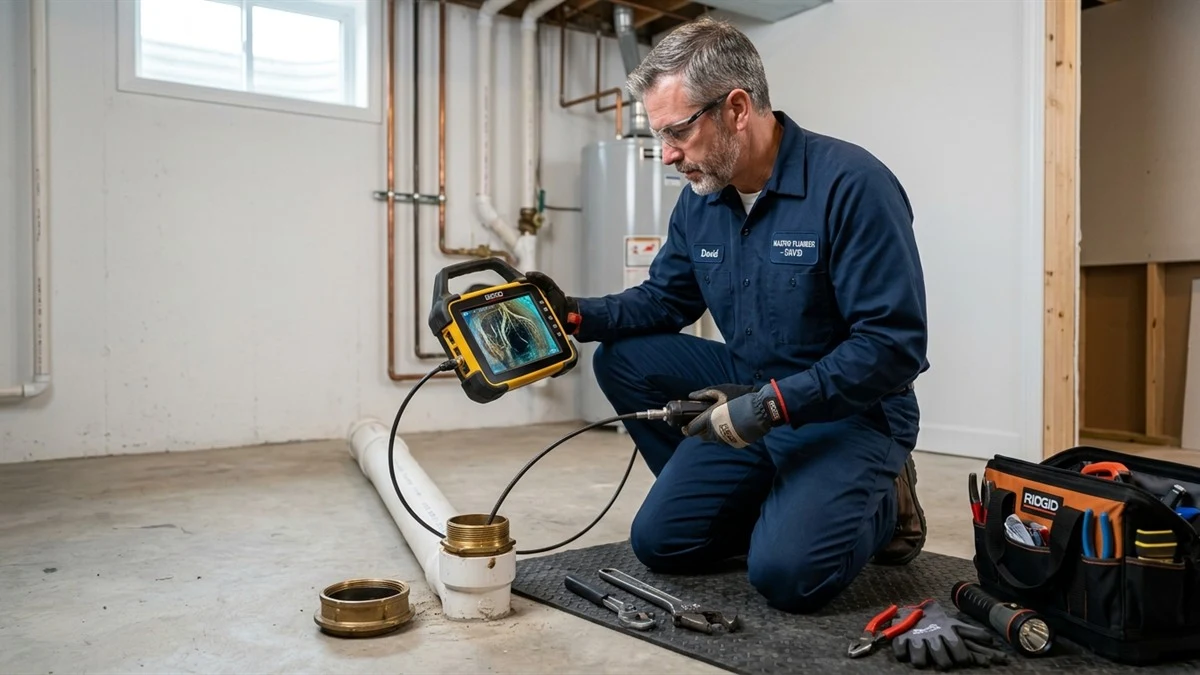
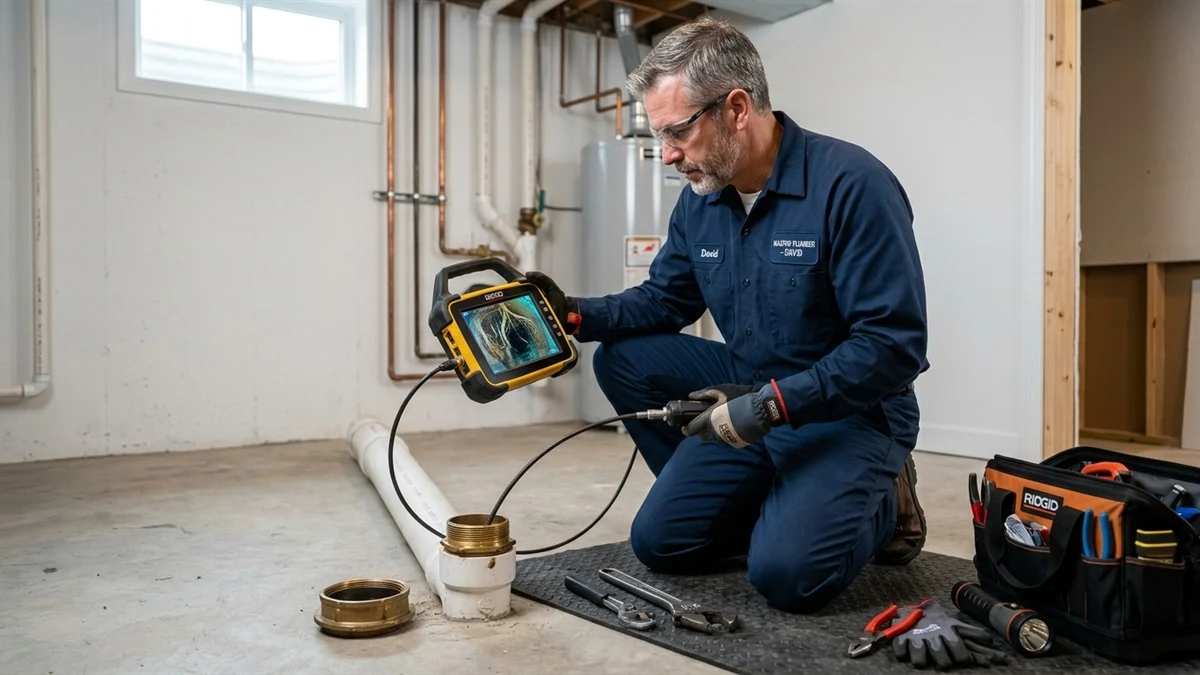
Optical camera inspection is the gold standard of modern drain diagnostics. Our plumbers deploy a flexible, fiber-optic camera head equipped with ultra-bright LED arrays and a high-resolution, self-leveling optical sensor into the cleanout access. As the camera travels down the pipe, a high-definition video monitor displays the exact internal condition of the line in real-time.
The camera reveals precisely what is blocking the flow: whether it is a thick mass of tree roots penetrating joint collars, a heavy accumulation of wet wipes caught on cast iron rust spurs, a foreign toy flushed down the toilet, a severe pipe sag with standing water, or an outright collapsed pipe wall. Digital footage is recorded and shared directly with the homeowner for total transparency.
Phase 4: Radio-Frequency (Sonde) Precision Depth Locating
Knowing what is blocking the pipe is only half the battle; knowing where it is located in your yard is equally critical. Our professional inspection cameras are integrated with an electromagnetic transmitter (known as a sonde) located right behind the camera lens. While the camera sits inside the pipe at the exact point of obstruction, the plumber walks above ground on your lawn using an electronic receiver wand.
This device pinpoints the precise location on your property within an accuracy of 2 inches, while simultaneously displaying the exact subterranean depth of the pipe (e.g., 6.4 feet below your flower bed). If excavation or spot repair is necessary, this eliminates all destructive exploratory digging, protecting your landscaping, concrete walkways, and driveway.

6. Professional Repair Methodologies: From Snaking to Trenchless Lining
Once the diagnostic phase establishes the root cause and location of the obstruction, our licensed plumbing specialists deploy the appropriate restorative methodology based on pipe material, age, and damage severity:
| Method | Target Blockage | Pipe Safety | Longevity of Relief |
|---|---|---|---|
| Continuous Cable Snaking (Rooter) | Dense root clumps, solid object plugs, paper clogs | High (when properly sized); caution on thin cast iron | Temporary to Moderate (30–90 days for roots; permanent for foreign objects) |
| Hydro Jetting (3,500–4,000 PSI) | Heavy grease, sludge, complete root shearing, mineral scale | Excellent on sound PVC, clay, and cast iron; avoid on broken clay | Long-Term (1–3 years; restores 100% full internal diameter) |
| Trenchless CIPP Pipe Lining | Cracked pipes, leaking joints, recurring root infiltration | Non-destructive; creates seamless new structural epoxy pipe inside old one | Permanent (50+ Year Manufacturer Warranty; 100% impervious to roots) |
| Targeted Spot Excavation & Repair | Completely collapsed sections, crushed pipes, severe bellies | Direct structural replacement using modern SDR-35 or Schedule 40 PVC | Permanent (Lifetime structural integrity for the replaced segment) |
Mechanical Cable Snaking: The Emergency Flow Restoration Tool
Heavy-duty commercial drain snaking utilizes an electric drum machine driving a 3/4-inch tempered steel inner-core cable up to 100 or 150 feet into the sewer line. Equipped with specialized cutting attachments—such as C-cutter blades, spade bits, or expanding root-saws—the rotating cable bores through solid obstructions, chewing through paper plugs and chopping through tree roots.
While snaking is the indispensable first-response tool to relieve hydraulic head pressure and drain standing sewage out of a flooded basement, homeowners must understand its technical limitations: a snake merely punches a hole through the obstruction. It does not wash pipe walls, it cannot scrape away solidified grease, and it leaves root tendrils alive inside joint collars, allowing them to regrow vigorously within 60 to 90 days.
Hydro Jetting: The Complete Restoration Solution
To achieve true long-term relief from recurring multi-drain backups, our master technicians utilize commercial high-pressure hydro jetting. A hydro jetter utilizes a commercial-grade pump that forces water through a reinforced, flexible hose at pressures up to 4,000 PSI at a flow rate of 12 to 18 gallons per minute.
At the tip of the hose sits a specialized stainless steel nozzle equipped with rear-facing high-velocity thrust jets and forward-penetrating cutting jets. The rear jets propel the hose forward through the pipe while acting as an aggressive, rotating water-blade that shears tree roots flush against the pipe wall, emulsifies hardened fats and oils, and scrubs away decades of rust and scale. The result is a sewer pipe restored to 100% of its original internal diameter, flowing with factory-new hydraulic efficiency.
Trenchless CIPP Epoxy Pipe Lining
When a sewer camera inspection reveals that root intrusion or cracked joints are severe, repeated snaking becomes a wasteful financial drain. Fortunately, modern technology allows us to permanently repair broken sewer pipes without tearing up your lawn, mature shade trees, patio, or asphalt driveway.
Trenchless Cured-in-Place Pipe (CIPP) lining involves inserting an epoxy-saturated, non-woven tubular felt liner into the existing damaged sewer line through a single small access point. Once inverted into position, the liner is inflated with compressed air or hot water, pressing the epoxy firmly against the interior walls of the old pipe. As the thermosetting resin cures, it forms a brand-new, seamless, jointless structural pipe within the old pipe. This newly created interior liner is entirely impervious to root intrusion, completely chemical-resistant, and engineered to last in excess of 50 years.
7. Crucial Homeowner Protocols: What to Do Immediately & What NOT to Do
The actions you take in the first 15 minutes of discovering multiple drains backing up will directly determine whether your repair costs remain confined to an affordable drain clearing service, or balloon into a $25,000 whole-home sewage restoration disaster:
CRITICAL WARNING: What You Must NEVER Do
- DO NOT keep flushing toilets to “test” if the clog is gone: Every flush dumps 1.6 to 3.5 gallons of fresh wastewater into an already overwhelmed stack. That water will not drain; it will immediately overflow through the base of the toilet or spill over the lip of your lowest shower pan.
- DO NOT pour chemical liquid drain cleaners down any drain: Over-the-counter chemical drain openers (such as Drano or Liquid-Plumr) are composed of heavy sodium hydroxide (lye) or sulfuric acid. When a main sewer line is blocked, these caustic chemicals sit trapped inside your pipes. Not only are they 100% ineffective against main line tree roots and severe blockages, but they also eat away at cast iron pipes and pose an extreme blinding and burn hazard to the emergency plumber who must subsequently cable the line.
- DO NOT run the dishwasher, clothes washer, or take a bath: High-volume appliances pump gallons of soapy, scalding water under pressure. Running a single laundry wash cycle during a main line clog will instantly flood your basement floor drain with dozens of gallons of dirty, sudsy wastewater.
MANDATORY EMERGENCY STEPS: Do This Immediately
- Cease all domestic water consumption: Instruct everyone in your household to stop running sinks, flushing commodes, showering, and operating washing machines.
- Locate and shut off the main water supply valve: If you suspect someone in the home might inadvertently run water, turn the main water shutoff valve (located in your basement, crawlspace, or near the water meter) clockwise to cut off potable water supply to the home.
- Keep children and pets away from contaminated areas: Isolate any bathroom or basement space displaying backflow to prevent tracking biological pathogens through the house.
- Call Broomfield Emergency Plumber immediately: Contact our 24/7 emergency dispatch team at (303) 647-3363. Our fully equipped service trucks are stationed across the Broomfield area with an average response time of 30 to 60 minutes.
8. Field Protocol: “What We Check on This Type of Emergency Call”
When you entrust your home to Broomfield Emergency Plumber during a multi-drain crisis, you receive the benefit of decades of frontline diagnostic plumbing experience. Here is the exact field checklist our licensed plumbing professionals execute upon arrival at your residence:
- Fixture Backflow Audit: We immediately inspect every fixture across all levels of the structure, establishing the exact hydraulic waterline and identifying all affected areas.
- Hydrostatic Pressure Assessment at the Cleanout: We check both interior mechanical cleanouts and exterior yard cleanouts to safely relieve pressure without creating an indoor geyser.
- Sewer Camera Structural Analysis: We run high-definition camera heads through the entire lateral to the city connection, examining for joint offsets, root ingress, pipe ovality, and structural bellies.
- City Main vs. Private Lateral Jurisdiction Check: We verify whether the blockage is within your property boundary or on the municipal utility side, coordinating with local Broomfield or Adams/Boulder County public works when appropriate.
- High-Pressure Mechanical Clearing: We deploy heavy-duty root cutters or hydro jetters to completely re-establish full-bore flow.
- Post-Clearing Video Verification: We perform a second, comprehensive CCTV camera sweep after the line is clear to prove that all roots, scale, and obstructions have been 100% eliminated, presenting the live footage directly to you.
- Sanitary Containment Guidance: We advise on immediate environmental sanitization protocols to protect your family’s health and safeguard your home’s value.
9. Local Context: Why Colorado Front Range Homes Are Particularly Vulnerable
Homeowners in Broomfield, Westminster, Louisville, Lafayette, Superior, and Thornton face geological and climatic plumbing challenges rarely encountered in other regions of the country. Understanding these local factors explains why main sewer line backups are so prevalent along the Colorado Front Range:
Expansive Bentonite Clay Soils: Much of the soil in the Denver-Boulder metropolitan corridor is rich in bentonite clay minerals. These soils exhibit severe shrink-swell characteristics: during wet spring snowmelt, the soil absorbs moisture and expands dramatically, exerting thousands of pounds of lateral hydrostatic pressure on underground sewer pipes. During dry, arid summer months, the clay shrinks and cracks, causing ground subsidence. This continuous seasonal heave shifts sewer pipe joints, snaps brittle clay pipes, and creates dramatic pipe bellies.
Deep Frost Lines and Freeze-Thaw Ground Movement: Colorado winters regularly bring prolonged sub-zero cold snaps where ground frost penetrates 30 to 36 inches deep. While sewer lines are typically buried 4 to 8 feet deep, the upper soil freeze pushes down upon lower soil strata, causing subtle differential settling that compromises older sewer lateral joints, inviting nearby tree roots seeking subterranean warmth.
Aging Municipal Infrastructure: Many residential neighborhoods in Broomfield and neighboring communities were developed in the 1960s, 70s, and 80s during the Front Range suburban expansion. These homes were plumbed with vitrified clay tile or unlined cast iron pipes that have now reached or far exceeded their engineered 50-year design lifespans. Proactive diagnostic camera inspections and hydro jetting are essential preventative maintenance for every homeowner in our region.
10. Frequently Asked Questions (FAQ)
Q1: Can I use a plunger to clear multiple backed-up drains?
Answer: No. A standard cup or flange plunger is designed strictly to clear localized clogs within an individual fixture’s P-trap (such as a wad of paper in a toilet horn or food scraps in a kitchen sink). When multiple drains are backing up, the blockage is located 30 to 80 feet downstream inside your 4-inch main sewer line. Plunging a toilet or shower will merely push trapped air and dirty sewage water through the vent stack or cause it to erupt out of an adjacent sink. It has zero mechanical impact on a main line sewer blockage.
Q2: Why does my toilet make a loud gurgling sound when the shower drains?
Answer: Gurgling or bubbling noises are caused by trapped air being forced through water traps under negative or positive pressure. When water draining from your shower hits a downstream blockage in the main drain, it displaces the air in the pipe. Unable to vent forward through the sewer line, the pressurized air forces its way backward up through the nearest water trap, which is almost always the toilet bowl. The bubbles you see and hear are sewer gases and displaced air erupting through the commode’s standing water seal.
Q3: How can I tell if the sewer backup is my responsibility or the city’s?
Answer: Under municipal municipal utility codes throughout Colorado, the property owner is legally and financially responsible for the entire private sewer lateral line from the exterior foundation of the home all the way to its connection point at the municipal sewer main in the middle of the street. To determine who is responsible for an active backup, a plumber checks your exterior cleanout: if the cleanout is dry while your house is backed up, the clog is on your property. If the cleanout is flooded to the top, we camera the line outward. If the blockage is past your property line tap and sitting within the public main, the municipal sewer department is responsible for clearing it.
Q4: Does homeowners insurance cover main sewer line backups?
Answer: Standard baseline homeowners insurance policies (HO-3) almost universally exclude water and sewer backup damage unless the homeowner has purchased a specific policy endorsement known as “Water Backup and Sump Overflow” coverage. This rider typically costs between $35 and $75 annually and provides between $5,000 and $25,000 in coverage for professional extraction, sanitization, structural drying, and drywall/flooring replacement. Contact your insurance agent immediately to verify whether this endorsement is active on your policy.
Q5: How often should I have my main sewer line professionally inspected with a camera?
Answer: For homes over 25 years old or properties with mature trees within 30 feet of the sewer lateral, we recommend a professional CCTV sewer camera inspection every 18 to 24 months. If your home has historic cast iron or clay pipes that have previously experienced root intrusion, an annual camera inspection combined with preventative hydro jetting is the most cost-effective insurance against unexpected emergency floods.
Q6: Why did my drains back up again just two weeks after being snaked?
Answer: Rapid recurrence of a sewer backup after snaking typically points to one of three underlying defects: (1) The cable machine only punched a narrow 2-inch pilot hole through a heavy grease or root blockage, which quickly closed back up; (2) The pipe has a severe structural belly (sag) where solids continuously collect; or (3) The pipe has suffered a structural collapse or joint offset that physical cable heads cannot repair. A comprehensive sewer camera inspection is mandatory to identify the permanent structural remedy.
Q7: What is the average lifespan of a residential sewer line in Broomfield?
Answer: Lifespans vary significantly by pipe material: historic vitrified clay tile typically lasts 50 to 60 years before joint failure and root infiltration become chronic; cast iron lines last 40 to 60 years depending on water chemistry and interior corrosion; while modern Schedule 40 PVC and SDR-35 sewer pipes have an engineered lifespan exceeding 100 years. If your home is reaching 50 years of age on original piping, trenchless CIPP lining or targeted pipe replacement should be evaluated.
11. Related Services & Internal Diagnostic Pathways
To continue your research and understand the specialized equipment and solutions available for your residential drainage system, explore our detailed technical service hubs:
- Emergency Plumbing Dispatch: Learn more about our rapid 24/7 service protocols at 24/7 Emergency Plumbing Services in Broomfield.
- Sewer & Main Line Solutions: Explore our specialized camera inspection, trenchless pipe repair, and lateral replacement options at Sewer Line Repair & Diagnostics Hub.
- Professional Drain Cleaning: Compare mechanical snaking, motorized augers, and high-pressure jetting at our Drain Cleaning & Clog Clearing Hub.
- Hidden Water Leaks: If your multi-drain backup is accompanied by unusual water pressure drops or foundation moisture, review our Electronic Leak Detection Services.
Multiple Drains Backing Up Right Now? Don’t Wait For Sewage To Overflow!
Every minute you delay running or holding water during a main sewer stoppage increases your risk of catastrophic blackwater flood damage. Our licensed, local Colorado master technicians are on call 24 hours a day, 7 days a week, 365 days a year with an average rapid response time of 30 to 60 minutes across Broomfield and the surrounding Front Range.