
1. Executive Summary & Physics of Fuel Gas Distribution
Natural gas powers the vast majority of residential heating infrastructure across Colorado’s Front Range, including forced-air furnaces, combi boilers, high-draw tankless water heaters, kitchen ranges, clothes dryers, and outdoor hearth appliances. Because winter ambient temperatures in Broomfield, Westminster, and Boulder regularly plummet below zero degrees Fahrenheit, fuel gas piping systems operate under intense volumetric demand throughout the extended heating season.
Fuel gas plumbing is governed by the International Fuel Gas Code (IFGC) and the National Fuel Gas Code (NFPA 54), enforced through local Colorado municipal building inspection departments. In standard residential systems, natural gas enters the property from the municipal utility distribution main through a underground service lateral at medium pressure (typically 10 to 60 PSI). The utility gas meter and pressure regulator assembly at the home’s exterior foundation steps this pressure down to a low-pressure domestic delivery threshold:
- Standard Low-Pressure Domestic Delivery: 1/4 PSI (pound per square inch), equivalent to 7 inches of water column (in. w.c.), or roughly 1.74 kPa. This is the engineered operating baseline for conventional natural gas appliances.
- Elevated Pressure Hybrid Delivery (2-PSI Systems): Modern larger custom residences or homes with high-draw appliances (such as 199,000 BTU/hr tankless water heaters or 100,000 BTU outdoor fire pits) frequently utilize a 2-PSI gas distribution grid. Elevated 2-PSI pressure allows smaller-diameter flexible tubing to deliver immense fuel volume across long runs, requiring an engineered line pressure regulator (LPR) upstream of each appliance to throttle the delivery back to 7 in. w.c.
The combustion chemistry of natural gas requires an exact stoichiometric air-to-fuel ratio. Methane requires approximately 10 volumes of air for every 1 volume of natural gas to achieve complete combustion:
CH₄ + 2 O₂ + 8 N₂ → CO₂ + 2 H₂O + 8 N₂ + Heat Energy (approx. 1,030 BTU per cubic foot)
When gas piping suffers micro-fractures, mechanical joint loosening, or seismic/soil subsidence shifting, unburned gas mixes with room air. The lower explosive limit (LEL) of natural gas is approximately 5% by volume in air, and the upper explosive limit (UEL) is 15%. Within this explosive boundary, any thermal or electrical spark will cause catastrophic volumetric detonation.
2. Piping Materials Comparison: Black Iron vs. CSST vs. Polyethylene (PE)
Plumbing contractors across the Front Range install three primary fuel gas piping materials, each engineered for distinct environmental, structural, and chemical exposures. Selecting the correct piping material and understanding its mechanical limitations is essential for structural life-safety.
1. Schedule 40 Black Steel (Malleable Iron Threaded Pipe)
Black iron pipe (ASTM A53) has been the bedrock of residential gas distribution for over a century. Manufactured from welded seamless carbon steel with a dark iron oxide coating, it provides unparalleled structural rigidity, mechanical impact resistance, and fire durability. Connections are made using tapered National Pipe Thread (NPT) fittings sealed with anaerobic Teflon paste and yellow gas-rated PTFE tape.
- Advantages: Completely impervious to accidental nail punctures or screw penetrations from drywall hanging; handles immense physical stress; zero requirement for electrical lightning bonding clamps; highly cost-effective per linear foot.
- Disadvantages: Labor-intensive installation requiring heavy pipe threaders and cutting dies; rigid geometry requires numerous threaded 90-degree elbows, tees, and couplings, creating dozens of potential micro-leak points; highly vulnerable to exterior galvanic corrosion when exposed to moisture or buried in soil.
2. Corrugated Stainless Steel Tubing (CSST)
Introduced in the late 1980s, Corrugated Stainless Steel Tubing (ASTM C1109) revolutionized residential gas rough-in. CSST consists of an ultra-flexible, corrugated continuous 304 or 316 stainless-steel tube encapsulated in a protective outer yellow or black polymer jacket. It can be pulled continuously through wall cavities, floor joists, and attic rafters like electrical Romex cable, eliminating 80% of the threaded joints required in rigid black pipe installations.
- Yellow-Jacketed CSST: Standard conventional CSST. Extremely flexible, but requires specialized direct equipotential electrical bonding to the home’s electrical grounding electrode system to prevent lightning-induced electrical arcing punctures.
- Black-Jacketed Arc-Resistant CSST (CounterStrike / FlashShield): State-of-the-art multi-layer composite CSST incorporating a conductive carbon-infused outer sleeve and aluminum wire mesh shield. It dissipates lightning energy and electrical transients across its entire surface, eliminating the need for dedicated large-gauge bonding jumpers under most Colorado municipal codes.
3. High-Density Polyethylene (HDPE / PE) Pipe
Underground exterior gas lines running from the house foundation to detached garages, workshop heaters, outdoor barbecue kitchens, or pool heaters must never use black steel or CSST. International Fuel Gas Code strictly mandates the use of yellow ASTM D2513 High-Density Polyethylene (HDPE) gas pipe joined by electrofusion or heat butt-fusion fittings.
- Underground Burial Rules: Polyethylene gas pipe must be buried at a minimum depth of 18 inches below grade (24 inches under driveways or vehicular pathways). It must be accompanied by an insulated #14 AWG solid copper yellow-jacketed tracer wire taped directly to the pipe to allow magnetic underground pipe locators to detect the non-metallic pipe in the future.
3. The Electrical Physics of CSST Lightning Bonding in Colorado
Colorado’s Front Range sits along “Lightning Alley,” experiencing intense convective summer thunderstorms and one of the highest densities of cloud-to-ground lightning strikes in North America. The interaction between lightning strikes and residential Corrugated Stainless Steel Tubing represents one of the most critical life-safety code developments in modern plumbing history.
The Arc-Perforation Phenomenon
When lightning strikes a home, nearby tree, or utility power pole, an immense electromagnetic pulse (EMP) induces thousands of volts of electrical potential across all conductive metallic systems inside the home—including electrical wiring, copper plumbing, HVAC ductwork, and gas lines.
Because standard yellow CSST has a wall thickness of only 0.010 to 0.012 inches (approximately the thickness of a few sheets of aluminum foil), it possesses higher electrical impedance than heavy-gauge copper wiring or thick Schedule 40 steel. If an electrical charge traveling along the gas pipe attempts to jump (arc) across an air gap to an adjacent grounded metallic object—such as an electrical wire staple, galvanized ductwork, or metal plumbing pipe—the localized heat of the electric arc instantly vaporizes a micro-hole through the thin stainless steel corrugation. High-pressure natural gas immediately vents out of the perforation and is ignited by the lingering electrical arc, resulting in an active blowtorch flame inside concealed wall or ceiling framing.
Colorado Code Bonding Standards (NFPA 54 / IFGC 310)
To prevent lightning-induced arcing punctures, Colorado municipal jurisdictions strictly enforce direct bonding protocols for all conventional yellow CSST systems:
- Bonding Conductor Sizing: A minimum #6 AWG bare or green insulated solid or stranded copper conductor must be connected directly to the gas piping system.
- Connection Point: The bonding clamp must be attached to a rigid brass CSST transition fitting, a black steel pipe nipple upstream of the first CSST run, or directly to the gas distribution manifold. The clamp must never be attached to the thin corrugated tubing itself.
- Termination Point: The opposite end of the #6 AWG conductor must terminate directly at the electrical service equipment enclosure, the grounded electrical grounding electrode conductor (GEC), or directly to the primary grounding rod electrode outside the building.
- Maximum Conductor Length: The bonding wire should be kept as short and straight as possible, typically not exceeding 75 feet in total run length, to minimize electrical inductance during high-frequency transient discharges.
4. Gas Line Sizing Engineering: BTU Load Calculations & Pressure Drop
A gas piping system is essentially a fluid dynamics delivery network. If a pipe is undersized, appliances at the end of the run will suffer severe pressure starvation when multiple gas appliances fire simultaneously. In high-efficiency condensing furnaces and tankless water heaters, pressure starvation leads to incomplete combustion, sooting, carbon monoxide (CO) production, ignition lockout errors (Error Code 11 or 12 on Rinnai/Navien systems), and burner flame lift.
Gas lines are engineered using the Longest Length Method outlined in IFGC Section 402.4:
Longest Length Sizing Workflow:
- Step 1: Calculate Maximum Appliance Demand: Sum the maximum rated BTU/hr input for every gas appliance connected to the system. (1 CFH of natural gas ≈ 1,000 BTU/hr).
- Whole-House High-Efficiency Furnace: 100,000 BTU/hr (100 CFH)
- Whole-House Tankless Water Heater: 199,000 BTU/hr (199 CFH)
- Gas Kitchen Cooktop / Range: 65,000 BTU/hr (65 CFH)
- Gas Clothes Dryer: 35,000 BTU/hr (35 CFH)
- Basement Gas Fireplace Insert: 30,000 BTU/hr (30 CFH)
- Total Connected Load: 429,000 BTU/hr (429 CFH)
- Step 2: Measure Longest Piping Run: Measure the physical distance from the gas meter outlet to the most hydraulically remote appliance. Suppose the basement fireplace is 80 feet away from the meter.
- Step 3: Consult IFGC Capacity Tables: Using the 80-foot sizing column (under 0.5 psi inlet pressure, 0.5 in. w.c. allowable pressure drop, 0.60 specific gravity), determine the minimum diameter required for each pipe segment to ensure delivery capacity exceeds the downstream demand.
- Step 4: Main Trunk Sizing: At 80 feet, a 1-inch black iron pipe can deliver only 283 CFH—far below our 429 CFH requirement! Therefore, the main gas trunkline leaving the meter must be sized at 1-1/4 inch (capacity: 580 CFH at 80 ft) or 1-1/2 inch.
| Pipe Nominal Diameter | Capacity at 20 Feet (CFH / MBH) | Capacity at 40 Feet (CFH / MBH) | Capacity at 60 Feet (CFH / MBH) | Capacity at 100 Feet (CFH / MBH) |
|---|---|---|---|---|
| 1/2-Inch Black Steel | 120 CFH (120,000 BTU) | 82 CFH (82,000 BTU) | 66 CFH (66,000 BTU) | 50 CFH (50,000 BTU) |
| 3/4-Inch Black Steel | 250 CFH (250,000 BTU) | 172 CFH (172,000 BTU) | 138 CFH (138,000 BTU) | 104 CFH (104,000 BTU) |
| 1-Inch Black Steel | 472 CFH (472,000 BTU) | 324 CFH (324,000 BTU) | 260 CFH (260,000 BTU) | 195 CFH (195,000 BTU) |
| 1-1/4-Inch Black Steel | 970 CFH (970,000 BTU) | 665 CFH (665,000 BTU) | 534 CFH (534,000 BTU) | 400 CFH (400,000 BTU) |
5. Professional Gas Leak Diagnostic & Pressure Testing Protocols
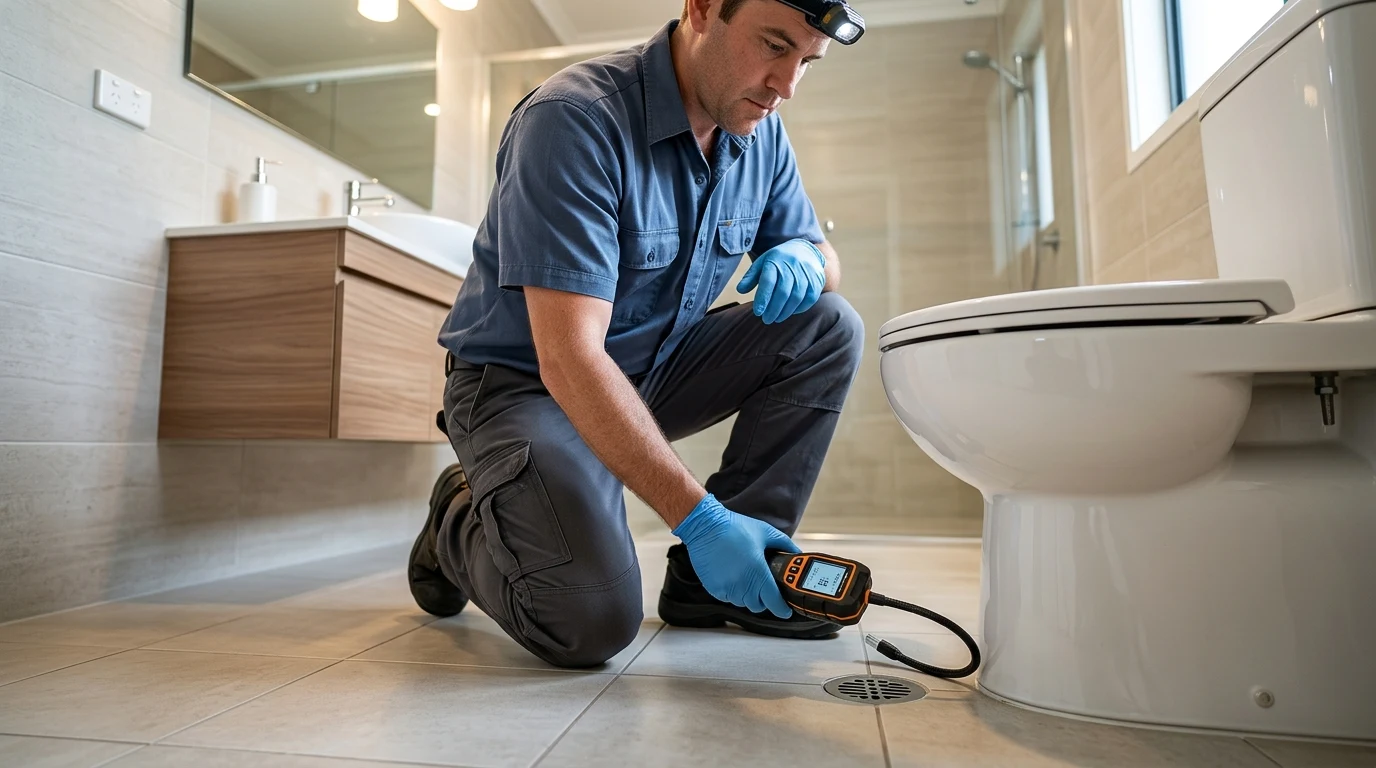
Locating and resolving micro-leaks in residential gas systems requires sophisticated diagnostic instrumentation. Licensed plumbers utilize two complementary testing methods: electronic combustible gas sniffing and high-precision mechanical pressure decay testing.
The 15-Minute Air Pressure Decay Test (IFGC Section 406)
When a gas leak is suspected or after installing new piping, the entire system must be isolated from the municipal supply and subjected to an official air pressure test before gas service can be activated:
- Appliance Isolation: Every connected gas appliance must have its manual shutoff valve closed, or flex line disconnected and capped. Gas control valves on furnaces and water heaters are rated for a maximum pressure of 1/2 PSI (14 in. w.c.). Subjecting them to test pressure will permanently rupture their internal rubber regulator diaphragms!
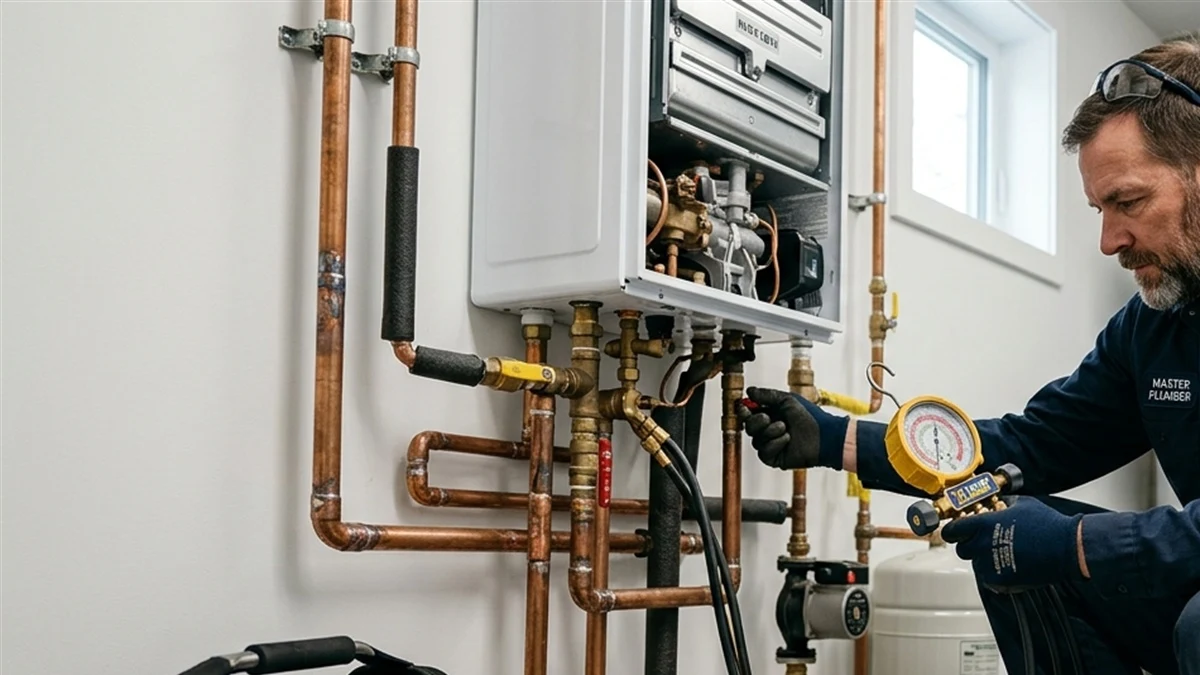
- Pressurization: The piping grid is pressurized with compressed air or inert nitrogen using a hand bicycle pump or portable compressor through a test manifold equipped with a 0–30 PSI diaphragm test gauge.
- Test Pressure Requirements: In Colorado, municipal codes mandate testing at not less than 1-1/2 times the proposed working pressure, but never less than 10 PSI (many Front Range inspectors require 15 to 20 PSI for 15 minutes).
- Pass/Fail Criteria: The gauge needle must exhibit zero pressure drop over the full test duration. If the needle drops even 0.25 PSI, a leak exists. The technician then applies an approved non-corrosive bubbling leak detection surfactant (such as Mega-Bubble) to every joint, fitting, union, and valve stem to pinpoint the micro-leak.
6. Sediment Traps (Drip Legs): The Small Fitting That Saves Furnace Valves
According to IFGC Section 408.4, an approved sediment trap (dirt pocket / drip leg) must be installed at the inlet to every gas appliance (with the exception of illuminating appliances, ranges, clothes dryers, outdoor grills, and gas fireplaces).
A sediment trap consists of a tee fitting with the gas supply entering the side or top run, and a capped vertical pipe nipple measuring at least 3 inches in length extending straight downward from the bottom outlet. As natural gas travels through the piping grid, it carries microscopic traces of pipe scale, metal shavings, cutting oil residues, and moisture droplets. When the gas stream reaches the tee, the sudden change in flow direction causes the denser particulate debris and liquids to drop harmlessly into the vertical capped nipple by gravitational inertia, preventing contamination of the appliance’s precision electromagnetic gas solenoid valve.
7. Homeowner Emergency Response: How to Shut Off Your Gas Meter Safely
Every adult member of a household should know the physical location of the exterior natural gas meter and understand how to execute an emergency mechanical shutoff using basic hand tools during a catastrophic gas leak, earthquake, or fire.
Step-by-Step Emergency Meter Shutoff Workflow:
- Locate the Exterior Meter: In Colorado, gas meters are typically mounted along the side or rear exterior foundation wall, or in a recessed alcove near the electric meter.
- Identify the Shutoff Valve: Look at the vertical steel pipe riser rising out of the ground before it enters the gas meter. Near the base of the riser is a heavy bronze or iron valve with a rectangular metal lug or tang (known as a stopcock or plug valve).
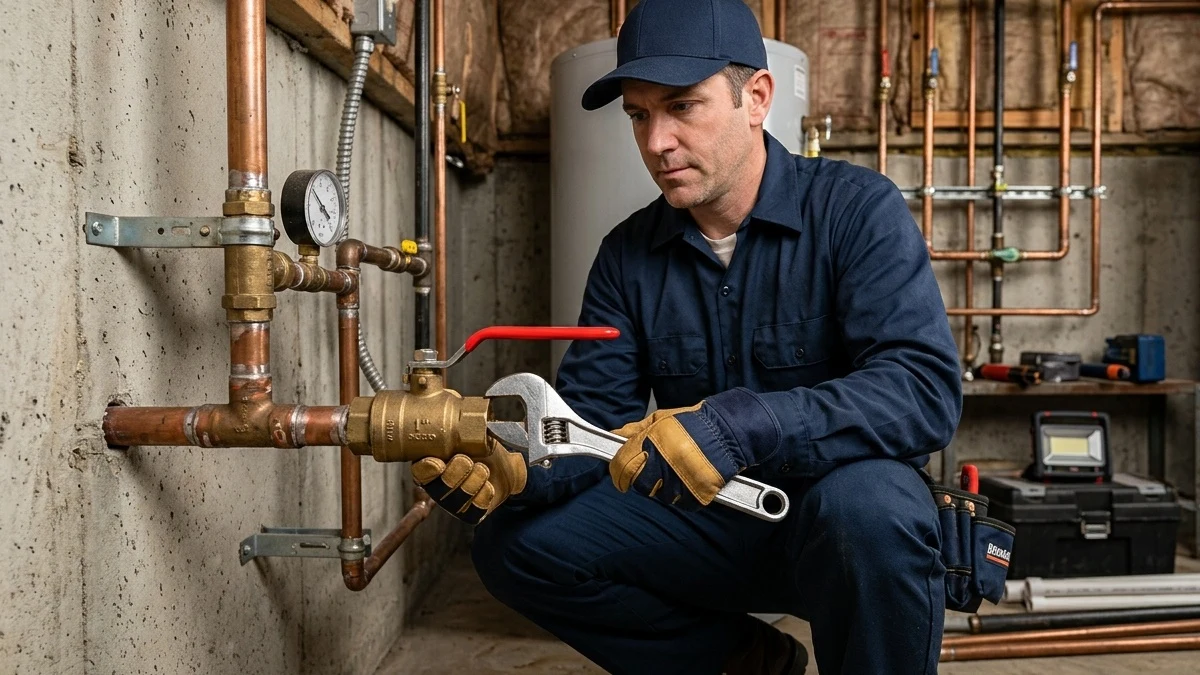
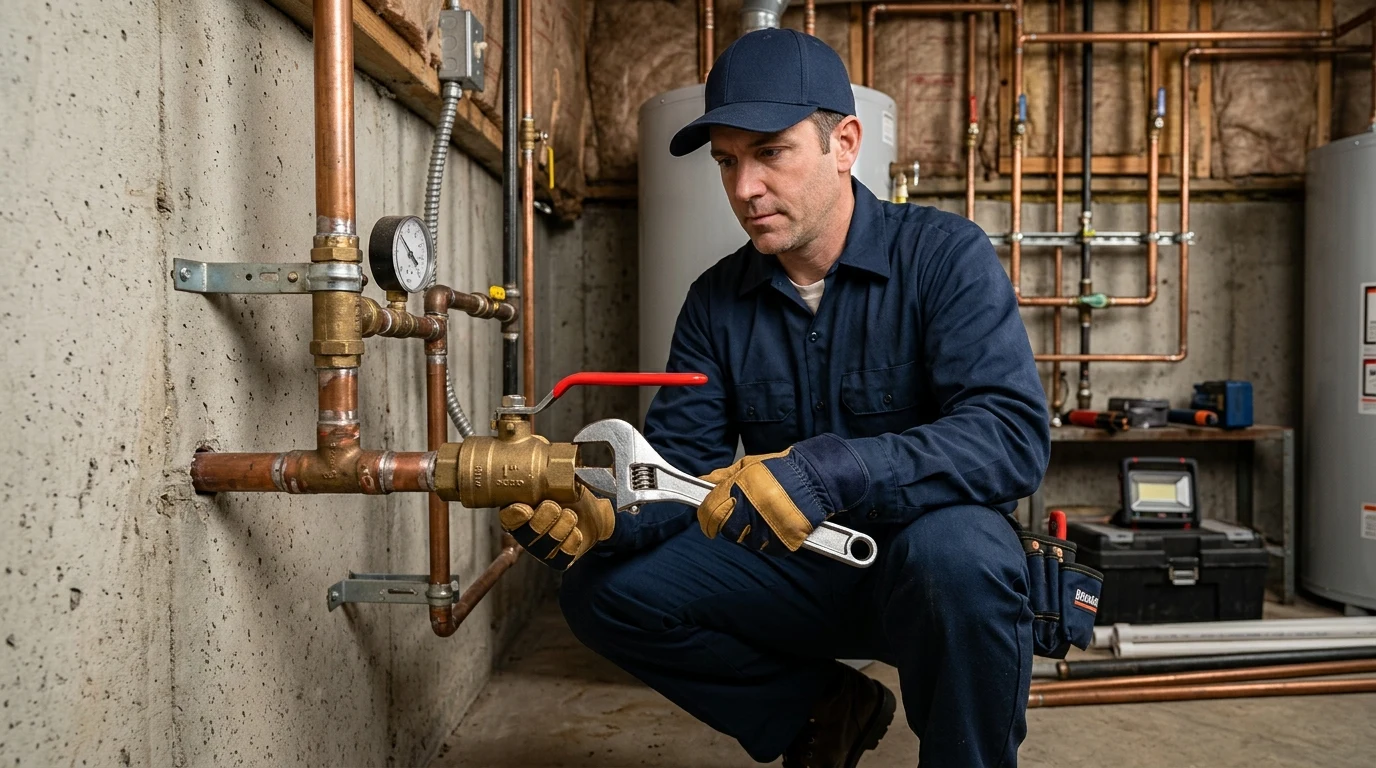
- Select the Right Tool: Keep a 10-inch or 12-inch adjustable crescent wrench, a dedicated emergency gas/water shutoff multi-tool, or a pipe wrench readily accessible in your utility room or garage.
- Execute the Quarter-Turn: Place the wrench jaws firmly across the rectangular tang. Turn the tang 90 degrees in either direction until the tang is completely perpendicular (crosswise) to the vertical pipe. When the holes on the tang align with the padlock eyelet on the valve body, the valve is fully closed.
- CRITICAL WARNING – DO NOT TURN BACK ON: Never attempt to reopen the gas valve yourself once it has been shut off! Opening the valve prematurely can flood your home with gas if an appliance valve or open pipe exists. Only a licensed plumbing contractor or utility technician from Xcel Energy is authorized to perform a safety check, re-pressurize the lines, and safely relight appliance pilot burners.
8. Appliance Gas Flexible Connectors: ANSI Z21.24 Standards & Single-Use Rules
The final mechanical link between the rigid building gas piping and an appliance is the flexible gas appliance connector. While seemingly simple, improper installation of flexible gas connectors is one of the most frequent causes of residential gas leaks and carbon monoxide exposure identified during home inspections across the Front Range.
Flexible gas connectors are governed by ANSI Z21.24 / CSA 6.10 and the International Fuel Gas Code Section 411:
- Single-Use Mandate (Never Reuse an Old Connector): Flexible corrugated metal connectors are engineered for single installation only. When a connector is bent into place, the thin corrugated stainless steel or brass undergoes work hardening. If that connector is disconnected and re-bent during a water heater or furnace replacement, microscopic fatigue cracks develop along the corrugation valleys. Over subsequent months of appliance vibration, these micro-fissures propagate into active gas leaks. Whenever an appliance is replaced, the flexible connector must be discarded and replaced with a brand-new, factory-certified assembly.
- Prohibition on Wall, Floor, or Partition Penetrations: Under IFGC Section 411.1.2, flexible gas connectors must never pass through walls, floors, partitions, ceilings, or appliance cabinets. The sharp sheet metal edges of drywall studs or appliance knockouts will saw through the thin metal tubing as the appliance vibrates during normal startup cycles. The rigid pipe must extend completely into the room or appliance cabinet before transitioning to the flexible connector.
- Maximum Permissible Lengths: Standard appliance connectors must not exceed 6 feet (72 inches) in total nominal length. Connectors for commercial food service equipment or movable kitchen appliances with casters may utilize flexible stainless-steel braided hose assemblies with integrated quick-disconnect couplings and restraint cables meeting ANSI Z21.69.
- Yellow Polymer Coating Protection: Modern connectors feature an electrostatically applied high-visibility yellow polymer coating. This coating protects the underlying stainless steel from chemical attack by household cleaning agents containing ammonia, bleach, or chlorides, which cause rapid stress corrosion cracking (SCC) in raw austenitic stainless steel.
9. Expansive Bentonite Soil & Seismic Stress on Colorado Gas Infrastructure
The geological composition of the Colorado Front Range—stretching from Broomfield and Westminster down through Golden and Highlands Ranch—is characterized by dense deposits of the Denver and Pierre Formations, which contain massive concentrations of expansive sodium bentonite montmorillonite clay.
When seasonal precipitation or snowmelt saturates these soil layers, the clay expands by up to 20% to 35% in volume, generating immense hydrostatic uplift pressures exceeding 15,000 pounds per square foot against residential basement slabs, foundation footers, and utility penetrations. During hot, arid summer stretches, the clay shrinks precipitously, creating expansive voids and differential settlement.
Impact on Buried & Foundation Gas Piping
This constant, cyclical ground movement exerts severe vertical shear forces and bending moments on gas piping entering the home. If a rigid black steel pipe is grouted solidly into a concrete foundation wall without an engineered expansion sleeve, differential foundation heave will snap the pipe at the exterior wall face or crack the threads of the nearest malleable iron fitting inside the basement.
To prevent foundation-induced gas piping fractures, Colorado mechanical codes specify stringent installation measures:
- Foundation Wall Sleeving: Gas piping penetrating an exterior concrete foundation wall must pass through a Schedule 40 steel or PVC sleeve with an annular space of at least 1/2 inch around the pipe. The annular void must be packed with flexible, gas-tight, elastomeric expanding foam or non-hardening modular mechanical hydrostatic seals (such as Link-Seal) that absorb foundation deflection without transferring mechanical load to the gas pipe.
- Exterior Utility Riser Flex Loops: Where underground polyethylene pipe transitions to above-ground steel at the gas meter, an anodeless transition riser with an integral flexible steel armor casing or an engineered swing-joint assembly must be installed. This accommodates ground subsidence without pulling the gas meter off its foundation wall anchors.
10. Combustion Air Engineering: Ventilation Sizing & Carbon Monoxide Prevention
A gas appliance can only operate safely if an adequate volume of fresh combustion air is continuously supplied to support stoichiometric oxidation. In legacy Front Range homes built before 1990, natural structural air infiltration through unsealed building envelopes provided abundant combustion air. However, modern high-performance energy-efficient homes in Broomfield feature tight vapor barriers, spray-foam insulation, and multi-pane argon windows. In these sealed structures, gas-fired furnaces, water heaters, and boilers can rapidly deplete room oxygen, causing burner backdrafting and lethal carbon monoxide (CO) generation.
Under IFGC Chapter 3, mechanical contractors calculate combustion air requirements using standardized engineering protocols:
Combustion Air Calculation Rules:
- The 50 Cubic Feet Rule (Indoor Air Method): If appliances draw combustion air entirely from within the building envelope, the mechanical room and communicating spaces must have a combined volume of at least 50 cubic feet per 1,000 BTU/hr of total appliance input rating. For a basement containing an 80,000 BTU furnace and a 40,000 BTU water heater (total 120,000 BTU/hr), the required volume is $120 times 50 = mathbf{6,000text{ cubic feet}}$ (equivalent to a 25′ × 30′ room with 8-foot ceilings).
- Two Permanent Openings Method (Outdoor Air): When indoor volume is insufficient, two permanent louvered ducts communicating directly with the outdoors must be provided—one commencing within 12 inches of the ceiling, and one commencing within 12 inches of the floor. When utilizing horizontal ducts, each opening must have a free area of not less than 1 square inch per 2,000 BTU/hr of total appliance input.
- Direct-Vent Sealed Combustion (Preferred Front Range Design): The modern engineering solution is installing 100% direct-vent (two-pipe) condensing appliances. Direct-vent equipment draws outdoor combustion air directly into an enclosed burner box via a dedicated PVC or polypropylene intake pipe, completely isolating the combustion process from interior indoor air quality and eliminating backdrafting hazards.
11. Comprehensive Gas Pipe Sizing & Pressure Drop Formulae
For complex custom piping layouts with non-standard delivery pressures or multiple branch tees, plumbing engineers verify flow capacity using the Mueller Flow Equation or the Spitzglass High-Pressure Formula for low-pressure natural gas systems:
Q = 3,550 times sqrt{frac{Delta h times D^5}{S times L times (1 + frac{3.6}{D} + 0.03 times D)}}
Where $Q$ is flow rate in cubic feet per hour (CFH), $Delta h$ is allowable pressure drop in inches of water column (typically 0.5 in. w.c.), $D$ is internal pipe diameter in inches, $S$ is specific gravity of natural gas (0.60 relative to dry air = 1.0), and $L$ is equivalent equivalent piping length in feet (including frictional resistance of fittings and valves).
In field practice, each 90-degree threaded malleable iron elbow adds equivalent frictional resistance equal to 2.5 to 3.5 linear feet of straight pipe, while standard full-port brass gas ball valves contribute approximately 0.8 feet of equivalent length. Ignoring fitting friction in long runs results in unacceptably high pressure drop and chronic burner lockout during cold weather peaks.
12. Frequently Asked Questions (FAQ)
Why does natural gas smell like rotten eggs?
Pure natural gas (methane) is completely odorless, colorless, and tasteless. For public safety, federal and state regulations mandate that utility companies inject a non-toxic chemical odorant called mercaptan (t-butyl mercaptan / thiophane) into the distribution grid. Mercaptan contains sulfur compounds that produce a pungent, unmistakable sulfur or rotten-egg odor detectable by the human nose at concentrations as low as 1 part per billion—long before the gas reaches dangerous combustible levels.
Can I run CSST flexible gas pipe through a concrete slab or masonry wall?
No. Corrugated Stainless Steel Tubing must never be embedded directly in concrete, mortar, or plaster. The chlorides, moisture, and alkaline chemistry of wet concrete will severely corrode the thin stainless steel wall. When crossing a masonry foundation or concrete floor, CSST must be routed through an approved, non-metallic conduit sleeve (such as Schedule 40 PVC) sealed at both ends with non-hardening firestop caulk.
What causes gas piping to develop leaks years after installation?
In Colorado, the primary cause of latent gas leaks is expansive soil movement (bentonite clay shifting the home’s foundation), seismic tremors, continuous vibration from nearby mechanical equipment (such as unbalanced washing machines or vibrating AC compressors), drying out of legacy pipe-dope compounds containing solvent evaporatives, and corrosion caused by moisture dripping onto unpainted black steel piping in damp crawlspaces.
Is it legal to use Teflon tape on natural gas pipe threads?
You cannot use standard white plumbing Teflon tape, as it is too thin and can be dissolved by liquid petroleum hydrocarbons. You must use specialized yellow gas-rated PTFE tape (meeting MIL-T-27730A standards) designed specifically for natural gas, propane, and butane. Professional plumbers typically apply yellow gas tape followed by a coating of anaerobic gas-rated pipe thread sealant (pipe dope) over the tape for a 100% leak-proof double seal.
Can I install my own gas line for an outdoor fire pit or barbecue grill?
Under Colorado state law and municipal codes in Broomfield, Westminster, and Boulder, fuel gas line installation requires a permit and must be performed by a licensed plumbing or mechanical contractor. Improper burial depth, lack of tracer wire, incorrect pipe sizing, or lack of proper pressure testing creates extreme fire and explosion hazards that can void your homeowner’s insurance policy.
How do I know if my existing CSST gas piping is properly grounded and bonded?
Inspect the gas manifold or the first section of black pipe entering your home near the gas meter or furnace room. If you see yellow-jacketed CSST, there must be a heavy brass bonding clamp attached to the black pipe or brass fitting with a thick, solid copper wire (#6 AWG) running directly to your electrical service panel’s ground bus or grounding rod. If no such wire exists, your system is unbonded and vulnerable to lightning arcing fires. Contact a licensed professional immediately to install compliant bonding.
What should I do if my carbon monoxide alarm sounds in the middle of the night?
Treat every carbon monoxide alarm as an immediate medical emergency. Immediately evacuate everyone in the household—including pets—into fresh outdoor air. Do not open windows or try to investigate the heating equipment. Once outside, call 911 immediately. Fire department personnel will arrive equipped with calibrated ambient CO monitors to sweep the home. Symptoms of CO poisoning include throbbing headaches, dizziness, nausea, confusion, and lethargy.
Can gas piping freeze during extreme Colorado winter weather?
Methane itself has a freezing point of -296°F and will not freeze in nature. However, natural gas contains microscopic traces of water vapor. If moisture condensates inside an uninsulated exterior utility meter or shallow underground pipe during sub-zero polar vortex storms (-15°F to -25°F), that water vapor can freeze into ice crystals, clogging the precision orifices of the utility regulator and starving your home’s furnace of fuel. Maintaining proper meter clearance and insulating above-ground piping prevents frost disruption.
24/7 Emergency Gas Leak Detection & Precision Gas Piping in Broomfield
Do not gamble with fuel gas safety. Broomfield Emergency Plumber provides 24/7 rapid response for combustible gas leak tracing, digital pressure testing, CSST electrical bonding upgrades, and gas line extensions for high-output tankless heaters and outdoor living amenities.