
It is 6:00 AM on a freezing Monday morning in Broomfield with the outside air temperature resting at minus eight degrees Fahrenheit. A commercial delivery driver hooks up a heavy-duty rubber washdown hose to the exterior commercial wall hydrant of a retail supermarket or corporate warehouse. The driver turns the loose-key tee handle. Nothing happens. No water flows.
Inside the building, chaos is already brewing.
Behind the finished drywall of the executive breakroom or retail sales floor, forty feet of pressurized municipal water is cascading through structural insulation.
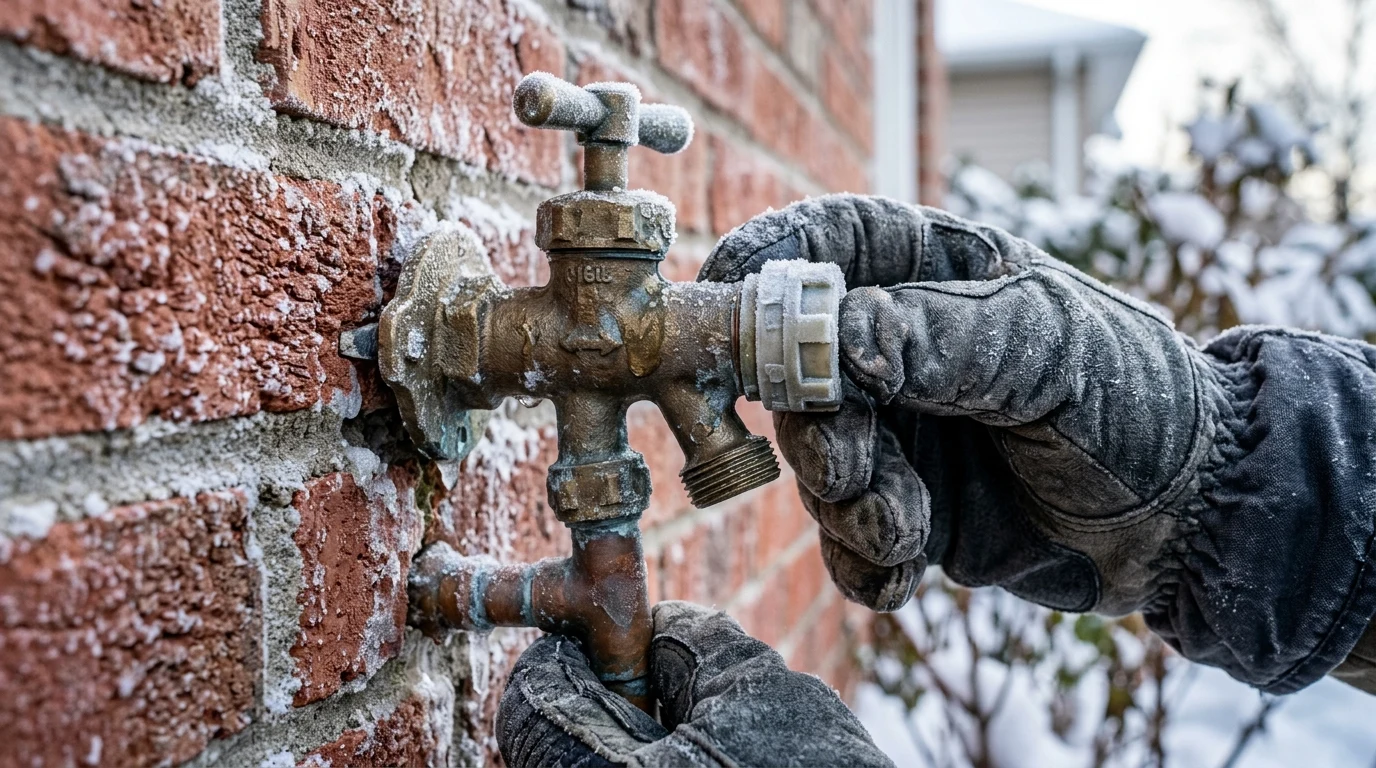
The commercial wall hydrant suffered a catastrophic **freeze split along its internal copper barrel casing**.
Commercial wall hydrants (commonly manufactured by Woodford, Zurn, or Watts) are engineered to prevent winter freezing by seating the shutoff valve deep inside the heated interior building envelope.
However, when facility maintenance staff leave pressurized hoses attached overnight, or when internal ASSE 1019 vacuum breakers seize due to mineral scale, trapped water cannot drain.
As temperatures drop along the Colorado Front Range, trapped water freezes. It expands by nine percent in volume.
That nine percent volumetric expansion generates hydraulic hoop stress exceeding **45,000 PSI**. It rips seamless copper tubing open like a soda can, shattering cast brass valve bodies and flooding commercial facilities from within.
Let’s examine the mechanical engineering of commercial freeze-proof wall hydrants, calculate hydraulic freeze forces, review ASSE 1019 and International Plumbing Code (IPC) backflow regulations, diagnose vacuum breaker failure modes, and detail master plumber winterization and emergency replacement protocols.
1. The Mechanical Anatomy of Commercial Freeze-Proof Wall Hydrants
How does an outdoor faucet survive Colorado winters when temperatures stay below freezing for weeks?
The secret lies in mechanical distance and gravity drainage.
A commercial freeze-proof wall hydrant (often specified as a Woodford Model B65, Zurn Z1320, or Watts HY-420) is not a standard hose bibb. It is an extended mechanical assembly spanning through exterior walls:
- Bronze Face Casting & Box Assembly: The external fixture head, often encased in a flush-mounted 304 stainless steel or polished brass lockable security box to prevent vandalism.
- Seamless Copper Casing Tube: An extended barrel measuring between 6 inches and 24 inches in length, penetrating through exterior brick, stone veneer, structural steel framing, and interior fiberglass insulation.
- Long Operating Rod (Drive Stem): A solid brass or stainless steel operating rod that runs through the center of the casing, transferring rotational torque from the external key to the internal valve seat.
- Deep Internal Valve Seat: Located at the opposite end of the casing tube, terminating safely inside the conditioned thermal envelope of the building where air temperatures remain above 55°F (13°C).
- Atmospheric Vacuum Breaker (ASSE 1019): An integrated backflow prevention device on the nozzle discharge designed to vent negative pressure and siphonage.
- Automatic Draining Gravity Pitch: The valve casing is engineered to drain completely dry by gravity as soon as the handle is turned off—provided no downstream restriction exists.
| Component | Engineering Specification | Material Composition | Primary Failure Mode |
|---|---|---|---|
| Casing Tube | ASTM B88 Type L Seamless Copper | Drawn Copper / Red Brass | Longitudinal burst split from trapped water freeze expansion. |
| Valve Seat & Washer | EPDM High-Temp Molded Disc | Buna-N / Neoprene / Fluorocarbon | Deformation from over-torquing; slow internal dripping behind drywall. |
| Operating Rod | ASTM B16 Free-Cutting Brass | Machined Brass / 304 Stainless | Torsional twisting or shearing when operated while frozen solid. |
| Vacuum Breaker Disc | ASSE 1019 Type C Standard | Noryl Thermoplastic & Silicone | Mineral scale jamming, diaphragm embrittlement, continuous spray leak. |
When the external key is closed, the valve washer seats firmly against the brass seat deep inside the building. The water remaining inside the long copper barrel drains out through the nozzle into the atmosphere.
The barrel sits empty and dry. With no water inside the cold zone, freezing cannot occur.
Unless something blocks the gravity drain path.
2. The Physics of Freeze-Splitting: Hydraulic Hoop Stress & Ice Crystallization
Why does ice burst seamless copper and cast bronze with such destructive power?
Water possesses a rare thermodynamic property known as **density anomaly**.
Most liquids contract continuously as they cool. Water contracts only until it reaches **39.2°F (4.0°C)**. Below this temperature, water begins expanding as hydrogen bonds align into an open hexagonal crystalline lattice (Ice Ih).
When water transitions from liquid to solid ice at 32°F (0°C), its volume expands by **approximately 9.05%**.
Calculating Hydraulic Hoop Stress in Frozen Casing Pipes
If water is trapped inside a closed container, this 9% volumetric expansion cannot expand freely. It exerts radial hydraulic pressure against the pipe circumference.
We calculate circumferential stress (hoop stress, $\sigma_h$) in a cylindrical pipe wall using **Barlow’s Formula**:
Where:
- $\sigma_h$ = Circumferential hoop stress ($PSI$)
- $P$ = Internal hydraulic freeze pressure ($PSI$)
- $D_o$ = Outside diameter of the copper casing tube ($inches$, typically $0.875″$ for 3/4″ nominal pipe)
- $t$ = Wall thickness of the copper casing ($inches$, $0.045″$ for Type L copper)
At temperatures below 0°F (-18°C), confined water generates internal pressures approaching **40,000 to 50,000 PSI**.
Let’s calculate the resulting hoop stress on Type L copper tubing:
The ultimate tensile strength (UTS) of annealed commercial copper is merely **30,000 to 40,000 PSI**.
The freeze-induced hoop stress exceeds the tensile strength of the copper pipe by **over ten times**.
The copper wall yields plastically, thins out, and tears open along its longitudinal grain in a violent split.

3. Why Freeze-Proof Hydrants Burst: The Hose-Attached Catastrophe
Why do “freeze-proof” hydrants freeze and burst?
The number one cause of commercial wall hydrant failure across the Front Range is **failure to disconnect hoses in winter**.
Consider what happens when a commercial janitorial team leaves a 50-foot washdown hose connected to a wall hydrant with a closed nozzle at the end:
- The maintenance worker turns the hydrant key off. The internal valve washer closes tight against the seat inside the building.
- Under normal conditions, water inside the long copper casing tube would drain outward through the nozzle.
- However, the connected hose is full of water, and the spray nozzle at the far end is closed.
- Atmospheric pressure and surface tension hold the water in place—exactly like holding your finger over the top of a drinking straw.
- The water remains trapped inside the casing tube, right where the pipe passes through uninsulated exterior masonry.
- Nighttime temperatures plummet below zero.
- The water in the hose freezes first, forming an airtight ice plug at the external nozzle.
- Ice begins advancing inward toward the warm building envelope.
- Trapped between the closed valve seat inside and the solid ice plug outside, expanding ice generates hydraulic pressures upwards of 45,000 PSI.
- The copper barrel tears open inside the wall cavity.
The Delayed Flood Hazard
Here is the dangerous part: while the water remains frozen solid, no leak appears. But as soon as the building warms up or someone turns the hydrant on in the spring, full municipal water pressure (70 to 90 PSI) dumps directly through the burst casing straight into the wall cavity. You don’t see water outside; you see water pouring through the ceiling downstairs.
4. ASSE Standard 1019 & International Plumbing Code (IPC) Backflow Mandates
Commercial exterior water outlets represent serious cross-contamination risks to potable municipal drinking water.
When maintenance personnel attach hoses for chemical washdown, pressure washing, or landscape chemical spraying, dangerous fluids can siphon back into the drinking water supply during a municipal water main depressurization event.
Under **International Plumbing Code (IPC) Section 608.13.6 and Section 608.15.4.2**, every commercial hose connection must be protected against backsiphonage and backpressure:
ASSE 1019 Performance Standards
Commercial freeze-proof wall hydrants must meet **American Society of Sanitary Engineering (ASSE) Standard 1019 (Vacuum Breaker Wall Hydrants)**:
- Type A (Non-Continuous Pressure): Standard residential/light commercial hydrant. Permitted only where water supply is turned off immediately after use. Not rated for continuous pressure over 12 hours.
- Type B (Draining Wall Hydrant): Features manual or automatic internal drainage ports that vent atmospheric air into the casing to break vacuum seals.
- Type C (Commercial Heavy-Duty / Continuous Pressure): Engineered for high-volume commercial, industrial, and institutional applications. Rated to handle continuous pressure lines and high temperature washdown loops up to 140°F (60°C).
The integral atmospheric vacuum breaker inside an ASSE 1019 hydrant incorporates a floating silicone poppet disc. Under positive forward water pressure, the poppet lifts and seals against the atmospheric vent ports, forcing water out through the hose.
As soon as line pressure drops below atmospheric pressure (or water flow ceases), the poppet drops by gravity, opening the internal air vent ports to break any siphoning vacuum before contaminated fluid can migrate upstream.
5. Vacuum Breaker Rupture, Scale Depletion & Atmospheric Venting Leaks
What causes commercial wall hydrant vacuum breakers to spray violently from their caps when turned on?
Vacuum breakers operate under harsh thermal and chemical stresses:
1. Calcite Mineral Scale Encrustation
Municipal water along the Colorado Front Range contains moderate-to-high calcium and magnesium hardness.
Every time a hydrant is closed, a thin film of water evaporates off the silicone vacuum breaker poppet. Over 18 to 24 months, rock-hard calcium carbonate ($CaCO_3$) scale encrusts the delicate seating disc.
The scale prevents the poppet from seating flat against the vent ports when water is turned on. Pressurized water sprays continuously out from beneath the plastic or chrome cap, drenching exterior walls and eroding mortar joints.
2. Thermal Shock & UV Degradation
Exterior hydrants facing south or west on commercial buildings experience brutal temperature swings. Summer sun bakes the brass head to 130°F (54°C), while winter cold drops it to -15°F (-26°C).
These thermal oscillations cause plastic vacuum breaker bodies (Noryl / POM resin) to become brittle. Under standard 80 PSI municipal water hammer shock waves, the brittle plastic retaining tabs fracture, blowing the vacuum breaker cap off the fixture entirely.
3. Diaphragm Inversion from Backpressure
If a commercial tenant hooks a high-pressure pressure washer or chemical dosing pump to a standard ASSE 1019 Type A hydrant, the downstream pump can generate backpressure higher than the building line pressure.
This backpressure inverts the thin elastomeric check diaphragm, tearing the rubber seal and permanently disabling both backflow protection and anti-siphon drainage.
6. Pitch & Slope Engineering: Why Improper Installation Kills Hydrants
A freeze-proof wall hydrant can have a working vacuum breaker and no hose attached, and still burst during a hard freeze.
How? **Reverse pitch (back-slope)**.
Under **IPC Section 306 and manufacturer installation standards (Woodford / Zurn)**, wall hydrants must be installed with a continuous downward slope toward the exterior nozzle of at least **1/8-inch to 1/4-inch per foot**:
Why is this slight downward angle mandatory?
If an inexperienced installer mounts the hydrant dead level or pitches it backward toward the building interior:
- When the valve closes, water remaining inside the long barrel cannot drain outward by gravity.
- The water pools in the lowest belly of the copper casing tube.
- During sub-zero cold snaps, cold masonry conducts heat away from the trapped water pool.
- The water freezes and splits the casing tube inside the wall cavity, even though the hydrant handle was closed and the hose was detached.
When our master plumbers install commercial wall hydrants, we verify pitch using precision digital torpedo levels, anchoring the internal copper supply piping with heavy-duty strut clamps to prevent future settling or sag.
7. Commercial Hydrant Sizing & Flow Capacity: Gallons Per Minute vs. Pressure Drop
Commercial facilities demand substantial water flow for truck washing, exterior landscaping, and dumpster pad sanitation.
What size hydrant is required to deliver adequate flow without starving building domestic pressure?
Flow through a commercial wall hydrant is modeled by the **Hazen-Williams Equation** for pressure drop through orifices and fittings:
| Hydrant Inlet Size | Casing Length | Dynamic Inlet Pressure (PSI) | Discharge Flow Rate (GPM) | Pressure Drop Across Hydrant ($\Delta P$) |
|---|---|---|---|---|
| 3/4-inch NPT (Standard) | 12-inch Casing | 50 PSI | 11.5 GPM | 14 PSI |
| 3/4-inch NPT (Standard) | 12-inch Casing | 75 PSI | 15.2 GPM | 18 PSI |
| 1-inch NPT (High Capacity) | 14-inch Casing | 50 PSI | 22.0 GPM | 11 PSI |
| 1-inch NPT (High Capacity) | 14-inch Casing | 75 PSI | 28.5 GPM | 15 PSI |
| 1-1/4-inch Flanged (Industrial) | 18-inch Casing | 80 PSI | 42.0 GPM | 12 PSI |
If a commercial facility requires high flow for washing dumpster enclosures or commercial fleet trailers, installing a standard 3/4″ hydrant creates severe choking.
At 15 GPM, velocity inside a 3/4″ copper tube exceeds **10.5 feet per second**—violating IPC Section 604.4 velocity limits (< 8.0 ft/s) and causing destructive cavitation erosion and water hammer shudder through interior partition walls.
For high-demand commercial applications, our master plumbers specify **1-inch full-port commercial hydrants (Woodford Model 67 or Zurn Z1300)** fed by dedicated 1-inch or 1-1/4-inch Type K copper service loops.
8. Anti-Siphon Hydrant Boxes: Security, Vandalism Resistance & Code Compliance
In commercial shopping plazas, schools, and urban retail centers, exterior plumbing fixtures face constant threats of unauthorized water theft, tampering, and physical vandalism.
Key Features of Commercial Security Hydrant Boxes
- Heavy-Gauge Recessed Box Enclosures: Fabricated from 14-gauge 304 stainless steel or cast red bronze, designed to be mortared flush into masonry wall faces.
- Key-Operated Cam Locks: Hinged access doors feature cylinder key locks or deep-recessed penta-head security latches that prevent unauthorized opening without proprietary master keys.
- Loose-Key Operating Tee Stems: Hydrants omit standard residential round wheel handles. The operating stem features a machined square or hex socket operated exclusively by a removable cast iron operating key.
- Internal Drain Weep Ports: The recessed box includes an engineered weep slot at the base to discharge any residual water from the vacuum breaker directly outside the building face rather than trapping it against the wall veneer.
9. Case Studies from Broomfield: Winter Hydrant Freeze Disasters
Real-world commercial plumbing failures provide clear insight for facility managers:
Case Study 1: The Holiday Weekend Rupture at an Interlocken Office Complex
The Building: A 65,000-square-foot Class A commercial office building in Interlocken.
The Situation: Over Thanksgiving weekend, outdoor temperatures dropped to -11°F. On Monday morning at 6:45 AM, building security discovered two inches of standing water across the entire ground-floor executive conference wing.
Our Master Plumber Diagnosis: An exterior landscaping crew had used the south wall hydrant on Wednesday afternoon to water new ornamental shrubs before shutting down for the four-day holiday. They disconnected the hose from the hydrant, but left a quick-connect brass shutoff adapter screwed onto the nozzle threads. The shutoff adapter held water inside the barrel. The 14-inch copper casing split wide open inside the insulated wall cavity directly above the dropped ceiling. An estimated 18,000 gallons of municipal water had flooded the office suite.
The Restoration: Our emergency response crew arrived within 25 minutes. We isolated the building domestic main, deployed emergency water containment, cut open the ruined drywall, and extracted the fractured casing. We installed a new heavy-duty Woodford Model B65 commercial box hydrant pitched at 1/4″ per foot, added an interior full-port isolation ball valve with an automatic drain port, and pressure-tested the assembly to 125 PSI. Total plumbing restoration took 3.5 hours.
Case Study 2: The Mysterious Sulfur Odor at a Flatiron Retail Center
The Building: A high-traffic strip center near Flatiron Crossing.
The Situation: A commercial coffee shop reported fluctuating water pressure and a strange chemical taste in their espresso machine rinse lines on Monday mornings.
Our Master Plumber Diagnosis: Inspection revealed that the adjacent property tenant had connected a 100-foot hose from their exterior wall hydrant to a dumpster pad chemical degreasing cart. The wall hydrant’s ASSE 1019 vacuum breaker had completely seized from heavy calcium scale. Over the weekend, when the main municipal street pressure dropped during nearby fire hydrant maintenance, chemical soap solutions had backsiphoned through the compromised vacuum breaker directly into the shared commercial potable water service line.
The Restoration: We immediately disconnected the chemical apparatus, disassembled and replaced the calcified vacuum breaker assembly with a certified ASSE 1019 Type C commercial unit, installed an additional dedicated ASSE 1013 Reduced Pressure Zone (RPZ) backflow preventer on the service branch, and sanitized the entire building distribution system to AWWA C651 disinfection standards.
10. Step-by-Step Master Plumber Hydrant Replacement Protocol
Replacing a fractured commercial wall hydrant inside a finished masonry or drywall wall requires surgical precision:
- Isolate Water Supply: Locate the dedicated branch shutoff valve inside the mechanical room or ceiling plenum. If no branch isolation exists, isolate the main building potable service.
- Depressurize and Drain: Open a low-point fixture to relieve hydrostatic pressure and drain standing water from the branch line.
- Interior Access Verification: Locate the interior connection point behind drywall or acoustic ceiling panels. Measure exact wall thickness from the exterior brick face to the internal water connection to select the proper casing length (available in 4″, 6″, 8″, 10″, 12″, 14″, 16″, 18″, and 24″ lengths).
- Disconnect Damaged Fixture: Cut the copper supply line using close-quarters tubing cutters, or unthread the male NPT connection from the internal drop-ear elbow.
- Remove Exterior Fasteners: Remove masonry anchors, security screws, or mortar joints securing the stainless steel box flange to the exterior facade.
- Extract Burst Barrel: Slide the ruined hydrant assembly outward through the core-drilled wall sleeve. Inspect the wall core for damp insulation or structural rot.
- Insert New Casing with Downward Pitch: Feed the new commercial hydrant into the wall sleeve, ensuring the external flange sits flush against the masonry face while maintaining a verified 1/4″ downward pitch toward the outside.
- Solder / Thread Interior Connection: Sweat the copper inlet or tighten the threaded connection using high-grade Teflon tape and anaerobic pipe thread sealant. Install an interior isolation ball valve with a waste drain port upstream of the hydrant.
- Anchor Exterior Flange & Sealant: Secure the faceplate with stainless steel masonry wedge anchors and seal the perimeter with exterior-grade polyurethane expansion joint sealant to prevent draft air infiltration.
- Hydrostatic Testing & Vacuum Breaker Inspection: Pressurize the assembly to line pressure (75 to 90 PSI), verify zero weeping at internal solder joints, test the operating stem for smooth closure, and observe automatic gravity drainage when shut off.
11. Seasonal Winterization Checklist for Front Range Facility Managers
Prevent costly emergency freeze ruptures across your commercial real estate portfolio by executing this seasonal protocol every autumn (by October 15th along the Front Range):
| Action Item | Target Deadline | Responsible Party | Critical Detail |
|---|---|---|---|
| Disconnect All Hoses & Quick-Connects | October 15 | Maintenance Staff | Remove all splitters, brass timers, and hoses from hydrant threads. |
| Close Interior Isolation Valves | October 20 | Facility Engineer | Shut the dedicated interior ball valve located in ceiling/mechanical room. |
| Open Exterior Hydrants & Drain Caps | October 20 | Facility Engineer | Open the outdoor hydrant 2 full turns; open the interior waste cap to drain. |
| Inspect Vacuum Breaker Diaphragms | October 25 | Licensed Plumber | Check for calcium scale encrustation, torn check discs, or brittle plastic. |
| Verify Security Box Weep Holes | November 1 | Maintenance Staff | Clear dirt, wasp nests, and caulking debris from box drainage slots. |
12. Thermal Bridging Across Exterior Wall Envelopes & Insulation Cavities
Why do some commercial wall hydrants freeze even when correctly sloped, drained, and disconnected from hoses?
The engineering culprit is **thermal bridging through structural steel stud framing**.
Modern commercial exterior walls in Colorado are built with light-gauge cold-formed steel studs (CFS) clad with exterior gypsum sheathing, continuous rigid insulation, and brick or metal panel veneer.
Steel conducts heat at **30 BTU/(hr·ft·°F)**—roughly 400 times faster than fiberglass batt insulation.
When a copper wall hydrant casing passes through an uninsulated steel stud knockout or touches a structural steel lintel, conductive heat transfer moves rapidly outward:
Where:
- $q$ = Conductive heat transfer rate ($BTU/hr$)
- $k$ = Thermal conductivity of the conducting metal ($k \approx 231 \text{ BTU/(hr}\cdot\text{ft}\cdot^\circ\text{F)}$ for copper, $k \approx 30$ for carbon steel)
- $A$ = Cross-sectional contact area ($ft^2$)
- $\Delta T$ = Temperature differential between heated indoor air (+68°F) and outdoor blizzard (-10°F, $\Delta T = 78^\circ\text{F}$)
- $\Delta x$ = Wall thickness distance ($ft$)
The heavy copper barrel acts as a thermal heat sink, pulling heat directly out of the internal building envelope toward the sub-zero exterior masonry.
If the interior wall cavity lacks proper air sealing around the penetration sleeve, sub-zero outdoor drafts pull across the barrel.
The internal valve seat—which is supposed to sit in a warm 60°F environment—drops below 28°F (-2°C). Water on the pressurized domestic supply side freezes right behind the valve washer.
Our master plumbers prevent thermal bridging by:
- Installing heavy-gauge closed-cell elastomeric thermal sleeves (Armacell / K-Flex) around the entire copper barrel length.
- Injecting expanding low-pressure closed-cell polyurethane foam around the wall sleeve to eliminate draft convective loops.
- Ensuring minimum casing penetration depth of at least **12 to 16 inches** to place the valve seat well beyond the interior vapor barrier and insulation face.
13. Emergency Action Steps: What to Do When a Wall Hydrant Splits Right Now
If a commercial wall hydrant has ruptured or water is actively flooding inside your building:
- Shut Off the Water Source Immediately: Trace the pipe backward through the ceiling space to find the local branch shutoff valve. If unmapped, shut off the main building commercial water meter gate valve.
- Do NOT Attempt to Turn the Outside Key: If the casing is already burst inside the wall, turning the outside handle off will NOT stop water that is already leaking behind the valve seat.
- Clear Finished Flooring & Electrical Paths: Remove electronic equipment, paper files, and inventory beneath the leak. Shut off localized electrical circuit breakers if water is dripping through lighting fixtures or dropped ceiling conduits.
- Open Up the Wall Cavity: Carefully cut away wet drywall to prevent mold amplification and relieve standing water weight before ceiling tiles collapse.
- Call Licensed Commercial Master Plumbers Immediately: Contact our rapid-response commercial emergency dispatch at (303) 647-3363. Our certified master plumbers carry commercial replacement hydrants, stainless security boxes, and heavy-duty casing assemblies on fully stocked service trucks 24 hours a day, 365 days a year across Broomfield and the northern Denver corridor.
Frequently Asked Questions (FAQ)
Why did my freeze-proof commercial wall hydrant burst even though it was shut off?
The most common cause is leaving a garden hose, quick-connect fitting, or spray nozzle attached to the hydrant nozzle. Even though the handle is closed, the attached hose traps water inside the copper casing tube. When sub-zero winter temperatures hit, the trapped water freezes and expands, tearing open the copper barrel inside the wall cavity.
What is the difference between an ASSE 1019 Type A and Type C wall hydrant?
An ASSE 1019 Type A hydrant is intended for non-continuous pressure applications where the valve is shut off immediately after use. An ASSE 1019 Type C hydrant is engineered for heavy-duty commercial and industrial installations, capable of handling continuous supply line pressure and elevated washdown water temperatures up to 140°F without diaphragm deformation.
Why is water spraying continuously out of the plastic cap on my wall hydrant?
Water spraying from beneath the vacuum breaker cap indicates a failed or calcified atmospheric vacuum breaker. Along the Colorado Front Range, hard water mineral scale coats the internal silicone poppet disc, preventing it from sealing against the vent ports when water is turned on. The vacuum breaker cartridge must be disassembled and replaced.
How steep should a commercial freeze-proof hydrant be pitched when installed?
Commercial freeze-proof wall hydrants must be installed with a continuous downward slope of at least 1/8-inch to 1/4-inch per foot toward the outside nozzle. If installed level or sloping backward, water cannot drain out by gravity when the valve is closed, causing residual water to freeze and rupture the casing barrel.
Can a burst wall hydrant cause contaminated water to enter our drinking water?
Yes. If the internal ASSE 1019 vacuum breaker fails or is omitted, any negative pressure in the municipal water main can siphon contaminated water from hoses resting in chemical wash buckets, fertilizer tanks, or dumpster sumps backward into the building’s potable drinking water system.
Commercial Wall Hydrant Emergency in Broomfield?
Don’t let a burst freeze-proof hydrant flood your commercial offices, retail floors, or warehouse inventory. Our licensed master plumbers provide 24/7 rapid emergency repair, code-compliant ASSE 1019 replacements, and winterization services.