
Step into the subterranean basement mechanical room of a three-story corporate office building off Destination Drive in Broomfield during the middle of January. Outside, snow covers the ground, and ambient temperatures sit at 14°F. Up on the second and third floors, commercial HVAC air handlers are roaring, pulling thousands of cubic feet of warm air upward through elevator shafts and stairwells in a powerful thermal updraft known as the **stack effect**.
Down in the basement, that upward chimney draft creates a continuous negative pressure zone of negative six to ten Pascals (-6 to -10 Pa) relative to the surrounding earth.
Over in the corner of the floor slab sits a heavy diamond-plate commercial sewage ejector and groundwater sump crock.
The perimeter neoprene lid gasket, installed eight years ago, has dried out, hardened, and shrunk by a quarter of an inch.
Through that microscopic gap around the perimeter of the lid, a continuous, invisible draft of subterranean gas is being sucked into the building.
There is no rotten egg smell. There is no visible smoke.
Yet a digital continuous radon monitor mounted four feet above the concrete slab flashes an emergency warning: **24.8 picocuries per liter (pCi/L)**—more than six times the EPA actionable health threshold!
Broomfield and Boulder counties sit squarely inside **EPA Radon Zone 1**, a geological region characterized by uraniferous granitic bedrock, Pierre shale, and high-permeability gravel formations. In commercial facilities, below-grade plumbing sumps are the primary structural breach through which radioactive radon gas ($^{222}Rn$), methane, and volatile organic compounds (VOCs) invade occupied workspaces.
Under **ANSI/AARST RMS-LB (Radon Mitigation Standards for Larger Buildings)**, the International Plumbing Code (IPC Section 712), and Colorado building health regulations, commercial drainage basins must be engineered as hermetically sealed environmental pressure barriers. Let’s dissect the physics of sub-slab soil gas transport, inspect elastomeric gasket permeation, examine Active Soil Depressurization (ASD) interactions, and review master plumber hermetic sealing protocols.
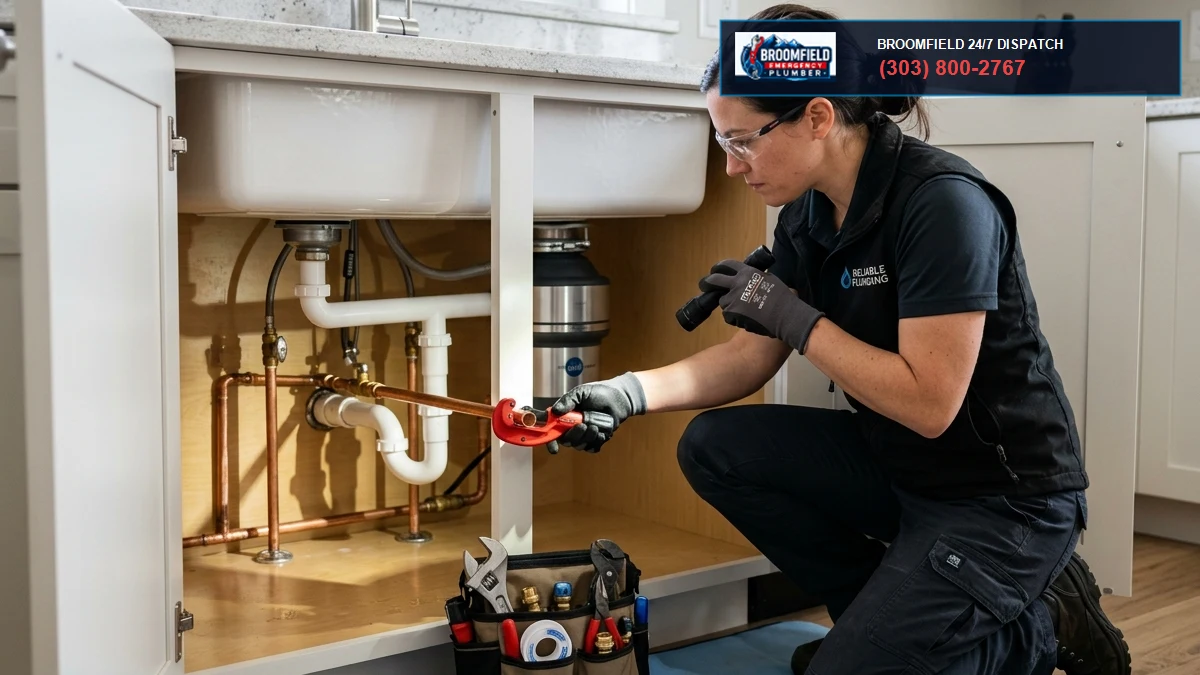
1. The Geological Reality: Why Front Range Basements Are Radioactive Sinks
Why is radon gas such a severe hazard along the Colorado Front Range?
Radon-222 is a naturally occurring radioactive noble gas produced by the radioactive decay chain of Uranium-238 present in Rocky Mountain granite.
Unlike mineral scale or waterborne bacteria, radon is an unreactive, inert gas:
- It carries zero color, zero odor, and zero chemical taste.
- It has a specific gravity of **9.73 (nearly eight times heavier than air)**.
- Because it is an inert noble gas, it does not bind to soil particles. It migrates freely through subterranean fractures, porous gravel bedding, and crushed aggregate beneath commercial concrete floor slabs.
â˜¢ï¸ The Alpha Particle Radiation Hazard
Radon has a radioactive half-life of 3.82 days. As it decays, it transforms into solid radioactive polonium isotopes ($^{218}Po$ and $^{214}Po$).
When office workers or hotel guests inhale indoor air containing elevated radon, these microscopic radioactive daughters attach directly to lung bronchial tissue. When they decay, they emit high-energy alpha particles ($5.49\text{ MeV}$)—microscopic atomic cannonballs that shatter DNA strands in pulmonary epithelial cells.
According to the EPA and the CDC, radon gas exposure is the number-one leading cause of lung cancer among non-smokers in the United States, causing over 21,000 fatalities annually!
2. The Stack Effect & Soil Gas Advection: The Hydraulic Suction Engine
How does gas buried six feet beneath a concrete slab get pulled into a commercial building?
Subterranean soil gas does not merely diffuse slowly through concrete; it is driven by **bulk advective pressure differentials**:
📠The Building Thermal Stack Effect Equation
$$\Delta P_{\text{stack}} = \rho_o \cdot g \cdot h \cdot \left(\frac{T_i – T_o}{T_i}\right)$$
Where:
- $\Delta P_{\text{stack}}$ = Driving pressure differential between basement and outdoor atmosphere (Pascals)
- $\rho_o$ = Outdoor air density ($1.225\text{ kg/m}^3$)
- $g$ = Gravitational acceleration ($9.81\text{ m/s}^2$)
- $h$ = Total vertical height of the commercial building (meters)
- $T_i, T_o$ = Absolute indoor and outdoor temperatures (Kelvin)
In a five-story commercial office building in Broomfield during winter, the stack effect generates a continuous basement vacuum of -8 to -15 Pascals.
A commercial sump basin is a direct, unshielded 36-inch hole punched through the concrete slab into the crushed rock drainage base. That open hole acts as a massive vacuum intake, sucking hundreds of cubic feet of concentrated radioactive soil gas (often measuring 2,000 to 10,000 pCi/L under the slab) directly into the building’s air supply!

3. Anatomy of a Basin Barrier Failure: Why Cheap Covers Leak
Many commercial properties built prior to 2015 feature basic sheet-metal or plywood split-covers loosely bolted over ejector pits.
Four mechanical weak points destroy the gas barrier:
| Failure Point | Mechanical Weakness | Gas Infiltration Mechanism | Master Plumber Solution |
|---|---|---|---|
| Perimeter Lid Gasket | Standard open-cell sponge rubber or dried butyl tape | Thermal drying, ozone degradation, and grease vapors harden the gasket. Suction pulls radioactive gas past warped steel flanges. | Install continuous 3/8-inch closed-cell **EPDM elastomeric compression foam** or 100% silicone O-ring bead torqued to 35 ft-lbs. |
| Pipe Discharge Penetrations | Crude oversized holes cut into the cover around 2-inch or 3-inch discharge pipes | Unsealed annular gaps act like open chimneys venting radon and methane into the mechanical room. | Deploy **cast-iron compression flange hubs** or heavy-duty neoprene mechanical pipe grommets clamped with stainless-steel worm bands. |
| Electrical Cable Pass-Throughs | Pump power cords and float switch wires draped loosely through open cover slots | Gases travel through the hole; even worse, gas migrates inside the hollow electrical conduit straight into electrical panels! | Install **liquid-tight, gas-tight cord grip compression bushings**; pack and pour Chico® EYS explosion-proof conduit sealing fittings. |
| Observation / Inspection Portals | Unsealed inspection hatches or missing portal plugs | Maintenance technicians remove access bolts to view floats and fail to re-seal the port. | Install an engineered **clear 1/2-inch polycarbonate viewing window** fitted with a bolted O-ring flange, allowing visual inspection without unsealing the pit! |
4. Active Soil Depressurization (ASD) Interactions: The Trap Siphon Threat
Commercial facilities often install commercial Active Soil Depressurization (ASD) radon mitigation systems: high-flow centrifugal inline fans (such as RadonAway or Fantech commercial units) pulling negative pressure from beneath the slab through 4-inch or 6-inch PVC vent stacks.
Here is the dangerous hydraulic conflict that inexperienced contractors overlook:
âš ï¸ The Floor Drain P-Trap Siphon Hazard
A commercial radon fan creates a subterranean vacuum of -150 to -300 Pascals (-0.6 to -1.2 inches of water column) directly beneath the slab.
If unsealed foundation perimeter drain tiles (French drains) connect directly into an open sump basin, that intense sub-slab vacuum pulls against the interior of the building!
If floor drains, trap primers, or emergency floor receptors are dry or unprimed, the radon fan can actually reverse air flow through the building’s drainage traps, sucking foul sewer gases out of dry waste lines and exhausting them through the roof, while pulling contaminated air across occupied tenant offices!
To prevent this, commercial plumbing codes mandate that groundwater dewatering sumps and sewage ejector basins must be **physically and pneumatically decoupled**:
- Groundwater sumps must utilize sealed check valves and dedicated independent trap priming.
- If an ASD radon suction pipe ties into a sump basin, the basin cover must be certified **airtight to 1.5 times the fan’s maximum shutoff suction head**.
- All nearby floor drains must be fitted with **ASME A112.18.8 / ASSE 1072 certified one-way barrier trap seal inserts (Green Drain)** to prevent reverse soil gas infiltration.
5. The Master Plumber Hermetic Sealing Retrofit Protocol
When indoor radon levels or sewer gas leaks breach commercial safety thresholds, our master plumbers execute a rigorous, code-compliant sealing retrofit:
- Sub-Slab Pressure Field Extension (PFE) Audit: Drill 3/8-inch test holes through the basement slab at 20-foot intervals; measure pressure differentials using an Energy Conservatory DG-1000 digital micromanometer to confirm the extent of negative pressure beneath the slab.
- Heavy-Duty Cover Fabrication: Install a custom 1/4-inch aircraft-grade 6061-T6 aluminum or 304 stainless-steel gas-tight diamond plate cover engineered to support a 500-pound surface live load.
- Full-Circumference Compression Gasketing: Apply a continuous, unbroken gasket of high-density closed-cell EPDM rubber around the basin rim flange. Fasten with stainless-steel Grade 316 drop-in anchors torqued in a crisscross pattern.
- Hermetic Cord Seal Manifold: Route all pump power leads, sensor wires, and transducer cables through multi-hole neoprene compression grommets mounted in an external junction box.
- Dedicated IPC Section 712 Atmospheric Vent: Ensure the ejector basin vent terminates through the building roof without mechanical restriction, allowing displaced air to escape naturally during pump discharge cycles without pressurizing the lid gasket.
6. Post-Installation Testing: Smoke Testing & Continuous Rad-Link Auditing
How do we prove that a commercial sump basin is 100% gas-tight?
Master commercial plumbers never guess; we verify using **positive-pressure chemical smoke diagnostics**:
- An electric smoke blower injects non-toxic white zinc-chloride diagnostic smoke into the basin under 1.0 inch water column of positive static air pressure.
- Technicians inspect every square inch of the basin perimeter, bolt penetrations, cord grips, and pipe flanges using intense halogen inspection lights.
- If a single wisp of smoke escapes, the fastener is re-torqued and sealed with elastomeric polyurethane sealant until **zero visible smoke leakage occurs**.
- Finally, a continuous digital radon monitor (Radalink or Sun Nuclear 1028-XP) records hourly radon levels for 72 hours, certifying that indoor levels have dropped permanently below **2.0 pCi/L**.
🚨 Emergency Commercial Sump & Radon Plumbing Service in Broomfield
Have indoor radon tests spiked above 4.0 pCi/L? Do your commercial basement sumps smell of sewer gas, or are your ejector lid gaskets cracked and leaking?
Call our 24/7 commercial emergency master plumbers at (303) 647-3363. We dispatch commercial plumbing crews equipped with aircraft-grade aluminum hermetic covers, digital micromanometers, chemical smoke blowers, and certified ANSI/AARST RMS-LB gas-barrier sealing assemblies.