
Imagine an industrial high-pressure hydro-jetter operating inside a commercial strip center or restaurant complex in Broomfield, Colorado. The diesel engine screams at 2,400 RPM on the trailer outside. Down in the sub-slab drain line, a hardened stainless steel nozzle blasts water at **4,000 PSI and 18 gallons per minute**. Suddenly, sixty feet down the lateral, the nozzle strikes a dense wall of saponified kitchen grease.
The forward momentum halts instantly.
Trapped hydraulic pressure surges violently backward.
Within milliseconds, an explosive geyser of black, rancid grease slurry, pulverized sewer sludge, and scalding water erupts out of the indoor cleanout riser. It coats the kitchen ceiling, splatters prep counters, and ruins thousands of dollars in dry food inventory.
This catastrophic phenomenon is known throughout the commercial plumbing trade as **hydro-jetting blowback and cleanout surcharge**.
When amateur contractors or inexperienced drain cleaners tackle commercial sanitary laterals without understanding hydrodynamic thrust vectors, cleanout airflow venting, and hydraulic backpressure, disasters happen.
High-pressure hydro-jetting is not just running an oversized pressure washer hose down a pipe. It is an industrial hydraulic process governed by fluid momentum, Bernoulli’s equation, and extreme velocity gradients.
Let’s analyze the physics of nozzle thrust dynamics, dissect the causes of high-pressure grease line blowback, review International Plumbing Code (IPC) cleanout standards, and explore the advanced blast-containment protocols our master plumbers use across the Colorado Front Range.
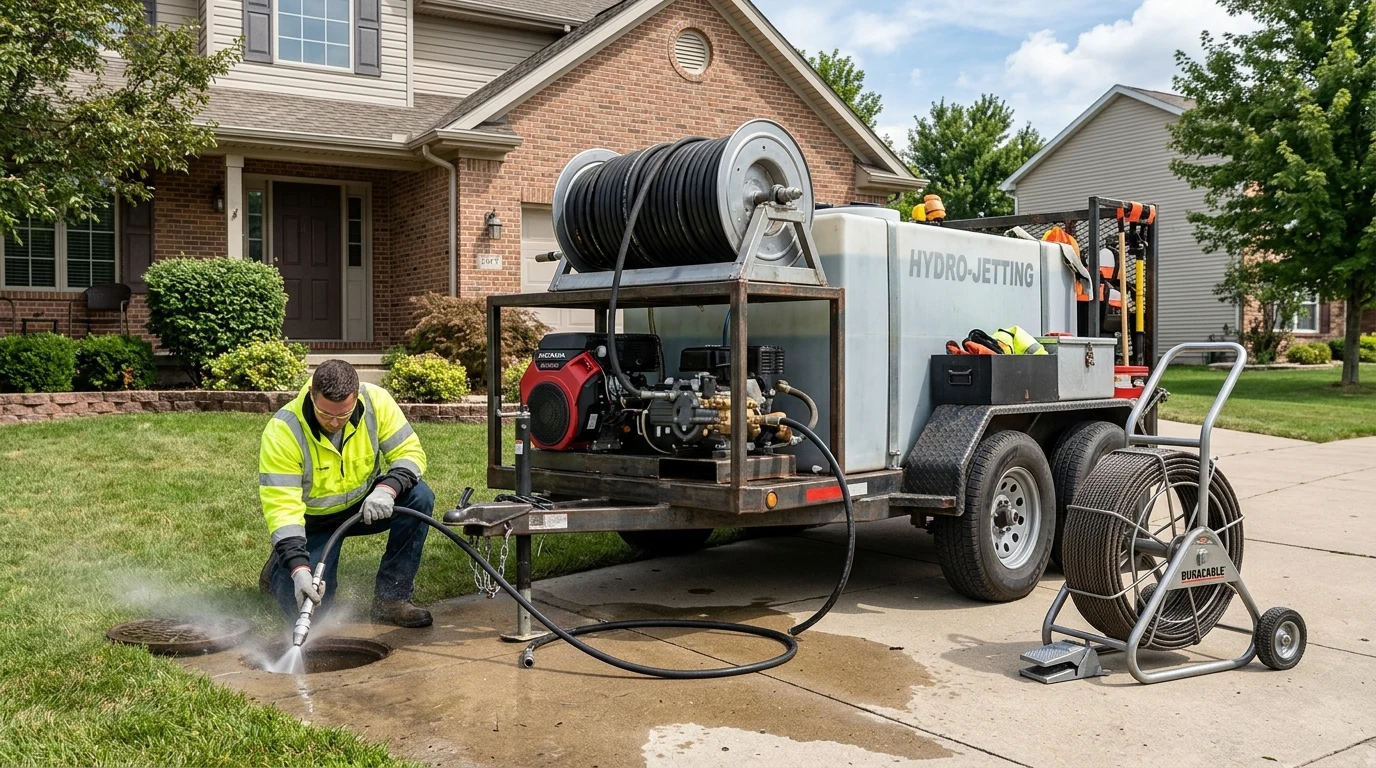
1. The Physics of Hydrodynamic Jetting: Thrust Vectors & Nozzle Reaction Forces
How does a flexible rubber hose pull itself hundreds of feet through a dark, greasy pipe without anyone pushing it?
The answer is **Newton’s Third Law of Motion: For every action, there is an equal and opposite reaction**.
A commercial hydro-jetting nozzle does not push water forward to pull itself along. Instead, it discharges water backward at high velocity through angled rear-facing orifices.
As high-pressure water exits the rear orifices, the momentum of the escaping fluid creates a forward thrust reaction force that propels the nozzle and hose deep into the sewer lateral.
Calculating Nozzle Reaction Thrust
We calculate the forward thrust force ($F_{\text{thrust}}$) generated by a commercial hydro-jetting nozzle using fluid momentum mechanics:
Where:
- $\dot{m}$ = Mass flow rate of water ($\dot{m} = \rho Q$, where $\rho$ is water density, $62.4 \text{ lb/ft}^3$ or $8.34 \text{ lb/gal}$)
- $Q$ = Volumetric discharge flow rate ($gal/min$ converted to $ft^3/s$)
- $v_e$ = Exit velocity of the fluid jet emerging from the nozzle orifice ($ft/s$)
- $\theta$ = Angle of the rear jet spray relative to the pipe centerline (typically $15^\circ$ to $45^\circ$)
The exit velocity ($v_e$) is determined by Bernoulli’s equation across the nozzle orifice differential pressure ($\Delta P$):
Where $C_d$ is the discharge coefficient of the machined ceramic or carbide insert (typically $0.90$ to $0.98$).
At an operating pressure of **4,000 PSI (27.6 MPa)**, water blasts out of nozzle orifices at supersonic speeds exceeding **770 feet per second (525 miles per hour)**.
In an 18 GPM commercial rig, this generates between **35 and 65 pounds of continuous forward pulling thrust**. That is enough force to drag 200 feet of heavy 1/2″ wire-braided hose around multiple 90-degree bends.
However, that exact same hydraulic energy creates an extreme hazard if flow becomes trapped or obstructed.
2. The Mechanics of Grease Blast-Back: Trapped Hydraulic Pressure and Air Compression
What causes a cleanout to erupt like a volcano during jetting?
Commercial grease lines do not fail like residential hair clogs.
In commercial restaurant laterals, fats, oils, and grease (FOG) form solid, non-porous cylindrical plugs—often spanning 10 to 30 continuous feet of pipe.
When an operator pushes a jetter nozzle toward this solid grease barrier from an upstream indoor cleanout, several dangerous physical phenomena occur simultaneously:
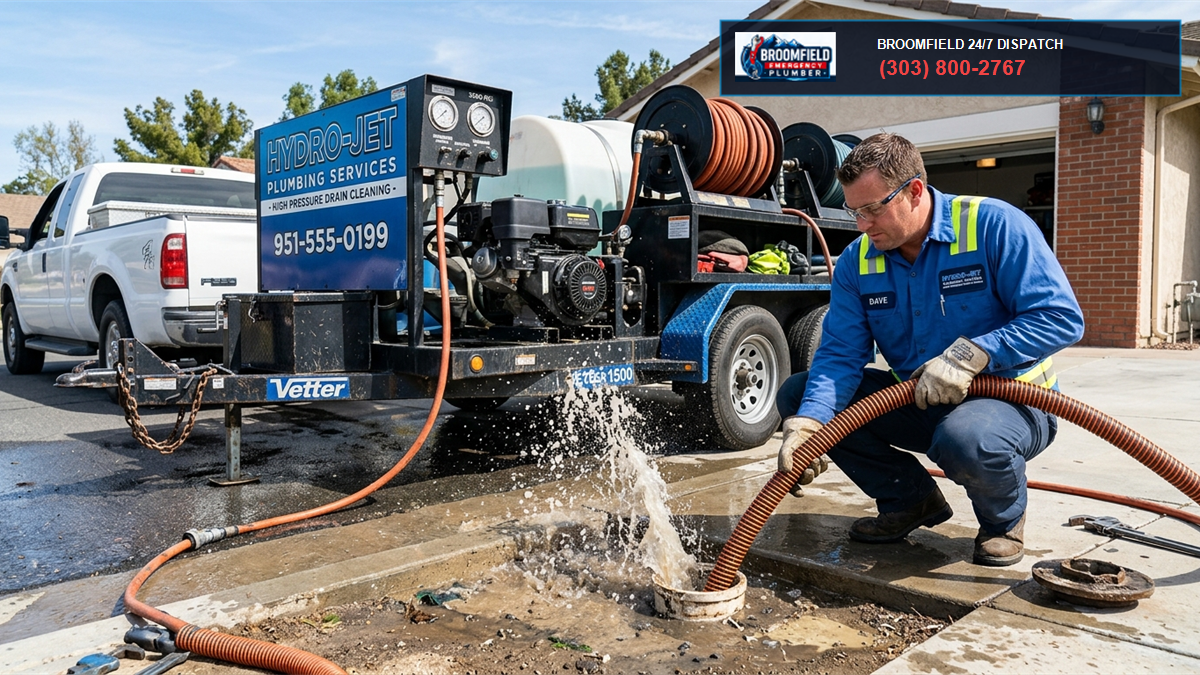
1. Hydraulic Piston Effect & Column Trapping
As the nozzle fires 18 gallons of water per minute into a sealed pipe section between the cleanout and the grease plug, that volume must go somewhere.
If the pipe ahead is 100% blocked, water cannot pass forward. The backward-firing jets fill the void behind the nozzle with pressurized water.
The liquid column acts as a hydraulic piston. The water is forced to reverse direction, accelerating backward toward the only open atmospheric relief point: the cleanout riser where the technician is standing.
2. The Pneumatic Air Spring: Boyle’s Law in Action
Sewer lines are never completely empty; they contain large pockets of sewer gas and atmospheric air.
As the high-velocity water jet advances toward a solid grease obstruction, the air trapped between the water column and the plug cannot escape. It compresses.
According to **Boyle’s Law ($P_1 V_1 = P_2 V_2$)**, compressing trapped sewer gas to half its volume doubles its internal absolute pressure.
As the jetter continues pumping water at 4,000 PSI, the trapped air pocket compresses into a high-energy pneumatic spring. When the nozzle penetrates or bounces off the obstruction, that compressed air pocket expands with explosive speed, shooting hundreds of gallons of grease-laden wastewater backward out of the pipe opening like a cannon.
3. Venturi Starvation and Vapor Cavitation
The intense velocity of water exiting rear orifices creates a localized low-pressure zone directly behind the nozzle body via the Venturi effect.
If the pipe is restricted, fluid pressure drops below the vapor pressure of water, generating microscopic cavitation vapor bubbles. When these bubbles collapse against pipe walls or grease dams, micro-jets generate localized shock waves exceeding **100,000 PSI**, which can shatter brittle vitrified clay tile (VCT) pipes or split aging cast iron hubs.
3. Upstream vs. Downstream Jetting: The Golden Rule of Commercial Drain Cleaning
Why do inexperienced operators flood buildings?
They violate the fundamental rule of commercial jetting: **Always jet UPSTREAM into a clog from a downstream access point whenever hydraulically feasible**.
| Operational Parameter | Downstream (Correct / Professional) | Upstream (High Risk / Amateur) |
|---|---|---|
| Access Point Location | Exterior yard cleanout, manhole, or grease interceptor inlet. | Indoor kitchen cleanout, floor drain, or basement sink trap. |
| Nozzle Direction | Propels UP the pipe toward the facility against flow. | Propels DOWN the pipe away from the facility with flow. |
| Debris Evacuation Path | Released grease flows naturally backward DOWNSTREAM toward interceptor. | Released grease is pushed ahead into smaller lines or stacks up behind nozzle. |
| Blowback Risk | ZERO risk to building interior; spray vents into exterior interceptor. | EXTREME; any line stall blows dirty sewage straight into kitchen. |
| Water Volume Evacuation | 100% of pump water drains away through opened downstream main. | Pump water pools inside building slab, searching for floor sink outlets. |
When our master plumbers set up on a commercial restaurant in Broomfield, we locate the exterior bi-directional cleanout or grease interceptor manhole.
We run our high-pressure hose into the interceptor inlet and feed it *upstream* toward the kitchen.
As the nozzle cuts through grease, gravity and water flow wash all broken fat chunks downstream directly into the grease trap—completely away from the building interior. No smells, no mess, and zero blowback inside the kitchen.
4. Nozzle Selection: The Science of Matching Orifice Geometry to Line Obstructions
You cannot clean a 6-inch grease-encrusted commercial main using a generic 15-degree cleaning nozzle.
Commercial drain technicians carry specialized nozzles engineered for specific pipe materials and clog densities:

1. Penetrator / Chisel Nozzle
Features 1 sharp forward jet (straight ahead at $0^\circ$), 3 or 4 forward-facing angled jets ($15^\circ$), and 6 high-thrust rear propulsion jets ($30^\circ$).
This nozzle acts as a hydraulic spearhead. It punches a relief borehole through solid grease dams, releasing trapped pressure and allowing water to drain so downstream cleaning can begin.
2. Rotary Grease Spinner (Warthog / Reaper)
Contains an internal viscous fluid governor that regulates head rotation speed between 200 and 500 RPM.
Dual high-velocity radial jets sweep the pipe circumference in overlapping circular paths. Rather than just punching a hole, the rotary spinner cuts grease off pipe walls like a spinning lathe, emulsifying thick fat blankets into microscopic particles.
3. Chain Flail Knockers
Mounted on a high-pressure jetter or flexible high-speed shaft, spinning circular chain links expand under centrifugal force to match the inner pipe diameter.
They pulverize rock-hard saponified calcium concretions and heavy cast iron tuberculation without fracturing the host pipe walls.
4. Cornering / Drop-Head Nozzles
Short, rounded brass bodies with flexible hose leaders designed to snake through tight commercial P-traps, short-radius sanitary tees, and multi-turn indirect waste offsets where long nozzles bind and wedge tight.
5. International Plumbing Code (IPC) Section 708: Cleanout Standards and Hydraulic Access
Why do so many commercial kitchens lack safe jetting access points?
Because contractors cut corners during original construction, installing undersized, unthreaded, or poorly located cleanouts.
Under **IPC Section 708 (Cleanouts)**, commercial drainage systems must provide accessible, properly sized cleanouts to permit full mechanical clearing:
- IPC Section 708.1.1 (Horizontal Drains): Cleanouts must be installed not more than 100 feet apart on horizontal drainage lines up to 4 inches, and not more than 100 feet apart on lines over 4 inches.
- IPC Section 708.1.2 (Change of Direction): A cleanout is mandatory for each change of direction greater than 45 degrees in building sewers and horizontal drain lines.
- IPC Section 708.1.5 (Cleanout Size): Cleanouts must match the nominal diameter of the pipe they serve up to 4 inches. A 4-inch main lateral must have a full 4-inch cleanout opening; reducing cleanouts down to 2 inches is a code violation that prevents the use of rotary descaling heads.
- IPC Section 708.1.8 (Clearance): Cleanouts must maintain at least 18 inches of unobstructed clearance in front of the opening for lines 3 inches and larger to allow proper hose reel and blast containment hookup.
When retrofitting commercial facilities in Broomfield, our master plumbers install **Two-Way Cleanouts (Bi-Directional Risers)**.
A two-way cleanout features a dual-sweep fitting allowing a jetter nozzle to be directed either upstream toward the building or downstream toward the municipal main from a single access point. This configuration provides total hydraulic flexibility while eliminating indoor blast-back hazards.
6. Water-Oil-Grease (WOG) Dynamics and Emulsification Chemistry
What happens to grease inside the pipe once high-pressure water hits it?
If you blast grease with cold water, you do not solve the problem. You merely relocate it.
Cold water breaks solid grease into cold, sticky chunks. As those chunks travel downstream into cooler sub-slab piping, they agglomerate—sticking together to form even larger blockages further down the line, often clogging the inlet baffle of the grease interceptor.
The Thermal Advantage: Hot-Water Hydro-Jetting
Commercial cooking oils and animal fats have distinct thermal melt profiles:
- Butter & Dairy Fats: Melt at 90°F to 95°F (32°C to 35°C).
- Beef Tallow & Lard: Melt at 105°F to 115°F (40°C to 46°C).
- Hydrogenated Vegetable Shortening: Melts at 115°F to 125°F (46°C to 52°C).
Our commercial jetting trailers feature on-board industrial diesel-fired water heaters that heat water up to **160°F to 180°F (71°C to 82°C)**.
When 160°F water impacts congealed grease at 4,000 PSI, the combination of intense kinetic energy and thermal liquefaction melts the lipid matrix on contact.
The rapid mechanical agitation shears the melted grease into microscopic droplets, creating a temporary **mechanical emulsion** that flows effortlessly downstream into the exterior grease interceptor without settling or sticking to the pipe crown.
7. Blast Containment Protocols: How Master Plumbers Protect Kitchens During Indoor Jetting
What happens when a pipe configuration offers no exterior access, forcing jetting from inside an active commercial kitchen?
Our master plumbers never open an indoor cleanout without implementing our **5-Stage Cleanout Blast Containment Protocol**:
- Engineered Splash Flange & Jetter Guide: We thread a specialized containment hood directly onto the cleanout riser. The assembly incorporates a rubber cone seal and heavy-duty brass ball valve. The jetter hose passes through a snug elastomeric grommet that strips water and grease off the hose while containing 100% of internal pressure splashes.
- Dual Auxiliary Vacuum Extraction: We clamp a 2-inch commercial wet vacuum extraction hose directly into the side port of the containment hood. As the jetter pumps 15 GPM, our vacuum system continuously extracts returned wastewater into sealed containment drums, preventing any puddle formation on kitchen tile.
- Atmospheric Vent Cap Relief: We verify that the commercial building roof vent stack is completely clear. Venting relieves positive pneumatic pressure, allowing air to escape out the roof rather than compressing inside the sub-slab drain.
- Containment Tenting & Poly Sheeting: In sensitive food preparation environments, we erect flame-retardant polyethylene containment walls around the work zone under negative air machines equipped with HEPA filtration.
- Radio-Controlled Jetter Shutoff: The technician guiding the hose inside the kitchen holds a wireless emergency deadman switch. If the nozzle binds or backpressure surges, releasing the switch kills high-pressure pump bypass within 150 milliseconds.
8. Hydraulic Shock & Water Hammer: Mitigating Pipe Ruptures
High-pressure water jetting creates significant dynamic hydraulic loading inside older piping systems.
When an operator rapidly closes a high-pressure foot valve or when a high-speed nozzle suddenly impacts a solid obstruction, the kinetic energy of the moving water column converts into an intense pressure wave known as **water hammer (Joukowsky equation)**:
Where:
- $\Delta P$ = Surge pressure rise ($N/m^2$ or PSI)
- $\rho$ = Fluid density
- $c$ = Speed of the acoustic pressure wave in the pipe fluid medium ($\approx 4,700 \text{ ft/s}$ in water)
- $\Delta v$ = Instantaneous change in fluid velocity ($ft/s$)
Abruptly cutting off an 18 GPM flow stream at 4,000 PSI can generate localized pressure spikes exceeding **6,000 to 8,000 PSI**.
In older, corrosion-thinned cast iron pipe or brittle vitrified clay tile, this instantaneous hydraulic shock will shatter pipe hubs, blow out rubber Fernco couplings, and blow out toilet wax seals on adjacent fixtures.
Our certified technicians utilize soft-ramping electronic pressure unloader valves and pulse-modulation dampeners to eliminate pressure spikes, protecting delicate commercial infrastructure.
9. Hose Friction Losses & Darcy-Weisbach Pressure Drop Across Long Runs
Why do some commercial jetting rigs fail to cut grease despite reading 4,000 PSI at the trailer pressure gauge?
The issue is **frictional head loss inside the high-pressure hose**.
Pressure at the pump gauge is never the pressure delivered at the nozzle tip. As water flows through hundreds of feet of flexible thermoplastic or wire-braided hose, internal fluid friction dissipates hydraulic energy as heat.
We model this pressure loss using the classical **Darcy-Weisbach Equation**:
Where:
- $\Delta P_f$ = Frictional pressure loss ($lbf/ft^2$ converted to PSI)
- $f$ = Darcy friction factor (determined via Reynolds number and hose relative roughness)
- $L$ = Total length of high-pressure hose ($ft$)
- $D_h$ = Inner diameter of the hose ($ft$)
- $\rho$ = Water density ($1.94 \text{ slugs/ft}^3$)
- $v$ = Fluid velocity inside the hose ($ft/s$, where $v = Q / A$)
Notice the exponential sensitivity to hose diameter ($D_h$). Because velocity ($v$) is inversely proportional to cross-sectional area ($A \propto D_h^2$), velocity squared ($v^2$) scales inversely with the fourth power of diameter ($D_h^4$).
A minor reduction in hose inner diameter causes a massive spike in friction loss:
| Hose Inner Diameter (ID) | Flow Rate (GPM) | Pressure Drop per 100 ft | Delivered Pressure at 200 ft (4,000 PSI Pump) | Effective Cleaning Power |
|---|---|---|---|---|
| 1/4-inch ID Hose | 4.0 GPM | 1,100 PSI / 100 ft | 1,800 PSI at nozzle (55% Loss) | Severely compromised; fails on dense grease. |
| 3/8-inch ID Hose | 10.0 GPM | 480 PSI / 100 ft | 3,040 PSI at nozzle (24% Loss) | Acceptable for 3″ secondary branches. |
| 1/2-inch ID Hose (Commercial Rig) | 18.0 GPM | 220 PSI / 100 ft | 3,560 PSI at nozzle (11% Loss) | Maximum impact; pulverizes hard fatbergs. |
If an inexperienced operator attempts to pump 16 GPM through a 200-foot run of 3/8″ hose, friction consumes over 1,800 PSI before water even reaches the nozzle. The nozzle dribbles against grease blocks without sufficient kinetic energy to slice through the buildup.
Our commercial rigs run heavy-duty **1/2-inch industrial hose** equipped with ultra-slick polymer inner jackets, guaranteeing maximum kinetic force at the cutting face.
10. WJTA Safety Standards, Anti-Reversal Leaders & Operator Hazard Controls
High-pressure water jetting is one of the most hazardous operations in the commercial mechanical trades.
Water at 4,000 PSI acts as a fluid razor blade. An accidental brush against a pressurized jet will slice through work boots, sever tendons, and inject contaminated sewage directly into deep muscle tissue—an injury known as a **high-pressure fluid injection injury**.
The WaterJet Technology Association (WJTA) and OSHA Standard 1910.212 mandate strict operator engineering controls:
1. The Anti-Reversal Leader Assembly (The “Stinger”)
In larger commercial drain lines (6-inch, 8-inch, or 10-inch mains), a standard flexible hose and short nozzle can perform a lethal maneuver: **pipe reversal**.
As the nozzle strikes an obstruction or pipe joint, the flexible hose buckles. The backward thrust of the rear jets causes the nozzle to turn 180 degrees inside the pipe. The nozzle begins propelling itself *backward* toward the cleanout opening at 20 feet per second.
If it exits the cleanout, the flying nozzle whips uncontrollably through the air, discharging high-velocity water that can instantly dismember or kill the technician.
To prevent pipe reversal, our master plumbers attach a **rigid 36-inch stainless steel leader pipe (the stinger)** directly between the flexible hose and the nozzle.
Because the rigid metal pipe is longer than the inside diameter of the drain line, it is geometrically impossible for the nozzle assembly to bend or turn around inside the pipe.
2. Operator Foot Valve & Pressure Relief Controls
The primary technician controlling the hose must continuously depress a mechanical or pneumatic **deadman foot valve**.
If the operator slips on greasy kitchen tile or loses physical control of the hose, removing foot pressure dumps pump pressure to zero in less than 200 milliseconds via an atmospheric bypass dump valve.
3. Personal Protective Equipment (PPE) Matrix
Our field technicians wear certified WJTA-compliant safety gear:
- Kevlar-reinforced high-pressure safety gaiters and steel-toed metatarsal blast boots rated up to 10,000 PSI.
- Full-face polycarbonate impact shields over ballistic safety glasses.
- Heavy nitrile chemical under-gloves beneath abrasion-resistant Kevlar armored gloves.
- Biological pathogen containment suits to protect against airborne aerosolized norovirus, hepatitis, and coliform bacteria.
11. Case Studies from Broomfield: Cleanout Disasters vs. Flawless Restorations
Here are two real-world case studies demonstrating the critical importance of professional jetting practices:
Case Study 1: The Kitchen Ceiling Disaster at a Broomfield Shopping Plaza
The Situation: A property management company hired an unlicensed handyman service to clear a backing-up kitchen line at a noodle bar in Broomfield. The handyman brought a small portable electric pressure washer inside, removed the 4-inch brass cleanout plug beneath the wok range, and shoved a rigid sewer nozzle down the pipe.
The Disaster: Thirty feet in, the nozzle hit a heavy calcium soap fatberg. Backpressure surged instantly. Because there was no containment hood, sixty gallons of hot black sewage blasted straight out of the cleanout opening, shooting eight feet into the air. It saturated acoustic ceiling tiles, coated stainless steel prep counters, and seeped under the partition wall into an adjacent dry goods store.
The Aftermath: The health department issued an immediate closure order. The restaurant suffered $38,000 in ruined food inventory, deep sanitation costs, and structural repairs.
Our Master Plumber Intervention: Our emergency commercial team was called to take over. We set up our trailer jetter at the exterior rear cleanout, deployed a 4,000 PSI Warthog rotary head running at 165°F, and emulsified the 20-foot fatberg within 45 minutes from the outside. We installed an IPC-compliant bi-directional cleanout riser outside the building to prevent indoor access forever.
Case Study 2: Emergency Saturday Night Clearing at an Interlocken Hotel
The Situation: An upscale hotel banquet kitchen hosting a 350-guest wedding reception experienced a complete main lateral blockage at 6:30 PM on a Saturday. Commercial dishwashers were backing up across the prep line.
Our Execution: Our commercial crew arrived in 20 minutes. Recognizing the critical operational timing, we deployed our 5-Stage Blast Containment System on the kitchen cleanout. Utilizing our dual vacuum recovery system and a 1-inch low-angle skid nozzle, we bored through the grease plug and extracted all return slurry directly to our vacuum tanks.
The Result: Not a single drop of wastewater touched the kitchen floor. The line was flowing at 100% capacity in 35 minutes. Banquet food prep proceeded without interruption, and the bride and groom never knew a crisis had occurred.
12. Equipment Comparison: Trailer Jetter vs. Cart Jetter vs. Mechanical Drum Snake
Commercial facilities often ask: “Why can’t I just rent a big snake from the tool rental store?”
Here is how commercial drain clearing technologies stack up:
| Equipment Type | Pressure / Power | Flow Rate | Grease Removal Capability | Best Fit For |
|---|---|---|---|---|
| Commercial Trailer Jetter | 4,000 PSI (Gas / Diesel) | 12 – 20 GPM | 100% Wall Emulsification & Descaling | 4″ to 12″ Commercial Mains & Grease Laterals |
| Portable Electric Cart Jetter | 1,500 – 2,200 PSI | 2.0 – 4.5 GPM | 60 – 75% Grease Clearing (Light) | 2″ to 3″ Secondary Branches & Indoor Traps |
| Mechanical Drum Snake (Cable) | Mechanical Torque (Rotating Steel) | 0 GPM (Dry) | 15 – 25% (Punches temporary hole only) | Solid objects, roots, rags, construction debris |
| High-Speed Flexible Shaft Miller | Rotary Carbide Chains (2,500 RPM) | Optional Mist | 90% Heavy Scale & Hard Saponification | Cast iron descaling & pipe preparation for lining |
Notice the stark difference in grease removal. A mechanical snake simply cuts a small hole through the center of a grease clog. As soon as hot kitchen water flows, loose grease collapses back into the hole, causing a repeat backup within days.
A trailer-mounted hydro-jetter washes the entire circumference of the pipe clean down to the original wall material, preventing repeat service calls.
13. Sewer Camera Inspection Verification: The Post-Jetting Standard
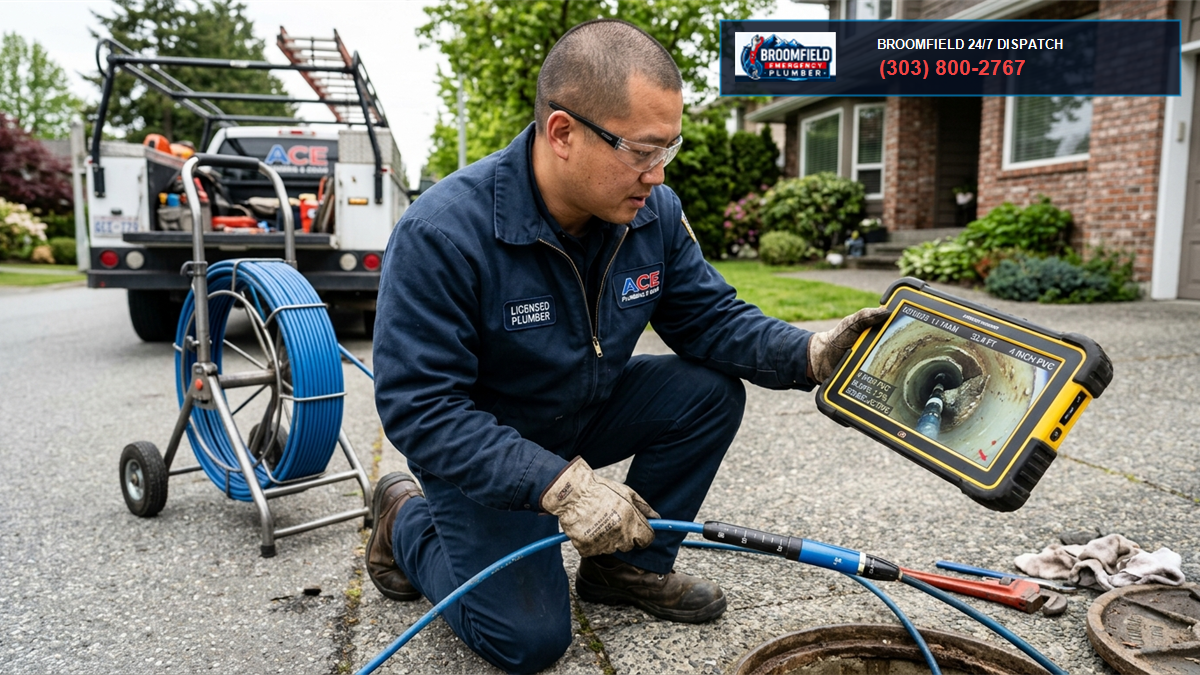
A hydro-jetting job is never complete until the entire line has been visually verified with a high-resolution color CCTV sewer camera.
Why is camera verification mandatory?
- Confirm 100% Pipe Wall Restoration: A pipe may drain water when 50% of the cross-section is still choked with grease. A camera verifies that the full 360-degree diameter is clear.
- Identify Hidden Structural Defects: Heavy grease blankets often hide cracked pipe bells, sheared clay joints, root intrusion, and structural pipe bellies (sags). Once the grease is scrubbed away, the camera reveals underlying pipeline defects.
- Locate Buried Sockets & Unmapped Tie-Ins: Self-leveling inspection cameras with 512 Hz radio transmitters allow our technicians to trace exact pipe runs, pipe depths, and branch connections under concrete slabs.
- Digital Video Documentation: We provide commercial facility owners and health inspectors with timestamped MP4 video recordings of the cleared lines for code compliance and warranty records.
14. Commercial Preventive Maintenance Programs: Ending Emergency Floods Forever
The most cost-effective way to manage commercial kitchen grease lines is scheduled maintenance before a surcharge occurs:
| Kitchen Facility Volume | Recommended Jetting Frequency | Grease Interceptor Pumping | Expected Downtime Savings |
|---|---|---|---|
| High-Volume Fast Food & 24-Hour Diners | Every 3 Months (Quarterly) | Every 30 to 60 Days | Eliminates 98% of peak-hour backup emergencies. |
| Full-Service Restaurants & Steakhouses | Every 4 to 6 Months | Every 60 to 90 Days | Prevents health inspection surcharge citations. |
| Corporate Cafeterias & School Kitchens | Twice Annually (Summer & Winter Breaks) | Every 90 Days | Zero disruption to scheduled daily meal service. |
| Commercial Bakeries & Coffee Shops | Annually | Every 90 to 180 Days | Prevents flour-dairy dough concretions in branch drains. |
15. Emergency Action Steps: What to Do When a Drain Starts Surcharging Right Now
If a commercial kitchen drain is currently backing up or threatening to overflow:
- Immediately Stop All Water Discharge: Order kitchen staff to turn off dishwashers, three-compartment sinks, and prep equipment. Every gallon poured down a sink will come out of the cleanout or floor sink.
- Do NOT Remove Cleanout Plugs Under Pressure: If the pipe is holding standing head pressure, removing the cleanout plug will instantly release an uncontrollable torrent of sewage onto your floor. Let a professional plumber contain the line first.
- Never Deploy Harsh Chemical Drain Openers: Sulfuric acid or caustic lye creates an extreme chemical burn hazard for the plumbing technicians who must clear the physical obstruction.
- Barricade the Work Area: Direct kitchen traffic away from contaminated tiles to prevent tracking pathogens through dining rooms and dry food storage.
- Call Licensed Master Plumbers Immediately: Contact our 24/7 commercial dispatch at (303) 647-3363. We deploy trailer jetters and certified master technicians across Broomfield within 30 to 45 minutes.
Frequently Asked Questions (FAQ)
What causes hydro-jetter blowback during drain cleaning?
Hydro-jetting blowback happens when an operator jets downstream toward a solid pipe blockage from an upstream indoor cleanout. The high-volume water stream cannot move forward, filling the pipe and compressing trapped sewer air pockets. When the air expands, it acts like a pneumatic spring, blasting hundreds of gallons of pressurized sewage backward out of the cleanout opening.
Can hydro-jetting damage old cast iron or clay sewer pipes?
When performed by certified master plumbers using calibrated nozzles and appropriate operating pressure (2,500 to 4,000 PSI), hydro-jetting is completely safe for structurally sound cast iron and clay pipes. However, amateur operators using incorrect nozzles or experiencing severe water hammer pressure spikes can damage brittle, unvented pipes. This is why professional pre-jetting camera inspection is essential.
Why is hot-water hydro-jetting superior to cold-water jetting for restaurants?
Cold water merely breaks hard grease into sticky, solid chunks that can lodge further downstream. Hot water heated to 160°F–180°F melts animal fats, lard, and vegetable oils, creating a fine mechanical emulsion that washes cleanly down the lateral directly into the exterior grease interceptor without re-solidifying.
How does a two-way cleanout prevent indoor kitchen flooding?
A bi-directional two-way cleanout features a dual-sweep fitting installed outside the building footprint. It allows master plumbers to insert jetting nozzles either upstream toward the building or downstream toward the municipal main from the exterior, keeping all grease slurry, spray, and pressure completely outside the kitchen.
How often should commercial restaurants hydro-jet their grease laterals?
High-volume commercial kitchens should schedule professional hydro-jetting every 3 to 6 months. Regular maintenance keeps pipe walls free of saponified fatbergs, prevents emergency dinner-rush shutdowns, and guarantees compliance with local municipal pretreatment regulations.
Commercial Sewer Line Blocked in Broomfield?
Don’t risk dirty cleanout blowbacks or kitchen shutdowns. Our licensed master plumbers use trailer-mounted hot-water hydro-jetters, blast containment hoods, and CCTV cameras to clear grease lines safely and permanently.