
At seven o’clock on a Friday evening during peak dinner rush in Broomfield, Colorado, a premier commercial restaurant, hotel banquet kitchen, or supermarket culinary deli suffers an operational nightmare. Frantic dishwashers drop their spray wands as murky, foul-smelling grease slurry bubbles up out of every kitchen floor sink.
Three-compartment pots-and-pans sinks refuse to drain.
Hot, rancid grease water overflows into food preparation walkways.
Out behind the building, the sub-grade concrete grease interceptor vault lid is weeping yellow lipid foam across the delivery alley.
The commercial grease interceptor has suffered a catastrophic **Baffle Collapse and FOG Surcharge Blowout**.
This is not a simple sink trap stoppage that a line cook can plunge clear.
It is an immediate health department violation, an environmental hazard under **Broomfield Municipal Code Chapter 13-08 (Fats, Oils, and Grease Pretreatment)**, and a structural mechanical failure governed by **ASME A112.14.3, PDI-G101 standards**, and biogenic sulfuric acid corrosion.
When an internal separation baffle rots through or a vented flow control device fails, thousands of gallons of emulsified animal fats bypass straight into the building lateral.
Within hours, the grease cools, saponifies with Front Range hard water minerals, and creates an impenetrable fatberg that chokes the building drain solid.
Let’s examine the fluid dynamics of hydromechanical grease separation, calculate Stokes’ Law lipid rise velocities, evaluate the EPA 25-Percent Rule mathematical limits, diagnose biogenic baffle rot, and detail master plumber structural restoration and high-temp hydro-jetting protocols across the Colorado Front Range.
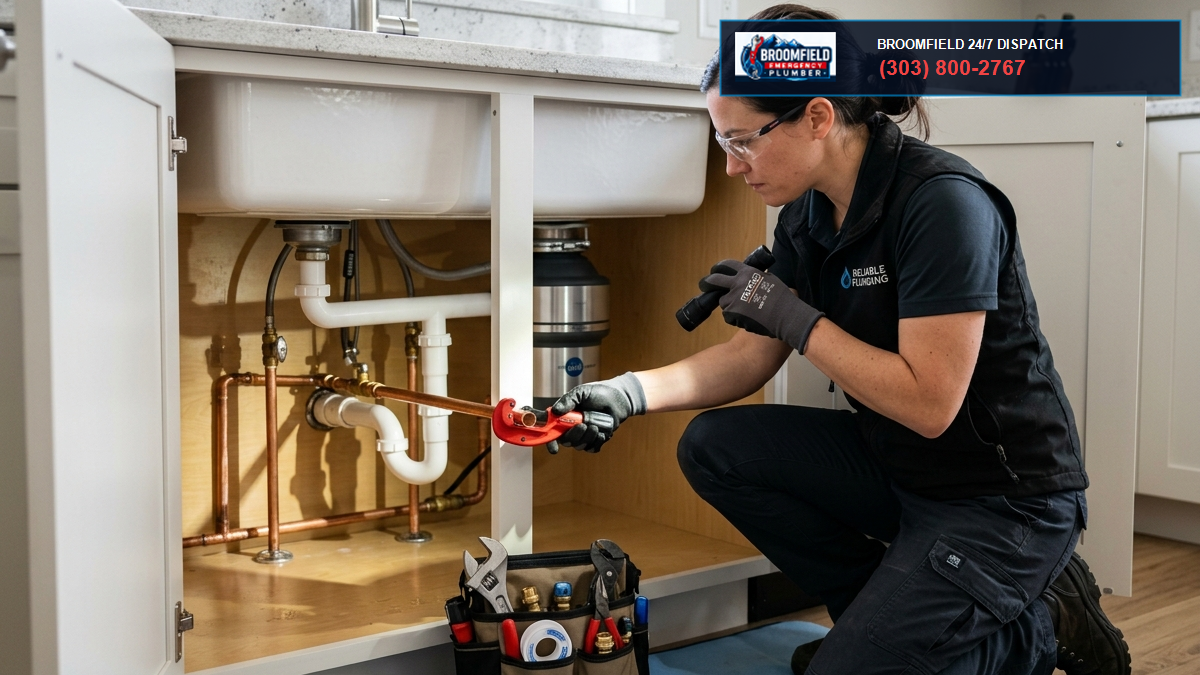
1. The Mechanical Engineering of Grease Interceptors: ASME A112.14.3 vs. Gravity Basins
Why do commercial kitchens require engineered grease interceptors rather than standard plumbing traps?
Commercial kitchens discharge wastewater laden with **Fats, Oils, and Grease (FOG)** at temperatures between 120°F and 160°F.
At cooking temperatures, grease is liquefied and emulsified with dishwashing surfactants.
As soon as this effluent enters cold underground sewer lines (where ground temperatures hover around 50°F in Broomfield), the grease rapidly cools, congeals, and solidifies onto pipe walls.
Under **International Plumbing Code (IPC) Section 1003.3 and Uniform Plumbing Code (UPC) Chapter 10**, all food service establishments (FSEs) must route greasy kitchen fixtures through an approved interceptor.
The industry utilizes two distinct engineering designs:
1. Hydromechanical Grease Interceptors (HGI) – ASME A112.14.3 / PDI-G101
Typically installed indoors under sinks or in floor pits adjacent to dishwashing stations.
HGIs utilize active fluid dynamics: an engineered external **vented flow control device**, kinetic velocity baffles, and air-entrainment mixing chambers.
Flow rates range from **20 GPM to 100 GPM** with certified grease retention capacities from 40 to 200 pounds of grease.
2. Gravity Grease Interceptors (GGI) – IAPMO / UPC Standards
Massive exterior underground precast concrete or fiberglass vaults buried outside the building footprint.
GGIs rely entirely on long hydraulic retention times (typically 20 to 30 minutes of undisturbed quiescent settling).
Volumetric capacities range from **750 Gallons to 2,500+ Gallons**.
| Engineering Metric | Hydromechanical Interceptor (HGI) | Gravity Vault Interceptor (GGI) | Key Operational Difference |
|---|---|---|---|
| Testing Standard | ASME A112.14.3 / PDI-G101 | IAPMO / UPC Chapter 10 | HGI requires certified flow control; GGI relies on volume. |
| Separation Mechanism | Air entrainment & kinetic baffles | Quiescent gravity settling | HGI separates grease 4x faster per gallon of footprint. |
| Retention Time | 3 to 5 Minutes | 20 to 30 Minutes | GGI requires massive tank volume to prevent washout. |
| Regulatory Sizing | Fixture Flow Rate (GPM Rating) | Drainage Fixture Units (DFU) & Hours | Sizing errors cause immediate hydraulic washout. |
Regardless of whether a facility utilizes an HGI or a GGI, proper separation depends entirely on the physical integrity of its **internal separation baffles**.
If a baffle collapses, retention time drops to near zero, turning the interceptor into a straight-through pipe that dumps raw grease directly into the city sewer.
UPC Table 1014.2.1 Sizing Calculations for Commercial Kitchens
How do engineers determine the exact required gallon capacity for an exterior commercial grease interceptor?
Under **Uniform Plumbing Code (UPC) Appendix H and Table 1014.2.1**, gravity grease interceptors are sized using total connected **Drainage Fixture Units (DFU)**:
Consider a full-service commercial restaurant kitchen in Broomfield:
- Two 3-compartment pot sinks: $2 \times 6 \text{ DFU} = 12 \text{ DFU}$.
- One commercial flight-type conveyor dishwasher: $6 \text{ DFU}$.
- Four commercial floor sinks: $4 \times 4 \text{ DFU} = 16 \text{ DFU}$.
- One wok range station: $4 \text{ DFU}$.
- Total Connected Kitchen Load: $\sum DFU = 38 \text{ DFU}$.
Calculating required tank volume:
The facility mandates a minimum **2,000-Gallon two-compartment gravity grease interceptor**.
If an undersized 1,000-gallon tank is installed instead, hydraulic retention time drops below fifteen minutes, washing emulsified grease straight into the municipal sewer line.
2. The Fluid Mechanics of Grease Separation: Stokes’ Law & Rise Velocity
How does an interceptor separate grease from moving water before the liquid escapes to the sewer?
The physics of gravity lipid separation is governed by **Stokes’ Law of Terminal Rise Velocity**:
Where:
- $v_r$ = Terminal vertical rise velocity of the grease droplet ($m/s$ or $ft/s$)
- $g$ = Gravitational acceleration ($32.2 \text{ ft/s}^2$)
- $d$ = Diameter of the emulsified grease droplet ($meters$ or $microns$)
- $\rho_w$ = Density of water ($998 \text{ kg/m}^3$ at 68°F)
- $\rho_g$ = Density of animal fats / vegetable oils (typically $890 \text{ to } 920 \text{ kg/m}^3$)
- $\mu$ = Dynamic viscosity of the wastewater ($Pa\cdot s$)
The Critical Droplet Size: 150-Micron Threshold
Notice the $d^2$ factor in Stokes’ Law above.
The vertical rise velocity is proportional to the **square of droplet diameter**.
Large grease globules ($d > 500 \text{ microns}$) rise to the surface in seconds.
However, kitchen dishwashing detergents break fats into microscopic emulsified droplets measuring **50 to 150 microns**.
A 150-micron droplet rises through still water at a sluggish velocity of only **0.005 feet per second (approx. 3.6 inches per minute)**.
To allow these microscopic droplets to float upward into the containment cap before effluent reaches the outlet pipe, the horizontal water velocity ($v_h$) across the interceptor must remain below **0.05 ft/s**:
This is why internal baffles are mandatory.
Baffles force incoming water downward into the quiet bottom zone of the tank, elongating the flow path and dissipating turbulent kinetic energy.
When an internal baffle breaks, horizontal velocity surges from 0.05 ft/s to over **1.2 ft/s**.
Turbulent eddy currents seize the microscopic grease droplets, carrying them straight through the outlet tee before they have time to float.
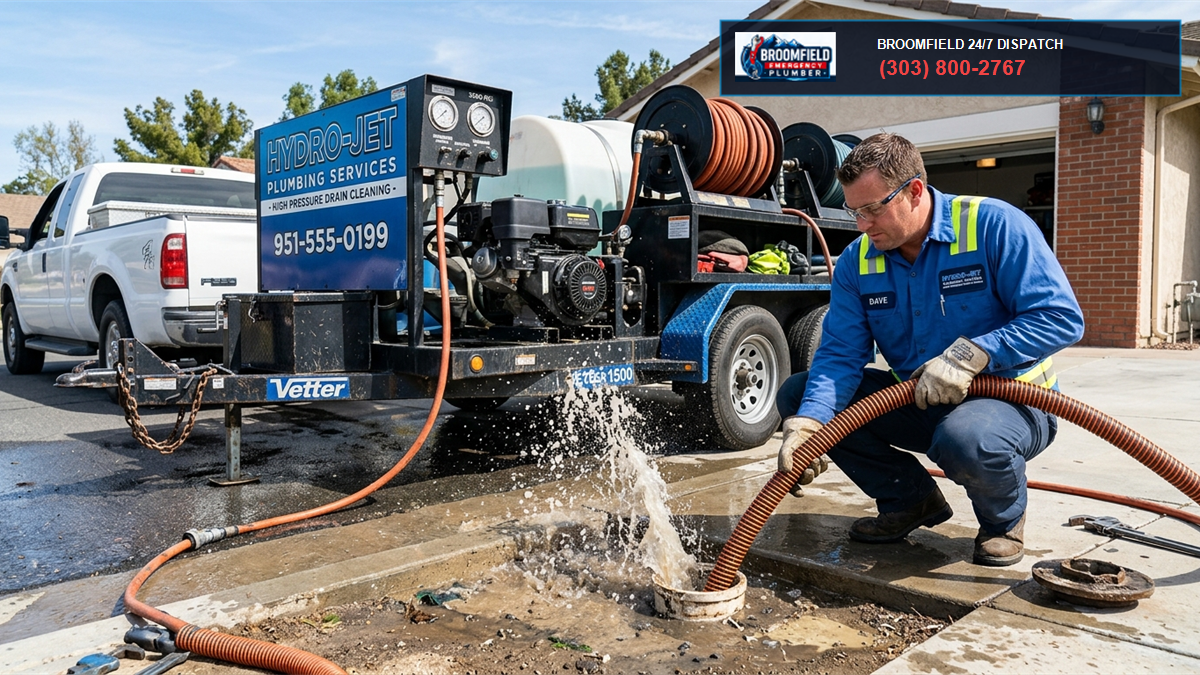
3. The EPA 25-Percent Rule & City of Broomfield Pretreatment FOG Mandates
How full can a commercial grease interceptor get before it fails code inspection?
Under **EPA Pretreatment Guidelines and City and County of Broomfield Municipal Code Section 13-08-140**, commercial food facilities are held to the strict **25-Percent Rule**:
When the combined thickness of the top floating grease layer ($d_{\text{grease}}$) and the bottom food solids sediment ($d_{\text{sludge}}$) reaches **twenty-five percent (25%)** of total liquid depth, the interceptor has reached its maximum design capacity.
It must be pumped out immediately by a licensed commercial waste hauler.
What Happens Beyond 25 Percent
When facility managers neglect pumping schedules and allow grease layers to accumulate past 35% or 45%:
- Effective Volume Loss: The clear water zone in the center of the tank is compressed. Effective hydraulic volume plummets by half.
- Fluid Velocity Spike: As cross-sectional area shrinks, fluid velocity through the clear zone doubles.
- Scour Velocity Resuspension: High-velocity water begins scouring settled food solids off the bottom and shearing chunks off the underside of the floating grease cap.
- Total Effluent Breakthrough: The interceptor enters full bypass mode. Effluent discharge samples show FOG concentrations spiking from compliant levels (< 100 mg/L) to catastrophic levels exceeding **1,500 to 4,000 mg/L**.
- Municipal Enforcement: Broomfield pretreatment inspectors issue immediate notices of violation, impose heavy administrative fines, and can mandate immediate water shutoff or restaurant operational suspension.
| Total Vault Liquid Depth | Max Allowable FOG + Sludge (25%) | Critical Violation Level (35%+) | Mandatory Municipal Action |
|---|---|---|---|
| 36 Inches (Typical HGI Pit) | 9.0 Inches Combined | > 12.5 Inches Combined | Immediate pumping within 24 hours required. |
| 48 Inches (Standard 1,000 Gal GGI) | 12.0 Inches Combined | > 16.8 Inches Combined | Formal Notice of Violation; mandatory proof of haul. |
| 60 Inches (Large 1,500 Gal GGI) | 15.0 Inches Combined | > 21.0 Inches Combined | Municipal surcharge penalties; possible facility shutoff. |
| 72 Inches (Industrial 2,500 Gal GGI) | 18.0 Inches Combined | > 25.2 Inches Combined | Administrative hearing; daily environmental civil fines. |
4. Biogenic Sulfuric Acid Corrosion: The Chemical Destroyer of Vault Baffles
Why do heavy concrete and metal baffles inside commercial interceptors crumble into powder?
The destruction is driven by **Microbiologically Induced Corrosion (MIC)**, commonly known as **Biogenic Sulfuric Acid Attack**.
A grease interceptor is a warm, anaerobic biochemical reactor.
The biological destruction occurs in three chemical phases:
Phase 1: Anaerobic Hydrogen Sulfide Generation
In the bottom settled food sludge layer, dissolved oxygen is completely depleted.
Anaerobic sulfate-reducing bacteria (*Desulfovibrio*) feed on organic sulfur compounds from meat and vegetable waste, reducing sulfates ($SO_4^{2-}$) into dissolved **Hydrogen Sulfide Gas ($H_2S$)**:
Phase 2: Gas Volatilization into Headspace
Because $H_2S$ has low solubility in warm, acidic water, it volatilizes out of the liquid into the sealed headspace between the grease cap and the vault concrete ceiling.
Phase 3: Aerobic Bacterial Oxidation to Sulfuric Acid
On the moist, un-submerged upper surfaces of concrete walls, steel baffle brackets, and outlet tees, aerobic sulfur-oxidizing bacteria (*Thiobacillus*) thrive in the humid headspace.
These bacteria metabolize $H_2S$ gas in the presence of oxygen, producing pure **Concentrated Sulfuric Acid ($H_2SO_4$)**:
The sulfuric acid condenses on the concrete roof and upper baffle walls.
The acid aggressively reacts with the calcium hydroxide ($Ca(OH)_2$) in structural concrete, converting solid Portland cement into soft, crumbly gypsum ($CaSO_4 \cdot 2H_2O$):
The structural concrete loses all compressive strength, turning into a white mush that crumbles between your fingers.
Heavy concrete baffle walls crack, lose anchorage, and collapse forward into the tank.
Steel hanging brackets dissolve completely.
When the baffle falls, thousands of pounds of trapped floating grease surge downstream into the municipal sewer main in a single catastrophic wave.

5. Flow Control Fitting Failures: Air-Entrainment Vents & Surge Washout
Why does an indoor hydromechanical interceptor overflow even when it was just pumped clean?
In indoor HGIs, the most critical mechanical component is not inside the tank—it is the **Vented Flow Control Fitting** installed on the incoming drain pipe.
Under **ASME A112.14.3 Section 4**, every certified HGI must be paired with an engineered flow control orifice designed to restrict incoming water velocity to the exact certified flow rating of the interceptor (e.g., 50 GPM).
The flow control fitting features a precision internal orifice plate and an air-entrainment intake port:
- Bernoulli Flow Limitation: Restricts discharge during simultaneous drainage of large 3-compartment sinks (which can discharge at over 120 GPM), preventing hydraulic washout.
- Air Entrainment Physics: As high-velocity water passes through the restriction orifice, it creates a local low-pressure zone that draws atmospheric air through an air intake vent. The entrained microscopic air bubbles attach to grease droplets inside the interceptor, accelerating their buoyant rise velocity by up to **300%**.
The Two Deadly Flow Control Failure Modes
- Orifice Orifice Clogging with Food Scraps: When dishwashers scrape plates into sinks without strainers, lemon wedges, chicken bones, and plastic straws jam the internal flow control orifice. The kitchen sinks back up immediately, leading cooks to assume the interceptor is full.
- Unqualified Tampering & Orifice Removal: Frustrated kitchen maintenance workers frequently remove the flow control orifice plate, believing it is an annoying restriction. Without flow control, a 100 GPM sink surge rushes into a 35 GPM interceptor. The massive hydraulic shockwave blows the floating grease cap straight into the outlet pipe, flooding the building lateral in minutes.
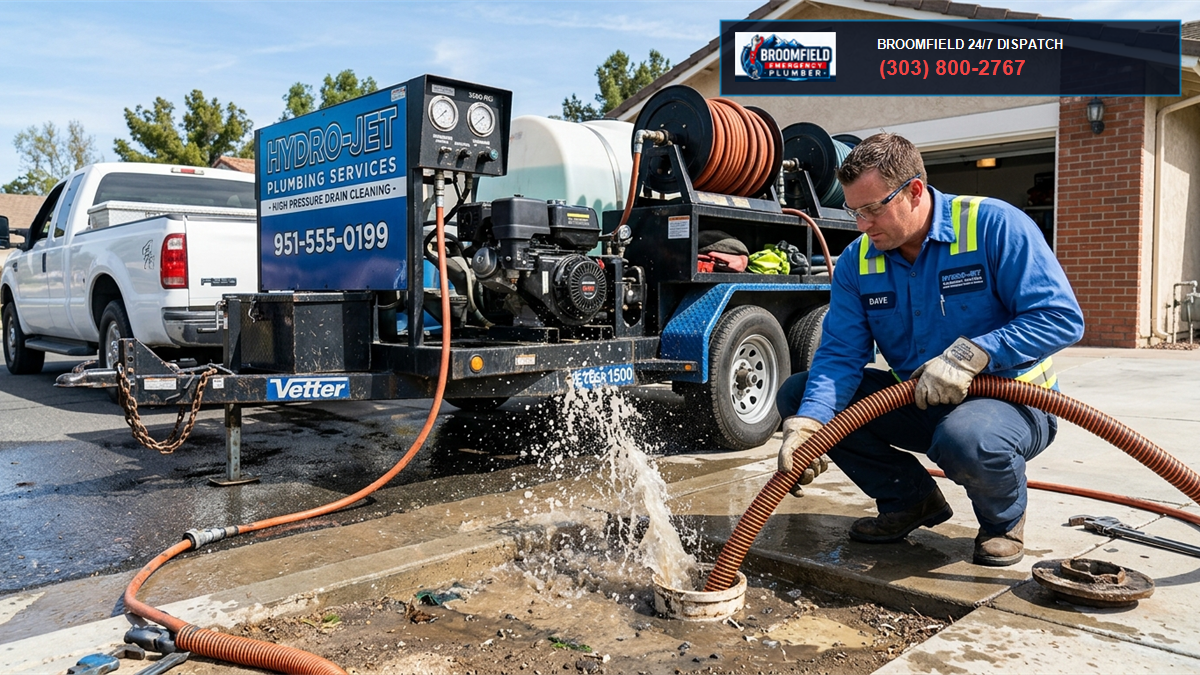
6. Master Plumber Remediation: Vacuum Evacuation, Poly Baffle Retrofits & 4,000 PSI Hydro-Jetting
When an interceptor baffle collapses or grease blows out into building laterals, how do our master plumbers restore operations?
We execute a **5-Step Master Commercial Restoration Protocol**:
Step 1: Total Liquid & Solid Evacuation
- We mobilize our high-capacity commercial vacuum tanker truck to evacuate 100% of the contents: the floating grease cap, clear water zone, and dense bottom sludge.
- We power-wash internal walls, ladders, and inlet/outlet pipes to remove hardened lipid scale.
- Technicians perform Sludge Judge core sampling on adjacent downstream lines to measure grease migration.
Step 2: Structural Confined-Space Vault Inspection
- Following OSHA Confined Space protocols (atmospheric testing for $O_2$, $H_2S$, $CO$, and combustible gases), a certified technician enters the vault.
- We evaluate concrete biogenic acid erosion depth and inspect the structural integrity of inlet drop tees, outlet sampling tees, and baffle support channels.
Step 3: High-Density Polyethylene (HDPE) Baffle Wall Retrofit
- Rather than pouring weak concrete or installing mild steel baffles that will rot again, we install engineered **High-Density Polyethylene (HDPE) or Structural Polypropylene Replacement Baffles**.
- HDPE is 100% chemically inert to biogenic sulfuric acid ($H_2SO_4$) and animal fats across a pH range of 0.5 to 14.0.
- We anchor the poly baffle using marine-grade **316 Stainless Steel Expansion Anchors and structural epoxy**, restoring full ASME hydraulic retention geometry for a lifetime of service.
Step 4: 4,000 PSI Hot-Water Hydro-Jetting Lateral Scour
- Grease that escaped during the baffle collapse will have coated the downstream 4-inch or 6-inch building sewer lateral.
- We deploy our commercial trailer-mounted hydro-jetter operating at **4,000 PSI at 18 GPM**, heated to **160°F**.
- Spinning ceramic warjet nozzles blast the congealed fatbergs and calcium stearate crusts off the pipe walls, scouring the lateral all the way to the municipal sewer main.
- We perform a full-color CCTV sewer camera video inspection to verify 100% pipe clearance.
Step 5: Municipal Pretreatment Recertification
- We refill the interceptor vault with clean potable water to establish proper operating seal levels before kitchen operations resume.
- We inspect and calibrate the upstream vented flow control device to ensure exact design GPM flow.
- We provide building management with certified pump-out manifests, structural repair reports, and video inspection files for Broomfield FOG municipal inspectors.
7. Real-World Case Studies from Broomfield Commercial Kitchen Facilities
Reviewing real-world commercial kitchen emergencies demonstrates how rapid plumbing engineering rescues food service operations from devastating shutdowns:
Case Study 1: The High-Volume Mexican Restaurant Floor Surcharge in Broomfield Town Center
The Facility: A premier 280-seat Mexican restaurant with a busy commercial kitchen operating seven days a week.
The Crisis: At 6:30 PM on a Friday evening with a full dining room, grease slurry erupted from three kitchen floor sinks. The dishwashing station was completely submerged in four inches of greywater. The restaurant manager was facing an emergency evacuation and a potential ten-thousand-dollar Friday night revenue loss.
Our Master Plumber Diagnosis: We arrived in 18 minutes. Diagnostic inspection of the exterior 1,500-gallon concrete gravity interceptor revealed that the intermediate concrete baffle wall had suffered complete biogenic acid collapse. The fallen concrete had crushed the outlet drop tee, blocking the sewer exit. The floating grease cap had reached 18 inches thick (violating the 25% rule at 38% total depth).
The Restoration: Our vacuum tanker pumped down the 1,500-gallon vault within 35 minutes, immediately relieving kitchen backpressure. Kitchen staff resumed limited food preparation. Overnight, our confined-space crew entered the vault, removed the collapsed concrete debris, and fabricated a custom heavy-duty 3/4-inch HDPE baffle wall anchored with 316 stainless steel hardware. We installed a new SDR-35 PVC outlet drop tee and hot-water hydro-jetted the 120-foot building lateral to the city main. The restaurant operated uninterrupted through the weekend.
Case Study 2: Corporate Campus Cafeteria FOG Violation in Interlocken
The Facility: A corporate dining facility serving fifteen hundred lunches daily to technology staff in Broomfield.
The Crisis: City of Broomfield wastewater inspectors pulled an effluent grab sample from the downstream monitoring manhole and recorded FOG concentrations of 1,280 mg/L (legal limit: 100 mg/L). The city issued an emergency Notice of Violation with daily escalating fines.
Our Master Plumber Diagnosis: We inspected the indoor 75 GPM hydromechanical interceptor. A kitchen maintenance worker had removed the vented flow control fitting two months prior to make sinks drain faster. The unthrottled 140 GPM discharge had washed the entire grease cap through the interceptor and into the building drain.
The Restoration: We pumped and power-washed the interceptor, installed an OEM factory-calibrated 75 GPM vented flow control fitting, and hydro-jetted the building sewer. Subsequent certified laboratory testing showed effluent FOG dropped to 38 mg/L, fully clearing the municipal violation.
Case Study 3: Supermarket Rotisserie Deli Line Surcharge on 120th Avenue
The Facility: A major grocery supermarket deli roasting over two hundred chickens daily on 120th Avenue in Broomfield.
The Crisis: Chicken grease and poultry fats backed up into the deli preparation floor sinks, threatening state retail food license suspension.
Our Master Plumber Diagnosis: The in-floor 50 GPM interceptor’s internal air-entrainment port was plugged solid with dried breading flour and dried grease. Without air entrainment, Stokes’ rise velocity collapsed, and fine chicken grease emulsified straight into the drainage lateral.
The Restoration: We chemically cleaned and descaled the air intake assembly, installed a secondary lint and sediment pre-filter basket on the rotisserie wash sink, and hydro-jetted the line using our 160°F high-temp rig. Normal deli production resumed the same afternoon.
Case Study 4: Craft Brewpub Brewery Kitchen Lockout near US-36
The Facility: A regional brewpub operating a commercial kitchen and active brewhouse in Broomfield.
The Crisis: Spent grain from the brewery combined with kitchen fryer grease inside a shared 1,000-gallon interceptor, forming an impermeable 24-inch lipid-grain crust that blocked the inlet baffle.
Our Master Plumber Diagnosis: Cross-connection of grain solids with kitchen FOG had accelerated anaerobic digestion, dropping fluid pH to 3.8 and eroding the concrete vault roof.
The Restoration: We evacuated the combined crust using our heavy vacuum truck, separated the brewery grain drains to an independent solids strainer basket, installed an epoxy acid-proof liner on the interceptor vault ceiling, and replaced the compromised inlet baffle.
Case Study 5: Luxury Convention Hotel Banquet Vault Surcharge in Broomfield
The Facility: A 400-room luxury convention resort with dual banquet kitchens serving twelve hundred guests nightly.
The Crisis: During a Saturday evening corporate gala dinner, both twin 2,000-gallon exterior concrete vaults experienced simultaneous hydraulic failure. Grease wastewater overflowed the parking lot access manholes, flowing toward stormwater retention swales and threatening direct MS4 civil environmental penalties.
Our Master Plumber Diagnosis: We deployed our emergency hazardous containment crew. Core sampling with a Sludge Judge revealed the dual vaults were operating at 48% total capacity (violating the 25% rule). Heavy loads of melted butter and animal braising fats had saturated the clear water zone. In addition, the central equalizer pipe between the twin vaults was blocked by a calcified fatberg.
The Restoration: We mobilized two 3,000-gallon vacuum tankers, pumping down both vaults simultaneously within 45 minutes to halt exterior overflow. We cleared the central equalizer pipe using our high-temperature 4,000 PSI hydro-jetting rig and installed automated high-level grease depth ultrasonic sensors that transmit wireless alerts to facility management when the grease cap reaches 20% capacity. Gala operations continued smoothly with zero municipal discharge.
8. Preventive Maintenance Checklist for Commercial Grease Interceptors
Maintain 100% municipal compliance, prevent kitchen floor backups, and protect concrete assets with this maintenance schedule:
| Frequency | System Component | Maintenance / Inspection Action | Engineering Standard / Benchmark |
|---|---|---|---|
| Daily | Sink Strainer Baskets | Empty and clean all 3-compartment and floor sink solids strainers | Prevent food scraps from entering flow control orifice. |
| Weekly | Indoor HGI Flow Control Vent | Inspect air-entrainment intake port for grease or lint blockages | Unobstructed airflow; active air drawing during sink drainage. |
| Monthly (Indoor HGI) | Complete Pump-Out & Clean | 100% pump-out of grease cap and bottom sludge; scrape baffle plates | Combined FOG and sludge depth strictly < 25% of liquid depth. |
| Every 30 to 90 Days (Exterior GGI) | Commercial Vault Vacuum Pumping | Full tanker pump-out; measure depth with Sludge Judge prior to haul | Maintain official waste manifest on site for Broomfield FOG audits. |
| Biannually | Internal Baffle Integrity Audit | Visual / probe inspection of concrete and poly separation baffles | Zero cracking, zero leaning, zero biogenic gypsum crumbling. |
| Annually | Hot-Water Hydro-Jetting Scour | 4,000 PSI at 160°F hydro-jet scour of building lateral to city main | Remove early stearate scale before hard fatberg crystallization. |
9. Emergency Action Steps: What to Do When Your Kitchen Floor Sinks Backup Right Now
If grease wastewater is erupting from your kitchen floor sinks or the interceptor is overflowing:
- Halt All Water Usage Immediately: Order all kitchen staff to stop washing dishes, empty no 3-compartment sinks, and halt all automated dishwasher cycles immediately. Halting influent volume stops indoor flooding.
- Do NOT Pour Caustic Chemicals or Degreasers Down Drains: Never pour chemical emulsifiers, solvents, or concentrated lye into a grease interceptor. Emulsifying chemicals dissolve grease temporarily, which allows it to pass the interceptor and solidify downstream in municipal mains—a direct violation of federal and local environmental laws carrying severe penalties.
- Deploy Absorbent Booms Around Walkway Drains: Place grease-absorbent booms and rubber spill dams around kitchen floor sinks to protect food storage areas, walk-in coolers, and dining room carpet.
- Inspect the Exterior Interceptor Vault Lids: Check if water is overflowing from the exterior manhole covers. If the vault is surcharging, the municipal lateral is blocked or the outlet drop tee is jammed.
- Call Licensed Master Plumbers Immediately: Contact our rapid-response commercial emergency grease team at (303) 647-3363. We deploy vacuum tanker trucks, 4,000 PSI hot-water trailer hydro-jetters, HDPE baffle fabrication specialists, and certified commercial technicians 24/7 across Broomfield and the Greater Denver Metro area.
Frequently Asked Questions (FAQ)
What is the 25-percent rule for commercial grease interceptors?
The 25-percent rule is a municipal and EPA pretreatment requirement stating that when the combined thickness of the floating grease cap and the bottom settled food solids reaches 25% of the interceptor’s total liquid depth, the unit has reached its design capacity. Beyond 25%, fluid velocity surges and the interceptor washes emulsified grease into the public sewer.
What causes grease interceptor baffles to collapse?
Baffle collapse is primarily caused by biogenic sulfuric acid corrosion. Anaerobic bacteria in bottom sludge produce hydrogen sulfide gas, which aerobic bacteria on un-submerged surfaces convert into pure sulfuric acid. The acid attacks concrete and metal, converting solid cement into weak gypsum that crumbles and falls into the tank.
Why did our kitchen sinks back up right after our interceptor was pumped?
This typically indicates that the vented flow control fitting upstream is clogged with food debris, or that escaped grease from a collapsed baffle has already solidified into a fatberg inside the downstream building lateral. Pumping the tank alone does not clear downstream lateral blockages; the line must be hot-water hydro-jetted.
Can we remove the flow control fitting to make our sinks drain faster?
No. Removing the flow control fitting violates ASME A112.14.3 and the International Plumbing Code. Without flow control, high-volume sink surges overwhelm the interceptor’s retention time, washing grease straight into the city sewer and triggering municipal FOG violations.
What type of replacement baffle should be installed in an old concrete vault?
We install engineered High-Density Polyethylene (HDPE) or structural polypropylene baffles anchored with 316 marine-grade stainless steel hardware. Unlike concrete or mild steel, HDPE is 100% impervious to biogenic sulfuric acid and animal fats, providing a permanent lifetime solution.
Commercial Grease Interceptor Emergency in Broomfield?
Don’t let a collapsed baffle, FOG surcharge, or municipal violation shut down your restaurant or food facility. Our master plumbers deploy vacuum tankers, 4,000 PSI hot hydro-jetters, and HDPE baffle reconstructions 24/7.