
At 2:40 AM on a Sunday morning in Broomfield, an alarm horn screeches across a three-hundred-thousand-square-foot commercial logistics warehouse near Highway 36. Inside the central fire command room, the main alarm panel flashes red: **WATERFLOW ALARM – ZONE 4 DRY PIPE RISER**. Simultaneously, the Broomfield Police and North Metro Fire Rescue dispatch emergency engines to the site.
There is no smoke. There is no fire.
Inside the unconditioned mezzanine loading dock, a six-inch Schedule 10 steel fire sprinkler main has split wide open along an eight-foot seam.
The dedicated fire booster pump has kicked into high gear, pumping **one thousand two hundred gallons of freezing water per minute** directly into the building.
Within fifteen minutes, eighteen thousand gallons of water inundate automated conveyor belts, computerized sorting racks, and millions of dollars in electronics inventory.
Why did a “dry” fire sprinkler system freeze and flood?
Facility managers often assume dry pipe systems are completely free of water. That is a dangerous misconception.
Dry pipe sprinkler systems depend on compressed air or nitrogen to hold back a pressurized water clapper valve under National Fire Protection Association (NFPA) 13 standards.
Every time the air compressor cycles, moisture condenses out of the compressed air.
If maintenance teams fail to drain auxiliary condensate collection points (drum drips) weekly, moisture pools in low points along branch piping.
When Front Range temperatures plunge below zero, that trapped moisture freezes into solid ice plugs. The ice expands, fractures the steel pipe, causes supervisory air pressure to drop, and trips the main dry pipe valve—flooding the system with hundreds of thousands of gallons of water.
Let’s examine the mechanical thermodynamics of dry pipe sprinkler systems, calculate clapper valve differential forces, review NFPA 13 and NFPA 25 freeze protection mandates, diagnose drum drip drainage failures, and detail master plumber emergency freeze restoration protocols.
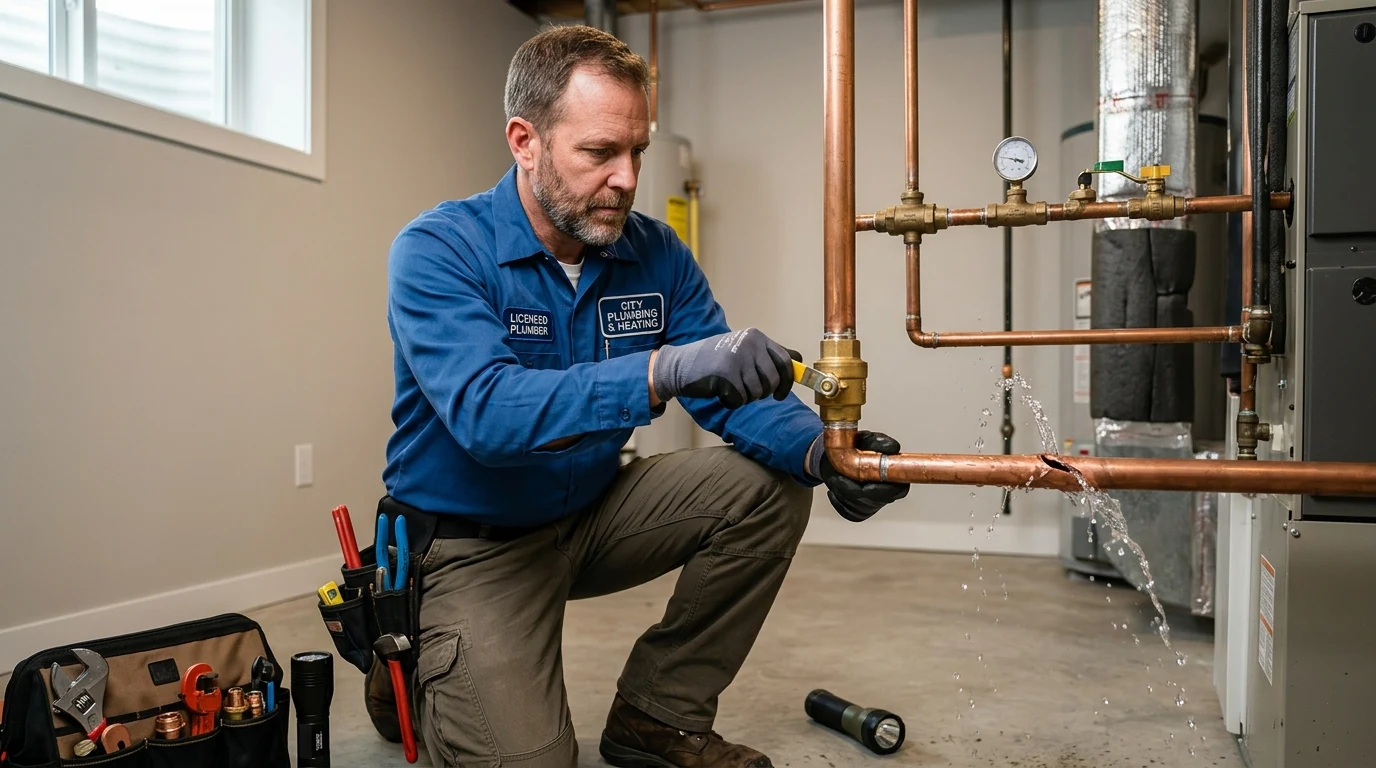
1. The Mechanical Engineering of Commercial Dry Pipe Fire Sprinkler Systems
Why do commercial warehouses, parking structures, and outdoor canopies use dry pipe systems instead of standard wet pipe systems?
In heated commercial buildings, wet pipe sprinkler systems remain permanently filled with pressurized water right up to every sprinkler head.
However, where ambient temperatures cannot be reliably maintained above **40°F (4.4°C)**, water would freeze, burst the pipes, and trigger catastrophic premature waterflow.
NFPA 13 mandates dry pipe systems for unconditioned spaces.
A commercial dry pipe system isolates pressurized water down in a heated mechanical riser room. Upstream of the dry pipe valve, the overhead piping network is charged exclusively with **compressed air or pressurized nitrogen ($N_2$)**:
- Dry Pipe Differential Valve: An engineered mechanical clapper valve that uses low-pressure air on the top side to hold back high-pressure municipal water on the bottom side.
- Air Compressor / Nitrogen Generator: Supplies supervisory air pressure (typically 30 to 45 PSI) to maintain the pneumatic clapper seal.
- Quick-Opening Device (Accelerator or Exhauster): Accelerates air evacuation during a fire to trip the water valve within 60 seconds as mandated by NFPA 13.
- Waterflow Pressure Switch & Alarm Gong: Senses the physical transition from air to water, sounding local alarm bells and sending immediate digital distress signals to the central monitoring station.
- Auxiliary Condensate Drains (Drum Drips): Two-valve drip legs installed at low points throughout the piping network to capture and drain accumulated condensation.
| Component | Code Standard | Operating Pressure | Primary Winter Failure Mechanism |
|---|---|---|---|
| Dry Pipe Valve Clapper | NFPA 13 / UL 260 | Air: 35 PSI / Water: 85 PSI | False trip from air leaks, priming water freezing, rubber seat degradation. |
| Auxiliary Drain (Drum Drip) | NFPA 13 Section 8.16.2.5 | Supervisory Air Pressure | Neglected drainage; trapped water freezes, splits ball valves, drops system air. |
| Overhead Branch Piping | ASTM A795 / A53 Schedule 10/40 | 30 – 45 PSI Air (Normal) | Inadequate pitch creates water pockets; ice plug splits thin-wall pipe seams. |
| Supervisory Air Switch | NFPA 72 Standard | Low-pressure alarm trip @ ~20 PSI | Slow pneumatic decay trips accelerator, causing full hydraulic line charge. |
When a fire occurs, heat shatters the glass bulb on a sprinkler head.
Supervisory air escapes through the open orifice. As system air pressure collapses, the clapper valve loses its hold. Water surges through the riser, rushing through the dry pipes to extinguish the flames.
That is how the system is supposed to operate. But when ice enters the equation, the sequence turns into an unmitigated disaster.
2. The Physics of the Differential Clapper Valve: Pressure-Area Force Balances
How does 35 PSI of air hold back 90 PSI of municipal water pressure without leaking?
The answer lies in **mechanical surface area ratios**.
A dry pipe valve is not a simple check valve. It is an asymmetrical differential valve where the surface area of the air-facing side of the clapper is significantly larger than the surface area of the water-facing side.
Calculating Clapper Equilibrium Forces
We model the mechanical force balance of a dry pipe clapper using static fluid force equations:
For the clapper to remain shut and sealed:
Most commercial dry pipe valves (Reliable, Tyco, Viking, Victaulic) feature an **area differential ratio between 5:1 and 6:1**:
This means one pound of air pressure on the top clapper surface counters five and a half pounds of water pressure on the bottom:
If municipal water pressure in Broomfield is **85 PSI**, the minimum air pressure required to prevent the valve from tripping is:
To provide a safety margin against municipal pressure surges, NFPA 13 mandates maintaining supervisory air pressure at least **15 to 20 PSI above the trip point**—typically 35 to 40 PSI.
Now, consider what happens when freezing temperatures crack a small auxiliary drain valve in an unheated dock.
Supervisory air begins hissing out through the fracture. Air pressure decays: 35 PSI… 28 PSI… 20 PSI… 15.4 PSI.
The moment air pressure drops below 15.5 PSI, the clapper violently swings open.
Eighty-five PSI of municipal water rushes through the dry valve. But the overhead pipes are already frozen or broken. The water has nowhere to go except through the freeze crack, creating an indoor tsunami.
3. Where Does the Water Come From? The Condensation Moisture Cycle
If dry pipe sprinkler systems are supposed to contain only air, where does the water that freezes come from?
Moisture enters dry fire systems through three distinct pathways:
1. Air Compressor Condensation (Psychrometric Moisture)
Ambient air in commercial mechanical rooms contains humidity. When the supervisory air compressor pulls in warm, humid mechanical room air and compresses it to 40 PSI, the dew point of the air rises dramatically.
As this compressed air travels into the cold overhead piping network in an unconditioned warehouse (where roof temperatures can drop to -10°F), moisture condenses out of the air stream.
Over several months of compressor cycling, gallons of liquid water collect along the bottom invert of the pipe.
2. Post-Trip Drainage Incompleteness
Whenever a dry system is trip-tested annually as mandated by NFPA 25, the entire pipe network fills with water.
After the test, technicians open the main drain and auxiliary drains. However, unless the system is pitched with absolute perfection and left open to drain for several days, hundreds of gallons of residual water remain trapped in low pipe sags.
3. Priming Water Carryover
Many older dry pipe valves require a layer of “priming water” on top of the clapper to keep the rubber seals lubricated and airtight.
During air surges or valve vibration, small amounts of priming water atomize into the air stream and carry over into the system piping.
4. NFPA 13 Section 8.16.2.5: Auxiliary Drains & Drum Drip Engineering
To prevent trapped condensation from freezing, NFPA 13 mandates the installation of **Auxiliary Drains (Drum Drips)**.
Under **NFPA 13 Section 8.16.2.5.3**, an auxiliary drain is required at every low point in a dry pipe system where trapped water exceeds 5 gallons.
Anatomy and Operation of a Proper Drum Drip
A compliant drum drip consists of:
- An upper 1-inch or 2-inch ball valve connecting to the sprinkler line.
- A 2-inch by 12-inch galvanized or black steel condensate collection chamber (the drum).
- A lower 1-inch drain valve with a threaded brass plug.
| Step | Upper Valve Position | Lower Valve Position | Operational Result |
|---|---|---|---|
| Normal Standby | OPEN | CLOSED (Plugged) | Condensation trickles down from the overhead pipe into the collection drum. |
| Draining Phase 1 | CLOSE | CLOSED | Isolates supervisory air pressure in the overhead system. |
| Draining Phase 2 | CLOSED | OPEN (Remove plug) | Discharges trapped water from the drum into a bucket. Air pressure remains intact. |
| Reset Phase | OPEN | CLOSED (Re-plug) | Re-opens collection drum to catch new condensation. |
The Fatal Maintenance Mistake
Never open both valves simultaneously! If an untrained janitor opens both the upper and lower valves at the same time, supervisory air will blast out into the atmosphere, causing system pressure to collapse within 15 seconds. The main dry pipe valve will trip, flooding the entire dry system with thousands of gallons of water!
5. Pipe Metallurgy & Freeze Rupture: Schedule 10 vs. Schedule 40 Steel
Why do modern commercial fire sprinkler lines split so easily during a freeze?
The issue lies in modern piping specifications.
Decades ago, fire systems were built exclusively using **Schedule 40 Black Steel Pipe (ASTM A53)** with threaded or flanged cast iron fittings.
Today, commercial fire protection contractors install **Schedule 10 Thin-Wall Steel Pipe (ASTM A795)** with roll-grooved mechanical couplings to speed installation and reduce structural dead weight.
Comparing Wall Thickness and Freeze Resistance
| Nominal Pipe Diameter | Schedule 10 Wall Thickness | Schedule 40 Wall Thickness | Wall Thickness Reduction | Freeze Rupture Susceptibility |
|---|---|---|---|---|
| 2-inch Pipe | 0.109 inches | 0.154 inches | 29.2% Thinner | High; splits within 4 hours of freeze. |
| 4-inch Main | 0.120 inches | 0.237 inches | 49.4% Thinner | Extreme; splits along seam under ice pressure. |
| 6-inch Main | 0.134 inches | 0.280 inches | 52.1% Thinner | Catastrophic longitudinal weld seam tear. |
Notice that on a 4-inch or 6-inch main, Schedule 10 pipe has **less than half the steel thickness** of traditional Schedule 40 pipe.
When water freezes inside a 4-inch Schedule 10 pipe, the thin metal wall cannot withstand the circumferential hoop stress.
Worse, roll-grooved couplings create localized stress concentration zones at the coupling indentations. When ice forms, the grooved ends pull out of mechanical couplings, detaching pipe sections completely and sending heavy steel lines crashing toward warehouse floors.
6. NFPA 13 Pitch & Slope Regulations: Eliminating Trapped Pockets
How do you prevent water from settling in overhead fire sprinkler pipes?
You pitch the pipe.
Under **NFPA 13 Section 8.16.2.3 (Drainage Pitch for Dry Systems)**, all piping in dry pipe systems must be pitched toward a drain point:
- Branch Lines: Must maintain a minimum pitch of **1/2-inch per 10 feet** ($0.0042 \text{ ft/ft}$ or approx. $1:240$).
- Mains & Cross-Mains: Must maintain a minimum pitch of **1/4-inch per 10 feet** ($0.0021 \text{ ft/ft}$) in unconditioned refrigerated spaces or outdoor structures.
In real-world commercial buildings, roof trusses settle over time.
Heavy snow loads on commercial roofs in Broomfield deflect steel bar joists by several inches. That deflection creates an unintended reverse slope—a **pipe belly**.
Water collects in the belly. During summer, it sits harmlessly. During winter, it freezes into a solid ice plug that blocks airflow, cracks the pipe, and trips the main valve.
Our master plumbers conduct laser-level pitch surveys across commercial fire sprinkler lines, adjusting clevis hangers and installing auxiliary drum drips at every structural sag point to guarantee positive drainage.
7. Nitrogen Inerting Systems: Ending Microbial Corrosion and Moisture Hazards
Why are premier commercial facilities in Broomfield replacing standard air compressors with **On-Site Nitrogen Generators**?
Compressed atmospheric air introduces two deadly threats into dry fire sprinkler systems: **moisture** and **oxygen**.
When oxygen reacts with moisture and steel pipe walls, aggressive **Microbiologically Influenced Corrosion (MIC)** and electrochemical oxidation occur:
Iron oxide scale flakes off the pipe walls, washing down into the dry valve seat and preventing the clapper from sealing.
What is worse, standard air compressors introduce high-humidity air that condenses into gallons of free water.
The Nitrogen Advantage
An engineered nitrogen generator extracts nitrogen from atmospheric air using semi-permeable hollow fiber membrane filters, filling the dry sprinkler system with **98% or higher pure nitrogen gas**:
- Sub-Zero Dew Point: Nitrogen generated on-site has an ultra-low dew point of **minus forty to minus sixty degrees Fahrenheit (-40°F to -60°F)**. There is virtually zero moisture to condense, pool, or freeze.
- Eliminates Oxygen Corrosion: Removing oxygen stops electrochemical oxidation and bacterial corrosion dead in its tracks.
- Multiplies Pipe Lifespan: Studies by the Fire Protection Research Foundation prove that nitrogen-inerted dry systems experience up to **5.3 times longer service life** than air-charged systems.
8. Quick-Opening Devices (QOD): Accelerators, Exhausters & Anti-Flooding Diagnostics
Why do large commercial dry pipe systems require specialized acceleration devices?
Under **NFPA 13 Section 8.2.3.6**, if a dry pipe system has a total water capacity exceeding **500 gallons** (or cannot deliver water to the most remote test inspector’s connection within **60 seconds** of head actuation), it must be equipped with an approved **Quick-Opening Device (QOD)**—typically an **Accelerator** or an **Exhauster**.
In massive warehouse dry systems containing thousands of gallons of air capacity, air takes several minutes to escape through a single 1/2-inch sprinkler orifice.
An accelerator bypasses this delay. It senses a rapid, minute pneumatic pressure drop (as small as 1 to 2 PSI in 10 seconds). It immediately vents high-pressure air directly to the intermediate chamber of the dry pipe valve, instantly unbalancing the differential clapper and tripping the water valve in less than 30 seconds.
How Cold Weather Destroys Accelerators
Accelerators are sensitive mechanical devices containing microscopic air orifices, delicate bronze bellows, and rubber diaphragms.
When condensation migrates down the dry riser, it settles into the accelerator trim piping:
- Moisture Ingress into Diaphragm Chambers: Water pools inside the lower chamber of the accelerator.
- Freeze Expansion: Cold air drafts from unsealed riser room doors freeze this water. Ice ruptures the internal rubber diaphragm and bends the sensitive actuating pushrod.
- False System Trips: The damaged accelerator malfunctions, dumping air pressure into the intermediate chamber and tripping the dry pipe valve during sub-zero night hours with zero fire present.
Our master plumbers service accelerator trim assemblies using **Anti-Flooding Ball Check Valves** (such as the Reliable Model B1 or Victaulic Model 746-LPA).
The anti-flooding valve automatically seals shut the instant water surges into the intermediate chamber, preventing corrosive water and pipe scale from ever entering the delicate accelerator body.
9. Ultrasonic Thickness Gauging (NDT) & Post-Freeze Hydrostatic Testing under NFPA 25
When an overhead dry fire sprinkler line experiences a freeze event, how do you verify whether the pipe is structurally safe to recharge with water?
You cannot simply look at the outside of the pipe.
Ice expansion stretches steel plastically before it splits. An expanded steel pipe may show zero visible exterior pinholes, but its wall thickness may have yielded and thinned by 40% to 60%, leaving the line dangerously weak.
Our master plumbing technicians deploy **Non-Destructive Testing (NDT) Ultrasonic Thickness Gauging (ASTM E797)**:
Where:
- $t$ = Measured residual wall thickness of the steel pipe ($inches$)
- $v_{\text{sound}}$ = Longitudinal acoustic velocity in structural carbon steel ($\approx 232,000 \text{ in/s}$ or $5,900 \text{ m/s}$)
- $t_{\text{transit}}$ = Measured round-trip transit time of the high-frequency ultrasonic pulse ($seconds$)
We scan every freeze-affected pipe segment:
- Schedule 10 Steel Benchmarks: Nominal 4-inch Schedule 10 pipe must maintain at least **0.120 inches** wall thickness. If ultrasonic scanning reveals wall thinning below **0.090 inches**, the pipe is structurally compromised and must be replaced immediately.
- Roll-Groove Indentation Integrity: We inspect roll grooves for radial deformation, flare expansion, or micro-cracks along the heat-affected zone (HAZ) of the longitudinal weld seam.
NFPA 25 Hydrostatic Retesting Mandate
Following any structural freeze repair or pipe replacement on a fire sprinkler system, **NFPA 25 Section 5.3.2** mandates a formal **Hydrostatic Retest**:
The repaired pipe section must be charged with water and pressurized to **200 PSI** (or **50 PSI above maximum system working pressure**) for a continuous duration of **two hours** with zero allowable drop in gauge pressure.
Only after passing this hydrostatic pressure hold can the system be drained, dried, purged, and safely returned to service under supervisory air.
10. Hydraulic Shock Mitigation: Soft-Closure OS&Y and Butterfly Supervisory Switches
When a six-inch fire sprinkler line splits and water is pouring through a warehouse roof, the natural instinct is to run to the riser room and slam the main valve shut as fast as humanly possible.
Slamming a large fire service valve shut abruptly can cause catastrophic structural failure to municipal infrastructure.
When a moving water column traveling at 10 to 15 feet per second is halted instantly, the kinetic energy converts into an explosive pressure wave governed by the **Joukowsky Equation**:
In a 6-inch municipal water main, slamming a gate valve shut in under two seconds generates instantaneous pressure spikes exceeding **400 to 600 PSI**.
This violent hydraulic shock wave travels backward into the street, shattering municipal water mains, blowing out underground curb stop valves, and shearing adjacent domestic backflow assemblies.
plumbing codes and NFPA 13 dictate that all main commercial fire control valves must be **slow-closing mechanical gear-operated valves**:
- OS&Y Gate Valves: Must take a minimum of **16 to 24 full handwheel revolutions** to close, guaranteeing a closure time greater than 5 to 10 seconds.
- Butterfly Valves: Must feature an internal worm-gear actuator that requires at least **8 to 12 rotations** of the hand crank to transit from fully open to fully closed.
- Electrical Tamper Switches (NFPA 72): Every control valve features integral supervisory switches that alert central alarm monitoring within two full revolutions of closure, preventing unauthorized or accidental valve shutoffs.
11. Case Studies from Broomfield: Winter Fire Sprinkler Emergencies
Real-world commercial sprinkler disasters illustrate the high stakes of freeze failures:
Case Study 1: The Logistics Center Disaster off Highway 36
The Building: A 220,000-square-foot distribution hub in Broomfield.
The Incident: Over a holiday weekend when outside air dropped to -14°F, an unheated high-bay loading dock experienced a complete sprinkler trip. An auxiliary drum drip located 25 feet above the floor had not been drained since the annual inspection ten months prior. Trapped condensation froze solid, splitting the drum drip ball valve. The resulting air leak dropped system pressure to 14 PSI. The main dry valve clapper tripped.
The Devastation: Two thousand gallons of water per minute surged into the frozen dock lines. The ice plug deflected the water flow, creating extreme water hammer that tore three roll-grooved couplings apart. Forty thousand gallons of water cascaded across automated sorting machinery before firefighters could locate and shut the main control valve. Total property and inventory losses exceeded $420,000.
Our Master Plumber Restoration: Our emergency industrial crew arrived in 30 minutes. We isolated the damaged riser, mobilized roll-grooving machines and 4-inch Schedule 40 replacement pipe, re-hung the piping with proper 1/2″ per 10-foot pitch, installed heated thermal enclosures around all auxiliary drum drips, and restored full fire protection coverage within 12 hours.
Case Study 2: Parking Structure Freeze Alarm in Flatiron
The Building: A 4-level commercial parking garage adjacent to a shopping center.
The Incident: At 4:15 AM on a Wednesday, the central fire alarm sounded on an unheated P-2 parking deck.
Our Master Plumber Diagnosis: An acoustic listening survey revealed that an 18-inch section of 2-1/2-inch dry branch line had sagged due to a broken hanger bracket. Trapped condensation had frozen into an 18-inch solid ice cylinder. The ice split the pipe along its underside. Supervisory air was escaping at 60 CFM, overwhelming the small air compressor.
The Master Plumber Restoration: Because we responded before the main clapper tripped, we manually locked the dry valve clapper in the closed position, repaired the fractured pipe using an approved mechanical coupling spool, re-supported the line with seismic-rated strut hangers, and purged the system with dry nitrogen. Not a single drop of water was discharged.
12. Master Plumber Emergency Response Protocol: What to Do When a Sprinkler Line Bursts
If a commercial fire sprinkler line ruptures or trips in your building, follow this emergency procedure:
- Notify Local Fire Dispatch Immediately: Call 911 or North Metro Fire Rescue. In commercial facilities, fire alarms automatically dispatch emergency units. Verify with dispatch that technicians are actively managing a freeze break, not an active fire.
- Locate the Main Sprinkler Control Valve: Go directly to the riser room. Look for the main **Outside Screw and Yoke (OS&Y) Gate Valve** or **Butterfly Control Valve**.
- Close the Control Valve Slowly: Turn the handwheel clockwise until the valve stem retracts fully (for OS&Y) or the indicator reads “SHUT”. Closing the valve slowly (taking at least 60 seconds) prevents destructive water hammer from rupturing city water mains.
- Open the Main 2-Inch Drain Valve: Turn the large ball valve on the 2-inch main drain line to discharge standing water directly outside or into the drain hub, relieving pressure on the broken branch lines.
- Establish a Mandatory “Fire Watch”: Under NFPA 25 and municipal fire codes, whenever a commercial fire sprinkler system is shut down for more than 4 hours, the facility must institute a continuous, documented physical Fire Watch patrol until certified repairs are complete.
- Call Licensed Commercial Master Plumbers Immediately: Contact our rapid-response commercial team at (303) 647-3363. We deploy licensed master technicians, pipe grooving equipment, replacement valves, and nitrogen purging systems 24/7 across Broomfield and the Denver Metro area.
13. Weekly and Monthly Winter Maintenance Checklist for Facility Managers
Maintain NFPA 25 compliance and prevent disastrous winter freeze ruptures with this structured schedule:
| Frequency | Inspection / Maintenance Action | Target Value / Benchmark | Corrective Action if Non-Compliant |
|---|---|---|---|
| Daily (Freezing Weather) | Check dry pipe riser room temperature | Minimum 40°F (4.4°C) | Verify unit heater operation; install backup electric heaters if < 40°F. |
| Weekly | Check air compressor cut-in / cut-out pressures | Cut-in: 30 PSI / Cut-out: 40 PSI | If compressor runs continuously, trace system for air leaks using soap bubble test. |
| Weekly (Autumn & Winter) | Drain all auxiliary condensate collection drains (drum drips) | Drain until dry air emerges | Document drained water volume in NFPA 25 facility log book. |
| Monthly | Inspect low-air pressure alarm switches | Alarm trips when air drops ~10 PSI | Test electrical switch contacts with fire alarm technician. |
| Annually (Pre-Winter) | Full trip test, interior pipe inspection, and pitch survey | Full clapper trip; 100% water evacuation | Certified master plumber NFPA 25 documentation for municipal fire marshal. |
Frequently Asked Questions (FAQ)
Why did my dry pipe fire sprinkler system freeze if there was no water in it?
Dry pipe systems contain compressed air that carries humidity. Over time, that humidity condenses out and settles in low pipe points and auxiliary drains. If this condensate is not drained regularly, winter cold snaps freeze the trapped water into solid ice plugs, splitting pipe seams and dropping supervisory air pressure, which triggers the main water valve.
What is the minimum temperature required for a fire sprinkler riser room?
Under NFPA 13 and NFPA 25 standards, valve enclosures and mechanical riser rooms housing water-filled fire protection components must be maintained at a minimum temperature of 40°F (4.4°C) at all times using permanent, monitored heating sources.
How often should auxiliary drains (drum drips) be drained during the winter?
In Colorado, auxiliary drains should be drained weekly throughout the freezing season (October through April). Immediately following an annual full-flow trip test, drum drips should be drained daily for several weeks until zero moisture is retrieved.
What happens if supervisory air pressure drops too low in a dry fire system?
If air pressure drops below the trip threshold of the differential clapper valve (typically around 15 to 20 PSI depending on incoming municipal water pressure), the clapper valve opens automatically. Thousands of gallons of water rush through the dry pipes, flooding through any freeze cracks present in the overhead lines.
Can our commercial building install nitrogen instead of compressed air in dry fire systems?
Yes. Installing an on-site nitrogen generator replaces humid atmospheric air with 98%+ pure dry nitrogen gas. Nitrogen has an ultra-low dew point (-40°F to -60°F), virtually eliminating condensation, winter freeze risks, and internal microbiological corrosion.
Commercial Fire Sprinkler Freeze Emergency in Broomfield?
Don’t let a frozen dry pipe sprinkler rupture destroy your commercial facility, inventory, and business operations. Our licensed master plumbers provide 24/7 rapid emergency isolation, pipe repair, grooving, and NFPA 25 compliance restorations.