
The Friday dinner rush at an upscale casual restaurant off Flatiron Crossing in Broomfield is at its peak.
Waitstaff are stacking dirty ramekins, sauté pans, and wine glasses into wash racks at a furious pace.
Suddenly, the lead steward waves down the executive chef: the digital temperature display on the high-temperature conveyor dishmachine is flashing an ominous red alarm.
The final sanitizing rinse water is hitting the dinner plates at a lukewarm 144°F.
The municipal health inspector from the Broomfield Public Health and Environment Department happens to be conducting an unannounced routine inspection.
She slaps a waterproof thermo-label test strip onto an entree plate and runs it through the flight tunnel.
The 160°F irreversible indicator strip stays stark white. Not even a trace of thermal reaction.
Under the Colorado Retail Food Establishment Rules and Regulations (6 CCR 1010-2) and NSF/ANSI Standard 3, high-temperature commercial dishmachines must deliver a minimum 180°F (82°C) final sanitizing rinse (165°F for stationary rack single-tank machines) to guarantee a minimum 160°F dish surface temperature.
A failure here is not a minor maintenance note. It is an immediate critical priority health violation that halts dishwashing operations instantly.
Without sanitized tableware, a restaurant cannot legally serve food.
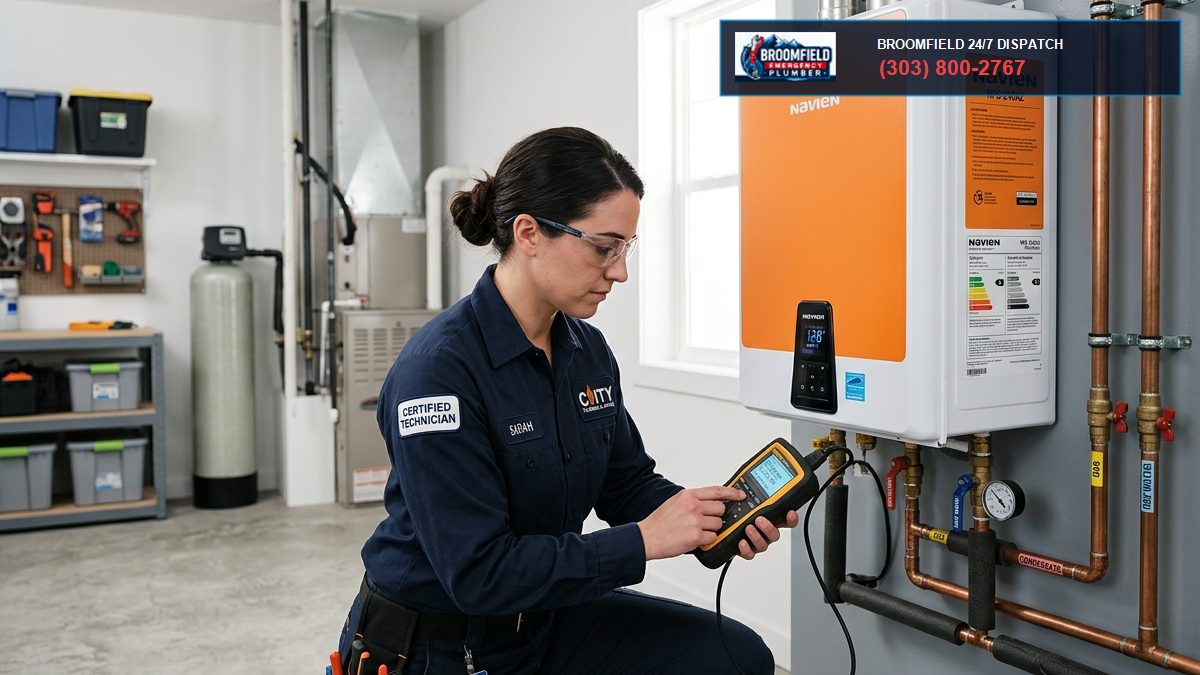
When our commercial emergency plumbing crew pulls up to the loading dock, we bypass the kitchen staff and go straight underneath the dishmachine table to the high-wattage electric immersion booster heater.
The booster heater is humming quietly, but its internal elements are completely encased in a quarter-inch jacket of rock-hard calcium carbonate scale.
The thermal heat cannot transfer to the rushing water.
To make matters worse, the booster’s mechanical paddle flow switch is jammed with scale grit, preventing the high-fire contactors from pulling in when the conveyor curtain opens.
Commercial dishwasher booster heater failures threaten food safety, destroy dishware turnover, and invite emergency shutdown orders.
1. The Thermodynamics of High-Temperature Commercial Warewashing
Commercial food establishments rely on two distinct methods to sanitize tableware, pots, and flatware: chemical sanitizing (low-temperature machines using chlorine hypochlorite) and thermal sanitizing (high-temperature machines using scalding hot water).
High-volume restaurants, hotel banquet kitchens, hospitals, and corporate cafeterias across Broomfield overwhelmingly prefer high-temperature machines.
Why? Because thermal sanitization dries glassware instantaneously without chemical spots or pungent chlorine odors.
Thermal sanitization relies on sheer thermal kill capacity.
According to NSF/ANSI Standard 3, sanitization occurs when pathogenic microorganisms (including Salmonella, Listeria monocytogenes, and Escherichia coli) are reduced by at least 99.999% (a 5-log reduction).
This requires the dishmachine to deliver a cumulative thermal dose known in engineering as Heat Unit Equivalents (HUE).
To achieve the mandatory 3,600 HUE threshold during an 8- to 12-second final rinse spray cycle:
- The rinse water leaving the spray nozzles must enter the chamber at a minimum of 180°F (82.2°C), not to exceed 195°F (90.6°C) to prevent atomized flash evaporation.
- The physical surface of the plates and silverware must reach at least 160°F (71.1°C) for a verified minimum duration.
Standard domestic or light-commercial water heaters cannot supply 180°F water directly to a building.
The International Plumbing Code (IPC Section 504.6) and OSHA safety standards strictly prohibit circulating potable water above 120°F to 140°F in general building piping due to immediate scalding risks at hand sinks and pre-rinse faucets.
Consequently, commercial kitchens install a primary water heater that supplies bulk hot water at 140°F (60°C).
Then, immediately adjacent to the warewasher, a high-output Booster Water Heater takes that 140°F water and gives it a rapid, dedicated 40°F thermal boost up to 180°F–185°F right before it strikes the dishes.
| Warewasher Cycle Stage | Required Water Temp (°F) | Mechanical Purpose | Health Code Standard |
|---|---|---|---|
| Pre-Wash / Scraping | 110°F – 120°F | Strips heavy food debris without baking starches onto ceramics | FDA Food Code § 4-501.112 |
| Detergent Wash Tank | 150°F – 160°F | Emulsifies animal fats and grease using alkaline detergents | NSF/ANSI Standard 3 |
| Final Sanitizing Rinse | 180°F – 195°F | Destroys residual bacteria; rapid thermal evaporation drying | 6 CCR 1010-2 / NSF-3 |
| Plate Surface Target | 160°F Minimum | 3,600 Heat Unit Equivalents (HUE) verification test | Thermo-label / Digital Probe |
2. Sizing Engineering: Power Requirements and High Altitude Physics
A booster heater must deliver immense thermal energy in seconds.
Unlike a residential water tank that slowly reheats over an hour, a commercial conveyor dishmachine demands on-demand instantaneous hot water whenever a dish rack triggers the trip arm.
To calculate the electric booster heater capacity required for a commercial conveyor dishwasher, master plumbers apply the thermal energy transfer equation:
Where:
- KW: Electrical heating power in kilowatts.
- GPH: Gallons per hour of final sanitizing rinse water demanded by the dishmachine spray manifold.
- ΔT: Temperature rise required (e.g., from 140°F inlet water up to 180°F rinse water = 40°F rise).
- 8.33: Weight of water in pounds per gallon.
- 3,412: British Thermal Units (BTU) per kilowatt-hour of electric power.
Consider a high-capacity conveyor dishmachine off Highway 36 processing 240 racks per hour.
Its technical cut sheet states a final rinse water consumption of 275 Gallons Per Hour (GPH).
If the facility’s primary kitchen water heater delivers an honest 140°F, the required temperature rise is 40°F ($180^\circ F – 140^\circ F$).
Rounding up to standard electrical manufacturing sizes, a 27 kW or 30 kW booster heater is required.
What happens if the primary kitchen water heater fails or drops its supply temperature down to 110°F during high morning prep demand?
Now the required temperature rise jumps to 70°F ($180^\circ F – 110^\circ F$).
The installed 30 kW booster heater is hopelessly undersized for a 70°F rise.
The water passes through the booster tank too quickly, spraying onto dinnerware at barely 152°F.
The result? Instant health code failure.
Broomfield Elevation and Boiling Point Compression
At Broomfield’s elevation of roughly 5,400 feet, water boils at approximately 202°F (94.4°C), not 212°F.
In sea-level commercial kitchens, a booster heater operating at 190°F leaves a comfortable 22°F buffer below the atmospheric boiling point.
In Broomfield, that same 190°F setting is just 12°F away from instantaneous flash boiling.
If a booster heater’s thermostat drifts upward by just 8°F due to calcium buildup on the sensor probe, water inside the heating chamber reaches 198°F to 200°F.
The moment that superheated water exits the spray nozzles and hits atmospheric room pressure, it violently flashes into atomized steam fog.
Live steam escapes through the conveyor curtains, filling the kitchen line with humid vapor while leaving virtually zero liquid water on the plates to rinse away detergent residues.
Calibrating booster thermostats in the Colorado Front Range requires pinpoint precision to balance the narrow window between the 180°F sanitation floor and the 195°F altitude boiling threshold.
3. Anatomy of Booster Heater Failures: The 5 Primary Culinary Culprits
When a commercial dishwasher fails its 180°F sanitizing rinse audit, our master plumbers systematically dismantle and inspect five core failure points:
1. Incoloy Heating Element Calcification & Thermal Insulating Scale
Water across Broomfield and Adams County contains substantial dissolved calcium and magnesium bicarbonate.
Inside a booster heater, water is driven to extreme temperatures (180°F+).
Calcium carbonate has an inverse solubility curve: unlike sugar or salt, calcium falls out of solution rapidly as water temperature climbs.
It crystallizes directly on the hottest surface available—the electric immersion heating elements.
A 1/8-inch layer of mineral scale acts as a severe thermal blanket.
Thermal conductivity of scale is less than 5% that of copper or incoloy metal.
The electric resistance coil inside the element glows red-hot, trapped inside its own calcified shell.
Unable to dissipate heat into the rushing water, the incoloy sheath overheats, bulges, and splits open with a deafening pop.
The internal magnesium oxide insulation floods with water, blowing high-amperage 480V three-phase fuses or tripping the main distribution breaker.
2. Flow Switch Mechanical Seizure & Paddle Erosion
Unlike residential water heaters that maintain an internal tank of hot water around the clock, high-recovery commercial booster heaters use an internal magnetic or mechanical paddle flow switch to control heating stages.
When the dishmachine’s conveyor triggers the final rinse solenoid valve, water starts moving through the supply line.
The rushing water pushes a stainless steel paddle.
The paddle tilts an external microswitch or moves a magnetic slug, signaling the electronic control board to energize the contactors and fire the heating elements.
Two severe mechanical failures plague flow switches:
- Scale and Particulate Seizure: Fine mineral scale flaking off boiler walls or incoming city mains lodges inside the switch pivot bushing. The paddle jams shut. Even though water is flowing, the contactors never close. Cold water sprays onto the dinner plates.
- Stuck Open (Dry-Firing): Scale wedges the paddle in the active “flow” position. When the dish rack exits and the rinse solenoid shuts off water flow, the switch fails to release. The 54 kW heating elements remain fully energized in stagnant, stationary water. Within 45 seconds, the water boils, the high-limit ECO (Energy Cut-Off) trips, and the safety relief valve discharges boiling water across the kitchen floor.
3. Magnetic Contactor Pitting & Contact Chattering
A 45 kW to 54 kW electric booster heater draws between 54 and 65 Amperes per phase at 480V three-phase power.
Every time a dish rack enters the final rinse zone (every 20 to 30 seconds during a busy meal rush), the heavy electromagnetic contactors pull in with a sharp metallic clack.
Over 10,000 switching cycles per month, electrical arcing across the silver-cadmium contact points creates carbon pitting and localized oxidation.
Eventually, contacts begin to “chatter”—rapidly bouncing open and closed dozens of times per second.
Chattering generates intense heat, melting the contact carrier plastic and causing one or more phases to drop out.
Running a three-phase booster heater on two phases (“single-phasing”) cuts heating output by over 50%.
The booster struggles along, unable to push rinse water past 148°F.
4. Thermostatic Probe Drift and Sensor Well Scaling
Booster heaters regulate temperature via an immersion capillary bulb or solid-state RTD (Resistance Temperature Detector) thermistor inserted into a brass or stainless steel thermal well.
If mineral scale coats the exterior of the thermal well, the sensor is insulated from the true water temperature.
The water surrounding the heating elements might be boiling at 200°F, but the scale-covered sensor reads a sluggish 165°F.
Conversely, capillary bulbs can lose their internal liquid charge through microscopic hairline fractures, causing the mechanical bellows to collapse.
A collapsed bellows thermostat permanently keeps the heating circuit open, leaving the booster completely dead.
5. Atmospheric Vacuum Breaker (ASSE 1004) Failure
Every commercial dishmachine final rinse supply line must be equipped with an ASSE 1004 or ASSE 1001 atmospheric vacuum breaker installed at least 6 inches above the flood level rim of the machine.
Its job is critical: prevent contaminated, grease-laden wash water from being siphoned backward into the restaurant’s potable drinking supply during a municipal water pressure drop.
However, atmospheric vacuum breakers operate on a delicate rubber poppet and disc assembly.
Subjected to continuous 180°F scalding water, standard rubber compounds harden, crack, and warp.
When the final rinse solenoid valve snaps shut, the backpressure wave slams the weakened poppet.
Hot water sprays out of the vacuum breaker air vents, cascading down the back of the dishmachine, shorting out electrical control boxes, and soaking floor areas.
4. Water Pressure and Flow Rate Dynamics: The Hidden Temperature Thief
One of the most common diagnostic errors made by inexperienced technicians is assuming every sanitizing temperature failure is an electrical element problem.
In truth, water flow pressure directly dictates rinse water temperature.
The final sanitizing spray manifold on a commercial warewasher is engineered with precision-machined brass spray nozzles.
These nozzles are calibrated to deliver an exact flow rate (e.g., 4.5 GPM) only when the dynamic (flowing) water pressure is maintained strictly between 15 PSI and 25 PSI (typically 20 PSI dynamic).
If the water pressure entering the booster heater is unmanaged or the pressure reducing valve (PRV) fails wide open:
- City water pressure in Broomfield frequently hits 75 to 95 PSI.
- If 85 PSI enters the booster heater, water roars through the heating chamber at 8 to 10 Gallons Per Minute—more than double its design velocity.
- The water rushes past the heating elements so quickly that it cannot absorb sufficient BTUs.
- Water exits the nozzles at high velocity as a fine mist at only 150°F, blowing plates out of their racks while failing sanitation standards.
Conversely, if water pressure drops below 15 PSI dynamic due to clogged supply strainers or undersized supply lines:
- The spray nozzles cannot generate a complete fan pattern.
- Water dribbles onto the dinnerware, leaving dry shadow zones where bacteria survive.
- The booster heater overheats because water flow is insufficient to carry heat away, tripping the manual reset high-limit safety.
Every commercial booster heater installation must feature an upstream, water-pressure-reducing valve with an integral pressure gauge mounted right before the dishmachine inlet.
5. Front Range Case Study: Emergency Booster Rebuild at a High-Volume Hotel
Location: 300-room hotel banquet conference facility near Interlocken Boulevard, Broomfield, CO.
The Emergency: On a Saturday afternoon before a 400-guest wedding reception dinner, the head of catering alerted the general manager that the main banquet conveyor dishmachine had stopped heating. Final rinse water was reading 128°F on the control board. The local health department had issued an ultimatum: restore 180°F sanitization within three hours or switch entirely to single-use disposable plates and cutlery for the banquet.
Master Plumber Diagnosis:
Our emergency commercial plumbing response team arrived on site within 35 minutes equipped with electrical diagnostic meters and commercial replacement elements.
We systematically isolated the electrical supply and performed a thorough diagnostic:
- Electrical Resistance Testing: Using a calibrated digital multimeter, we checked continuity across the three 18-kW immersion elements in the 54-kW booster heater. Element bank #1 showed infinite resistance (open circuit—completely burned out). Element bank #2 showed a dead short to ground (sheath ruptured). Only Element #3 was operational, providing just 18 kW of heating capacity instead of the required 54 kW.
- Mechanical Flow Inspection: Upon unbolting the booster heater inspection flange, we discovered the lower third of the vessel was packed solid with white calcium carbonate sediment. The failed elements were buried in scale.
- Dynamic Pressure Check: The upstream brass pressure reducing valve had failed internally; dynamic rinse pressure was surging to 48 PSI, causing excessive flow velocity through the tank.
The Emergency Solution:
- We isolated and drained the booster vessel, vacuuming out more than 20 pounds of mineral scale and sludge using a heavy-duty slurry extractor.
- We pulled all three failed incoloy heating elements and installed heavy-duty low-watt-density incoloy replacement elements with fresh EPDM high-temperature gaskets, torquing flange bolts to exact manufacturer specifications.
- We replaced the pitted 60-amp three-phase magnetic contactor and cleaned the auxiliary control wiring.
- We installed a new heavy-duty Wilkins commercial water pressure reducing valve, adjusting dynamic flowing pressure to precisely 20.0 PSI on the digital gauge.
- We acid-descaled the copper sensing well and applied fresh thermal transfer compound to the RTD temperature probe.
The Verification:
We powered the booster station and fired up the conveyor dishmachine.
Rinse water temperature surged to an exact 184.5°F.
We ran three consecutive test racks carrying 160°F irreversible thermo-labels through the tunnel.
Every label turned dark black, confirming a verified dish surface temperature of 165°F.
The banquet team resumed operations with an hour to spare before guest arrival, completely avoiding health department citations and customer disruption.

6. Step-by-Step Commercial Booster Diagnostic Protocol
When your commercial dishmachine fails its sanitizing rinse audit, follow this rigorous diagnostic sequence to pinpoint the mechanical or electrical root cause:
Phase 1: Flow and Pressure Verification
- Turn on the dishmachine and engage the final sanitizing rinse cycle.
- Observe the dynamic water pressure gauge mounted on the rinse line. The needle must hold steady between 15 PSI and 25 PSI while water is spraying.
- If pressure is above 25 PSI, adjust the PRV adjustment screw counterclockwise to reduce flow velocity.
- If pressure is below 15 PSI, inspect the upstream Y-strainer. Close the isolation valve, pull the mesh screen, and clean out accumulated rust chips and pipe debris.
Phase 2: Temperature Differential (ΔT) Audit
- Measure the incoming water temperature at the booster heater inlet using an immersion test port or surface thermocouple probe.
- Confirm the primary kitchen water heater is supplying water at a minimum of 135°F to 140°F. If incoming water is under 120°F, your primary kitchen water heater is failing, overwhelming the booster heater.
- Measure the booster heater discharge water temperature during active spraying. Discharge must read between 180°F and 195°F.
- If the temperature differential is less than 30°F despite normal flow pressure, proceed immediately to electrical diagnostics.
Phase 3: Electrical Resistance and Amperage Testing
- Lock out and tag out (LOTO) the 208V, 240V, or 480V main electrical disconnect switch feeding the booster heater. Verify zero voltage with a calibrated non-contact voltage tester and multimeter across all phases.
- Inspect the magnetic contactors for blackened contact pads, pitted silver surfaces, or melted coil housings.
- Disconnect element jumper bars. Measure the electrical resistance (Ohms) across each individual heating element terminal using the resistance formula:
R = \frac{V^2}{P}
(For example, a 6,000-watt, 480-volt element should measure approximately 38.4 Ohms. An infinite reading indicates a broken internal coil; a reading near zero indicates a dead short).
- Test continuity between each element terminal and the brass tank shell. Any continuity reading below 1,000,000 Ohms (1 Megohm) confirms an insulation breakdown. Replace the element immediately.
Phase 4: High-Limit Safety and Flow Switch Testing
- Locate the manual-reset high-temperature ECO (Energy Cut-Off) switch. Check if the red button has popped out. If tripped, reset it and investigate why the water overheated (typically caused by stuck contactors or scale insulation).
- Remove the paddle flow switch and verify free mechanical motion. Clean any mineral scale crust from the pivot hinge using white vinegar or a descaling agent.
- Reassemble, restore power, and monitor operating current with an inductive clamp-on ammeter around each hot phase conductor. Confirm amperage matches nameplate specifications when the rinse cycle fires.
7. Scheduled Preventative Maintenance for Commercial Warewash Systems
Commercial booster heaters operate in high-stress, high-heat environments.
Without scheduled maintenance, mineral scale and mechanical wear will shut down your kitchen.
Implement this preventative maintenance program to guarantee food safety compliance:
- Daily (Kitchen Stewards): Run an irreversible 160°F thermo-label test strip through the conveyor cycle during every meal shift. Record the final sanitizing rinse temperature in the daily kitchen HACCP compliance logbook. Inspect the vacuum breaker for visible weeping.
- Weekly (Kitchen Management): Clean the dishmachine final rinse spray nozzles. Remove nozzles with a wrench, clear mineral scale pinholes using a soft wire brush, and ensure uniform spray fan coverage across all rack lanes.
- Monthly (Facility Maintenance): Manually trip the temperature and pressure (T&P) safety relief valve on the booster heater to clear scale sediment from the valve seat. Inspect the incoming water strainer mesh. Inspect the upstream water softener to confirm zero grain hard water breakthrough.
- Quarterly (Licensed Master Plumber): Perform an electrical load balance audit with a clamp-on ammeter. Inspect magnetic contactors for contact erosion. Check dynamic rinse water pressure at 20 PSI. Delime and acid-flush the booster heater vessel to dissolve internal scale deposits before elements burn out.
- Annually (Master Plumber Certification): Certified performance testing of the ASSE 1004 / ASSE 1001 vacuum breaker and upstream backflow preventers. Disassemble the booster tank, inspect element sheaths, test ECO cutoff calibration, and replace the sacrificial anode rod if equipped.
8. Frequently Asked Commercial Booster Heater Questions
Why does our dishmachine thermometer show 180°F, but the health inspector test strip fails?
This common discrepancy occurs because machine dials measure liquid water temperature inside the booster vessel or rinse manifold, whereas thermo-labels measure the actual dish surface temperature inside the wash chamber. If your dynamic water pressure is too low (below 15 PSI), rinse nozzles are clogged with scale, or wash racks are moving through the conveyor tunnel too quickly, heat does not transfer to the ceramic plates. The plate surface never achieves the mandatory 160°F threshold. Both the water temperature (180°F minimum) and the dish surface temperature (160°F minimum) must be achieved simultaneously.
Can we switch our commercial dishmachine to chemical sanitizing if the booster dies?
In an emergency, some commercial dish machines can be temporarily converted to low-temperature chemical sanitizing, but this requires an approved chemical dispensing injection pump (sodium hypochlorite), compatible low-temp alkaline detergents, health department notification, and machine re-programming. Low-temp sanitizing requires water at 120°F to 140°F and leaves dishes wet because chemical sanitizing lacks the rapid thermal evaporation of 180°F water. For high-volume kitchens, repairing the booster heater is far faster and preserves ware turnover speed.
What causes the booster heater relief valve to drip hot water constantly?
Constant dripping from the ASME temperature and pressure (T&P) relief valve is usually caused by thermal expansion or mineral scale trapped on the silicone valve seat. When water is heated from 140°F to 180°F, it expands. If your plumbing system has a backflow preventer or check valve without a functioning thermal expansion tank, internal hydraulic pressure spikes above the 150-PSI relief rating. Alternatively, a stuck magnetic contactor may be overheating the tank into a runaway thermal condition. A dripping relief valve requires urgent master plumber diagnosis.
How does hard water in Broomfield impact commercial booster heater life expectancy?
Unconditioned municipal water in Broomfield typically carries 7 to 12 grains per gallon of total hardness. In a booster heater running at 180°F, this hardness causes extreme calcium precipitation. Without a dedicated commercial water softener supplying 0-grain soft water to the dishmachine line, high-watt-density heating elements fail within 3 to 6 months. Operating a commercial kitchen in Broomfield requires dedicated water softening upstream of all high-temperature warewashing equipment.
What is the difference between an instantaneous booster heater and a storage booster tank?
A storage booster heater maintains an internal insulated tank (typically 6 to 16 gallons) of pre-heated 180°F water ready for sudden dish rack demands. Storage boosters are standard on door-type and small conveyor machines. An instantaneous (tankless) booster heater has zero storage and heats water instantaneously on demand using immense electrical power (up to 54 kW to 72 kW). Instantaneous units save floor space but are far more sensitive to flow switch malfunctions and rapid mineral scaling.
9. Hydraulic Water Hammer & Solenoid Valve Water Shock in Commercial Warewashing Systems
Commercial dishwashers cycle fast-acting solenoid valves hundreds of times per service shift.
A typical heavy-duty industrial solenoid valve snaps closed in roughly 30 to 50 milliseconds.
When 4.5 Gallons Per Minute of pressurized 140°F or 180°F water moving through copper pipes at 6 to 10 feet per second is halted instantly, that moving kinetic energy cannot disappear.
According to the Joukowsky Hydraulic Shock Equation:
Where:
- \Delta P: Instantaneous hydraulic pressure surge (Pounds per Square Foot or PSI).
- \rho: Fluid density (slugs/ft³).
- c: Speed of the acoustic pressure wave in copper pipe (roughly 4,200 to 4,500 ft/s).
- \Delta v: Change in water velocity upon instantaneous valve closure (ft/s).
In an unprotected commercial kitchen line, a 30-millisecond solenoid shutoff produces an acoustic pressure spike exceeding 350 to 500 PSI.
You hear it as a sharp, gun-shot metallic bang echoing above the kitchen acoustic tiles.
Over weeks of repetitive hammering:
- Solder joints on rigid Type L copper lines fatigue, develop micro-fissures, and blow apart.
- Internal rubber diaphragms in the booster heater’s expansion tank rupture, waterlogging the cushion chamber.
- The delicate internal stainless steel paddle on the booster flow switch flexes backward and shears off at the pivot pin.
- Pressure gauges spin off calibration, leaving kitchen technicians blind to actual hydraulic conditions.
Under the PDI-WH 201 and ASSE 1010 standards, every commercial dishmachine final rinse feed must be protected by a properly sized, stainless steel piston-type or gas-charged bellows water hammer arrester installed within 6 feet of the solenoid valve.
Relying on old-fashioned copper pipe air chambers is completely useless.
Capped vertical copper pipe stubs rapidly absorb water and become waterlogged within days, providing zero surge protection against violent solenoid shocks.
10. Advanced Chemical Scale Control: Softeners vs Anti-Scale Filtration
Because Front Range water carries aggressive mineral hardness, treating incoming water to the dishmachine booster heater is essential.
Commercial food establishments commonly evaluate two primary water conditioning strategies:
| Technology | Mechanism | Booster Heater Suitability (180°F) | Maintenance Demand |
|---|---|---|---|
| Ion-Exchange Water Softener | Exchanges Ca²⺠and Mg²⺠ions for Na⺠using cationic resin beads | Gold Standard: Guarantees 0 GPG soft water; prevents element encrustation | Weekly salt refills; periodic resin descaling |
| Template Assisted Crystallization (TAC) | Converts dissolved hardness into microscopic stable crystal seed clusters | Marginal at 180°F: High thermal dwell time causes crystals to dissolve and re-plate | Annual media replacement; no salt needed |
| Polyphosphate Sequestration Cartridges | Binds calcium ions in a chemical cage to inhibit crystallization | Unsuitable: Polyphosphate breaks down into orthophosphate above 150°F, creating severe sludge | Monthly cartridge changes |
For high-temperature 180°F conveyor booster heaters, a twin-alternating ion-exchange commercial water softener is the only proven engineering solution.
Twin tanks ensure that even while one resin tank regenerates at 2:00 AM or during the afternoon prep rush, the second tank provides seamless zero-grain soft water to the booster.
This single plumbing asset extends heating element life from months to years, slashes electric utility bills, and guarantees crystal-clear, spot-free glassware for restaurant guests.
Need Emergency Commercial Dishwasher Booster Heater Repair in Broomfield?
Is your commercial dishmachine failing health department temperature inspections? Has your booster heater tripped its high limit, burned an immersion element, or stopped supplying 180°F sanitizing water?
Contact Broomfield’s commercial food service plumbing experts at (303) 647-3363. We provide 24/7 rapid response for restaurants, hotels, and institutional kitchens across Broomfield and the northern Denver metro area. Our master plumbers arrive equipped with commercial replacement elements, contactors, PRVs, and descaling gear to get your kitchen passing health inspections immediately.