
Walk into the mechanical room of a commercial office tower, brewery, or hotel in Broomfield, Colorado. You will almost certainly spot a bank of ultra-high-efficiency condensing commercial water heaters firing away. Boasting thermal efficiencies between 94% and 98%, these units are engineering marvels. They extract almost every usable BTU from burning natural gas. But they harbor a corrosive secret beneath their stainless steel jackets.
For every 100,000 BTUs of natural gas consumed, a condensing water heater extracts roughly one gallon of water from the flue gas.
That liquid isn’t benign pure water.
It is an aggressive chemical cocktail of carbonic, nitric, and sulfurous acids carrying a raw pH between **2.9 and 4.0**. That puts commercial water heater condensate right alongside pure vinegar or lemon juice on the logarithmic pH scale.
When facilities managers fail to monitor condensate neutralization systems, that unbuffered acid chews right through building infrastructure.
It dissolves commercial cast iron drain hubs down to crumbling graphite shells. It eats deep, hollow trenches into structural concrete foundation footings. It eats away brass drain components, corrodes sub-slab DWV lines, and dumps raw acidic waste into municipal sewer mains in direct violation of municipal environmental discharge codes.
International Plumbing Code (IPC) Section 314 mandates strict condensate disposal protocols.
Let’s explore the chemical thermodynamics of condensing combustion, calculate acid production rates, troubleshoot limestone neutralizer depletion, review IPC compliance standards, and outline master plumber emergency remediation protocols across the Colorado Front Range.
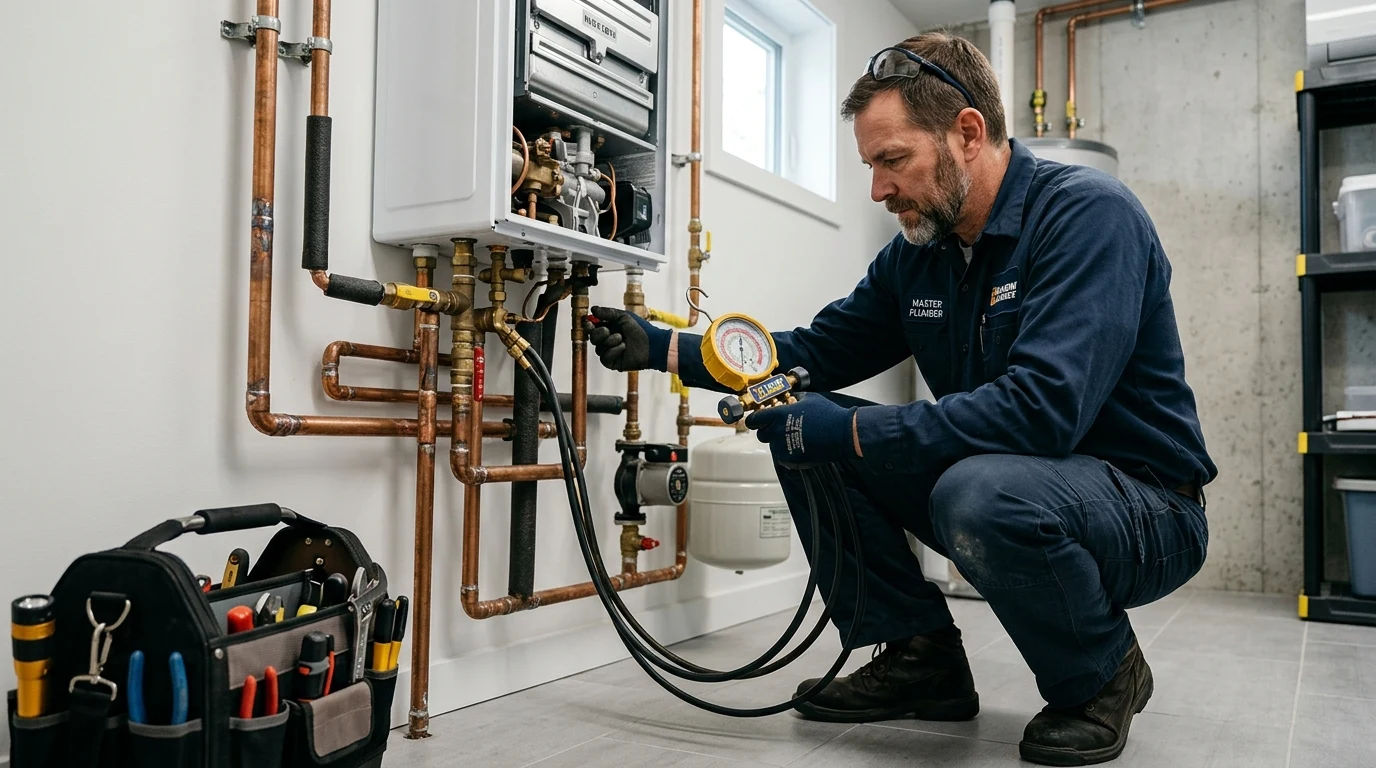
1. The Thermodynamics of Condensing Combustion: Why High Efficiency Creates Acid
How does a water heater achieve 96% thermal efficiency?
Traditional atmospheric water heaters waste massive amounts of thermal energy. Flue gases exit the exhaust vent at 350°F to 450°F (177°C to 232°C) to maintain natural buoyancy and prevent moisture condensation inside the chimney. That escaping heat represents wasted fuel dollars.
Condensing water heaters change the equation completely. They incorporate a secondary heat exchanger—typically fabricated from 316L surgical-grade stainless steel or corrosion-proof silicon-aluminum alloy.
Incoming cold municipal water (often entering at 40°F to 50°F along the Colorado Front Range) circulates through this secondary coil, dropping exhaust flue gas temperatures below their **dew point of approximately 130°F (54°C)**.
As flue gas drops below the dew point, the water vapor created during combustion undergoes a phase change from gas to liquid. This condensation releases the latent heat of vaporization—roughly **970 BTUs per pound of water condensed**. The heater absorbs this extra thermal energy, pushing overall efficiency past 95%.
The Chemical Reactions of Flue Gas Condensation
Natural gas is primarily methane ($CH_4$). The idealized stoichiometric combustion equation is:
In the real world, combustion air contains 78% nitrogen ($N_2$), along with trace sulfur compounds added as odorants (mercaptans). Inside the high-temperature burner flame, intense thermal oxidation takes place, generating acidic combustion byproducts:
- Carbonic Acid Formation: Carbon dioxide dissolves rapidly into the condensing water droplets:
$$CO_2 + H_2O \rightleftharpoons H_2CO_3 \rightleftharpoons H^+ + HCO_3^-$$
- Nitric & Nitrous Acid Formation: Atmospheric nitrogen oxidizes into nitrogen oxides ($NO_x$), which react with moisture:
$$2NO_2 + H_2O \rightarrow HNO_3 + HNO_2$$
- Sulfuric Acid Formation: Trace mercaptan sulfur oxidizes to sulfur dioxide ($SO_2$), creating sulfurous and sulfuric acids:
$$SO_2 + H_2O \rightarrow H_2SO_3 \quad \xrightarrow{O_2} \quad H_2SO_4$$
The result is an acidic condensate with a raw pH hovering between **3.0 and 4.2**. Because the pH scale is logarithmic, fluid at pH 3.0 has **10,000 times higher hydrogen ion concentration** than neutral potable water at pH 7.0.
2. Condensate Volume Calculations: Estimating Daily Acidic Discharge
How much acid does a commercial facility actually dump into its drainage system every day?
Facility operators often underestimate the immense volume of condensate generated by commercial equipment.
We calculate condensate output using the standard combustion engineering equation:
Under normal Colorado operating conditions, a fully condensing system yields approximately **0.75 to 1.0 gallon of condensate per hour for every 100,000 BTU/hr of firing rate**.
Let’s look at real-world numbers across typical commercial facilities in Broomfield:
| Facility Type | Total Firing Capacity (BTU/hr) | Average Daily Run Time | Daily Condensate Volume (Gallons) | Annual Acidic Discharge (Gallons) |
|---|---|---|---|---|
| Boutique Hotel / Hospitality (40 Rooms) | 500,000 BTU/hr (Bank of 2) | 8 Hours | 32 – 40 Gallons | 11,680 – 14,600 Gal |
| Multi-Family Apartment Complex (120 Units) | 1,500,000 BTU/hr (Bank of 3) | 10 Hours | 112 – 150 Gallons | 40,880 – 54,750 Gal |
| Commercial Craft Brewery / Washdown | 2,000,000 BTU/hr | 12 Hours | 180 – 240 Gallons | 65,700 – 87,600 Gal |
| Commercial Athletic Club / Aquatic Center | 3,000,000 BTU/hr (Central Plant) | 14 Hours | 315 – 420 Gallons | 114,975 – 153,300 Gal |
Think about that last row. An aquatic center or multi-family complex discharges upwards of **50,000 to 150,000 gallons of unbuffered, pH 3.2 acid** directly into its plumbing system every year.
Without effective neutralization, that volume will destroy any building drainage system.
3. International Plumbing Code (IPC) Section 314 & Environmental Discharge Regulations
Discharging raw condensing water heater runoff directly into a standard floor drain is illegal under state and municipal plumbing codes.
Under **IPC Section 314.1 (Condensate Disposal)**, liquid condensate from fuel-burning appliances, air-conditioning units, and refrigeration equipment must be collected and discharged to an approved plumbing fixture or disposal area.
More critically, **IPC Section 314.2.1 and Section 803.1 (Waste Neutralization)** dictate:
“Corrosive liquids, acids, and other harmful chemicals that could damage the sanitary sewer system, destroy plumbing fixtures or piping materials, or inhibit municipal sewage treatment processes shall not be discharged into the plumbing system without being thoroughly neutralized or rendered innocuous.”
Local Front Range Discharge Thresholds
Municipal wastewater utility authorities across Broomfield, Westminster, and the Metro Wastewater Reclamation District enforce strict pH discharge limits under local industrial pretreatment regulations:
- Minimum Permissible Effluent pH: Typically **5.5 to 6.0** (anything lower is classified as hazardous corrosive waste).
- Maximum Permissible Effluent pH: Typically **9.0 to 9.5**.
- Prohibited Discharge: Direct discharge of fluids with pH < 5.0 into public sewer infrastructure is subject to municipal stop-work orders, retroactive infrastructure damage assessments, and daily financial penalties under the Clean Water Act.
When code enforcement officers or commercial building inspectors audit a mechanical room, an absent or expired condensate neutralizer is cited as a serious mechanical code violation.
4. The Destruction of Concrete Slabs, Cast Iron, and Copper Piping
What happens when unbuffered pH 3.2 condensate leaks or drains onto commercial building components?
The chemical destruction is rapid and unforgiving.
1. Concrete Slab Etching and Foundation Cavitation
Concrete is an alkaline composite material composed of aggregate bound together by hydrated Portland cement. The primary binder is calcium silicate hydrate, interspersed with free calcium hydroxide ($Ca(OH)_2$), maintaining an alkaline internal pH around 12.5 to 13.0.
When acidic condensate (pH 3.2) drips onto an unsealed concrete slab, a vigorous acid-base reaction occurs:
The acid strips the cement binder, converting structural concrete back into loose sand and gravel. Over two to three years of steady dripping, condensate carves deep channels 4 to 6 inches deep into the mechanical room slab.
In post-tensioned slab construction common across Broomfield commercial buildings, this acid seepage reaches structural steel reinforcement cables. The high hydrogen ion concentration induces **stress corrosion cracking and catastrophic cable failure**, compromising whole building structural integrity.
2. Graphitic Corrosion of Cast Iron DWV Piping
Commercial buildings constructed prior to the mid-2000s rely heavily on hub-and-spigot or hubless cast iron for sub-slab sanitary drainage.
Cast iron contains approximately 3% to 4% carbon in the form of microscopic graphite flakes suspended in an iron matrix. When unbuffered acid enters the pipe, **graphitic corrosion (leaching)** takes place.
The acid selectively dissolves the ductile iron metal, leaving behind only the brittle graphite skeleton. To the naked eye, the pipe looks intact. But touch it with a screwdriver tip, and the wall crumbles like soft modeling clay.
The bottom of the pipe rots out completely, dumping grease and commercial sewer discharge directly into the sub-slab soil.
3. Copper and Brass Dissolution
Amateur installers sometimes route condensate drain lines using copper refrigeration tubing or drain into copper floor sink waste arms.
Nitric and sulfuric acids dissolve metallic copper through oxidative leaching, creating vivid bright green copper sulfate and copper nitrate encrustations. Within six to twelve months, the 0.035″ wall of Type M copper develops pinhole sprays, spraying acidic water behind mechanical drywall.
5. The Chemistry of Limestone Neutralization Systems
How do commercial facilities neutralize hundreds of gallons of acid safely and affordably?
The engineering industry standard is passive **granular calcium carbonate ($CaCO_3$) limestone neutralization**.
The Neutralization Chemical Reaction
A condensate neutralizer consists of a corrosion-proof polypropylene or PVC vessel filled with high-purity crystalline limestone chips (minimum 90% to 95% calcium carbonate content).
As acidic condensate flows across the media bed, hydrogen ions react with the calcium carbonate:
This reaction yields three harmless products:
- Dissolved calcium ions ($Ca^{2+}$), which are completely non-corrosive.
- Pure neutral water ($H_2O$).
- Dissolved carbon dioxide ($CO_2$), which vents safely into the air.
When properly sized, fluid entering the vessel at pH 3.1 exits the discharge nozzle at **pH 6.5 to 7.8**—perfectly safe for cast iron, concrete, and municipal sewer disposal.
6. Types of Commercial Condensate Neutralizers: Inline Tubes vs. Tank Reservoirs vs. Powered Pumps
Selecting the proper neutralizer depends on total commercial boiler input capacity, available floor space, and gravity drainage elevation:
| Neutralizer Type | BTU Rating Range | Media Capacity | Best Applications | Maintenance Interval |
|---|---|---|---|---|
| Inline Capsule / Tube | 100,000 to 500,000 BTU/hr | 2 to 6 lbs ($CaCO_3$) | Wall-hung commercial units, tight mechanical closets, light restaurants. | Every 3 to 6 months |
| Floor-Mount Baffled Tank | 500,000 to 2,000,000 BTU/hr | 20 to 50 lbs ($CaCO_3$) | Hotels, multi-family central boiler plants, industrial breweries. | Every 6 to 12 months |
| Integrated Pump Neutralizer | 250,000 to 1,200,000 BTU/hr | 8 to 15 lbs ($CaCO_3$) | Basement mechanical rooms with drain points elevated above boiler level. | Every 4 to 6 months |
| Active Chemical Dosing Station | > 3,000,000 BTU/hr | Liquid Sodium Hydroxide / Soda Ash | District heating plants, hospital campuses, municipal utility centers. | Continuous monitoring |
In facilities where the gravity floor drain is higher than the water heater condensate drain pan (common in basement installations across Broomfield), an **Integrated Neutralizer Pump** is mandatory.
Never install a standard residential plastic condensate pump upstream of the neutralizer.
Raw pH 3.2 acid dissolves the pump’s rubber impeller seal, etches the stainless steel float shaft, and burns out the motor windings within months, causing nasty basement floods. The neutralizer must always sit upstream of the pump, or you must deploy an engineered acid-resistant all-in-one neutralizer pump.
7. Sizing Calculations: Contact Time, Flow Rate, and Media Depletion Rates
Why do so many commercial neutralizers fail health and plumbing inspections even when full of rocks?
Because they were undersized. The acid rushes through the canister too fast to react.
Effective neutralization is governed by **hydraulic contact time (residence time)**. The acidic fluid must remain in physical contact with the calcium carbonate pellets for a minimum of **8 to 12 minutes** to raise pH from 3.0 up to safe levels (>6.5).
Calculating Minimum Media Bed Volume
We calculate the minimum required limestone volume using:
Where:
- $Q_{\text{peak}}$ = Peak condensate flow rate ($gal/min$)
- $t_{\text{residence}}$ = Target residence contact time ($min$, typically 10 minutes)
- $\phi$ = Bed void fraction (porosity between limestone chips, typically $0.40$ to $0.45$)
If a commercial boiler battery fires at 2,000,000 BTU/hr, it generates up to 20 gallons of condensate per hour ($0.33 \text{ GPM}$).
At a 10-minute residence time, the fluid volume inside the tank must be 3.33 gallons. Accounting for the 40% void fraction of gravel packing, the physical tank volume must hold at least **8.3 gallons of limestone media** (approx. 70 to 80 pounds of rock).
Installing a dinky 3-pound residential inline tube on a 2-million BTU commercial boiler is completely ineffective. Condensate shoots through the tube in 30 seconds. The effluent exits at pH 3.4, eating through your building’s cast iron drain lines completely unchecked.
8. Why Limestone Media Fails: Channeling, Passivation, and Sludge Coating
Even correctly sized neutralizers lose their chemical potency over time due to three physical failure mechanisms:
- Hydraulic Channeling: Water takes the path of least resistance. Over months of steady flow, condensate cuts a single narrow flow channel through the center of the limestone bed. The water bypasses 80% of the rock media, dropping contact time to near zero. Effluent pH crashes back down to dangerous acidic levels.
- Chemical Passivation (Sulfate Blindness): When combustion air contains sulfur compounds, the sulfuric acid reacts with calcium carbonate to form **calcium sulfate ($CaSO_4 \cdot 2H_2O$, gypsum)**. Unlike highly soluble calcium chloride, gypsum has low solubility. It forms an impermeable, glassy mineral crust over the limestone pellets. The acid can no longer touch the reactive rock underneath. The reaction stops dead.
- Airborne Particulate & Biological Sludge: Commercial mechanical rooms draw large volumes of combustion air. That air brings dust, lint, pet dander, and microscopic soot particles. These particles wash out with the condensate, forming a black, gelatinous slime blanket over the media that smothers the limestone.
This is why simply looking through a clear plastic tube and seeing rocks is not enough. You must physically test the discharge water with a calibrated digital pH meter.

9. Approved Condensate Piping Materials: IPC Section 314.2.2 Standards
Can you run commercial condensate through PVC, CPVC, polypropylene, or copper?
Plumbing codes leave zero room for ambiguity. Under **IPC Table 314.2.2**, piping materials for condensate drainage must be chemically resistant to the discharge fluid:
| Piping Material | Code Compliant for Acid Condensate? | Temperature Rating | Master Plumber Evaluation |
|---|---|---|---|
| Schedule 40 PVC (ASTM D1785) | YES (Downstream of trap) | Max 140°F (60°C) | Industry standard. Impervious to acid, cost-effective, easy solvent-weld install. |
| Schedule 80 CPVC (ASTM F441) | YES (Recommended) | Max 200°F (93°C) | Superior choice for commercial boilers prone to high-temperature thermal purges. |
| Polypropylene (PP / PP-R) | YES (High Chemical Spec) | Max 180°F (82°C) | Heat-fused, zero solvent cement joints; perfect for industrial and lab washdown lines. |
| Copper (Type L / M) | STRICTLY PROHIBITED | N/A | Rapidly leached and perforated by nitric and carbonic acids. Code violation. |
| Cast Iron / Galvanized Steel | STRICTLY PROHIBITED (Unbuffered) | N/A | Suffers severe graphitic corrosion and wall collapse unless neutralized upstream. |
Notice the temperature rating for standard PVC: **140°F (60°C)**.
During boiler malfunction, burner misfire, or secondary heat exchanger scaling, exhaust flue gases can spike. If flue temperatures climb past 150°F, hot acidic water warps, softens, and separates standard Schedule 40 PVC slip joints.
For commercial high-input boilers, our master plumbers recommend **Schedule 80 CPVC** or heat-fused polypropylene to handle both thermal spikes and chemical exposure.
10. Freeze Protection for Exterior and Unconditioned Condensate Lines
Along the Colorado Front Range, winter temperatures regularly plunge below zero degrees Fahrenheit.
Commercial rooftop units, parking garage water heaters, and mechanical rooms situated near unconditioned fresh-air louvers face a severe risk: **condensate line freezing**.
Because condensate drains trickle slowly (a tiny continuous drip of a few drops per second), they have virtually zero thermal mass. As soon as cold outdoor draft air strikes an uninsulated drain pipe, ice crystals form along the inside wall.
Within three hours, an exterior condensate line freezes solid.
The Dangerous Domino Effect of Frozen Condensate Lines
- The drain pipe freezes completely shut.
- Condensate backs up into the internal drain pan and secondary heat exchanger.
- Modern commercial water heaters detect the backup via an internal pressure switch or conductive condensate level sensor, triggering an **E-04 / Flue Pressure Error**.
- The unit locks out on safety shutdown.
- At 3:00 AM in a 100-room hotel or apartment complex, all domestic hot water stops completely.
If the safety switch fails to trip, condensate backs up directly into the combustion blower housing, destroying the fan motor, shorting the spark igniter, and cracking the ceramic burner matrix.
Our master plumbers protect Front Range condensate lines using:
- Self-regulating commercial heat trace cable rated at 5 to 8 Watts per foot.
- Closed-cell elastomeric foam insulation (minimum 1.0-inch wall thickness).
- Internal auxiliary mechanical overflow air gaps with code-approved emergency relief ports.
11. Case Studies from Broomfield: Commercial Mechanical Room Disasters
Real-world failures illustrate why routine condensate maintenance matters:
Case Study 1: The Crumbling Foundation in an Interlocken Data Center
The Building: A mission-critical commercial facility in Interlocken with a 1,200,000 BTU high-efficiency hydronic boiler array.
The Issue: During a quarterly facilities walkthrough, an engineer noticed that a 4-inch deep crater had formed in the concrete directly beneath the main boiler rack. The floor drain was completely clogged with gray sand.
Our Master Plumber Diagnosis: The original installation crew had omitted an acid neutralizer, piping the 1-inch clear vinyl condensate lines directly across the raw concrete floor into an unlined cast iron floor drain. Over four years, an estimated 80,000 gallons of pH 3.1 condensate had etched a 6-foot-long trench through the structural slab, exposing the top layer of welded wire mesh and dissolving the cast iron drain collar completely.
The Master Plumber Restoration: We secured structural engineering sign-off, epoxy-patched the excavated slab trench, installed a heavy-duty 50-lb commercial baffled limestone neutralizer tank, replaced the ruined cast iron drain hub with chemical-grade polypropylene, and instituted a digital pH testing protocol. The effluent pH now measures a solid 7.2.
Case Study 2: Peak-Rush Lockout at a Broomfield Hotel
The Building: A 120-room hotel off Highway 287.
The Issue: On a Friday morning at 7:00 AM, the hotel general manager received dozens of furious guest calls complaining of ice-cold showers. Both commercial condensing water heaters had locked out on an E-29 error code.
Our Master Plumber Diagnosis: We arrived on-site in 25 minutes. We found that the small inline neutralizer capsule had completely clogged with black combustion soot and passivated gypsum scale. Backpressure had forced condensate back into the secondary heat exchanger sump, flooding the ceramic flame rectification probe.
The Master Plumber Restoration: We disassembled and cleaned the burner collector box, replaced the fouled flame sensor, removed the undersized capsule, and installed an oversized dual-chamber clear-acrylic neutralizer with isolation bypass valves. Both heaters were firing at 100% capacity within 45 minutes, restoring full hot water to all 120 guest rooms.
12. Routine Inspection & Maintenance Checklist for Facility Managers
To keep your commercial water heaters running at peak efficiency while protecting building assets, implement this structured maintenance schedule:
| Frequency | Component / Action | Acceptable Benchmark | Corrective Action if Failed |
|---|---|---|---|
| Monthly | Digital pH testing of neutralizer discharge effluent | pH > 6.0 (Ideal: 6.5 – 7.5) | If pH < 5.5, dump, flush, and recharge limestone media immediately. |
| Monthly | Visual inspection of condensate drain lines and joints | Zero leaks, no sagging, unobstructed flow | Re-strap sagging lines to maintain 1/8″ to 1/4″ per foot slope. |
| Quarterly | Check limestone media bed depth and condition | Media filled to marked fill line; no gypsum crust | Stir media to break channels; top off with fresh pellets. |
| Quarterly | Inspect condensate trap assembly on water heater | Clean water column; no soot or black slime | Remove trap, flush with clean water, refill trap seal before restart. |
| Biannually | Test high-water float switch on neutralizer pump | Pump activates cleanly; alarm trips on high water | Disassemble pump basin, clear debris, replace switch if sticky. |
| Annually | Complete vessel dump, chemical sanitization, and full recharge | Virgin $CaCO_3$ media with >90% purity | Certified master plumber maintenance log sign-off for code records. |
13. Master Plumber Step-by-Step Neutralizer Recharge Procedure
When replenishing limestone media in a commercial neutralizer, follow this certified trade protocol:
- Isolate Equipment & Disconnect Power: Turn off water heater power or switch off the dedicated condensate pump circuit breaker to prevent unexpected water discharge during servicing.
- Isolate Flow with Three-Valve Bypass: If equipped, close the inlet and outlet ball valves and open the temporary bypass valve to allow ongoing boiler operation during the recharge.
- Drain and Inspect Spent Slurry: Open the lower drain plug into an acid-resistant bucket. Carefully remove spent limestone gravel. Inspect the bottom of the vessel for black carbon soot, rust flakes, or calcified gypsum crusts.
- Sanitize Vessel Interior: Flush the container thoroughly with warm clean water. Scrub interior baffles and inlet filter screens with a stiff nylon brush to remove biological biofilms.
- Load High-Purity Limestone Media: Fill the vessel with certified commercial-grade calcium carbonate chips (grain size 1/2″ to 3/4″, minimum 90% purity). Do not use agricultural limestone dust or landscape crushed marble, which pack too tightly and cause immediate flow clogs.
- Prime the Water Column: Pour 1 to 2 gallons of clean potable water through the vessel before sealing the lid. This pre-wets the media, washes out initial stone dust, and fills downstream P-traps to prevent flue gas infiltration.
- Re-test Effluent pH: Reconnect supply lines, power on the water heater, allow condensate to flow for 15 minutes, and verify that effluent measures above pH 6.5 using a calibrated digital meter.
14. Emergency Service Protocols: When Condensate Backups Flood Your Mechanical Room
If you walk into your commercial mechanical room and discover standing water around your water heaters, act swiftly:
- Step 1: Check for Electrical Hazards: If water level reaches electrical conduits, boiler base plates, or transfer pumps, do not step into the water. Shut off power at the main mechanical disconnect panel.
- Step 2: Check Water Heater Display Codes: Note any error codes (such as E-04, E-29, or Condensate Blockage) before turning off the power switch.
- Step 3: Clear the Drainage Discharge Point: Verify whether the backup is localized inside the neutralizer tube or if the building’s floor drain is backing up due to a sub-slab main line clog.
- Step 4: Never Disconnect Condensate Hoses While Boilers Fire: Uncoupling hoses while boilers operate releases toxic carbon monoxide ($CO$) and combustion gases directly into the mechanical room.
- Step 5: Call Licensed Commercial Emergency Plumbers: Contact our rapid-response team at (303) 647-3363. Our master technicians carry commercial neutralizer tanks, replacement pumps, Schedule 80 CPVC, and high-purity limestone media on our mobile service trucks 24 hours a day, 365 days a year.
Frequently Asked Questions (FAQ)
Why is water heater condensate acidic in the first place?
Condensate forms when high-efficiency condensing heat exchangers cool natural gas flue gases below their dew point (approx. 130°F). The moisture condenses and absorbs carbon dioxide, sulfur compounds, and nitrogen oxides from the exhaust gases, creating a mixture of carbonic, nitric, and sulfuric acids with a raw pH between 2.9 and 4.0.
What happens if I don’t install an acid neutralizer on my commercial water heater?
Without a neutralizer, raw acid will dissolve cast iron drain pipes from the inside out, eat deep holes through concrete floors and foundations, and corrode sub-slab plumbing lines. It also violates International Plumbing Code (IPC) Section 314 and local municipal wastewater pretreatment standards, risking substantial environmental fines and emergency shutdowns.
How often should limestone media be replaced in a commercial neutralizer?
In most commercial facilities, limestone media should be tested monthly and completely replaced every 3 to 6 months depending on boiler run hours and firing capacity. If digital pH testing shows effluent dropping below pH 6.0, the media must be replaced immediately regardless of time elapsed.
Can I use ordinary landscape marble or garden limestone to refill my neutralizer?
No. Landscape stone and garden limestone have uncontrolled chemical purities and contain excessive fine dust that quickly compacts into an impermeable mud layer, causing condensate to back up into the heater. Commercial neutralizers require washed, high-purity crystalline calcium carbonate pellets ($CaCO_3$ > 90%) sized between 1/2″ and 3/4″ to maintain proper fluid flow and contact time.
Why did my commercial water heater shut down with a condensate blockage error code?
Commercial condensing water heaters feature built-in safety pressure switches and liquid level sensors in the heat exchanger condensate pan. If your neutralizer, trap, or exterior drain line clogs or freezes, water backs up inside the secondary heat exchanger. The unit locks out automatically to prevent water from flooding the burner blower and electrical controls.
Commercial Water Heater Condensate Emergency in Broomfield?
Protect your concrete foundations, drain piping, and heating equipment from severe acid destruction. Our licensed master plumbers provide same-day emergency neutralizer replacement, pH testing, and code-certified repairs.