
Table of Contents: Cast Iron Sewer Forensics & Rehabilitation Engineering Guide
- 1. Executive Summary: The Post-War Cast Iron Infrastructure Crisis
- 2. Metallurgy & Chemical Pathology: Graphitization, Crown Rot & Invert Channel Wear
- 3. Geotechnical Soil Resistivity & External Bentonite Clay Corrosion
- 4. Fluid Dynamics, Colebrook-White Friction & Manning’s Roughness Degradation
- 5. Forensic CCTV Diagnostic Scoping & Ultrasonic Wall Thickness Caliper Audits
- 6. Comprehensive Engineering Comparison Matrix: Descaling vs. Hydro Jetting vs. CIPP vs. Trenching
- 7. Step-by-Step High-Speed Mechanical Chain Descaling & Trenchless Rehabilitation Protocol
- 8. Colorado Front Range Submarket Profiles: 1950s-1970s Housing Stock & Sub-Slab Cast Iron
- 9. Financial Life-Cycle Analysis: Preventative Descaling vs. Indoor Concrete Slab Demolition
- 10. Comprehensive Extended FAQ Section (12 Detailed Engineering Questions)
- 11. Schedule Cast Iron Video Scope & High-Speed Descaling Consultation
1. Executive Summary: The Post-War Cast Iron Infrastructure Crisis
Beneath the concrete basement slabs, crawlspaces, and manicured front lawns of tens of thousands of mid-century homes across the Colorado Front Range lies a ticking subterranean plumbing emergency: deteriorating gray cast iron sanitary sewer piping. Installed extensively between the early 1950s and late 1970s across established neighborhoods in Westminster, Thornton, Arvada, and older sections of Broomfield, cast iron was long heralded by municipal civil engineers as the premier, heavy-duty material for residential Drain-Waste-Vent (DWV) and sewer lateral infrastructure.
However, materials science and metallurgy have proven that cast iron possesses a finite, predictable operational lifespan of approximately 50 to 65 years in residential wastewater environments. Across northern Denver Metro, virtually every original cast iron sewer system installed prior to 1980 has now exceeded its engineered design life. Homeowners in these properties increasingly confront a frustrating and escalating cycle of chronic plumbing failures: recurring mainline toilet backups, slow-draining sub-level bathtubs, foul subterranean sewer gas odors, and mysterious cracks appearing along finished basement concrete slabs.
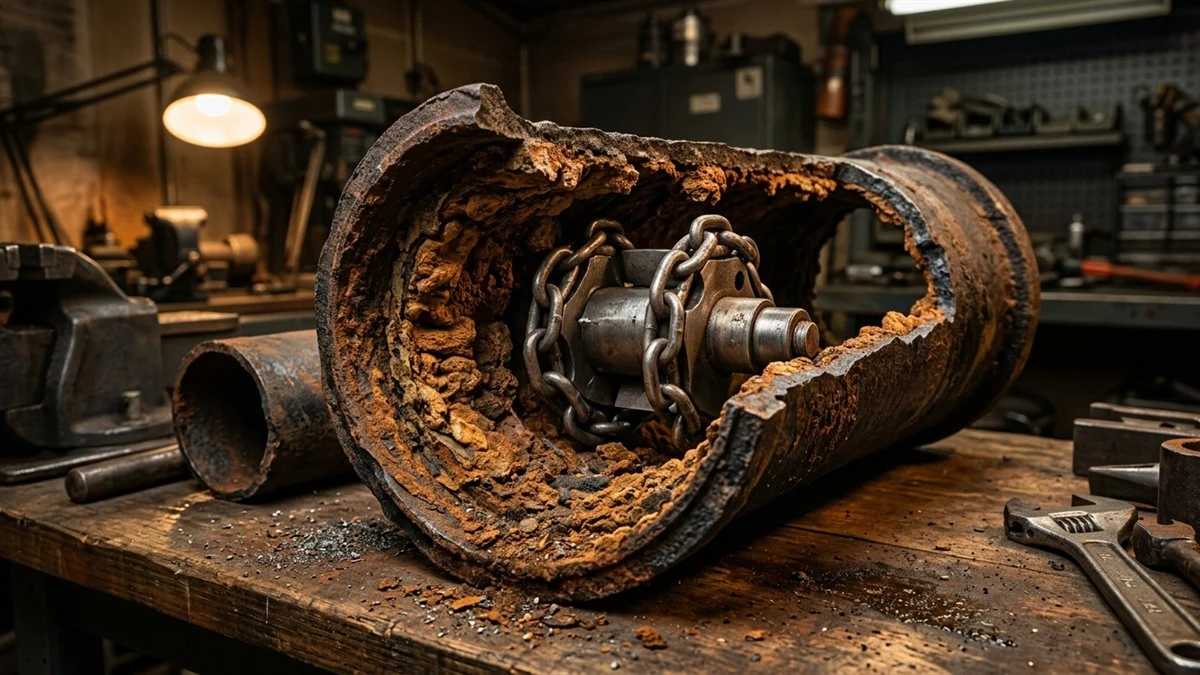
Historically, remediating deteriorated cast iron piping beneath a home was an intrusive and destructive financial nightmare. Licensed plumbing contractors had no choice but to bring heavy pneumatic jackhammers into finished basements, pulverizing concrete floor slabs, destroying custom tile and hardwood flooring, generating hazardous silica dust, and leaving families displaced for weeks while trenches were dug by hand. The total cost of under-slab excavation frequently surpassed $20,000 to $35,000 once secondary flooring and structural foundation reconstruction were tallied.
Today, advanced trenchless rehabilitation engineering—specifically high-speed mechanical chain descaling coupled with Cured-In-Place Pipe (CIPP) epoxy inversion lining—allows licensed master plumbers to structurally restore aging cast iron sewer lines directly from exterior cleanouts without breaking an inch of interior concrete. This comprehensive engineering guide explores the chemical mechanisms of cast iron decay, the physics of hydraulic friction loss, forensic video diagnostic criteria, and the economic comparison between mechanical descaling and total pipe replacement across northern Colorado.
2. Metallurgy & Chemical Pathology: Graphitization, Crown Rot & Invert Channel Wear
Cast iron is not a pure element; it is an iron-carbon alloy containing 2% to 4% carbon in the form of microscopic graphite flakes dispersed within a crystalline ferrite (iron) matrix. When cast iron sewer pipes carry residential blackwater and greywater for half a century, three distinct electrochemical and biochemical degradation mechanisms destroy the pipe wall:

1. Graphitic Corrosion (Graphitization)
Graphitic corrosion is an insidious form of galvanic de-alloying unique to gray cast iron. When cast iron is immersed in an electrolyte (such as mineral-rich residential wastewater and moist subterranean soils), an internal galvanic cell forms between the pure iron ferrite matrix (which acts as the anode) and the carbon graphite flakes (which act as the cathode). Over decades, the iron matrix is selectively dissolved and leached away:
The tragedy of graphitization is that the pipe retains its original exterior shape, wall thickness, and visual appearance. However, the metallic iron is entirely gone, replaced by a soft, porous, brittle matrix of graphite and iron oxide rust. A graphitized cast iron pipe can be easily punctured with a common screwdriver, and it shatters like brittle ceramic pottery when subjected to external ground settlement or hydraulic pressure surges.
2. Bottom Channel Rot (Invert Erosion)
Gravity sewer lines operate partially full: wastewater continuously flows along the bottom 25% of the pipe circumference (known as the pipe invert). Over decades, abrasive solid waste, sand slurry from washing machines, and acidic organic acids carve away the protective iron oxide patina along the flow channel. Simultaneously, standing puddles in flat or slightly sagged pipes create continuous anaerobic corrosion cells.
Eventually, the bottom of the pipe rots through completely. The cast iron transitions into an open-bottom “half-pipe” or “channel trough,” allowing thousands of gallons of blackwater to drain directly into the structural soils beneath the basement foundation slab, washing away supporting aggregate and creating massive soil voids.
3. Sulfuric Acid Crown Rot (Microbially Induced Corrosion)
While the bottom of the pipe suffers liquid erosion, the top crown of the pipe suffers atmospheric biogenic corrosion. In poorly ventilated or sluggish sewer lines, anaerobic bacteria produce hydrogen sulfide gas ($H_2S$), which rises into the pipe headspace. Aerobic sulfur-oxidizing bacteria (Thiobacillus) residing on the moist upper pipe wall metabolize this gas into concentrated biogenic sulfuric acid:
This acid aggressively dissolves the cast iron crown, creating long longitudinal cracks and gaping holes through which subterranean soil and biological tree roots invade.
3. Geotechnical Soil Resistivity & External Bentonite Clay Corrosion
While internal chemical and biological reactions attack cast iron from within, Colorado’s unique geology attacks buried sewer laterals from the outside. The geological substrate across Broomfield, Westminster, and Arvada is dominated by the Pierre Shale formation, composed of dense sodium montmorillonite and bentonite clays.
Electrochemical Soil Resistivity
The corrosive potential of soil surrounding a buried iron pipe is directly related to its electrical resistivity ($\rho$, measured in Ohm-centimeters):
- Resistivity greater than 10,000 Ohm-cm: Essentially non-corrosive (dry, well-drained sandy loam).
- Resistivity 2,000 to 5,000 Ohm-cm: Moderately corrosive.
- Resistivity below 1,000 to 2,000 Ohm-cm: Extremely Corrosive. Front Range bentonite clay formations regularly register soil resistivities between 700 and 1,800 Ohm-cm due to high concentrations of dissolved sulfate, carbonate, and chloride mineral salts washed down from the Rocky Mountain watershed.
In low-resistivity bentonite soils, stray electrical ground currents and natural oxidation-reduction potential (redox potential) differences between moist sub-slab soil and dry lawn soil generate aggressive exterior galvanic pitting cells. Cast iron pipes in these formations experience external wall loss rates of up to 0.15 mm to 0.25 mm per year. After 40 to 50 years, external pitting meets interior channel wear, causing complete structural wall perforation.
4. Fluid Dynamics, Colebrook-White Friction & Manning’s Roughness Degradation
As cast iron corrodes, the oxidized iron byproducts ($Fe_2O_3$ and $Fe_3O_4$) expand dramatically, occupying between 4 to 10 times the physical volume of the original metal. This volumetric expansion creates jagged, razor-sharp rust mounds known as tubercles that project inward from the pipe walls.

The Colebrook-White Equation & Boundary Layer Turbulence
The Darcy-Weisbach friction factor ($f$) in turbulent fluid pipe flow is governed by the Colebrook-White equation:
Where $\epsilon$ is the absolute equivalent roughness height of internal wall protrusions, $D$ is internal diameter, and $Re$ is the Reynolds number ($Re = \rho v D / \mu$). In new cast iron or CIPP epoxy liner, the absolute roughness height is negligible: $\epsilon = 0.05\text{ mm to }0.15\text{ mm}$. The laminar boundary layer remains stable, and fluid velocity flows unimpeded.
In heavily tuberculated cast iron, rust ridges grow to heights of $\epsilon = 5.0\text{ mm to }15.0\text{ mm}$ (protruding up to 1/2-inch into the flow channel!). This massive relative roughness ($\epsilon / D > 0.10$) completely shatters the hydraulic boundary layer, causing violent micro-vortices and immense dynamic drag. Under Manning’s formulation:
Manning’s roughness coefficient skyrockets from n = 0.012 up to n = 0.026 to 0.028. Wastewater flow velocity plummets below the critical 2.0 feet-per-second self-cleansing threshold. Solid suspended particulate and toilet paper immediately settle onto the jagged rust floor, creating chronic, recurring blockages that no standard mechanical drain snake can permanently resolve.
5. Forensic CCTV Diagnostic Scoping & Ultrasonic Wall Thickness Caliper Audits
Accurately assessing the structural health of an underground cast iron sewer lateral requires sophisticated non-destructive diagnostic testing:

High-Definition Self-Leveling CCTV Video Scoping
A self-leveling color fiber-optic camera equipped with a high-output LED array and a 512 Hz sonde transmitter is navigated from the cleanout through the entire cast iron run. The technician inspects for four critical structural failure indicators:
- Channel Loss (Bottom Voiding): Determining whether the pipe invert retains solid iron or whether standing water is running directly over exposed subterranean soil bedding.
- Tuberculation Occlusion Percentage: Measuring the percentage of internal bore reduction caused by rust blisters (e.g., a 4-inch pipe reduced to a 2-inch opening).
- Longitudinal Crown Fractures: Identifying stress cracks along the upper quadrant caused by expansive bentonite clay soil heave.
- Lead-and-Oakum Hub Separation: Checking for separated bell-and-spigot joints where root clusters have invaded through porous packing rope.
Ultrasonic Wall Thickness Caliper Testing
Before an aging cast iron pipe can be approved for trenchless CIPP lining, technicians must verify that the host pipe retains sufficient residual hoop strength. Using ultrasonic thickness gauges or calibrated laser profiling cameras, plumbers measure the remaining iron wall thickness. Under ASTM F1216 CIPP design calculations, a host pipe must retain at least 2.5 mm to 3.0 mm of structural wall to safely support the mechanical descaling process and anchor the structural epoxy sleeve.
ASTM F1216 Structural CIPP Thickness Design Equations
When designing a CIPP epoxy composite liner to rehabilitate deteriorated underground cast iron, civil plumbing engineers calculate the required minimum liner wall thickness ($t$) using the ASTM F1216 Design Equation for Fully Deteriorated Gravity Pipelines:
Where:
- t: Required structural composite liner thickness (inches or mm)
- D: Mean internal diameter of the host cast iron pipe (nominal 4.0 or 6.0 inches)
- K: Soil support enhancement factor (typically 7.0 for well-compacted Front Range soils)
- E_L: Long-term 50-year flexural modulus of elasticity of the cured epoxy composite (typically 300,000 to 450,000 PSI under ASTM D790 testing)
- \nu: Poisson’s ratio of the structural polymer resin (0.35)
- N: Factor of safety (industry standard is N = 2.0)
- P_t: Total combined subterranean load, incorporating vertical prism soil overburden pressure ($P_s$), hydrostatic groundwater head pressure ($P_w$), and AASHTO H-20 dynamic highway traffic wheel loading ($P_l$):
In typical Front Range residential settings with a 6-foot burial depth beneath a concrete driveway, this equation dictates a minimum structural liner thickness of 3.0 mm to 4.5 mm for 4-inch sewer lines and 6.0 mm for 6-inch lines. Once fully polymerized, this seamless epoxy composite functions as an independent, stand-alone structural pipeline capable of withstanding complete host pipe collapse for over 100 years.
6. Comprehensive Engineering Comparison Matrix: Descaling vs. Hydro Jetting vs. CIPP vs. Trenching
To assist homeowners and facility managers in evaluating their cast iron restoration options, the technical comparison table below details operational metrics across the four competing remediation methodologies:
| Remediation Method | Excavation & Disruption | Restoration Scope | Expected Lifespan | 50-Year Cost Efficiency |
|---|---|---|---|---|
| Standard Mechanical Snaking | Zero dig (Cleanout access) | Punches temporary 1″ hole in clog; leaves rust scale intact. | 30 to 90 Days (Clogs recur quickly) | POOR (Continuous service calls) |
| High-Pressure Hydro Jetting | Zero dig (Cleanout access) | Flushes soft grease and sand slurry; cannot shear heavy rust blisters. | 1 to 2 Years | FAIR (Maintenance measure only) |
| Mechanical Chain Descaling + CIPP Epoxy Lining | Zero Dig: Restores pipe beneath slab from outside cleanout. | Strips scale to bare metal; installs structural seamless 50-yr epoxy sleeve. | 50+ to 100 Years | OUTSTANDING (Saves finished basements) |
| Traditional Open-Cut Slab Demolition & Replacement | Catastrophic: Jackhammers interior basement concrete slabs. | Excavates and replaces old pipe with new PVC; requires complete subfloor reconstruction. | 50 to 75 Years | VERY EXPENSIVE ($20k-$35k+ total project) |
7. Step-by-Step High-Speed Mechanical Chain Descaling & Trenchless Rehabilitation Protocol
Restoring a calcified cast iron pipe to pristine hydraulic flow capacity requires a specialized multi-stage engineering protocol:
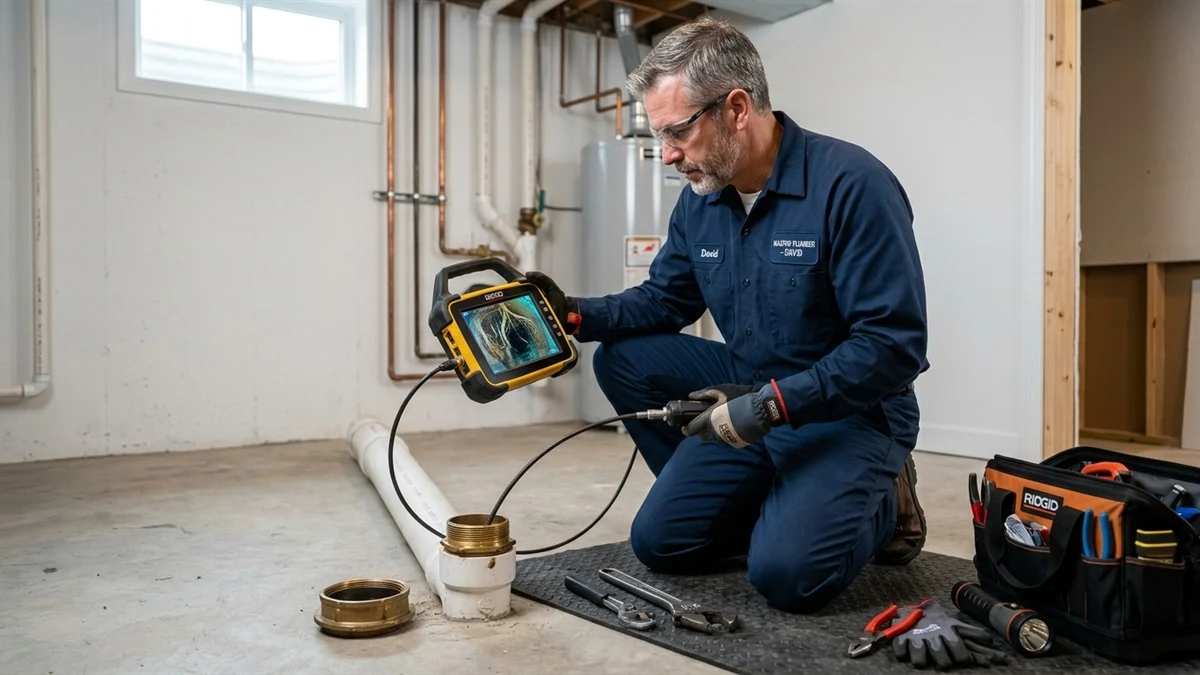
- Pre-Cleaning Video Assessment:
A high-definition CCTV camera navigates the line to record pre-restoration conditions, locate branch connections (such as laundry or secondary bathroom ties), and verify that the pipe invert has sufficient structural continuity to support mechanical knocking.
- High-Speed Flexible Shaft Chain Descaling:
A specialized high-speed flexible shaft machine (such as a Picote Maxi-Miller or Ridgid K9-306) is inserted through the cleanout. The machine spins specialized carbide-tipped circular chain knockers at 1,800 to 2,200 RPM. The centrifugal force throws the hardened carbide chain links against the interior pipe wall with incredible kinetic energy, pulverizing mineral tuberculation and rust blisters back down to the original gray cast iron bore without damaging the underlying structural wall.
For transition areas where plastic PVC ties into older cast iron, technicians swap to smooth cyclone chain assemblies or nylon-wrapped deburring brushes to prevent aggressive carbide teeth from gouging soft thermoplastic walls.
- Concurrent Hydro Jetting Slurry Evacuation:
Simultaneously with chain descaling, a commercial hydro jetter operating at 3,500 PSI with a 15 GPM rear-facing nozzle washes the pulverized rust slurry, sand, and calcium chips downstream into the municipal collector main, leaving the interior pipe walls completely clean and dry.
- Robotic Lateral Branch Mapping & Reinstatement Preparation:
If secondary branch lines (such as a basement laundry or secondary bathroom tie-in) connect into the main cast iron line beneath the slab, technicians insert a robotic locator to map their exact linear footage and clock-position orientation (e.g., 2 o’clock or 10 o’clock) to prepare for post-lining robotic reinstatement.
Following epoxy curing, a high-frequency pneumatic robotic micro-cutter equipped with diamond router bits navigates to each branch connection under closed-circuit fiber-optic television guidance, milling out the liner coupon smoothly to re-open 100% full-bore secondary drainage.
- Trenchless CIPP Epoxy Inversion Lining:
A seamless, non-woven needle-punched polyester felt tube vacuum-impregnated with structural epoxy resin is loaded into an inversion vessel. Regulated compressed air turns the liner inside out down the newly descaled pipe, pressing the resin-soaked felt tightly against the bare cast iron wall. The resin cures rock-hard within 2 to 4 hours, creating a stand-alone, seamless composite pipe directly inside the host cast iron.
- Post-Restoration Fiber-Optic Quality Audit:
A final CCTV camera run verifies that the newly lined pipe has a mirror-smooth Manning’s roughness coefficient (n = 0.009), seamless transitions at all joints, and 100% restored circular diameter, providing the homeowner with digital video proof and a transferable 50-year structural warranty.
8. Colorado Front Range Submarket Profiles: 1950s-1970s Housing Stock & Sub-Slab Cast Iron
Cast iron sewer pipe failure is heavily clustered in specific mid-century residential subdivisions across northern Denver Metro:
- City of Westminster (Shaw Heights, Countryside, Skyline Vista, Harris Park): Subdivisions built between 1955 and 1975 feature extensive cast iron plumbing beneath finished basement slabs. Due to high soil moisture near Standley Lake, exterior soil corrosion combines with interior graphitization, causing bottom channel rot that frequently manifests as mysterious sewer odors in finished basement family rooms.
- City of Thornton (Grange Creek, Woodglen, Yorkborough, Skylake): Thornton’s mid-century housing inventory was constructed with cast iron DWV stacks and sub-slab laterals. Thornton’s mineral-rich water accelerates internal iron tuberculation, choking 4-inch lines down to 2 inches or less after 40 years of service. Mechanical chain descaling coupled with CIPP lining has saved hundreds of Thornton homeowners from costly concrete jackhammering.
- Arvada & Wheat Ridge (Olde Town Arvada, Alta Vista, Scenic Heights): Post-war ranches and split-level homes built throughout the 1950s and 1960s frequently feature unlined cast iron laterals passing beneath established mature tree rows. Severe tree root intrusion through corroded hub joints is the leading cause of emergency blackwater backups in this corridor.
- City and County of Broomfield (Original Broomfield Townsite, Miramonte): Older neighborhoods near Midway Boulevard and 1st Avenue feature 1960s cast iron systems that are currently experiencing critical structural fatigue. Shifting bentonite clays common to Broomfield crack brittle cast iron hubs, requiring trenchless CIPP sleeves to bridge damaged joints.
- North Denver & Adams County Corridor (Welby, Sherrelwood, Berkley): Mid-century brick bungalows and ranches in unincorporated Adams County feature deep 8-to-10-foot sewer laterals laid in highly alkaline alluvial clays. Full trenchless CIPP lining avoids deep front-yard excavations that destabilize foundation footings.
9. Geotechnical Sub-Slab Soil Voiding & Structural Foundation Settlement
When an underground cast iron sewer pipe experiences bottom channel rot beneath a finished basement or garage slab, the consequences extend far beyond plumbing drainage backups. Gravity sewer lines carry between 150 and 350 gallons of greywater and blackwater daily for an average household. When the bottom invert of the pipe rots open, this massive volume of water escapes directly into the aggregate bedding beneath the slab.
Hydraulic Soil Piping & Underground Cavitation
As pressurized pulses of wastewater discharge from toilets, washing machines, and showers, the escaping liquid initiates a geological failure mode known as Hydraulic Subterranean Piping. The escaping water fluidizes fine sands and silts in the bedding layer, washing them downstream along exterior gravel fissures. Over months and years, this continuous fluid transport creates massive subterranean air pockets—often measuring 3 to 6 feet wide and several feet deep—directly beneath structural concrete floors.
Expansive Clay Soil Heave & Slab Cracking
In communities across Broomfield, Westminster, and Arvada, the underlying bedrock is Pierre Shale, rich in expansive sodium bentonite clay minerals. When raw wastewater continuously saturates this clay stratum, the clay absorbs moisture into its crystalline interlayer sheets, swelling with hydraulic pressures exceeding 8,000 to 10,000 pounds per square foot (psf).
This localized upward swelling exerts immense differential heave against the basement slab. The unreinforced or lightly reinforced concrete slab bends and fractures, producing diagonal shear cracks across basement tile, buckled hardwood flooring, and jammed interior doors. In severe cases, sewage saturating perimeter foundation footings causes uneven building settlement, compromising the structural integrity of load-bearing walls. Restoring the cast iron lateral through trenchless CIPP lining halts this subterranean fluid escape immediately, stabilizing the moisture profile of foundation soils.
10. Financial Life-Cycle Analysis: Preventative Descaling vs. Indoor Concrete Slab Demolition
Investing in non-invasive mechanical descaling and trenchless CIPP restoration delivers massive cost savings over historical concrete excavation:
| Restoration Approach | Base Plumbing Cost | Secondary Property Reconstruction | Total Financial Investment | Project Disruption |
|---|---|---|---|---|
| High-Speed Descaling + CIPP Trenchless Lining | $6,500 – $10,500 ($150-$220/ft) | $0 (Zero interior damage) | $6,500 – $10,500 | 1 Day: Clean, non-invasive; completed from exterior cleanout. |
| Traditional Indoor Concrete Slab Excavation | $8,000 – $14,000 (Demolition & pipe) | $10,000 – $22,000+ (Pour new slab, re-tile, replace hardwood, repaint) | $18,000 – $36,000+ | 2 to 3 Weeks: Jackhammers, heavy dust, family displacement. |
| Recurring Emergency Snaking (Band-Aid Approach) | $350 – $600 per call (3-4x per year = $1,800/yr) | Recurring blackwater backup cleanup ($5,000+ per event) | $15,000+ over 5 Years | Continuous anxiety, unsanitary overflows, lost property value. |
10. Comprehensive Extended FAQ Section
Q1: How do I know if my Colorado home has cast iron sewer pipes?
If your home was constructed prior to 1980 across Westminster, Thornton, Arvada, or older Broomfield and has not had a full modern sewer line replacement, it almost certainly features cast iron drainage piping. You can visually inspect the main vertical soil stack in your basement or crawlspace: cast iron is heavy, dark charcoal gray or oxidized black metallic piping with raised foundry lettering and rounded bell hubs sealed with lead-and-oakum, as opposed to modern white Schedule 40 PVC or black solid ABS plastic. Additionally, a professional fiber-optic CCTV video sewer scope through your exterior cleanout will definitively identify the internal dark, textured metallic bore characteristic of aging cast iron.
Q2: What is “channel rot” in cast iron pipes?
Channel rot occurs along the bottom invert of the pipe where wastewater flows constantly. The combination of abrasive waste slurry, corrosive greywater chemicals (including laundry detergents and dish soaps), and anaerobic microbial acid reactions gradually eats away the iron metal from the inside out. Over decades, the bottom wall thins from its original 8 mm down to paper-thin foil until the bottom of the pipe disappears completely. This creates an open trough where wastewater escapes directly into the foundation soil, causing subterranean cavitation, soil voiding, and foundation slab cracking.
Q3: Will chemical drain cleaners dissolve rust scale in cast iron pipes?
No! Chemical drain cleaners (containing sulfuric acid or sodium hydroxide) generate extreme exothermic heat and corrosive chemical reactions that violently accelerate cast iron degradation. They eat away the remaining metallic iron while doing nothing to remove hard calcium carbonate or mineral tubercles. Chemical cleaners should never be used in cast iron piping.
Q4: How does high-speed mechanical chain descaling work?
A specialized machine spins a flexible steel shaft driving carbide-tipped circular chain knockers at up to 2,200 RPM. Centrifugal force expands the chains against the pipe circumference, chipping away hard rust tubercles, calcified mineral scale, and root spurs back down to the smooth, original pipe wall without puncturing the host pipe. Water lubrication is pumped continuously during the descaling operation to flush pulverized iron slurry downstream, leaving a clean, pristine metallic surface optimal for subsequent epoxy adhesion.
Q5: Can you descale a cast iron pipe that has completely lost its bottom?
If a cast iron pipe has suffered total bottom channel loss over extensive lengths, mechanical descaling alone cannot fix it because the chain knockers will strike raw soil. However, if the pipe retains its upper circular geometry, technicians can perform gentle preparation and install a structural CIPP epoxy liner that bridges the missing invert, creating a brand-new self-supporting pipe.
Q6: Why do tree roots love cast iron pipes so much?
Cast iron pipes were joined using lead-and-oakum bell-and-spigot joints. Over decades of ground shifting, the lead loosens and the organic oakum rope decomposes. Warm, moisture-laden sewer vapors escape into the dry Colorado soil, acting as a powerful biological beacon that attracts tree roots. Roots enter through microscopic seams and expand rapidly inside the pipe.
Q7: What is the lifespan of a CIPP liner installed inside old cast iron?
CIPP epoxy liners installed in accordance with ASTM F1216 standards have a laboratory-certified structural design lifespan exceeding 50 to 100 years. The cured epoxy sleeve is non-corrosive, impervious to chemical attacks from household cleaners, and completely jointless, eliminating root entry permanently.
Q8: How long does a cast iron descaling and lining project take?
A typical residential cast iron descaling and CIPP lining project is completed in a single day (6 to 8 hours). The pipe is descaled and hydro jetted in the morning, the epoxy liner is inverted and cured by early afternoon, and full plumbing service is restored the very same evening.
Q9: Does homeowner’s insurance pay for cast iron sewer pipe descaling or replacement?
Standard homeowner’s policies exclude gradual wear-and-tear corrosion like cast iron deterioration. However, if you have added an optional Service Line Coverage or Water/Sewer Backup Endorsement rider to your policy, insurance will often cover $10,000 to $20,000 toward trenchless lateral rehabilitation following a verified structural failure.
Q10: What happens to branch line connections when an under-slab pipe is lined?
When an epoxy liner is deployed, it temporarily covers any secondary fixture branch lines (like basement laundry or bathroom drains) that connect to the main run. Once the resin cures rock-hard, technicians navigate a computerized robotic micro-cutter equipped with diamond router bits to reinstate the branch openings with millimeter precision.
Q11: Can hydro jetting alone fix corroded cast iron pipes?
Hydro jetting is excellent for flushing soft grease, sand, and mud slurry. However, water jets alone cannot shear off hard, calcified iron rust tubercles welded to the pipe wall. High-speed mechanical chain knockers are required to mechanically pulverize the iron scale down to smooth metal before hydro jetting washes the slurry away.
Q12: How do I know if my cast iron pipes are causing sewer gas smells in my home?
Graphitic corrosion and biogenic sulfuric acid eat hairline pinholes and cracks into the upper crown of cast iron vent stacks and sub-slab pipes. Sewer gases seep out through these fissures into wall cavities and beneath basement slabs. A professional artificial smoke test or electronic $H_2S$ sensor sweep will instantly confirm whether cast iron cracks are leaking gas.
11. Schedule Cast Iron Video Scope & High-Speed Descaling Consultation
Are Aging Cast Iron Pipes Causing Frequent Drain Backups?
Do not let contractors jackhammer your finished basement concrete slab. Our licensed master plumbers specialize in high-speed mechanical chain descaling and trenchless CIPP epoxy lining across Westminster, Thornton, Arvada, and Broomfield. Full 50-year warranties included.