
Table of Contents: Non-Invasive Underground & Slab Leak Detection Engineering Guide
- 1. Executive Summary: The Structural Threat of Concealed Slab Leaks in Colorado
- 2. Geological Forces: Bentonite Clay Soil Heave, Foundation Uplift & Slab Pipe Shear
- 3. Physics of Acoustic Leak Detection: Transducers, Frequency Resonance & Ground Mic Arrays
- 4. Infrared Thermography Science: Stefan-Boltzmann Law, Delta-T Anomalies & Emissivity
- 5. Molecular Tracer Gas Technology: Non-Flammable Hydrogen-Nitrogen Molecular Probing
- 6. Step-by-Step Master Plumber 5-Phase Diagnostic Localization Protocol
- 7. Surgical Remediation Strategies: Direct Slab Penetration vs. Overhead PEX-a Reroute
- 8. Comprehensive Non-Invasive Leak Detection Technology Comparison Matrix
- 9. Colorado Front Range Submarket Profiles: Expansive Soils, Bedrock Depths & Municipal Pressures
- 10. Financial Risk Analysis: $450 Precision Acoustic Diagnostic vs. $45,000 Structural Demolition
- 11. Comprehensive Extended FAQ Section (12 Detailed Engineering Questions)
- 12. 24/7 Emergency Non-Invasive Slab Leak Detection Dispatch
1. Executive Summary: The Structural Threat of Concealed Slab Leaks in Colorado
Beneath the concrete foundation slabs, finished basements, and structural floor assemblies of homes throughout the Colorado Front Range lies a complex, pressurized subterranean network of domestic water supply piping. Installed decades ago during initial construction, these Type L soft copper lines, galvanized iron pipes, or early-generation plastics were embedded directly into crushed stone, sand beds, or poured structural concrete. Subjected to continuous 60 to 90 PSI municipal hydraulic pressure, relentless thermal expansion cycles, and Colorado’s notoriously volatile geological soils, these subterranean water lines eventually develop catastrophic structural breaches known as slab leaks.
A pressurized water leak occurring beneath a 4-to-6-inch reinforced structural concrete slab represents one of the most perilous emergencies a property owner can face. Left unmitigated, a pinhole leak discharging a mere 1.5 gallons per minute injects over 2,160 gallons of pressurized water into the sub-slab earth every 24 hours. In Colorado’s unique geological environment, this massive saturation does not simply drain away into deep bedrock. Instead, it saturates expansive bentonite clay strata, triggering violent soil swelling, hydraulic soil liquefaction, and upward foundation upheaval capable of cracking exterior brick veneer, racking doorframes, and shearing structural footing walls.

Historically, locating a slab leak required destructive exploratory trenching—jackhammering randomly through finished hardwood, Italian tile, and structural concrete slabs based on little more than a technician’s educated guess. Today, master diagnostic plumbers employ non-invasive, military-grade diagnostic technologies. By combining Acoustic Sub-Surface Ground Microphones, Radiometric Infrared Thermography, and Hydrogen-Nitrogen Molecular Tracer Gas Sniffers, licensed specialists can pinpoint the subterranean breach to within an exact 2-inch radius through 6 inches of concrete and dense sub-base without swinging a single hammer. This comprehensive engineering guide explains the physics of acoustic resonance, thermal gradient imaging, forensic isolation protocols, and surgical remediation options across Broomfield, Westminster, Thornton, and Denver Metro.
In addition to mitigating structural foundation collapse, precision non-invasive leak detection protects homeowners from predatory or destructive remediation practices. When an uncertified technician attempts to find a leak by tearing up tens of feet of finished flooring, the resulting restoration costs often eclipse the cost of the plumbing repair tenfold. Modern acoustic and thermal diagnostic sciences empower property owners with empirical, sensor-verified coordinates, allowing for surgical spot excavations or cost-effective overhead reroutes that leave finished flooring and concrete slabs completely undisturbed.
Furthermore, early intervention halts the progressive erosion of foundational sub-base materials. Once escaping high-pressure water liquefies the structural sand cushion beneath a post-tensioned or monolithic slab, hollow subterranean pockets develop. Without solid mechanical sub-grade support, the concrete begins deflecting under the weight of exterior bearing walls, load-bearing center partitions, and interior furnishings. Utilizing non-destructive acoustic and thermal diagnostics within the first 24 to 48 hours of suspected leakage is the only proven method to arrest foundation settlement before permanent structural deflections occur.
2. Geological Forces: Bentonite Clay Soil Heave, Foundation Uplift & Slab Pipe Shear
Understanding why slab leaks are exceptionally prevalent and destructive along the Colorado Front Range requires an examination of the region’s geological makeup. Much of Broomfield, Adams County, Jefferson County, and Boulder County sits atop the Cretaceous Pierre Shale formation, known colloquially as expansive bentonite clay.
The Crystal Chemistry of Expansive Bentonite
Bentonite clay is composed primarily of montmorillonite, a smectite clay mineral with an expandable 2:1 crystal lattice structure. In its dry state, the microscopic mineral layers remain tightly bound. However, when water molecules penetrate the interlayer spaces, the lattice expands violently. Bentonite clay can swell by up to 15% to 25% of its original volume and exert swelling pressures in excess of 10,000 to 15,000 pounds per square foot (PSF)!
Hydraulic Upheaval & Foundation Shear Mechanics
Under normal seasonal conditions, residential foundation engineers construct structural grade beams or floating basement slab floors to isolate foundation movement. However, when an underground hot or cold copper line ruptures beneath the slab, thousands of gallons of pressurized water supercharge the dry bentonite clay directly beneath the building footprint:
- Differential Soil Uplift: The clay immediately surrounding the leak expands aggressively, while soil 15 feet away remains at baseline moisture. This creates extreme differential uplift force ($\Delta F = \sigma_{swell} \cdot A$), bending the concrete slab upward into an arched crown.
- Shearing of Embedded Utility Lines: As the concrete slab deflects upward while the surrounding grade beams remain pinned by deep foundation caissons, rigid copper pipes cast into the concrete are subjected to intense mechanical shear stress. A single localized leak can induce secondary pipe shears elsewhere under the home!
- Soil Liquefaction & Sub-Base Void Formation: In areas with sandy or crushed stone sub-base, pressurized water eroding out of the pipe washes away the fine aggregate, creating subterranean caverns or voids beneath the slab. Deprived of soil bearing support, the heavy concrete slab fractures under its own dead weight once domestic water pressure is shut off.
- Corrosive Soil Electrolysis: Front Range subsoils frequently contain elevated concentrations of sulfates, alkali minerals, and water-soluble chlorides. When a subterranean leak saturates these mineral beds, the resulting moisture creates a low-resistivity galvanic electrolyte cell around embedded copper piping. This accelerates external pitting corrosion, causing multiple pinholes to form rapidly along adjacent runs.
3. Physics of Acoustic Leak Detection: Transducers, Frequency Resonance & Ground Mic Arrays
When pressurized fluid escapes through an orifice in a pipe wall, it generates distinct kinetic energy in the form of mechanical sound waves and structural vibrations. Acoustic leak detection is the science of capturing, amplifying, and filtering these micro-acoustic frequencies to map the exact subterranean origin of the breach.
The Orifice Jet & Vortex Cavitation Acoustics
As water at 70 PSI forces its way through a jagged 0.5-millimeter pinhole in a copper tube, fluid velocity accelerates dramatically according to Torricelli’s Law ($v = \sqrt{2g \Delta H}$). This high-velocity jet creates intense turbulence, fluid friction against the orifice edges, and microscopic cavitation bubbles that collapse violently. This physical turbulence generates sound across three distinct acoustic channels:
- Pipe Wall Vibration (Structural Transmission): High-frequency sound waves (1,500 Hz to 4,000 Hz) travel longitudinally along the metallic pipe wall in both directions from the leak.
- Fluid Column Transmission: Acoustic waves travel through the pressurized water column inside the pipe, resonating at valves, manifolds, and fixture risers.
- Ground & Soil Transmission (Rayleigh Waves): Low-frequency acoustic waves (100 Hz to 800 Hz) propagate radially outward through the surrounding soil, gravel bed, and up through the concrete slab surface as surface acoustic waves.
Acoustic Attenuation & Frequency Damping in Geological Media
As acoustic waves propagate outward from the pressurized orifice, high frequencies attenuate rapidly due to the internal damping properties of surrounding materials. Soil moisture, gravel particle size, and concrete density directly affect signal transmission. In loose sandy sub-base, acoustic energy dissipates rapidly, shifting the dominant detectable frequency band downward toward 300 to 600 Hz. Conversely, in dense, saturated structural concrete, Rayleigh waves travel with minimal acoustic attenuation, producing sharp, high-amplitude spikes when captured directly above the leak epicenter.
Piezoelectric Geophone Transducers & Notch Filtering
Modern acoustic leak locators utilize ultra-sensitive piezoelectric ceramic crystals housed inside heavy brass geophone bells or ground contact plates. When surface acoustic waves reach the concrete floor, they induce microscopic mechanical deflections in the crystal, generating proportional electrical micro-voltages ($V = g_{33} \cdot \sigma$).
These electrical signals are routed through digital signal processors (DSP) equipped with selectable high-pass, low-pass, and band-pass notch filters. By filtering out ambient background noise—such as wind, street traffic, refrigerator compressors, and furnace blowers (typically operating below 150 Hz)—the technician isolates the sharp 500 Hz to 1,200 Hz hiss characteristic of pressurized subterranean water escape. The exact physical location of the leak corresponds to the absolute peak in decibel amplitude and acoustic frequency density.
Furthermore, master plumbers utilize acoustic cross-correlation systems when tracking longer underground runs. By positioning two synchronized accelerometers on accessible ends of the pipe (such as the main shutoff and an exterior hose bibb), the correlator calculates the exact arrival time difference ($\Delta t$) of the acoustic signal. Using the known speed of sound in water-filled copper ($v \approx 1,200 \text{ m/s}$), the instrument calculates the leak distance with sub-inch mathematical accuracy ($d = \frac{L – v \cdot \Delta t}{2}$).
4. Infrared Thermography Science: Stefan-Boltzmann Law, Delta-T Anomalies & Emissivity
While acoustic instruments listen to kinetic sound waves, radiometric infrared thermography visualizes the thermal electromagnetic radiation emitted by surface materials. Under the Stefan-Boltzmann Law, all physical objects above absolute zero emit thermal radiation proportional to the fourth power of their absolute temperature:
Where $\epsilon$ represents surface emissivity, $\sigma$ is the Stefan-Boltzmann constant, and $T$ is absolute temperature in Kelvin.
Thermal Conduction Through Concrete Slabs
When a domestic hot water pipe (transporting water at 120°F to 130°F) ruptures beneath a slab, the escaping scalding water saturates the surrounding gravel and contacts the underside of the concrete. Heat transfers upward through the concrete slab via thermal conduction governed by Fourier’s Law ($q = -k \nabla T$).
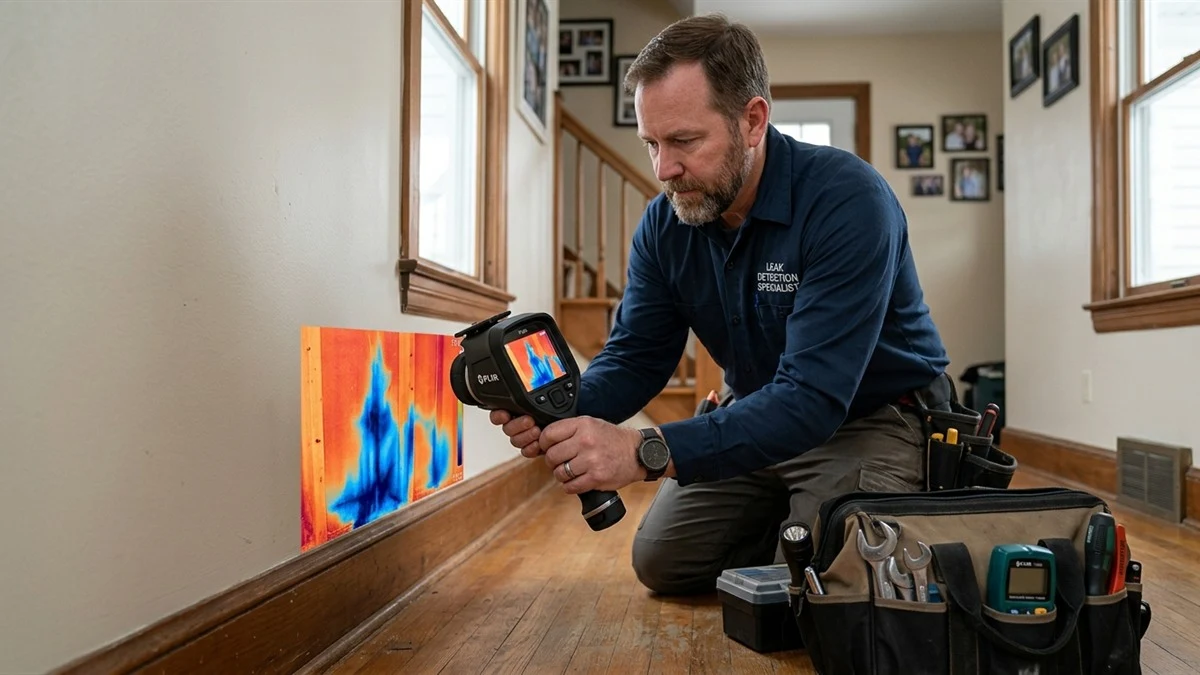
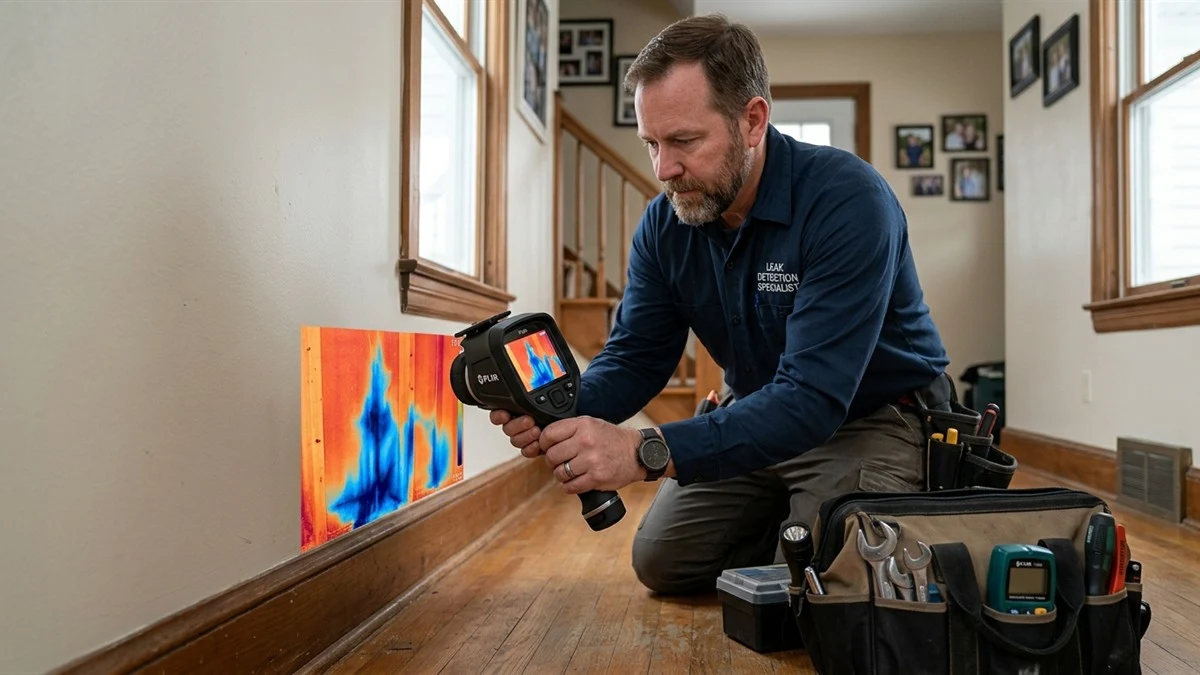
Concrete has a relatively high thermal conductivity ($k \approx 1.0 \text{ to } 1.8 \text{ W/m}\cdot\text{K}$). Within 30 to 60 minutes, the concrete slab directly above the rupture warms significantly compared to surrounding unheated floors. A calibrated FLIR radiometric thermal imaging camera detecting long-wave infrared radiation (7.5 to 14 $\mu m$) visualizes this anomaly as a vivid, blooming thermal heat plume.
Surface Emissivity Calibration & Material Corrections
Accurate thermographic diagnostics require adjusting camera emissivity settings ($\epsilon$) for different floor finishes. Unpolished concrete exhibits high emissivity ($\epsilon \approx 0.92$), allowing clear thermal imaging. However, glossy porcelain tiles or hardwood polyurethane coatings have lower emissivity and high reflectivity, which can mirror overhead ambient light sources. Certified thermographers apply non-reflective matte testing tape or adjust regional emissivity parameters to eliminate false positives and reveal true subsurface conductive heat signatures.
The Thermal “Blossom” Profile & Core Triangulation
The thermal signature of a subterranean hot water leak does not present as a uniform puddle. Instead, it displays a distinct Gaussian thermal gradient:
- The Thermal Core (Epicenter): A tight, high-temperature focal point with well-defined borders where scalding water makes primary contact with the slab.
- The Thermal Halo (Diffusion Ring): A lower-temperature, feathering perimeter where heat dissipates through lateral conduction and subterranean water migration.
By mapping the temperature profile across the floor surface, a thermographer isolates the highest Delta-T ($\Delta T$) reading, triangulating the underground breach point to within inches before confirming with acoustic microphones.

5. Molecular Tracer Gas Technology: Non-Flammable Hydrogen-Nitrogen Molecular Probing
In complex diagnostic scenarios—such as cold water slab leaks beneath thick carpet and pad, heavily insulated foundations, or low-pressure micro-leaks (less than 5 PSI loss per hour)—neither acoustics nor thermal imaging may yield conclusive data. In these advanced cases, master plumbers deploy Molecular Tracer Gas Technology.
The 95/5 Forming Gas Mixture
The plumbing line under investigation is fully isolated and drained of water using compressed nitrogen. The technician then charges the isolated line with an industrial forming gas mixture consisting of 95% pure nitrogen ($N_2$) and 5% hydrogen ($H_2$) (certified under ISO 10156 as completely non-flammable and non-toxic).
Molecular Permeation Physics
Hydrogen is the smallest, lightest element in the universe (molecular weight $M \approx 2.016 \text{ g/mol}$). Due to its minute molecular diameter and low kinetic viscosity, hydrogen gas escapes through the microscopic fissure in the pipe with extreme velocity. Once outside the pipe, the buoyant gas travels vertically through gravel, earth, vapor barriers, and even microscopic pores within structural concrete slabs!
The diagnostic technician sweeps the floor surface with a specialized electronic hydrogen sniffing sensor equipped with an electrochemical micro-fuel cell. As the hydrogen molecules permeate upward through the floor, the detector registers concentrations in parts per million (PPM). The point of maximum PPM readout identifies the exact underground breach coordinate, completely bypassing background environmental noise.
Unlike acoustic detection, which can be masked by roaring furnace fans or structural vibrations, tracer gas sensing is completely immune to ambient auditory interference. It is capable of detecting microscopic seepage rates as small as 0.05 gallons per hour through 10 inches of monolithic concrete, making it the premier forensic choice for cold water lines and radiant floor heating circuits.
6. Step-by-Step Master Plumber 5-Phase Diagnostic Localization Protocol
Locating a subterranean leak without unnecessary property damage demands a rigorous scientific protocol executed by certified technicians:

- Phase 1: Flow Verification & Low-Flow Meter Dial Testing:
Ensure all interior faucets, toilets, ice makers, and irrigation valves are fully closed. Inspect the municipal water meter. If the triangular or star-shaped low-flow leak detection dial is spinning continuously, pressurized water is escaping. Record the flow rate over a 15-minute interval to calculate exact hourly water loss.
- Phase 2: Hot vs. Cold Supply Isolation:
Close the cold water isolation shutoff valve located directly above the water heater. Re-inspect the water meter dial. If the meter stops spinning immediately, the leak is located on the hot water supply loop. If the meter continues spinning, the leak resides on the cold water main branch beneath the slab.
- Phase 3: Hydrostatic Pressure Decay Testing:
Attach a precision oil-damped pressure gauge to an isolated branch line. Pressurize the circuit to 80 PSI with an inert nitrogen rig, seal the test manifold, and monitor pressure decay over 10 minutes. A rapid drop verifies an active line breach, while line isolation valves are cycled to isolate the leak to a single structural manifold zone.
- Phase 4: Multi-Spectral Thermal Scanning:
For hot water line leaks, scan all finished floors using an infrared thermal imaging camera calibrated to high thermal sensitivity (NETD < 40 mK). Identify surface temperature blooms, map thermal conduction paths, and document potential water migration beneath baseboards and interior partition walls.
- Phase 5: Acoustic Resonant Triangulation & Cross-Correlation:
Deploy a piezoelectric ground microphone equipped with concrete contact transducers. Perform a structured grid search across the suspect zone, recording decibel levels at 12-inch intervals. Identify the peak acoustic resonant spike, verify frequency distribution, and mark the exact excavation coordinate with non-staining chalk.
7. Surgical Remediation Strategies: Direct Slab Penetration vs. Overhead PEX-a Reroute
Once the subterranean leak coordinate is positively identified, property owners face a critical engineering decision regarding the remediation strategy:
Method 1: Direct Surgical Concrete Spot Penetration (Direct Repair)
If the leak is located in an unfinished utility room, storage closet, or easily accessible area, technicians perform a direct surgical repair. Using an electric concrete breaker equipped with HEPA dust containment, an exact 18×18-inch opening is excavated through the slab. The damaged sub-base gravel is removed, the split copper section is cut out, and a new section of Type L copper or PEX is spliced in using silver-brazed fittings or code-approved mechanical couplings. The opening is then re-compacted, vapor-sealed, and patched with high-strength concrete.
Method 2: Non-Destructive Overhead PEX-a Reroute (The Gold Standard)
In homes with expensive hardwood floors, heated stone tile, or finished living areas, breaking the slab is financially foolish. Instead, master plumbers perform a complete overhead supply reroute. The damaged underground copper line is permanently decommissioned and abandoned in place beneath the concrete.
A new, ultra-durable PEX-a (cross-linked polyethylene) line is routed from the water heater or main manifold up through interior wall cavities, across the ceiling joists, and dropped down inside walls directly to the target fixtures. This method eliminates the need to touch finished flooring, provides a brand-new accessible water line with zero sub-slab joints, and guarantees that another slab leak will never occur on that line!
Furthermore, an overhead PEX-a reroute preserves the structural continuity of post-tensioned foundation slabs. In modern Front Range construction, post-tensioned concrete slabs contain high-strength steel tendons tensioned under 30,000+ pounds of hydraulic force. Accidental cutting of a live post-tensioned cable during blind jackhammering can violently breach the foundation and cause severe structural collapse. Overhead reroutes bypass post-tensioned slab demolition entirely, eliminating all structural liability.
8. Comprehensive Non-Invasive Leak Detection Technology Comparison Matrix
The comparative matrix below illustrates the strengths, limitations, and optimal applications of non-destructive diagnostic tools:
| Diagnostic Technology | Operating Physical Principle | Target Leak Profile | Accuracy Precision | Demolition Level |
|---|---|---|---|---|
| Piezoelectric Ground Acoustic Mic | Acoustic orifice turbulence & Rayleigh surface waves. | High-pressure domestic water line leaks (> 40 PSI). | Within 2-to-4 inches | ZERO (100% Non-Invasive) |
| Radiometric Infrared Thermography | Stefan-Boltzmann thermal radiation & conductive heat bloom. | Hot water line breaches beneath tile, concrete, or wood. | Within 6-to-12 inches | ZERO (100% Non-Invasive) |
| Hydrogen-Nitrogen Molecular Tracer | Sub-atomic gas diffusion through concrete micropores. | Low-pressure micro-leaks, deep burial, or cold water lines. | Within 2 inches | ZERO (100% Non-Invasive) |
| Random Exploratory Jackhammering | Blind physical demolition based on intuition. | Obsolete, high-risk unscientific guesswork. | Unpredictable (Huge error margins) | CATASTROPHIC ($5,000+ floor damage) |
9. Colorado Front Range Submarket Profiles: Expansive Soils, Bedrock Depths & Municipal Pressures
Subterranean plumbing vulnerabilities vary substantially across the northern Denver metropolitan corridor:
- City and County of Broomfield (Broadlands, Country Vista, Lac Amora): Extensive bentonite shale formations in Broomfield mean that even minor subterranean leaks lead to rapid foundation heave. Many 1990s homes feature copper plumbing routed below floating basement slabs; when high municipal pressures (upwards of 95 PSI) stress thin-wall Type M copper, underground pinholes develop rapidly along un-reamed pipe joints.
- City of Westminster (Standley Lake, Countryside, Promenade): Westminster features a mix of mid-century ranch homes on flat slabs and 1980s multi-level split entries. Mineral-rich domestic water causes internal electrolytic pitting in copper lines, while aggressive exterior soils corrode un-sleeved copper pipes embedded directly in concrete without protective polyethylene wrap.
- City of Thornton (Woodglen, Grange Creek, Hunters Glen): Eastern Adams County soils contain heavy alkali salts and fine silts. Leaks under slabs in Thornton frequently wash out sandy sub-base strata, creating large underground sinkholes beneath basement floors that go unnoticed until concrete slabs suddenly drop and crack.
- Arvada & West Denver (Leyden Rock, Candelas, Whisper Creek): Proximity to the foothills creates rolling topography and significant elevation differences, resulting in extreme static water pressure variations. High municipal pressure spikes combined with rocky, abrasive sub-base soils cause friction wear on underground copper as pipes expand and contract with hot water usage.
- Louisville & Lafayette (Coal Creek Ranch, Old Town): Historic coal mining activities and alluvial riverbed deposits create localized shifting ground strata. In these areas, overhead PEX-a reroutes are almost universally preferred over slab spot repairs, as aging copper networks frequently develop successive pinhole failures within months of an initial repair.
10. Financial Risk Analysis: $450 Precision Acoustic Diagnostic vs. $45,000 Structural Demolition
Investing in certified non-invasive leak detection represents immense financial protection for property owners:
| Diagnostic / Remediation Strategy | Typical Investment Range | Property Impact & Structural Safety | Cost Efficiency Rating |
|---|---|---|---|
| Non-Invasive Diagnostic Package (Thermal + Acoustic) | $380 – $650 | Pinpoints subterranean leak to exact 2-to-4 inch coordinate; zero flooring damage. | OPTIMAL: Saves thousands in needless floor replacement. |
| Surgical PEX-a Overhead Reroute | $1,800 – $3,800 | Abandons compromised slab pipe; runs brand-new accessible PEX-a line overhead; preserves all flooring. | PERMANENT FIX: Eliminates all future subterranean leak risks. |
| Unmitigated Bentonite Heave & Foundation Repair | $25,000 – $65,000+ | Severe foundation upheaval, helical pier installation, structural mudjacking, framing repair. | FINANCIAL CATASTROPHE: Extreme structural devastation. |
11. Comprehensive Extended FAQ Section
Q1: What are the earliest warning signs of an underground slab leak?
Common early indicators include: (1) An unexplained surge in your monthly water utility bill; (2) The low-flow indicator dial on your water meter spinning when all fixtures are off; (3) Unusually warm spots on finished tile, laminate, or carpet floors; (4) The continuous sound of running water or hissing inside basement walls; (5) A water heater that fires continuously without hot water usage; and (6) Cracking in drywall corners or foundation stem walls caused by soil upheaval.
Q2: How does a plumber locate a leak under concrete without breaking the floor?
Professional diagnostic plumbers utilize non-invasive sensor equipment: (1) Piezoelectric acoustic ground microphones that capture and filter the ultrasonic sound waves of escaping pressurized water; (2) High-resolution radiometric infrared cameras that detect minute surface temperature variations caused by underground hot water plumes; and (3) Non-flammable hydrogen-nitrogen tracer gas sniffers that detect gas molecules permeating through the concrete slab.
Q3: Why are slab leaks so common in Colorado homes?
Colorado’s Front Range features highly expansive bentonite clay soils that swell and shrink dramatically with moisture shifts. As the ground shifts, underground pipes experience intense physical friction and stress against rock and concrete. Furthermore, aggressive soil minerals corrode un-sleeved copper tubing from the outside, while high municipal water pressure causes cavitation wear from the inside.
Q4: Is it better to jackhammer the slab or do an overhead pipe reroute?
In the vast majority of cases, an overhead PEX-a reroute is superior. Breaking through concrete creates massive dust, compromises the slab’s vapor barrier, destroys costly floor finishes, and leaves an aging, potentially compromised copper line in the ground. An overhead reroute permanently abandons the underground pipe, runs a durable new PEX-a line through interior walls and ceilings, and preserves your finished flooring entirely.
Q5: Can a slab leak cause structural damage to my home’s foundation?
Yes, absolutely. In Colorado’s bentonite clay soils, hundreds of gallons of water leaking beneath a slab trigger massive soil swelling. This expansion can exert over 10,000 pounds per square foot of upward pressure, lifting foundation walls, cracking floor slabs, throwing structural framing out of square, and jamming interior doors and windows.
Q6: How accurate is acoustic leak detection equipment?
In the hands of an experienced master diagnostic plumber, modern acoustic ground microphones combined with digital notch filters can pinpoint a subterranean water leak within an exact 2-to-4-inch radius through 4 to 8 inches of reinforced structural concrete and dense gravel sub-base.
Q7: Does homeowner’s insurance pay for slab leak detection and repair?
Most Colorado homeowner’s insurance policies cover the cost of “tear-out and access” (the specialized leak detection and accessing the pipe) as well as water damage restoration to flooring and walls under standard sudden-and-accidental coverage. However, the physical plumbing repair itself (the $200-$400 plumbing pipe splice) is typically the homeowner’s responsibility. Always check your specific policy wording.
Q8: How long does a non-invasive slab leak detection inspection take?
A comprehensive non-invasive leak detection survey—including water meter flow tracking, isolation testing, thermal imaging, and acoustic frequency triangulation—typically takes between 1.5 and 3 hours depending on home size, flooring materials, and foundation complexity.
Q9: Can a slab leak occur on a cold water line as well as a hot water line?
Yes. Both hot and cold lines are equally vulnerable to external soil corrosion, physical rock abrasion, and mechanical shear. Hot water lines fail slightly more often due to thermal expansion and contraction cycles that cause the metal to rub repeatedly against gravel, but cold water line slab leaks are frequent and equally hazardous to foundation stability.
Q10: What should I do immediately if I suspect a slab leak in my house?
Immediately shut off your main water supply valve to halt water flow into the foundation sub-grade. Turn off your water heater (gas valve to “Pilot” or electric breaker off) to prevent tank damage. Then, call a licensed emergency plumber equipped with non-invasive acoustic and thermal detection gear before anyone begins breaking concrete.
Q11: Will epoxy pipe lining (ePIPE) fix a slab leak?
Epoxy lining involves blowing liquid resin through existing pipes to seal pinholes from the inside. While sometimes marketed for slab repairs, master plumbers generally advise against epoxy lining for underground residential water lines in Colorado. Expanding bentonite clay creates structural shifting that easily cracks brittle epoxy coatings. An overhead PEX-a reroute provides a vastly superior, permanent solution.
Q12: How do plumbers know which line is leaking under the slab?
Plumbers systematically isolate supply zones: first by shutting off the water heater to separate hot and cold loops, then using pneumatic test plugs and manifold isolation valves to pressure-test individual pipe runs. Tracking pressure drop with high-precision digital gauges confirms exactly which line is leaking before acoustic or thermal tools are deployed.
12. 24/7 Emergency Non-Invasive Slab Leak Detection Dispatch

Suspect an Underground Water Leak Beneath Your Slab?
Do not allow subterranean water to destroy your foundation or permit contractors to tear up your floors with jackhammers. Our master diagnostic plumbers pinpoint underground slab leaks to within inches using advanced non-invasive thermal and acoustic technologies across Broomfield, Westminster, Thornton, and Denver Metro.