
Table of Contents: Trenchless Sewer Repair Engineering Guide
- 1. Executive Summary: The Subterranean Infrastructure Crisis
- 2. Cured-In-Place Pipe (CIPP) Lining: Chemical Resins, Calibration Tubes & Hydraulic Physics
- 3. Pneumatic & Static Pipe Bursting: Conical Expander Heads, Geotechnical Cavity Expansion & HDPE
- 4. Traditional Open-Cut Excavation: When Trenching Remains Structurally Unavoidable
- 5. Exhaustive Engineering Comparison Matrix: CIPP vs. Bursting vs. Open Trench
- 6. Step-by-Step Trenchless Rehabilitation Protocol: Mechanical Preparation & Curing
- 7. Environmental Benefits: Carbon Footprint, Landscape Preservation & Root Immunity
- 8. Colorado Front Range Submarket Profiles: Pierre Shale, Expansive Soil Shear & Municipal Codes
- 9. Transparent Pricing & Financial Investment Analysis: 50-Year Cost of Ownership
- 10. Comprehensive Extended FAQ Section (12 Detailed Questions)
- 11. Schedule High-Definition Video Sewer Scope & Trenchless Consultation
1. Executive Summary: The Subterranean Infrastructure Crisis
Beneath the manicured lawns, concrete driveways, mature cottonwood trees, and flagstone patios of residential homes across the Colorado Front Range lies a vital utility that homeowners rarely consider until catastrophic failure strikes: the private sanitary sewer lateral. This underground conduit—typically four or six inches in nominal diameter—is tasked with conveying thousands of gallons of pathogenic Category 3 blackwater away from household plumbing fixtures outward to the municipal sewer collector main beneath the street.
When a sewer lateral collapses, fractures under expansive soil movement, or becomes completely occluded by biological tree root invasion, homeowners are confronted with an immediate structural, sanitary, and environmental emergency: raw sewage bubbling up through basement floor drains, sub-level shower pans, and mechanical room basins. Historically, remediating a failed subterranean sewer line required a catastrophic civil engineering undertaking known as traditional open-cut trenching. Heavy diesel excavators would arrive, tearing through pristine landscaping, demolishing concrete driveways, ripping up custom stone retaining walls, and leaving homeowners with a massive trench, weeks of disruption, and tens of thousands of dollars in secondary structural restoration bills.

The development of trenchless sewer rehabilitation technologies—specifically Cured-In-Place Pipe (CIPP) epoxy lining and trenchless pneumatic/static pipe bursting—has permanently transformed sanitary utility engineering. Today, licensed master plumbing specialists can structurally rehabilitate or completely replace an entire underground sewer line from a single small access point, preserving precious landscaping, reducing project timelines from weeks to hours, and installing jointless pipelines with continuous design lifespans exceeding fifty to one hundred years.
However, trenchless technology is not a generic, one-size-fits-all miracle. Selecting between CIPP epoxy lining, pipe bursting, and selective open-trench excavation requires rigorous engineering analysis of host pipe integrity, hydraulic grade slope, ground settlement bellies, and municipal connection regulations. This definitive technical guide breaks down the fluid mechanics, structural physics, materials science, and economic realities of trenchless sewer restoration across Broomfield, Westminster, Thornton, and the northern Denver metropolitan corridor.
2. Cured-In-Place Pipe (CIPP) Lining: Chemical Resins, Calibration Tubes & Hydraulic Physics
Cured-In-Place Pipe (CIPP) lining is an advanced trenchless methodology governed by ASTM International Standard F1216 (Standard Practice for Rehabilitation of Existing Pipelines by the Inversion and Curing of a Resin-Impregnated Tube) and ASTM F2019 (for glass-fiber reinforced CIPP). In practical terms, CIPP does not merely coat the inside of an aging pipe; it constructs a brand-new, structurally self-supporting, seamless composite pipe directly inside the deteriorating host pipe.

The Anatomy of the CIPP Composite Assembly
A residential CIPP liner consists of three distinct engineering elements:
- The Non-Woven Needle-Punched Polyester Felt Tube: The structural carrier tube is manufactured from high-density, multi-directional polyester synthetic fleece fibers. The thickness of the felt is engineered with mathematical precision (typically 3mm to 4.5mm for residential 4-inch lines and 6mm for 6-inch commercial lines) to meet rigid structural hoop-stress requirements under subterranean earth and traffic loads.
- The Impermeable Polyurethane / PVC Outer Thermoplastic Membrane: The exterior facing of the felt is bonded to an impervious elastomer coating. During installation, this membrane acts as the smooth internal flow surface of the newly formed pipe, providing an ultra-low Manning’s roughness coefficient that drastically boosts wastewater flow velocity.
- Two-Part Liquid Epoxy / Silicate Resin System: Prior to insertion, the dry felt tube undergoes a rigorous vacuum impregnation process (known as “wetting out”). A precision-metered, two-part thermosetting resin—blending high-tensile epoxy oligomers with an amine hardener—is drawn through the felt under negative vacuum pressure. Mechanical pinch rollers calibrate uniform saturation across every square millimeter of the fabric, ensuring zero dry voids or air inclusions.
Hydraulic Mechanics: Manning’s Flow Equation & Friction Loss Gains
Homeowners often worry that inserting a liner inside an existing 4-inch sewer lateral will restrict flow capacity by reducing pipe diameter. Fluid mechanics engineering proves the exact opposite. The volumetric flow rate in a gravity sewer is dictated by Manning’s Equation:
Where:
- Q: Flow discharge capacity (cubic feet per second, cfs)
- n: Manning’s roughness coefficient of the internal pipe wall
- A: Cross-sectional flow area (square feet)
- R_h: Hydraulic radius (A / P, where P is the wetted perimeter)
- S: Hydraulic slope gradient (feet of vertical drop per linear foot of run)
In older vitrified clay pipe (VCP) with mortar erosion and misaligned bell-and-spigot joints, the roughness coefficient is typically n = 0.015 to 0.017. Heavily scaled, pitted cast iron pipes can exhibit friction factors as severe as n = 0.018 to 0.022. In contrast, a cured epoxy CIPP liner possesses a mirror-smooth, frictionless thermoplastic boundary layer with an exceptionally low roughness factor of n = 0.009.
Even though the cross-sectional diameter decreases by 3 to 4.5 mm (less than 4% total diameter reduction), the radical 40% to 50% drop in internal wall friction more than compensates for the minor cross-sectional reduction. As a result, actual hydraulic discharge velocity increases by 18% to 28%, preventing solid suspended particulate from settling and virtually eliminating paper clogs.
Pneumatic Inversion Mechanics: Turning the Pipe Inside Out
Once wet-out is complete, the liner is loaded into a pressurized inversion drum. The technician secures the leading open end of the liner over an airtight inversion collar inserted into an exterior yard cleanout riser. As regulated compressed air (or a column of pressurized water) is introduced into the drum, the hydraulic force pushes the liner forward, turning it completely inside out like an inverted sock as it travels down the buried pipe.
This inversion mechanism offers critical engineering advantages: the resin-saturated felt is driven firmly against the inner circumference of the host pipe under 10 to 15 PSI of continuous radial pressure. The expanding resin is forced into every cracked clay joint, hairline fissure, and pinhole void, mechanically anchoring the liner to the host substrate while conforming perfectly around 45-degree and 90-degree directional bends without wrinkling.
Thermal and Ambient Exothermic Curing
Once fully deployed to the municipal street tap, the resin must cross-link into a rock-hard thermoset polymer. This is accomplished via controlled ambient curing, recirculating pressurized hot water (140°F to 180°F), continuous low-pressure steam, or advanced UV-curing light trains. Within two to four hours, the exothermic chemical reaction achieves 100% cure, yielding a stand-alone structural pipe with a flexural modulus exceeding 300,000 to 450,000 PSI under ASTM D790 standards.
3. Pneumatic & Static Pipe Bursting: Conical Expander Heads, Geotechnical Cavity Expansion & HDPE
While CIPP lining excels at rehabilitating pipes with intact structural alignment, it cannot correct severe reverse-slope bellies or restore pipelines that have physically crushed into rubble. In these catastrophic scenarios, the premier trenchless replacement methodology is Trenchless Pipe Bursting (governed by the International Pipe Bursting Association standards).

The Mechanical Principles of Pipe Bursting
Pipe bursting is a replacement technique that uses brute hydraulic or pneumatic force to shatter the existing host pipe outward into the surrounding soil while simultaneously pulling a brand-new, full-diameter or upsized pipe into the resulting borehole behind it.
The physical system operates through specialized mechanical components:
- The Hardened Steel Conical Bursting Head: At the front of the tooling assembly sits a heavy, hardened alloy steel expander head. The nose diameter is slightly smaller than the existing pipe, but the rear shoulder expands outward to a diameter 10% to 25% larger than the host pipe. In pneumatic systems, an internal reciprocating piston delivers hundreds of high-impact blows per minute; in modern static systems, a continuous hydraulic pulling unit exerts 30 to 50 tons of steady axial pulling force.
- Heavy-Duty Interlocking Steel Pulling Rods: A high-tensile segmented, interlocking steel rod string is fed from a pulling pit excavated near the property boundary or street curb back through the existing sewer lateral to an entry pit near the house foundation.
- Seamless High-Density Polyethylene (HDPE) Pipe String: Trailing immediately behind the bursting head is a continuous length of DR-17 or DR-11 High-Density Polyethylene (HDPE) pipe. Individual 40-foot sticks of HDPE are fused together on-site using a specialized butt-fusion heating plate at 425°F under hydraulic pressure according to ASTM F2620 protocols. The resulting molecular weld is completely monolithic—the joint is actually stronger than the pipe wall itself!
Geotechnical Cavity Expansion Theory in Front Range Soils
Understanding how surrounding earth accommodates the shattered host pipe relies on Cavity Expansion Theory. When the conical bursting head drives through brittle vitrified clay or corroded cast iron, it exerts enormous radial stress ($\sigma_r$) exceeding the fracture limit of the host pipe material:
Where $P_b$ represents the peak bursting pressure exerted at the expander shoulder, $r_o$ is the bursting head outer radius, and $r$ represents the radial distance into the surrounding soil prism. The host pipe fragments are driven into the plastic deformation zone of the bedding soil. Because HDPE possesses exceptional ductile elasticity, it glides into the newly expanded cavity without suffering scratching or notch stress. Once the expander passes, elastic rebound in cohesive soils grips the exterior of the HDPE pipe, creating a solid, stable subterranean bedding envelope.
4. Traditional Open-Cut Excavation: When Trenching Remains Structurally Unavoidable
Despite the immense advantages of trenchless technology, ethical, master-level plumbing diagnostic engineers must acknowledge that trenchless methods are not universally applicable. In certain structural failure modes, traditional open-cut mechanical excavation remains the only code-compliant engineering solution.
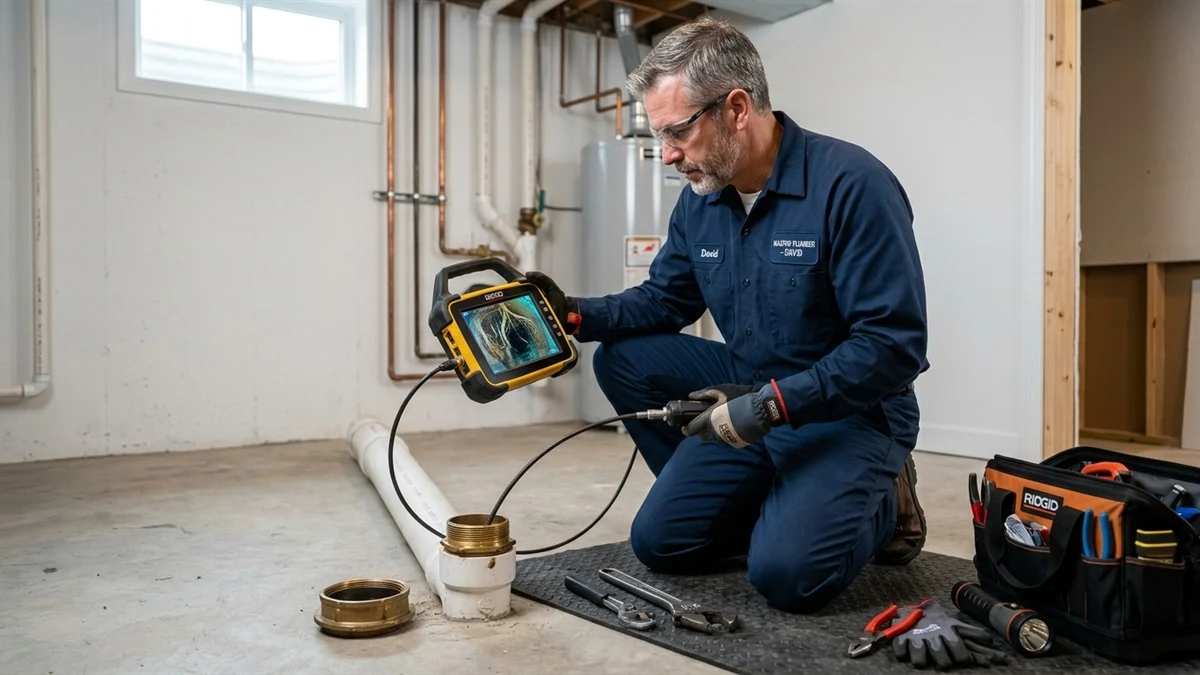
The Problem of Severe Hydraulic Bellies (Reverse Slope Sags)
Gravity sewer lines must maintain a continuous downward slope of at least 1/4-inch per foot (or 1/8-inch per foot for 6-inch lines under specific engineering approvals). If unstable, expansive bentonite soils have heaved or settled, creating a deep belly where water and solid waste pool continuously, neither CIPP lining nor pipe bursting will correct the grade. CIPP liners adhere to the host pipe, perfectly replicating the belly; pipe bursting follows the path of the existing borehole, maintaining the sag. To eliminate a deep belly, an open trench must be excavated, the trench bottom laser-graded, and new SDR-35 PVC laid on compacted, crushed aggregate bedding.
Unlined Complex Party Laterals & Utility Encounters
In older Front Range communities like Old Town Louisville or historic Westminster, properties occasionally share “party laterals” where multiple residential branch lines tie into a single main lateral without individual municipal cleanouts. Furthermore, if high-voltage electrical conduits, fiber-optic telecom lines, or high-pressure gas mains were cross-bored directly adjacent to the sewer lateral path, the radial expansion of pipe bursting risks catastrophic utility strikes, making precision open-cut daylighting mandatory.
5. Exhaustive Engineering Comparison Matrix: CIPP vs. Bursting vs. Open Trench
To assist homeowners and civil contractors in evaluating these three competing rehabilitation methodologies, the side-by-side engineering matrix below analyzes operational parameters, physical limitations, and structural properties:
| Technical Parameter | CIPP Epoxy Inversion Lining | Static / Pneumatic Pipe Bursting | Traditional Open-Cut Excavation |
|---|---|---|---|
| Governing Industry Standards | ASTM F1216, ASTM F1743, ASTM D790 | ASTM F2620, IPBA Guidelines, PPI TN-43 | ASTM D3034 (SDR-35 PVC), UPC / IPC Codes |
| Excavation Footprint | Zero Dig: Uses existing 4″ cleanout riser. | Minimal Dig: Small 4’x4′ launch pit and receiving pit. | Continuous Trench: Complete 60-100 ft trench, 4-10 ft deep. |
| Hydraulic Roughness (Manning’s n) | 0.009 (Ultra-smooth resin boundary) | 0.009 (Monolithic smooth HDPE bore) | 0.009 – 0.011 (PVC with gasketed joints every 10-20 ft) |
| Pipe Diameter Modification | Slight internal reduction (3mm – 4.5mm wall) | Maintains full diameter OR Upsizes 4″ to 6″ | Customizable to any specified SDR diameter |
| Joint Integrity | 100% Jointless Continuous Sleeve | 100% Monolithic Butt-Fused Joints | Segmented joints with elastomeric gaskets every 10-20 ft |
| Ability to Correct Reverse Slope Bellies | No (Conforms directly to existing pipe grade) | Marginal (Can slightly bridge minor grade sags) | Complete: Laser grading of aggregate bedding base |
| Typical Project Duration | 4 to 8 Hours (Same-day restoration) | 1 to 2 Days (Pits excavated, pulled, backfilled) | 5 to 10 Days (Heavy equipment, utilities, restoration) |
| Surface Restoration Impact | None ($0): Lawns, trees, and driveways untouched | Minimal ($300-$800): Patch two small access pits | Catastrophic ($3,000-$15,000+): Repave asphalt/concrete, re-sod |
| Expected Design Lifespan | 50+ to 100 Years (ASTM 50-year structural rating) | 100+ Years (HDPE is impervious to chemical rot and ground shear) | 50 to 75 Years (SDR-35 PVC pipe on graded bedding) |
6. Step-by-Step Trenchless Rehabilitation Protocol: Mechanical Preparation & Curing
Executing a flawless trenchless CIPP installation requires meticulous subterranean site preparation. An epoxy liner can only bond and cure properly if the host pipe is prepared down to bare structural material:
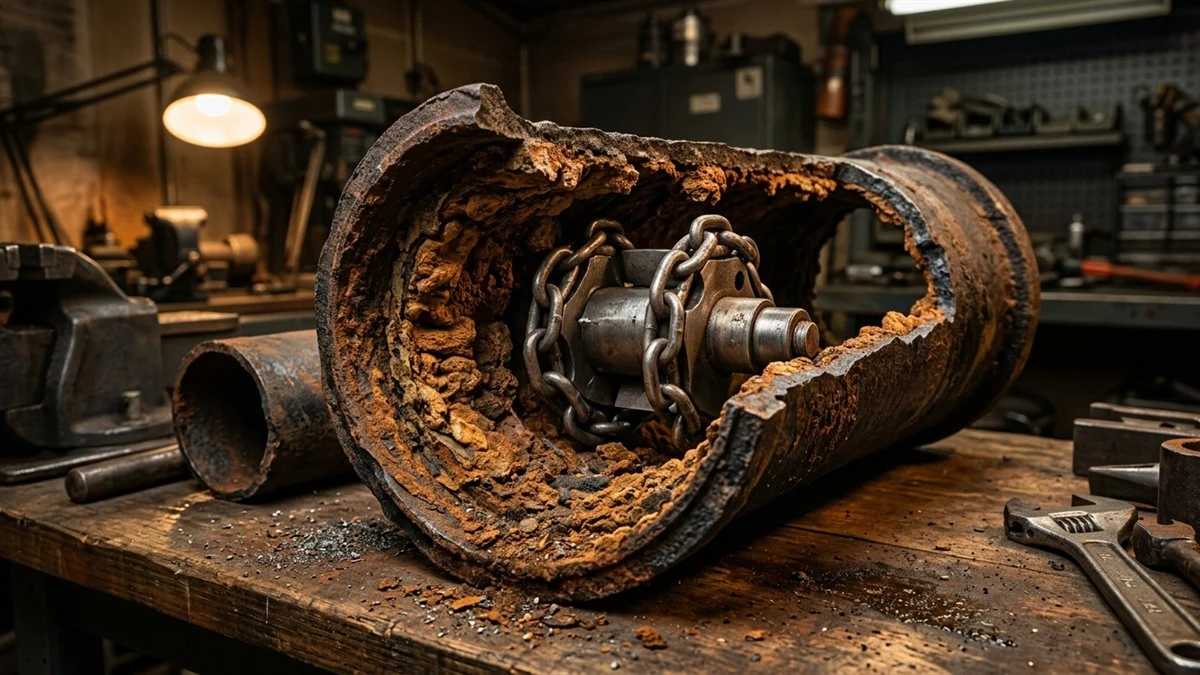
- Closed-Circuit Video Pre-Survey & Laser Calibration:
A self-leveling color CCTV camera navigates the lateral from foundation to street tap. Technicians measure precise linear footage, identify branch tie-ins, mark offset joint depths, and verify that the host pipe retains structural hoop geometry.
- Mechanical Descaling & Root Annihilation:
A high-speed flexible shaft machine spinning carbide-tipped chain knockers at 2,000 RPM is deployed through the line. The centrifugal whipping action pulverizes calcified mineral scale, strips decades of cast iron rust blisters, and shaves tree root trunks completely flush with clay joints.
- High-Pressure Hydro Jetting Hydro-Wash:
Commercial hydro jetters firing 4,000 PSI water through multi-directional 360-degree rotating nozzles wash all pulverized scale, roots, and sand slurry out of the pipe into the city main, leaving pipe walls completely clean and dry.
- Vacuum Impregnation (Wet-Out) & Calibration:
The precision felt liner is measured to exact field length. A metered batch of two-part epoxy resin is poured into the tube and drawn through the synthetic fibers under vacuum pressure. Calibrated electric rollers guarantee 100% saturation without trapped air bubbles.
- Pneumatic Inversion Deployment:
The liner is loaded into an inversion vessel and driven into the host pipe under continuous regulated air pressure, inverting smoothly along the pipe run and pressing tightly against the host pipe walls.
- Controlled Exothermic Polymerization (Curing):
Heat or ambient temperature monitors track the chemical cross-linking reaction. Once fully cured rock-hard, internal pressure is relieved, and the ends of the liner are trimmed cleanly at cleanout and municipal tap junctions.
- Robotic Lateral Branch Reinstatement:
In residential systems where secondary fixtures or subterranean basement branch laterals connect directly into the mainline lateral downstream of the cleanout, the newly inverted and cured liner covers these junctions. A computerized robotic micro-cutter equipped with high-torque diamond router bits is navigated to each junction under CCTV fiber-optic guidance, opening up the lateral branch connection with millimeter precision.
- Post-Installation CCTV Quality Audit:
A second fiber-optic video survey inspects the newly formed liner, verifying uniform wall thickness, seamless transitions, and flawless jointless flow, providing homeowners with permanent digital video records for insurance and real estate documentation.
7. Environmental Benefits: Carbon Footprint, Landscape Preservation & Root Immunity
Modern municipal utility engineering places intense scrutiny on ecological disruption and greenhouse gas emissions. Trenchless sewer restoration represents a massive ecological leap forward over historical excavation:
- Massive Carbon Footprint Reduction: Traditional open-cut sewer replacement requires mini-excavators, dump trucks hauling tons of soil, asphalt paving rollers, and diesel transport rigs operating for days. CIPP lining and pipe bursting utilize compact trailer-mounted rigs operating for a single afternoon, cutting total project carbon emissions by up to 80% to 90%.
- Saving Mature Suburban Tree Canopies: In established neighborhoods across Westminster, Arvada, and Broomfield, mature silver maples, blue spruces, and cottonwoods line sewer lateral paths. Open-trench excavators routinely sever major structural tap roots, destabilizing century-old trees and forcing their removal. Trenchless lining glides silently beneath root networks without disturbing a single root fiber.
- Eliminating Sanitary Landfill Burden: Digging up 80 feet of vitrified clay or cast iron pipe generates thousands of pounds of construction rubble destined for local landfills. Trenchless CIPP leaves the old host pipe buried harmlessly in place, utilizing it as an exterior casing for the new composite sleeve.
- Groundwater Protection & Infiltration Prevention: Broken sewer pipes allow raw sewage to leach into shallow groundwater aquifers during dry spells, while allowing storm runoff to infiltrate municipal collection plants during spring storms (Inflow & Infiltration / I&I). CIPP permanently seals all cracks, protecting local water tables and municipal treatment capacity.
8. Colorado Front Range Submarket Profiles: Pierre Shale, Expansive Soil Shear & Municipal Codes
Subterranean sewer infrastructure across northern Denver Metro faces unique geological and regulatory challenges that dictate trenchless methodology selection:
- City and County of Broomfield (Anthem, Broadlands, Country Vista, Greenway Park): Broomfield sits on the notorious Pierre Shale formation, characterized by heavy sodium montmorillonite and bentonite clays. When moisture levels shift from wet spring snowmelt to arid summer droughts, these expansive clays exert swelling pressures exceeding 8,000 to 10,000 pounds per square foot (psf). This extreme soil movement causes rigid pipe joints to shear horizontally or sink vertically. CIPP lining and continuous butt-fused HDPE pipe provide the ultimate defense: their jointless design eliminates the weak points where soil shear causes fractures, preventing wastewater exfiltration that attracts aggressive cottonwood root systems.
- City of Westminster (Standley Lake, Countryside, Shaw Heights, Sheridan Green): Westminster maintains rigorous municipal code oversight regarding the public right-of-way and sewer tap connections at the city main. When performing trenchless CIPP lining within municipal easements, plumbing contractors must ensure liners terminate precisely at the factory clay tap saddle without protruding into the flow line of the public main. In older Westminster subdivisions constructed in the 1960s and 1970s, cast iron laterals frequently suffer heavy interior tubercular rust scaling; mechanical chain knockers and hydro jetting are strictly mandatory before lining inversion.
- City of Thornton (Grange Creek, Woodglen, Skylake, Hunters Glen): Thornton’s older residential inventory frequently features under-slab cast iron infrastructure that has experienced bottom channel wear from decades of acidic residential greywater discharge. Trenchless CIPP lining enables complete under-slab pipe reconstruction directly from exterior cleanouts, sparing Thornton homeowners from catastrophic indoor slab jackhammering, concrete dust contamination, and expensive hardwood/tile replacement.
- Arvada, Wheat Ridge & West Denver Submarkets: Older agricultural parcels developed in the mid-20th century often utilized long 80-to-120-foot vitrified clay pipe runs passing beneath established mature tree rows. Static pipe bursting with DR-11 HDPE is widely specified here to eliminate recurrent root blockages and upsize older 4-inch lines to modern 6-inch high-capacity lines.
- Louisville, Lafayette & East Boulder County: Boulder County communities emphasize environmental sustainability, making the carbon emission savings and tree canopy preservation of trenchless CIPP lining the preferred civil rehabilitation choice. Strict local clean water rules favor CIPP to prevent sanitary infiltration into local creek watersheds.
9. Transparent Pricing & Financial Investment Analysis: 50-Year Cost of Ownership
Evaluating the true financial investment of sewer lateral replacement requires calculating both upfront construction costs and secondary property restoration expenditures:
| Rehabilitation Method | Upfront Plumbing Cost | Secondary Property Restoration | Total Real Investment | 50-Year Value Rating |
|---|---|---|---|---|
| Trenchless CIPP Epoxy Lining | $6,500 – $11,500 ($140-$220/ft) | $0 (Zero landscape damage) | $6,500 – $11,500 | OUTSTANDING: Lifetime jointless root defense; single-day completion. |
| Trenchless Static Pipe Bursting | $7,000 – $12,500 | $400 – $1,200 (Patch 2 small pits) | $7,400 – $13,700 | EXCEPTIONAL: Installs brand-new 100-year HDPE; allows pipe upsizing. |
| Traditional Open-Cut Excavation | $5,500 – $10,000 (Base pipe only) | $4,000 – $15,000+ (Driveway repaving, landscaping, sod, trees) | $9,500 – $25,000+ | POOR: Highly disruptive; costly secondary property reconstruction. |
10. Comprehensive Extended FAQ Section
Q1: Will trenchless CIPP lining reduce my sewer pipe diameter?
The thickness of a cured CIPP epoxy liner is only 3mm to 4.5mm, reducing internal diameter by less than 4% to 5%. However, because the cured epoxy creates an ultra-smooth, slick surface (Manning’s roughness coefficient n = 0.009) compared to rough, eroded clay (n = 0.015) or corroded cast iron (n = 0.020), hydraulic flow capacity and discharge velocity actually increase by 18% to 28%. Solid waste and toilet tissue flow significantly faster, virtually eliminating paper snags and recurrent mainline backups.
Q2: Can tree roots penetrate a CIPP epoxy liner?
No. Tree roots cannot physically penetrate a properly installed CIPP liner. Roots enter sewer pipes through porous mortar seams, failing rubber Fernco couplings, and misaligned bell-and-spigot joints where vapor condensation escapes into the surrounding soil. A CIPP liner forms a continuous, seamless, jointless sleeve from foundation to street tap, completely eliminating all entry seams. Furthermore, cured structural epoxy is non-porous and chemically inert, offering no moisture signals that attract root hairs.
Q3: How long does trenchless sewer lining take from start to finish?
A residential CIPP lining project is typically completed in a single day (6 to 8 hours). Technicians perform initial CCTV camera inspection and mechanical chain descaling in the morning, invert and calibrate the resin liner by midday, cure the structural epoxy over 2 to 3 hours, and perform post-cure robotic camera inspection before late afternoon, restoring full sanitary plumbing service the very same evening.
Q4: When is a sewer pipe NOT eligible for CIPP lining?
CIPP lining cannot be installed under three specific structural conditions: (1) The host pipe has completely collapsed into rubble with total loss of circular bore, making it impossible to invert a calibration tube; (2) Surrounding soil has completely cavitated into the pipe run; or (3) The pipe contains severe reverse-slope bellies where standing water pools. Because CIPP liners conform directly to the host pipe contours, they replicate existing grade defects. In these cases, trenchless pipe bursting or precision open-cut excavation is required.
Q5: What is the lifespan of a trenchless HDPE burst pipe?
High-Density Polyethylene (HDPE) pipe installed via static or pneumatic pipe bursting has an engineered laboratory lifespan exceeding 100 years. HDPE is completely immune to rust, electrochemical corrosion, bacterial hydrogen sulfide gas deterioration, and biological root intrusion. Its flexible molecular structure effortlessly accommodates ongoing Front Range expansive soil heave without cracking.
Q6: Does homeowner’s insurance pay for trenchless sewer repair?
Standard homeowner’s policies typically exclude subterranean utility lines outside the home’s foundation. However, many Colorado homeowners carry an optional Service Line Coverage or Water/Sewer Backup Endorsement rider (typically costing $30 to $60 annually). These riders commonly provide $10,000 to $20,000 toward trenchless lateral rehabilitation or replacement following verified structural failure.
Q7: Is trenchless pipe bursting safe around other utilities?
Yes, provided comprehensive utility locating is completed prior to work. Technicians submit locate requests via Colorado 811 to locate all adjacent gas mains, electrical conduits, and fiber-optic telecom lines. Plumbers maintain mandatory clearance buffers and excavate small exploratory “potholes” to daylight any crossing utilities before pulling the bursting head through the ground.
Q8: Can you line pipes that run beneath concrete basement slabs?
Yes. Under-slab CIPP lining is one of the most cost-effective applications of trenchless technology. It restores deteriorated cast iron pipes beneath finished basement floors, tile, and hardwood without jackhammer demolition, hazardous dust contamination, or disruptive structural rebuilding. The entire line is rehabilitated from an exterior cleanout riser or basement utility stack.
Q9: What happens to branch line connections when a main line is lined?
If secondary drain lines (such as a basement laundry or bathroom branch) connect into the main lateral downstream of the launch cleanout, the CIPP liner will initially cover these junction points. Once the resin cures, a specialized robotic micro-cutter equipped with diamond routing bits is deployed into the line under closed-circuit video guidance to precisely reinstate the branch openings.
Q10: Are municipal permits required for trenchless sewer repair in Colorado?
Yes. Municipal jurisdictions across the Front Range—including the City and County of Broomfield, City of Westminster, and City of Thornton—require civil plumbing permits for lateral sewer rehabilitation. Licensed contractors submit pre- and post-installation fiber-optic CCTV camera footage to municipal building inspectors to certify structural compliance before the permit is officially signed off.
Q11: How does CIPP handle shifts and offsets in old clay pipe joints?
During pneumatic inversion, the flexible felt liner navigates offset joints up to 10% to 15% without difficulty, conforming to the contours and bridging the gaps with structural epoxy to create a smooth, continuous hydraulic transition. If an offset is severe (greater than 20%), a mechanical grinding head or localized spot-repair excavation is used before liner deployment.
Q12: Can trenchless pipe bursting increase my sewer line size?
Yes. Static pipe bursting can easily upsize older 4-inch sewer lines to 6-inch HDPE lines. By using an upsized conical expander head (typically 7 inches in rear diameter), the tool shatters the old 4-inch host pipe outward into the surrounding soil cavity, pulling full 6-inch DR-11 HDPE into place. This is especially valuable for expanding homes, finished basements with added bathrooms, or commercial conversions.
11. Schedule High-Definition Video Sewer Scope & Trenchless Consultation
Confronting a Failed or Broken Sewer Line?
Do not let contractors destroy your landscaping, driveway, or mature trees with massive backhoes. Our licensed master plumbers specialize in non-invasive trenchless CIPP lining and seamless pipe bursting across Broomfield, Westminster, Thornton, and Denver Metro. Full 50-year warranties included.