
The dishwashing pit of a high-volume restaurant near Flatiron Crossing Mall in Broomfield is backing up at 7:30 PM on a Friday rush.
Soapy, scalding water laden with animal fat and emulsified oils is bubbling out of the floor sink beneath the three-compartment pot wash station.
Across the tiled kitchen floor, an oily film is spreading toward the main cook line.
Line cooks are slipping.
The kitchen manager is on his knees beside a stainless steel cabinet tucked beneath the dish table: an engineered Grease Recovery Device (GRD).
Inside the unit, the internal electric heating element is glowing cherry red beneath a crust of burnt tallow.
The rotating oleophilic skimmer wheel is completely stationary.
Its fractional horsepower drive motor is humming loudly, burning hot enough to blister paint, locked in place by a solid brick of congealed beef tallow and frying shortening.
The spring-loaded silicone wiper blade that is supposed to scrape liquid grease off the rotating disc into an external collection caddy has warped and torn.
Yellow grease has bypassed the wiper entirely, spilling back down into the static separation chamber.
Downstream, the 3-inch drain line is choking.
City of Broomfield industrial pretreatment inspectors take a zero-tolerance stance on grease discharges: exceed the 100 mg/L effluent threshold or dump visible grease down the city main, and your facility faces immediate stop-work citations and punitive sewer surcharges.
When an automated grease recovery device jams, you do not just have a plumbing problem.
You have an operational disaster that threatens public health compliance, kitchen safety, and thousands of dollars in emergency hydro-jetting bills.
1. The Mechanical Evolution: Passive Interceptors vs. Automated GRDs
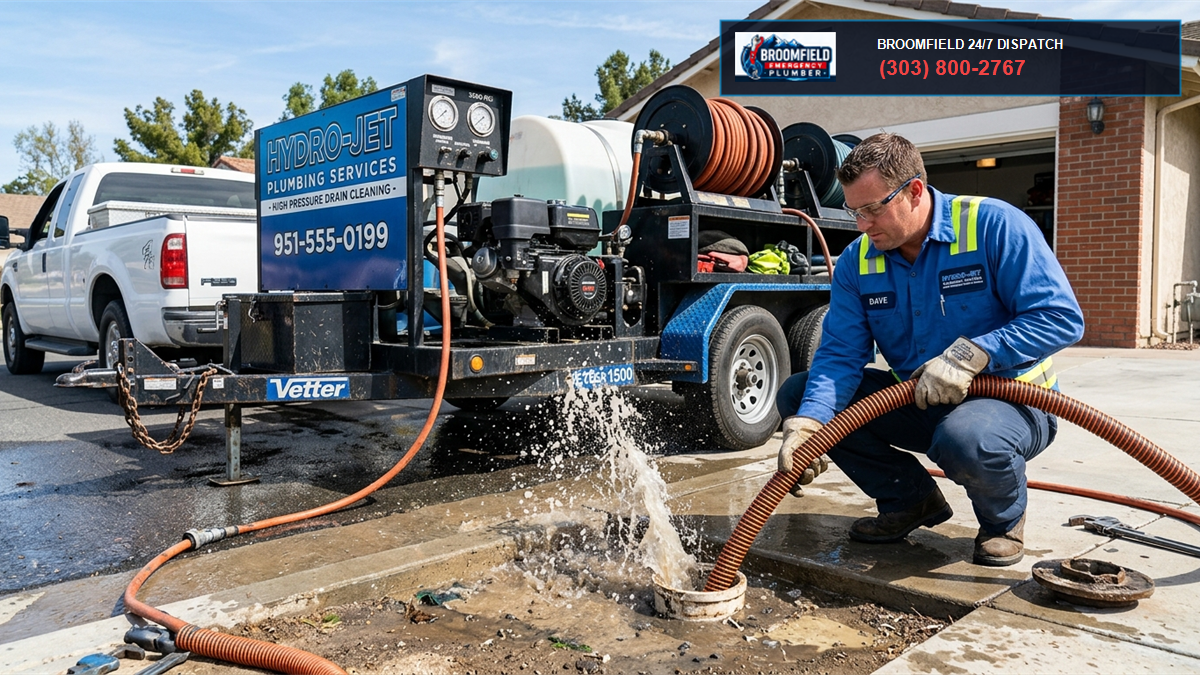
For decades, commercial kitchens relied solely on massive underground concrete grease interceptors (often 750 to 2,000 gallons) buried outside the building envelope.
In modern multi-tenant commercial centers, urban high-rises, airport concourses, and leased shopping centers across Broomfield, exterior underground vaults are frequently impossible to install.
The solution was the invention of Automated Grease Recovery Devices (AGRDs / GRDs) certified under ASME A112.14.3 and ASME A112.14.4.
Unlike traditional passive grease traps that merely store rotting fats, oils, and grease (FOG) until a pump truck arrives, an automated GRD actively extracts separated oil on a programmed daily cycle:
| Feature | Passive Hydromechanical Interceptor (HGI) | Automated Grease Recovery Device (GRD) |
|---|---|---|
| Governing Standards | ASME A112.14.3, PDI G-101 | ASME A112.14.4, CSA B481.1 / B481.5 |
| Operating Principle | Static gravity separation; manual scooping or monthly pump-out required. | Thermal liquefaction + motor-driven oleophilic skimming wheel/belt. |
| FOG Storage Volume | High internal holding capacity; degrades rapidly once 25% rule is reached. | Minimal internal holding volume; requires continuous automated extraction. |
| Primary Failure Mode | Surcharge bypass, baffle wall collapse, hydrogen sulfide corrosion. | Skimmer motor freeze, wiper blade warping, immersion heater burn-out. |
| Broomfield Compliance Risk | Late pumping leads to massive grease discharge into municipal main. | Mechanical breakdown stops skimming; tank overflows within 24 to 48 hours. |
The core advantage of an ASME A112.14.4 unit is that recovered grease is collected in an external caddy as clean, de-watered yellow grease that can be sold for biofuel recycling.
However, because these units pack heating elements, digital timers, electric gear motors, float switches, and delicate silicone wiper blades into a caustic wastewater chamber, they require meticulous mechanical care.
2. Fluid Dynamics of Grease Separation: Stokes’ Law in Commercial Sinks
Every grease interceptor operates on the fundamental physical principle of differential buoyancy.
Liquid water has a density ($\rho_w$) of approximately $1.00 \, \text{g/cm}^3$ ($62.4 \, \text{lb/ft}^3$) at room temperature.
Animal fats, vegetable oils, and restaurant greases possess a lighter density ($\rho_g$), typically ranging from $0.88$ to $0.93 \, \text{g/cm}^3$.
Because oil is lighter than water, grease globules naturally rise toward the liquid surface.
The terminal rising velocity ($v_t$) of a spherical grease droplet through a wastewater column is governed mathematically by Stokes’ Law:
$$v_t = \frac{g \cdot d^2 (\rho_w – \rho_g)}{18 \mu}$$
Where:
- $g$: Acceleration due to gravity ($9.81 \, m/s^2$ or $32.2 \, ft/s^2$).
- $d$: Diameter of the grease droplet ($m$ or $ft$).
- $\rho_w$: Density of the wastewater ($kg/m^3$).
- $\rho_g$: Density of the grease globule ($kg/m^3$).
- $\mu$: Dynamic viscosity of the fluid ($Pa \cdot s$).
Notice the exponential power of droplet diameter: $d^2$.
If a grease droplet is large ($100 \, \mu m$), its rising velocity is rapid. It floats to the top of the tank in seconds.
However, if a dishwasher utilizes harsh industrial detergents, caustic degreasers, or high-pressure spray nozzles operating above 140°F, grease is mechanically and chemically emulsified into microscopic droplets ($d < 10 \, \mu m$).
When droplet diameter drops by a factor of 10, rising velocity drops by a factor of 100!
The tiny oil droplets will not float to the surface within the short retention time of the tank.
They wash straight through the baffles and escape into the municipal sewer line, coating city pipes with sticky saponified grease crusts.
The Hydraulic Retention Time (HRT) Equation
For separation to succeed, fluid retention time ($t$) inside the separation chamber must exceed the time required for the smallest targeted grease droplet to float from the tank floor to the liquid surface:
$$t = \frac{V_{\text{active}}}{Q_{\text{peak}}}$$
Where $V_{\text{active}}$ is the clear liquid volume between the inlet baffle and outlet weir, and $Q_{\text{peak}}$ is the maximum instantaneous fixture flow rate.
If a commercial kitchen removes the upstream flow control fitting (a restricted orifice plate with air intake designed to limit sink drainage to 20 or 35 GPM), dishwashers will dump 50 GPM through a 25 GPM interceptor.
Retention time is cut in half.
Turbulent flow rips through the chamber, sweeping un-separated grease directly down the effluent pipe.
Laminar Flow Dynamics & Reynolds Number Suppression
Stokes’ Law applies exclusively under conditions of pure laminar flow.
The moment fluid movement within the separation chamber transitions into turbulence, chaotic cross-current eddies physically overpower the gentle buoyant upward drift of the grease globules.
The hydraulic state inside the interceptor is determined by the dimensionless Reynolds Number ($Re$):
$$Re = \frac{\rho \cdot v \cdot D_H}{\mu}$$
Where:
- $\rho$: Fluid density ($kg/m^3$).
- $v$: Mean horizontal fluid velocity across the separation cross-section ($m/s$).
- $D_H$: Hydraulic diameter of the flow channel ($m$), calculated as $D_H = \frac{4A}{P_w}$ (where $A$ is flow cross-sectional area and $P_w$ is wetted perimeter).
- $\mu$: Dynamic fluid viscosity ($Pa \cdot s$).
In high-performance ASME A112.14.4 grease recovery units, the internal flow chamber is engineered to maintain a Reynolds number strictly below 500.
To achieve this radical dampening of fluid momentum, the incoming waste stream passes through an engineered perforated diffuser baffle plate.
The plate sheds the high-velocity jet energy of the drain pipe, transforming turbulent inlet discharge into a smooth, horizontal laminar sheet.
At Broomfield’s high altitude (5,420 feet), air density is 17 percent lower than at sea level.
The vented flow control fitting draws atmospheric air into the waste stream to cushion the hydraulic slug.
If the flow control vent becomes clogged with grease splatter or dust, air aspiration stops.
A solid siphon forms, yanking water through the interceptor at violent velocities that spike the Reynolds number past 4,000, destroying all grease separation capability.
3. Forensic Pathology: What Causes GRD Mechanical Failures?
Automated grease recovery devices fail in predictable, destructive ways.
When our commercial emergency plumbing trucks arrive at a flooded Broomfield restaurant, our diagnostic inspection focuses on four core failure mechanisms:
A. Immersion Heater Element Failure & Solid Tallow Freezing
Vegetable oils remain liquid at room temperature.
Animal fats—specifically beef tallow, bacon grease, and butterfat—possess high melting points ranging from 104°F to 118°F (40°C to 48°C).
At room temperature (70°F), animal fat solidifies into a rock-hard, waxy mass.
To allow the rotating skimmer wheel to collect grease, every ASME A112.14.4 GRD is equipped with an internal electric immersion heater (typically 500W to 1,500W).
The heater is programmed to energize 30 to 60 minutes before the skimming motor starts, liquefying the floating grease cap.
When the immersion heater burns out—often due to mineral scale crusting or operating dry during low-water events—the grease cap cools into a solid, impenetrable brick.
When the timer attempts to start the skimmer wheel, the polymer wheel or stainless steel disc is encased in rock-hard tallow.
The drive motor tries to spin against the immovable solid block.
The gear train strips its nylon teeth, or the motor windings overheat and trip the internal thermal overload fuse.
B. Wiper Blade Wear, Warping & Silicone Delamination
The rotating wheel or belt of an automated GRD is manufactured from a specialized oleophilic (oil-attracting) polymer or stainless steel alloy.
Water falls away from the surface, while liquid oil clings to the rotating wheel.
As the wheel exits the wastewater bath, it passes between precision-molded silicone or Viton wiper blades.
The wiper blades physically squeegee the oil off both sides of the wheel, directing the liquid grease into a sloped discharge trough leading to the collection caddy.
Over three to six months of kitchen service, the wiper blades take a brutal beating:
- Continuous contact with 140°F grease leaches plasticizers from the silicone elastomer.
- Microscopic bone fragments, breading crumbs, and charred grill grit act as sandpaper, gouging the wiper’s precision bevel edge.
- The blade warps away from the wheel surface, creating a 1/16-inch gap.
Once that gap forms, grease is no longer scraped into the caddy.
The wheel merely spins in circles, picking up oil and plunging it right back into the water chamber.
The grease layer thickens until it drops below the outlet baffle, sending concentrated FOG into the building’s drainage plumbing.
C. Solids Strainer Basket Overflow & Baffle Choking
Commercial wastewater does not just contain liquid grease. It carries rice, noodles, poultry skin, coffee grounds, and toothpicks.
Every GRD features an internal perforated stainless steel solids strainer basket located directly beneath the inlet pipe.
Under ASME standards, kitchen staff must manually pull and empty this strainer basket daily.
In reality, busy kitchen crews neglect the basket for days.
Food solids accumulate until the perforations are 100 percent blinded.
Incoming water can no longer drain through the basket.
Wastewater spills over the top of the basket rim, carrying heavy food chunks directly into the flotation chamber.
Dense food particles sink to the bottom, burying the immersion heater and forming an anaerobic septic sludge blanket.
Floating food particles wedge between the skimmer wheel and the chassis, physically jamming the rotating mechanism.
D. Chemical Saponification (The “Grease Concrete” Reaction)
Commercial dishwashers rely on high-alkalinity detergents containing sodium hydroxide ($NaOH$) or potassium hydroxide ($KOH$).
When alkaline wash water (pH 10 to 12) at 160°F mixes with animal triglycerides inside the grease trap, a chemical reaction occurs: saponification.
$$\text{Triglyceride} + 3\text{NaOH} \xrightarrow{\Delta} \text{Glycerol} + 3\text{R-COO}^-\text{Na}^+ \quad \text{(Metallic Soap Salts)}$$
These sodium and calcium fatty acid soap salts are not slippery bar soaps.
They react with calcium in Broomfield’s municipal water to form rock-hard, insoluble calcium stearate deposits commonly known in the trade as grease concrete.
Grease concrete coats internal level sensors, welds float switches into a fixed position, and builds up along discharge pipes until water cannot escape.
4. City of Broomfield Industrial Pretreatment & Code Mandates
Plumbing in commercial food service establishments is strictly governed by local environmental rules.
The City of Broomfield Industrial Pretreatment Program enforces strict limits on wastewater discharges entering the municipal collection system:
- Maximum Oil & Grease Limit: 100 mg/L (milligrams per liter) total petroleum hydrocarbons / animal-vegetable fats.
- pH Range Limits: Effluent pH must remain between 5.5 and 9.5 at all times. Caustic chemical dumping that pushes pH outside this envelope triggers instant environmental penalties.
- Temperature Limit: Wastewater entering the public sewer must not exceed 140°F (60°C), as excess heat liquefies grease, carrying it into the city main where it cools and blocks public infrastructure.
- Mandatory Maintenance Logs: Facilities must maintain a verifiable grease interceptor cleaning and skimming maintenance log on site for a rolling 3-year period, available for unannounced municipal inspection.
Under International Plumbing Code (IPC Section 1003), grease interceptors must be sized according to fixture drainage load and equipped with certified flow control devices.
Failing an environmental pretreatment inspection in Broomfield can result in mandatory installation of multi-thousand-dollar automatic compliance monitoring valves, administrative fines up to \$1,000 per day, and immediate suspension of food service operations.
5. Real-World Commercial Case Studies Across Broomfield
Our master plumbers troubleshoot grease recovery and commercial drainage emergencies across Broomfield restaurants, hotels, and corporate kitchens.
Here are six real-world case studies detailing how we cleared disastrous kitchen backups and restored environmental compliance:
Case Study 1: Flatiron Crossing Steakhouse Skimmer Gearbox Meltdown
Facility: A high-volume upscale steakhouse near Flatiron Crossing Mall.
The Emergency: During dinner service, the kitchen dish machine backed up completely.
Wastewater flooded the server alley.
The facility manager reported their Big Dipper automated GRD was displaying an error code and emitting a pungent burning electrical odor.
Forensic Diagnostic: We removed the motor housing cover.
The 120V fractional horsepower drive motor was seized solid.
Inside the separation chamber, the internal immersion heating element had suffered a burned-out resistance coil four days earlier.
Without heat, prime beef tallow and clarified butter from the steak prep station had cooled into an 8-inch solid fat layer.
When the morning skimming timer fired, the polymer skimming wheel was locked inside the hardened fat.
The motor attempted to turn, stripped the internal acetal drive gears, and cooked its stator windings.
The Emergency Intervention:
- Our team utilized high-temperature portable wash units to melt and vacuum-extract over 45 gallons of congealed tallow into sealed recovery drums.
- We installed a brand-new, factory-certified 1,000W Incoloy immersion heater element with an integrated digital high-limit thermostat.
- We replaced the drive motor and hardened stainless steel drive gearbox.
- We installed fresh precision silicone wiper blades, calibrating blade contact pressure using feeler gauges to exactly 0.015-inch deflection.
- We tested the automated heating and skimming cycle: within 45 minutes, clean yellow grease was successfully discharging into the external collection caddy.
Outcome: The kitchen reopened for Saturday lunch service. Pretreatment sampling confirmed effluent oil and grease levels at 42 mg/L, well below the 100 mg/L city threshold.
Case Study 2: Interlocken Tech Campus Cafeteria Flow Control Removal Failure
Facility: A corporate dining hall serving 1,400 meals daily in Interlocken Technology Park.
The Emergency: The facility received a formal Notice of Violation from Broomfield Pretreatment Inspectors after municipal water sampling revealed an alarming 480 mg/L grease concentration in the sewer lateral.
Forensic Diagnostic: The cafeteria was operating a 50 GPM automated grease recovery system.
However, kitchen staff had complained months earlier that sinks were draining too slowly.
An unlicensed handyman had removed the vented flow control fitting from the inlet piping beneath the three-bay sink!
When both wash bays were drained simultaneously, flow surged to 75 GPM through the 50 GPM interceptor.
Fluid retention time plummeted from 4.2 minutes down to 1.1 minutes.
Turbulent water blasted through the internal baffles, washing un-separated grease directly into the building sewer main.
The Solution:
- We re-installed a certified ASME A112.14.3 flow control device with a 2-inch atmospheric air intake vent.
- We performed a high-temperature rotary hydro-jetting scour on the 180-foot lateral out to the city connection, clearing over 300 pounds of saponified grease scale.
- We recalibrated the GRD skimming cycle to run three 45-minute skimming sessions daily to match heavy morning and afternoon meal prep schedules.
Outcome: Effluent testing dropped from 480 mg/L down to 31 mg/L. The city dismissed the violation without fines.
Case Study 3: 120th Avenue Mexican Restaurant Saponification “Grease Concrete”
Facility: A busy Mexican restaurant specializing in slow-cooked carnitas and fried chips.
The Emergency: Sinks were gurgling, and grease was bypassing the recovery wheel, discharging into the downstream cleanout stack.
Forensic Diagnostic: We found that the kitchen was using an aggressive caustic degreaser (pH 13.2) to wash grease filters and pans.
The chemical reaction between the pork lard and sodium hydroxide had generated massive grease concrete deposits.
A rock-hard white crust coated the optical liquid level sensors.
The unit’s PLC believed the tank was empty of grease, so it never signaled the skimming motor to run.
Meanwhile, unskimmed lard was overflowing the internal outlet baffle.
The Solution:
- We acid-descaled the internal stainless steel chamber and mechanically chiseled away grease concrete from sensors and weirs.
- We replaced the blinded optical sensors with self-cleaning conductance probes.
- We worked with the restaurant management to switch from caustic sodium hydroxide cleaners to an enzyme-compatible, neutral-pH commercial kitchen degreaser.
- We trained staff on daily strainer basket maintenance.
Outcome: Automated skimming resumed flawless operation, extracting 12 gallons of liquid oil daily into collection drums.
Case Study 4: Broomfield Medical Pavilion Kitchen Wiper Blade Blowout
Facility: A healthcare dietary kitchen preparing patient meals.
The Emergency: Oil was leaking from the bottom seams of the GRD cabinet, running across the dietary prep floor and violating Colorado Department of Public Health and Environment (CDPHE) sanitation standards.
Forensic Diagnostic: The primary silicone wiper blade had torn along its mounting spine.
A stainless steel scrub pad wire had passed through the dish sink, wrapped around the rotating skimmer wheel, and sliced through the silicone wiper like a razor blade.
Oil scraped from the wheel was missing the collection trough, dripping down the inside of the electrical enclosure and pooling beneath the unit.
The Solution:
- We performed an emergency sanitization of the unit chassis and replaced electrical wiring exposed to hot grease.
- We installed an upgraded, fiber-reinforced dual-durometer Viton wiper blade assembly resistant to physical tears and chemical degradation.
- We installed an ultra-fine mesh secondary magnetic strainer basket ahead of the interceptor to catch metal scouring fragments before they reach the skimming mechanism.
Outcome: Full sanitary compliance was restored before the CDPHE health inspection. External leaks dropped to zero.
Case Study 5: US-36 Craft Brewery Taproom Solid Food Choke
Facility: A brewery and gastro-pub off US-36 in Broomfield.
The Emergency: The GRD was overflowing its top lid gasket during weekend peak service, spilling foul-smelling gray water into the bar area.
Forensic Diagnostic: Dishwashing staff had stopped emptying the internal solids strainer basket.
Spent brewing grains and fry batter had completely clogged the basket.
Water backed up to the lid seal, forced its way past the worn neoprene cover gasket, and flooded the floor.
Worse yet, rotting grain had dropped to the tank floor, generating corrosive hydrogen sulfide ($H_2S$) gas that was pitting the internal heating element sheath.
The Solution:
- We evacuated the septic sludge blanket using heavy-duty vacuum extraction equipment.
- We replaced the eroded heating element with an Incoloy-800 acid-resistant element.
- We replaced the crushed lid gasket with an oil-resistant closed-cell EPDM gasket.
- We installed an external, easily accessible pre-strainer box with a removable drawer, making daily solids disposal fast and effortless for bar staff.
Outcome: Odors were eliminated, lid weeping ceased, and kitchen drainage capacity was fully restored.
Case Study 6: Fast-Casual Chicken Franchise Skimmer Timing Misconfiguration
Facility: A busy fried chicken franchise along 120th Avenue.
The Emergency: Downstream sewer pipes were choking with grease every six weeks, requiring recurring emergency rooter and jetting calls.
Forensic Diagnostic: The restaurant was producing high volumes of poultry grease.
However, the digital timer on their AGRD was programmed to run the heating and skimming cycle at 2:00 PM—right in the middle of their busiest lunch shift!
During lunch, the three-compartment sink was discharging continuous hot water.
The intense hydraulic turbulence inside the tank prevented grease from floating to the surface.
The skimmer wheel was spinning in a swirling vortex of turbulent soapy water, recovering less than 5% of available grease.
Then, overnight when the water was calm and grease finally floated, the skimmer was off!
The next morning, the first rush of sink water washed the stagnant grease layer straight into the sewer.
The Solution:
- We reprogrammed the PLC controller logic: the unit now enters a 2-hour quiet settling period starting at 11:30 PM after kitchen closing.
- At 1:30 AM, the heating element activates, liquefying the settled grease cap.
- From 2:15 AM to 4:00 AM, the skimmer wheel runs in dead-calm water, achieving maximum separation efficiency.
- We installed a high-capacity grease caddy equipped with an optical level alarm that prevents overfilling.
Outcome: Daily grease extraction increased from 1.5 quarts to 3.8 gallons. Downstream pipe blockages stopped completely.
Case Study 7: Flatiron Mall Food Court Multi-Station Baffle Fracture & Ultrasonic Alarm Glitch
Facility: A high-throughput Asian noodle and dim sum kitchen in a commercial shopping center.
The Emergency: Greasy effluent was bypassing the unit, backing up floor sinks across three adjacent food court tenant stalls and triggering an emergency health inspection threat.
Forensic Diagnostic: Disassembly revealed that the molded internal PVC outlet baffle had fractured down its center spine.
High-temperature discharge from a commercial wok range water curtain (continuous 175°F discharge) had softened the plastic baffle over eighteen months of extreme thermal cycling.
Under peak hydraulic load, the compromised baffle flexed and snapped clean off its mounting bracket.
With the outlet baffle missing, floating hot oil was sucked straight down the discharge invert without ever reaching the skimming wheel.
Compounding the catastrophe, the ultrasonic grease-depth sensor on top of the tank was coated with dried flour and cornstarch dust, preventing the controller from detecting the missing separation layer.
The Solution:
- We fabricated and installed a heavy-gauge 316 stainless steel replacement baffle assembly secured with marine-grade fasteners, immune to 180°F thermal softening.
- We installed an inline thermostatic tempering valve ahead of the interceptor to blend cold tap water into the wok drainage whenever discharge exceeds 135°F.
- We cleaned and recalibrated the ultrasonic transducer head, setting a high-grease audible siren and BMS alert contact.
- We cleared 120 feet of common food court collector pipe using hot-water rotary hydro-jetting at 3,200 PSI.
Outcome: Effluent temperature was stabilized below 130°F, grease separation returned to 98% efficiency, and neighboring food court tenants experienced zero drain backups.

6. Step-by-Step GRD Inspection & Wiper Calibration Protocol
Servicing an automated grease recovery device requires precision mechanical calibration.
Follow this master plumber protocol to restore optimal skimming performance:
Phase 1: Mechanical De-Energization & Solids Audit
- Disconnect electrical power to the GRD at the dedicated GFCI disconnect switch. Lock out / tag out the circuit.
- Unlatch the lid clamps and remove the main access cover. Inspect the lid gasket for tears, brittleness, or grease swelling.
- Remove the stainless steel solids strainer basket. Empty all food waste into the trash. Inspect basket perforations: clean with a stiff nylon brush and hot water.
- Inspect the bottom sludge depth using a Sludge Judge core sampler. If settled food solids exceed 2 inches, pump down the unit.
Phase 2: Thermal & Electrical Verification
- Inspect the immersion heating element sheath: check for burnt carbon scale, blisters, or physical bending.
- Using a digital multimeter, measure the electrical resistance across the heater terminals (typically 12 to 28 ohms depending on wattage):
- An infinite ($\infty$) resistance reading indicates an open, burned-out heating coil. Replace the element.
- Check continuity from each terminal to the steel sheath: any continuity indicates an internal ground fault. Replace immediately.
- Test the high-limit safety thermostat: verify it snaps shut below 130°F and opens cleanly if water temperature exceeds 160°F.
Phase 3: Skimmer Wheel & Wiper Blade Alignment
- Manually rotate the skimmer wheel by hand: verify smooth, silent rotation without bearing grind or shaft play.
- Inspect the oleophilic surface: clean away calcified scale using a non-abrasive plastic scouring pad. Never use steel wool or metal scrapers on polymer discs.
- Inspect both wiper blade contact edges: check for nicks, tears, or curled edges. If worn, replace with a matched set.
- Re-install the wiper assembly. Adjust the tension mounting screws until the wiper blade edge exerts uniform contact across the entire width of the wheel.
- Verify that the wiper discharge trough slopes cleanly toward the external grease caddy without dips or obstructions.
Phase 4: Operational Cycle Run Test
- Restore electrical power. Manually trigger the “Test / Manual Skim” mode on the digital controller.
- Verify the heater engages. Allow 20 minutes for the water surface to reach skimming temperature (115°F to 125°F).
- Verify the drive motor starts smoothly. Observe the rotating wheel: confirmed oil should adhere to the disc, be squeegeed off cleanly by the wipers, and flow steadily into the caddy.
- Verify zero liquid water is escaping into the grease caddy. (Only clear oil should be collected).
7. Preventative Maintenance Schedule for Commercial GRDs
Adhering to this disciplined preventative maintenance schedule prevents catastrophic kitchen backups and guarantees Broomfield environmental compliance:
- Daily (Kitchen Staff): Empty the internal solids strainer basket at the end of each shift. Check the external grease collection caddy: empty yellow grease into dedicated recycling barrels before the caddy reaches 80% capacity. Wipe clean the exterior trough.
- Weekly (Kitchen Staff / Management): Clean the wiper blades with a warm damp cloth. Check the digital clock and timer settings: verify skimming cycles run during off-peak hours. Inspect the liquid surface: confirm no hardened fat crust is forming.
- Monthly (Facility Maintenance): Clean the immersion heating element sheath to prevent carbon scale buildup. Inspect the lid gasket and latches for tight vapor seal. Check the inlet flow control device air vent: ensure the vent hole is not plugged with grease or dust.
- Quarterly (Licensed Master Plumber Service): Comprehensive electrical audit of heating elements, motor current draw, and thermostat calibration. Replace silicone wiper blades. Perform a complete pump-down and chamber hydro-wash to purge bottom anaerobic sludge. Hydro-jet the downstream kitchen discharge lateral to clear saponification scale. Update and sign the municipal environmental compliance log.
Need Emergency Commercial Grease Recovery Device (GRD) Repair in Broomfield?
Is your commercial kitchen grease trap backing up into your dish pit? Has your automated skimmer motor seized, is your heating element burned out, or has Broomfield issued a wastewater pretreatment violation?
Call Broomfield’s commercial kitchen plumbing emergency specialists at (303) 647-3363. Our licensed master plumbers carry replacement GRD drive motors, precision wiper blades, Incoloy heating elements, and trailer-mounted hot-water hydro-jetters to restore your kitchen operations 24 hours a day, 7 days a week.