
The dedicated fire riser vault outside a 250,000-square-foot industrial distribution warehouse off 120th Avenue in Broomfield is cold and damp.
Down in the concrete vault, illuminated by our headlamps, sits an 8-inch Double Check Detector Assembly (DCDA).
The building’s fire sprinkler system is fully pressurized.
Not a single sprinkler head has activated.
No inspector test valve is open.
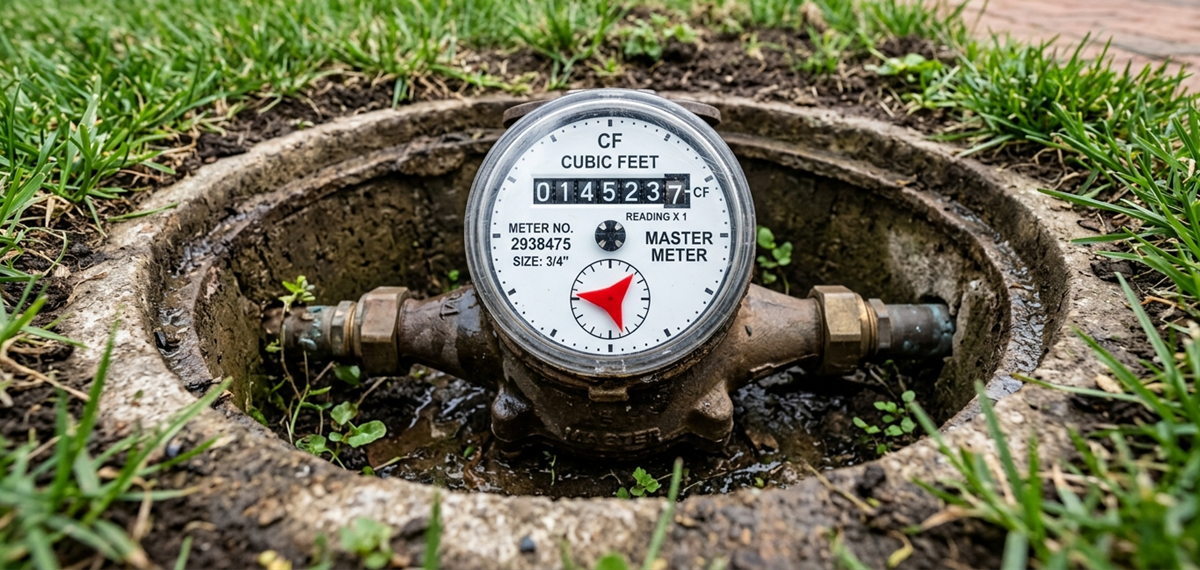
Yet, on the small 3/4-inch copper bypass loop piped in parallel around the massive 8-inch mainline valve body, the mechanical low-flow detector meter is quietly spinning.
One tenth of a gallon every forty-five seconds.
That adds up to nearly two hundred gallons a day of treated municipal drinking water vanishing into the facility’s underground dedicated fire service line.
The facility manager looks baffled.
“Is there a massive leak under the concrete slab, or is the backflow preventer broken?” he asks.
In commercial plumbing and fire protection, this condition is known as bypass meter creep.
It is one of the most deceptive diagnostic challenges a facility engineer can face.
A spinning bypass meter can signal an undetected underground fire main blowout that is silently eroding structural soil beneath the warehouse foundation.
Alternatively, it can indicate that the internal check valves inside the multi-thousand-dollar backflow assembly have suffered catastrophic disc delamination, scale fouling, or spring failure.
When an ASSE 1015 fire sprinkler backflow assembly fails, the consequences are severe: municipal water contamination, immediate fire code violation citations from the North Metro Fire Rescue District, and catastrophic loss of fire suppression flow during a structural emergency.

1. Understanding the DCDA: ASSE 1015 vs. ASSE 1048 & NFPA Standards
Commercial fire sprinkler lines represent a severe cross-connection hazard to municipal potable water supplies.
Fire sprinkler piping contains stagnant water that can sit motionless inside black iron or ductile iron mains for years.
This stagnant water turns pitch black.
It becomes heavily colonized by iron-oxidizing bacteria, anaerobic sulfur-reducing microbes, chemical corrosion inhibitors, and biological pathogens.
If a municipal main break occurs on 120th Avenue, street pressure drops instantly from 60 PSI down to zero or even negative pressure (siphonage).
Without an operational backflow prevention assembly, thousands of gallons of toxic, stagnant fire system sludge would be siphoned straight back into Broomfield’s public drinking water supply.
| Assembly Type | Industry Standard | Mechanical Configuration | Required Application |
|---|---|---|---|
| DCDA (Double Check Detector Assembly) | ASSE 1015 / AWWA C510 | Mainline double check valve (4″-12″) with a parallel bypass loop containing a small double check and low-flow meter. | Low to moderate hazard wet or dry fire sprinkler systems without chemical additives (foam/antifreeze). |
| RPDA (Reduced Pressure Detector Assembly) | ASSE 1047 / AWWA C511 | Mainline reduced pressure principle assembly with differential relief valve and parallel bypass RP assembly with meter. | High-hazard fire systems containing toxic chemicals, AFFF firefighting foam, or antifreeze loops. |
| DCDA-II (Type II Detector Assembly) | ASSE 1048 | Mainline double check valve with a bypass loop that routes around only the second mainline check valve with a single check and meter. | Modern compact fire riser retrofits requiring reduced footprint and lower hydraulic head loss. |
Under both the International Plumbing Code (IPC Section 312 / 608) and NFPA 25 (Standard for the Inspection, Testing, and Maintenance of Water-Based Fire Protection Systems), all commercial backflow assemblies must undergo certified hydrostatic differential testing at least once every 12 months.
The dual purpose of the DCDA bypass meter is straightforward:
- It detects unauthorized or illegal domestic water tie-ins tapped into the unmetered fire service line.
- It flags slow, insidious plumbing leaks in the downstream fire sprinkler piping or underground ductile iron grid before structural damage occurs.
2. Fluid Mechanics of the DCDA: Why the Bypass Meter Spins
To understand how a DCDA operates, you must examine how hydraulic pressure splits across two parallel paths.
The mainline double check assembly consists of two large spring-loaded check valves in series inside a heavy ductile iron or stainless steel casing.
Each mainline check valve is designed with a calibrated spring that requires a minimum differential pressure ($\Delta P$) to crack open:
$$\Delta P_{check1} \ge 1.0 \text{ PSID}, \quad \Delta P_{check2} \ge 1.0 \text{ PSID}$$
In practice, the mainline spring load is engineered so that the mainline check valve disc will not crack off its bronze seat until water flow exceeds roughly 1.5 to 3.0 gallons per minute (GPM).
Meanwhile, the small 3/4-inch bypass loop has check valves with slightly lighter spring tension or a lower hydraulic cracking threshold.
When a very small flow occurs downstream (between 0.05 GPM and 2.0 GPM), the differential pressure across the mainline is insufficient to crack open the heavy 8-inch clapper.
Therefore, 100 percent of that low-velocity water is routed through the bypass loop, driving the mechanical register on the detector meter.
When a fire sprinkler head opens or a fire engine connects to the Fire Department Connection (FDC), demand surges to hundreds or thousands of gallons per minute.
The large differential pressure instantly forces the heavy mainline check valves wide open, delivering unrestricted high-velocity fire suppression flow.
The Five Root Causes of Bypass Meter Creep
When our commercial emergency plumbing team is called out to investigate a creeping bypass meter in Broomfield, we perform a systematic differential isolation test to isolate the failure:
- Mainline Check Valve 1 (CK1) Disc Weep: If Check Valve 1 fails to hold a tight seal against backpressure, municipal pressure fluctuations will pump water back and forth across the assembly. As municipal street pressure rises at night, water forces past CK1; as street pressure drops during morning peak demand, water pushes backward through the bypass, spinning the meter.
- Underground Fire Main Ductile Iron Joint Blowout: An underground gasket leak or corrosion pinhole on the private fire service line downstream of the vault creates a continuous, low-volume water draw that runs non-stop 24 hours a day.
- Dry-Pipe Fire Valve Priming Water Loss: In unheated warehouses or parking structures, dry-pipe sprinkler systems hold back water using pressurized air or nitrogen. If the dry valve differential clapper weeps water into the intermediate chamber, the automatic drip valve discharges water to the drain, creating a constant low-flow makeup draw through the bypass meter.
- Thermal Expansion in Trapped Fire Risers: In facilities where fire lines pass through heated warehouse ceilings or uninsulated roof trusses exposed to intense Colorado solar radiation, water expands as temperature rises:
$$\Delta V = V_0 \cdot \beta \cdot \Delta T$$
When the warehouse cools at night, the trapped water contracts. The resulting pressure drop draws fresh water through the bypass meter to repressurize the riser.
- Bypass Check Valve Failure: Debris or mineral scale lodges under the seat of the bypass check valve itself, allowing reverse flow or erratic registration.
3. Forensic Pathology: Why Commercial Fire Backflows Fail
Unlike domestic plumbing valves that cycle daily, commercial fire sprinkler backflow assemblies sit closed for months or years at a stretch.
This lack of movement creates unique, severe failure modes that our master plumbers encounter across commercial properties:
A. EPDM Disc Delamination & Permanent Compression Set
The sealing element inside each mainline check valve consists of a heavy synthetic elastomer disc—typically EPDM or Buna-N nitrile rubber—clamped inside a stainless steel disc holder.
Under constant line pressure (70 to 120 PSI) exerted for five to ten years without cycling, the rubber undergoes compression set.
The elastomer permanently deforms, losing its elastic memory.
Worse yet, chloramines used for disinfection in Broomfield municipal water chemically degrade EPDM over time.
The chlorine-ammonia bond attacks polymer crosslinks, causing the rubber disc to swell, blister, and delaminate.
Pieces of spongy, decayed rubber peel away from the disc holder.
When flow stops, the ragged, uneven rubber face cannot seal flat against the precision-machined bronze seat ring.
High-pressure water weeps through the gaps, causing immediate failure during annual ASSE 1015 differential pressure testing.
B. Front Range Tuberculation & Mineral Scale Crust
Dissolved calcium and magnesium in Front Range municipal supplies react with the iron bodies of unlined fire valves and black steel sprinkler pipe.
The result is tuberculation: jagged, rust-colored nodules of ferric hydroxide and calcium carbonate that grow across internal valve chambers.
Tubercles form directly along the hinge pin, clapper arm bushings, and seat rings.
When an emergency flow event occurs, the clapper opens.
However, as it attempts to swing shut, the encrusted mineral nodules mechanically bind the hinge arm.
The clapper hangs partially open, allowing massive backflow into the municipal supply.
C. Microbiologically Induced Corrosion (MIC) in Stagnant Fire Mains
Because fire lines represent dead-end systems with zero flow, dissolved oxygen is quickly consumed by bacteria, creating a strict anaerobic environment.
Under these conditions, Sulfate-Reducing Bacteria (SRB) such as Desulfovibrio thrive beneath bio-slime colonies on the interior pipe walls.
These microbes utilize sulfate ions in the water to metabolize organic carbon, producing toxic hydrogen sulfide gas ($H_2S$):
$$\text{SO}_4^{2-} + 8\text{H}^+ + 8e^- \xrightarrow{\text{SRB}} \text{S}^{2-} + 4\text{H}_2\text{O}$$
The dissolved sulfide reacts with iron to form black iron sulfide ($FeS$) and sulfuric acid ($H_2SO_4$).
This acid etches deep pinhole pits through ductile iron valve walls and chews through internal stainless steel torsion springs.
When an internal torsion spring snaps from MIC embrittlement, the check valve loses its required mechanical pre-load.
It can no longer close against backpressure, failing ASSE 1015 testing immediately.
4. NFPA 25 Forward Flow Testing Mandates: What Most Contractors Miss
Many plumbing contractors simply hook up their differential test gauge, verify that Check 1 holds $\ge 1.0 \text{ PSID}$ and Check 2 holds $\ge 1.0 \text{ PSID}$, slap an inspection tag on the riser, and walk away.
That is a dangerous, incomplete test.
NFPA 25 (Standard for the Inspection, Testing, and Maintenance of Water-Based Fire Protection Systems) strictly mandates a full Forward Flow Test at least once every three years (and annually in many jurisdictions).
The code requirement is clear:
“The backflow prevention assembly shall be forward-flow tested at the minimum design flow rate of the fire sprinkler system, including hose stream allowance, to ensure full-stroke clapper movement.”
Why is this forward flow test critical?
A check valve clapper can hold static backpressure during a bench differential test while remaining completely incapable of opening fully under fire demand!
If a delaminated rubber disc swells or a corroded hinge pin binds at 15 degrees of opening, water will still not backflow under static pressure.
However, if a warehouse fire breaks out and multiple sprinkler heads fuse, that jammed clapper restricts hydraulic flow like an un-cracked gate valve.
Discharge pressure to the sprinkler grid drops below hydraulic design requirements, starving sprinkler heads of water and allowing the fire to engulf the facility.
To perform a true NFPA 25 forward flow test, our master plumbers connect high-flow monster hoses from the test header to calibrated flow nozzles, flowing hundreds or thousands of gallons per minute while measuring friction pressure drop across the assembly.
5. Real-World Commercial Case Studies Across Broomfield
Here are six real-world commercial fire backflow emergencies diagnosed and resolved by our master plumbing teams across Broomfield, Colorado:
Case Study 1: Interlocken Technology Center Underground Fire Main Blowout
Facility: A multi-building technology and data center campus in Interlocken.
The Emergency: The campus facility manager received an alert from the municipal water utility that the private 8-inch fire service line was registering continuous water flow of 4.2 GPM on the DCDA bypass meter.
Zero fire alarms or waterflow tamper switches had triggered inside the data center.
Forensic Diagnostic: We arrived with certified acoustic leak correlators and ultrasonic listening equipment.
First, we closed the downstream OS&Y control valve on the 8-inch DCDA inside the vault.
The bypass meter stopped spinning immediately.
This confirmed that the DCDA check valves were holding tight, and the leak was located in the buried 8-inch ductile iron piping between the vault and the building riser.
We deployed digital acoustic ground microphones along the buried pipe alignment.
Eighty feet east of the vault, beneath an asphalt employee parking lot, our listening instruments picked up the distinctive high-frequency hiss of a subsurface blowout.
Excavation revealed a blown mechanical restraint gland gasket on an 8-inch 45-degree ductile iron elbow.
Expanding Front Range clay soil had shifted during spring freeze-thaw cycles, exerting lateral shear stress that pulled the pipe joint apart.
Over 6,000 gallons of water per day had been carving a subterranean sinkhole beneath the asphalt.
The Solution:
- We isolated the municipal street tapping valve.
- We removed the damaged fitting and installed a heavy-duty stainless steel Megalug mechanical restraint sleeve with EPDM pressure gaskets.
- We poured a 3,000-PSI reinforced concrete thrust block to permanently brace the elbow against soil shifting.
Outcome: Bypass meter creep dropped to absolute zero. The parking lot was saved from catastrophic sinkhole collapse.
Case Study 2: Flatiron Crossing Commercial Retail Center Disc Delamination
Facility: A major anchor retail department store in Broomfield.
The Emergency: During the annual fire inspection by North Metro Fire Rescue District, the 6-inch Ames DCDA failed ASSE 1015 testing.
Check Valve 1 showed zero differential pressure hold, and water continuously discharged out of Test Cock 2 when pressurized backpressure was applied.
The facility was issued a 72-hour notice of violation, threatening mandatory fire watch closure.
Forensic Diagnostic: Our emergency crew responded within two hours.
We depressurized and unbolted the top grooved access cover of Check Valve 1.
The internal rubber disc was completely ruined.
Nine years of chloraminated municipal water exposure had caused the EPDM disc to soften into a spongy texture.
A 3-inch section of the outer sealing edge had torn completely free from the disc plate and was wedged between the clapper and the bronze seat ring, preventing closure.
The Solution:
- We extracted the torn rubber remnants and descaled the bronze seat ring using brass scouring tools.
- We installed a genuine factory Ames elastomeric rebuild kit, including a reinforced EPDM disc, stainless steel disc guide, and new heavy-duty torsion return spring.
- We rebuilt Check Valve 2 and the small bypass double check assembly proactively.
- We retested the assembly using a calibrated 5-valve differential pressure gauge: Check 1 held 4.8 PSID, and Check 2 held 3.2 PSID (well above the 1.0 PSID minimum).
Outcome: Full recertification paperwork was submitted and approved by the fire marshal within 18 hours, avoiding store closure and expensive fire watch personnel fees.
Case Study 3: Cold-Storage Logistics Distribution Dry-Pipe Surge Failures
Facility: A refrigerated food distribution facility in Broomfield.
The Emergency: The bypass meter on the 10-inch DCDA was spinning intermittently, advancing 15 to 20 gallons every time the refrigeration compressors cycled on.
Forensic Diagnostic: We audited the fire suppression riser room.
The facility utilized a dry-pipe fire sprinkler system in the -10°F freezer warehouse.
When the massive industrial refrigeration evaporators kicked on, the rapid chilling of air inside the freezer caused the nitrogen gas pressure inside the sprinkler pipes to drop rapidly according to the Ideal Gas Law:
$$P_2 = P_1 \times \left(\frac{T_2}{T_1}\right)$$
As gas pressure contracted, the differential clapper inside the dry-pipe valve shifted slightly on its seat, weeping a small amount of priming water into the intermediate chamber and discharging out the automatic drip valve.
Every time this occurred, the DCDA bypass meter spun to replenish the lost priming water.
The Solution:
- We rebuilt the differential air seat and water clapper on the dry-pipe valve.
- We installed a dedicated regenerative air-dryer package and nitrogen generator to maintain positive dry gas pressure that does not contract with temperature swings.
- We adjusted the nitrogen supervisory pressure to 40 PSI with automated fast-fill bypass regulation.
Outcome: The dry valve intermediate chamber remained bone-dry. The DCDA bypass meter ceased all uncommanded registration.
Case Study 4: Industrial Manufacturing Facility Microbiological (MIC) Spring Failure
Facility: An advanced aerospace precision machining facility in Broomfield.
The Emergency: During an insurance compliance audit, Check Valve 2 on the facility’s 6-inch fire backflow failed to re-seat after manual exercise.
When backpressure was applied, water rushed backwards through Test Cock 3 at over 20 GPM.
Forensic Diagnostic: Disassembly of Check Valve 2 revealed severe black microbial bio-slime covering all interior surfaces.
The stainless steel clapper torsion spring had suffered catastrophic stress corrosion cracking.
It was snapped into three separate pieces.
Microbiological testing confirmed high concentrations of anaerobic Sulfate-Reducing Bacteria (SRB).
The dead-end fire line had sat stagnant for seven years.
The biogenic hydrogen sulfide acid produced by the microbes had attacked the grain boundaries of the 304 stainless steel spring wire, leading to hydrogen embrittlement and mechanical snap under tension.
The Solution:
- We performed an emergency hydrostatic chemical flush of the fire riser vault piping, neutralizing the bio-slime.
- We replaced the internal components with a high-grade 316 stainless steel cam-check assembly and upgraded corrosion-resistant springs.
- We plumbed an automated periodic flush loop with an electronic timer valve to purge the fire service entrance line quarterly, preventing future stagnant water microbe growth.
Outcome: Check Valve 2 passed with 3.8 PSID hold. The facility maintained its FM Global insurance underwriting certification.
Case Study 5: Commercial Office Building Forward Flow Clapper Jam
Facility: A four-story commercial medical office building off 120th Avenue.
The Emergency: During a required NFPA 25 3-year forward flow test, the master plumbers opened three 2-1/2-inch test hose lines to achieve design flow (750 GPM).
The water pressure immediately cratered from 82 PSI down to 18 PSI, and flow maxed out at only 310 GPM.
The building’s fire sprinkler system could not satisfy its hydraulic design criteria.
Forensic Diagnostic: Static backpressure testing indicated both check valves were holding $\ge 1.0 \text{ PSID}$.
Why did pressure collapse during flow?
We removed the inspection plates on the 6-inch mainline check valves.
Inside Check Valve 1, heavy calcium scale and rust nodules had bridged the clearance between the clapper arm and the internal valve body wall.
The clapper could only swing open 20 percent of its full travel before mechanically wedging against the mineral crust.
It acted as a severe hydraulic restriction orifice.
Under peak flow, hydraulic friction consumed 64 PSI of pressure across the valve!
The Solution:
- We removed the clapper assemblies and mechanically sand-scoured and descaled the entire ductile iron interior down to bare metal.
- We recoated the internal casing with an NSF-61 certified fusion-bonded epoxy lining to prevent future mineral adhesion.
- We installed new hinge pins, bronze bushings, and disc holders.
- We re-ran the NFPA 25 forward flow test: the assembly delivered 750 GPM with only 6.2 PSI of total friction loss across the assembly.
Outcome: Hydraulic design compliance was fully restored, ensuring adequate water delivery to high-hazard medical suites during a fire emergency.
Case Study 6: Broomfield Tech Park Freeze-Damaged Bypass Meter Assembly
Facility: An R&D engineering warehouse in Broomfield.
The Emergency: Following an Arctic cold snap where ambient temperatures plummeted to -18°F, water was discovered spewing out of the outdoor backflow “hot box” insulated enclosure.
Forensic Diagnostic: The electric thermostatic heater inside the insulated aluminum hot-box had suffered a tripped circuit breaker.
While the massive 8-inch mainline backflow had enough thermal mass to resist freezing, the small 3/4-inch copper bypass loop had frozen solid.
The bronze casing of the low-flow detector meter had split wide open along its bottom casting seam.
The small bypass double check valve body was cracked, spraying 40 GPM of water into the enclosure and flooding the street gutter.
The Solution:
- We immediately shut down the bypass isolation ball valves, halting the water spray while keeping the building’s mainline fire protection fully pressurized and active.
- We piped a brand-new 3/4-inch Type K copper bypass manifold equipped with a new Neptune T-10 magnetic drive detector meter and Febco ASSE 1015 bypass double check valve.
- We replaced the failed hot-box heater with a dual-redundant heating package featuring an integrated freeze alarm thermostat tied to the building automation system (BAS).
Outcome: The fire sprinkler system remained operational throughout the repair. The facility gained remote temperature monitoring to prevent future freeze splits.

6. Step-by-Step ASSE 1015 Differential Testing Protocol
Testing an ASSE 1015 Double Check Detector Assembly requires an ASSE-certified backflow prevention assembly tester utilizing a calibrated 3-valve or 5-valve differential pressure test gauge.
Follow this precise field testing protocol:
Phase 1: Pre-Test Inspection & Bleeding
- Notify North Metro Fire Rescue District dispatch and building monitoring companies before touching any fire line valves to prevent false alarm dispatches.
- Inspect the DCDA assembly for physical damage, corrosion, or leaks. Record serial numbers, model, size, and detector meter reading.
- Open and flush Test Cocks 1, 2, 3, and 4 to purge all sediment, pipe scale, and rust from the test ports before connecting sensitive differential gauges. Close test cocks.
Phase 2: Check Valve 1 (CK1) Differential Test
- Connect the high-pressure hose of the test gauge to Test Cock 2. Connect the low-pressure hose to Test Cock 3.
- Bleed all air from the test gauge and hoses by opening the high and low bleed valves.
- Close the downstream OS&Y shutoff valve (Shutoff Valve 2) tightly.
- Observe the differential pressure gauge reading: Check Valve 1 must hold a minimum differential pressure of 1.0 PSID (typical healthy valves hold 3.0 to 5.5 PSID).
- If differential pressure drops to zero, Check Valve 1 has failed due to disc wear, seat fouling, or a broken spring.
Phase 3: Check Valve 2 (CK2) Differential Test
- Move the high-pressure hose to Test Cock 3, and move the low-pressure hose to Test Cock 4.
- Bleed air from the gauge lines.
- Close Shutoff Valve 1. Open the high bleed valve to drop pressure downstream of Check Valve 2 while holding pressure between the checks.
- Observe differential reading: Check Valve 2 must hold a minimum differential pressure of 1.0 PSID.
- A reading below 1.0 PSID indicates Check Valve 2 failure.
Phase 4: Bypass Assembly & Meter Audit
- Repeat differential testing on the small 3/4-inch or 1-inch bypass double check assembly using its dedicated miniature test cocks.
- Verify the bypass check valves hold $\ge 1.0 \text{ PSID}$.
- Observe the low-flow detector meter register with all downstream fire valves closed: the test hand / dial must remain completely motionless for a minimum of 15 minutes.
7. NFPA 25 Preventative Maintenance Schedule for Fire Backflows
Adhering to this structured maintenance schedule guarantees life-safety compliance, protects municipal drinking water, and prevents catastrophic facility flooding:
- Monthly: Visually inspect the DCDA vault or riser room. Confirm OS&Y shutoff valves are fully open and mechanically chained or monitored with supervisory tamper switches. Record the bypass detector meter register reading to identify creeping underground leaks before they surface. Check freeze protection heaters in outdoor hot-box enclosures.
- Quarterly: Exercise all OS&Y control valves through their full stroke to prevent stem calcification. Inspect the vault floor for groundwater infiltration; verify the sump pump is operational.
- Annually (Mandatory): Certified ASSE 1015 differential pressure field testing by a licensed master plumber. Submit signed inspection test reports to the local water purveyor and North Metro Fire Rescue District. Flush all test cocks and inspect bypass strainers.
- Every 3 to 5 Years: Perform full NFPA 25 forward flow testing at design demand flow rate. Disassemble both mainline check valves: replace all elastomeric rubber discs, inspect bronze seat rings for wire-drawing grooves, and replace internal torsion springs. Rebuild the bypass double check assembly and test the bypass water meter calibration.
Need Emergency Commercial Fire Sprinkler Backflow Testing or Repair in Broomfield?
Has your commercial fire sprinkler backflow failed its annual ASSE 1015 differential test? Is your DCDA bypass meter creeping continuously, or has an underground fire service main blown out beneath your parking lot?
Call Broomfield’s commercial backflow emergency specialists at (303) 647-3363. Our ASSE-certified master plumbers carry factory rebuild kits for Ames, Wilkins, Febco, and Watts DCDA assemblies, digital acoustic underground leak correlators, and heavy-duty excavation equipment to restore your life-safety compliance 24 hours a day, 7 days a week.