
Table of Contents: Basement Floor Drain Diagnostic Guide
- 1. Executive Summary: The Anatomy of a Basement Floor Drain Failure
- 2. Sub-Slab Hydraulic Physics: The Lowest Gravity Relief Point
- 3. Comprehensive Diagnostic Matrix: Waste Type, Timing & Origins
- 4. The 5 Major Root Causes of Basement Floor Drain Overflows
- 5. Sump Pump Cross-Connections & Groundwater Flooding Hazards
- 6. Step-by-Step Immediate Homeowner Containment Protocol
- 7. Critical Warnings: What NEVER to Do During a Floor Drain Backup
- 8. How Master Plumbers Clear and Remediate Basement Floor Drains
- 9. Permanent Protection: Backwater Prevention Valves & Sump Systems
- 10. Colorado Front Range Submarket Profile: Saturated Bentonite & Slabs
- 11. Transparent Pricing & Restoration Cost Factors Deep-Dive
- 12. Comprehensive Extended FAQ Section (12 Detailed Questions)
- 13. 24/7 Emergency Basement Drain Dispatch Action Plan
1. Executive Summary: The Anatomy of a Basement Floor Drain Failure
Walking down your basement stairs and hearing the sloshing sound of standing water or catching the pungent, sulfurous odor of raw human sewage is a homeowner’s absolute worst nightmare. At the lowest elevation of your foundation slab—typically positioned in the mechanical utility room near the furnace and hot water heater, or adjacent to a basement laundry station—sits a cast iron or PVC floor drain with a slotted metal grate. Under normal operating conditions, that drain serves as a passive safety valve, quietly receiving innocuous condensate from your air conditioner, high-efficiency furnace, or water heater temperature-and-pressure relief valve.
However, when murky, particulate-laden water, laundry detergent suds, or foul blackwater begins bubbling violently upward through that metal floor strainer and spreading across your concrete slab, your home is experiencing a critical sanitary failure. A basement floor drain backup is never an isolated localized clog. It is the definitive physical symptom that your main sewer lateral, building sub-slab drain, or municipal collector main has suffered a complete hydraulic blockage downstream.
Because the floor drain represents the lowest physical opening connected to your home’s drainage network, gravity dictates that every gallon of water discharged from upper-level fixtures—whether from an upstairs toilet flush, a 20-minute shower, a dishwasher wash cycle, or a washing machine rinse—cannot exit the foundation footprint. Instead, that wastewater fills the vertical plumbing stack and erupts directly into your finished or unfinished basement. Left unaddressed for even a few hours, Category 3 blackwater saturates structural framing, ruins drywall, destroys personal storage, and exposes occupants to severe biological contamination.
For homeowners across the Colorado Front Range—including Broomfield, Westminster, Thornton, Louisville, Superior, and Arvada—basement floor drain failures carry unique regional risks. Sub-surface expansive bentonite clay soils swell violently when saturated with wastewater, heaving concrete basement slabs and cracking structural foundation walls. Understanding the hydraulic physics of sub-slab drainage, taking immediate protective action, and deploying professional diagnostic solutions is critical to protecting your home and family.
2. Sub-Slab Hydraulic Physics: The Lowest Gravity Relief Point
To comprehend why wastewater always surfaces at the basement floor drain rather than an upstairs sink or main-floor toilet, one must analyze the hydraulic gradient of residential Drain-Waste-Vent (DWV) engineering.

Residential plumbing operates on gravity. Horizontal drainage branches must maintain a continuous downward slope—typically 1/4-inch per foot—leading toward the primary vertical soil stacks. These vertical stacks convey waste downward through the structure, penetrating through the foundation slab and connecting to the horizontal building drain buried beneath the concrete floor.
The basement floor drain is tied directly into this under-slab building drain, protected only by a water-filled P-trap located 6 to 12 inches below the concrete slab surface. The top of the floor drain strainer sits flush with the lowest finished concrete grade. Now, consider the fluid physics of hydrostatic head pressure:
When an obstruction (such as tree root infiltration, a grease dam, or a collapsed clay pipe collar) blocks the 4-inch sewer lateral outside your foundation wall, forward wastewater flow stops. As fixtures on the upper levels of the home are used, liquid accumulates inside the vertical soil stack. Water has a physical density of approximately 8.34 pounds per gallon, generating 0.433 PSI of downward hydrostatic pressure for every vertical foot of elevation head.
Because water is an incompressible fluid, the accumulating column of water pushes outward in all directions seeking atmospheric pressure equilibrium. It cannot escape through an upstairs toilet bowl located 10 to 18 feet above the slab; the hydrostatic head pressure forces the wastewater to exit through the lowest open atmospheric orifice on the entire piping network: the basement floor drain. Continuing to use water upstairs simply pumps gallons of sewage directly onto your basement floor.
3. Comprehensive Diagnostic Matrix: Waste Type, Timing & Origins
The visual characteristics, timing, and physical composition of the liquid emerging from your basement floor drain reveal the exact mechanical failure mode within your plumbing infrastructure:
| Emerging Waste Appearance | Timing of Overflow | Triggering Activity | Primary Mechanical Failure | Urgency & Containment Action |
|---|---|---|---|---|
| White Suds & Murky Greywater | During laundry spin-out or dishwasher pump cycle | High-volume appliance discharge (15 – 20 GPM) | Partial main sewer lateral restriction (grease or roots) | High; power down appliance; snake or hydro jet 4-inch lateral. |
| Dark Blackwater with Solids & Tissue | Immediately after flushing any toilet in home | Toilet flush volume (1.6 to 3.5 gallons) | Complete main sewer lateral blockage or pipe collapse | CRITICAL BIOHAZARD EMERGENCY; cease all water use; dispatch emergency crew. |
| Clear or Slightly Sandy Groundwater | During heavy Colorado spring rain or rapid snowmelt | Zero indoor water being run in the house | Rising hydrostatic water table or failing foundation perimeter drain | High; inspect sump pump operation; check exterior foundation grading. |
| Steady Slow Trickle / Wet Concrete Ring | Continuous, 24 hours a day without stopping | All household fixtures completely idle | Leaking water heater T&P valve, furnace condensate line, or municipal surcharge | Moderate; check HVAC condensate pump and water heater pressure relief valve. |
| Violent Surge of Sewage (No Indoor Use) | Sudden eruption during intense municipal storm event | Neighbors reporting simultaneous basement flooding | Municipal city street sewer main surcharge | CRITICAL EMERGENCY; contact city public works dispatch; close backwater valve. |
4. The 5 Major Root Causes of Basement Floor Drain Overflows
Understanding what physically triggers a floor drain failure enables homeowners to choose permanent engineering repairs rather than repeated temporary snaking:

- Tree Root Infiltration in Older Lateral Piping: In established Front Range communities (such as Westminster, older Broomfield neighborhoods, and Thornton), sewer laterals installed prior to the mid-1980s consist of vitrified clay or unlined cast iron. Mature cottonwood, maple, and willow roots sense the subterranean moisture vapor escaping through joint seams, penetrate the mortar collars, and expand into impenetrable biological nets that trap toilet tissue, wipes, and grease.
- Congealed Fats, Oils, and Grease (FOG): Culinary greases poured down kitchen sinks cool as they travel through unheated under-slab piping. The grease solidifies along the bottom and crown of the 4-inch pipe, forming a rock-hard waxy constriction that prevents high-velocity appliance wastewater from passing.
- Expansive Soil Settlement & Pipe Bellies (Sags): Active bentonite clay soils throughout the Denver Metro expand when wet and contract when dry. Over decades, this soil movement causes buried sewer pipes to lose their mandatory gravitational downward slope, forming low dips (bellies). Water, toilet tissue, and heavy solids settle in the belly, forming recurring dams that force effluent back into basement floor drains.
- Municipal Street Main Surcharge: During severe summer cloudbursts or flash flooding along the Front Range, stormwater runoff can infiltrate aging municipal sanitary sewer mains through manhole covers and cracked pipes (Inflow & Infiltration). When the city main fills beyond capacity, sewage flows backward under pressure through private sewer laterals, exploding out of basement floor drains.
- Unflushable Synthetic Wipes (Fatbergs): Despite misleading “flushable” packaging, synthetic wipes are manufactured from woven plastic and polyester fibers that do not break down in water. They catch on minor pipe scale, rust nodules, or root tendrils, accumulating into dense, solid masses that completely seal 4-inch lateral pipes.
5. Sump Pump Cross-Connections & Groundwater Flooding Hazards
Many Colorado basements feature two distinct drainage systems: the **sanitary drainage system** (which conveys human waste and fixture drainage to the city sewer) and the **groundwater perimeter drain system** (perforated French drain tiles around foundation footings that channel subterranean groundwater into a sump pit).
Under municipal plumbing codes across Broomfield, Westminster, and Thornton, **it is illegal to discharge sump pump groundwater into your home’s sanitary floor drain**. Sump pump water must be pumped outside away from the foundation footprint. In homes where an unlicensed handyman or previous owner illegally routed a sump pump discharge hose into the basement floor drain, severe flooding occurs during wet spring snowmelts. The high-volume groundwater pump overwhelms the 4-inch sanitary building drain, forcing water and trapped sewer sediment back up through the floor drain and across the basement slab.
6. Step-by-Step Immediate Homeowner Containment Protocol
The moment you observe wastewater rising from your basement floor drain, execute these four immediate containment phases to protect your home and prevent biological contamination:

- Phase 1: Implement an Absolute Domestic Water Freeze: Instantly inform every occupant in the home that all water consumption must cease immediately. Prohibit toilet flushing, showering, running vanity faucets, or operating garbage disposals. If a dishwasher or clothes washing machine is running, pause or power off the machine immediately. Every gallon of water used upstairs will emerge directly through the basement floor drain.
- Phase 2: Shut Off the Main Water Supply: Locate your home’s primary domestic water shutoff valve (typically located on the front basement wall near the water meter and pressure reducing valve). Rotate a quarter-turn ball valve lever 90 degrees perpendicular to the pipe, or turn a round gate valve wheel clockwise until seated firmly. This guarantees zero additional water can enter your plumbing network.
- Phase 3: Secure Electrical and Mechanical Equipment: If standing water has reached furnace electrical wiring, water heater controls, extension cords, or floor outlets, **never step into the standing water**. Electrocution can occur through contaminated water. Switch off the dedicated circuit breakers supplying the basement at your electrical panel. Simultaneously, shut down your central HVAC heating and cooling system at the thermostat to prevent air blowers from circulating toxic airborne bioaerosols and hydrogen sulfide gas throughout upper living spaces.
- Phase 4: Isolate Room Boundaries & Evacuate Vulnerable Occupants: Place heavy utility towels or absorbent barriers along the thresholds of finished basement rooms to prevent contaminated water from spreading to carpeted areas. Evacuate children, elderly family members, and pets from the basement level to eliminate pathogen exposure.
7. Critical Warnings: What NEVER to Do During a Floor Drain Backup
When sewage backs up through a basement floor drain, homeowners frequently make well-intentioned mistakes that escalate property damage and create severe health risks:
- Never Pour Chemical Drain Cleaners Down an Overflowing Floor Drain: Chemical drain cleaners contain concentrated sulfuric acid or caustic sodium hydroxide (lye). Because the blockage is located 40 to 80 feet away in your exterior yard sewer lateral, the chemicals will merely sit in the standing water pooling on your basement slab. This creates an acidic, toxic reservoir that burns skin and eyes, melts shoe soles, and creates hazardous chemical splashback when a licensed plumber operates mechanical clearing cables.
- Never Attempt to Plug or Seal the Floor Drain Grate: Homeowners often grab heavy sandbags, rubber stoppers, or bricks to “seal” the floor drain. Because the pipe is backed up with vertical head pressure, blocking the floor drain merely forces the sewage to rise to the next lowest open fixture—typically overflowing your basement shower stall, bathtub, or lower-level toilet bowl.
- Never Use a Consumer Shop Vacuum on Sewage: Standard household wet/dry vacuums lack sealed HEPA filtration systems. Vacuuming raw blackwater aerosolizes pathogenic bacteria (E. coli, Salmonella) and fungal spores directly into the basement air, creating dangerous respiratory biohazards.
8. How Master Plumbers Clear and Remediate Basement Floor Drains
When our licensed emergency plumbing specialists arrive to resolve a basement floor drain backup, they follow a methodical diagnostic and restoration protocol:

First, the technician accesses the main sewer line via an exterior yard cleanout riser. Working from the outside eliminates the risk of tracking sewage through your living areas. If no exterior cleanout exists, the technician accesses the line through an unfinished basement cleanout plug or by safely removing a basement toilet using sealed containment trays.
Second, a high-torque mechanical drum machine loaded with heavy 3/4-inch steel inner-core cable is deployed, boring an initial relief cut through the obstruction. Once standing water recedes, the technician transitions to **Commercial High-Pressure Hydro Jetting**. Delivering 4,000 PSI at 15 gallons per minute, the rotary water nozzles scour 100% of grease sludge, tree roots, and scale from the 4-inch pipe walls, flushing all debris out to the municipal street main.
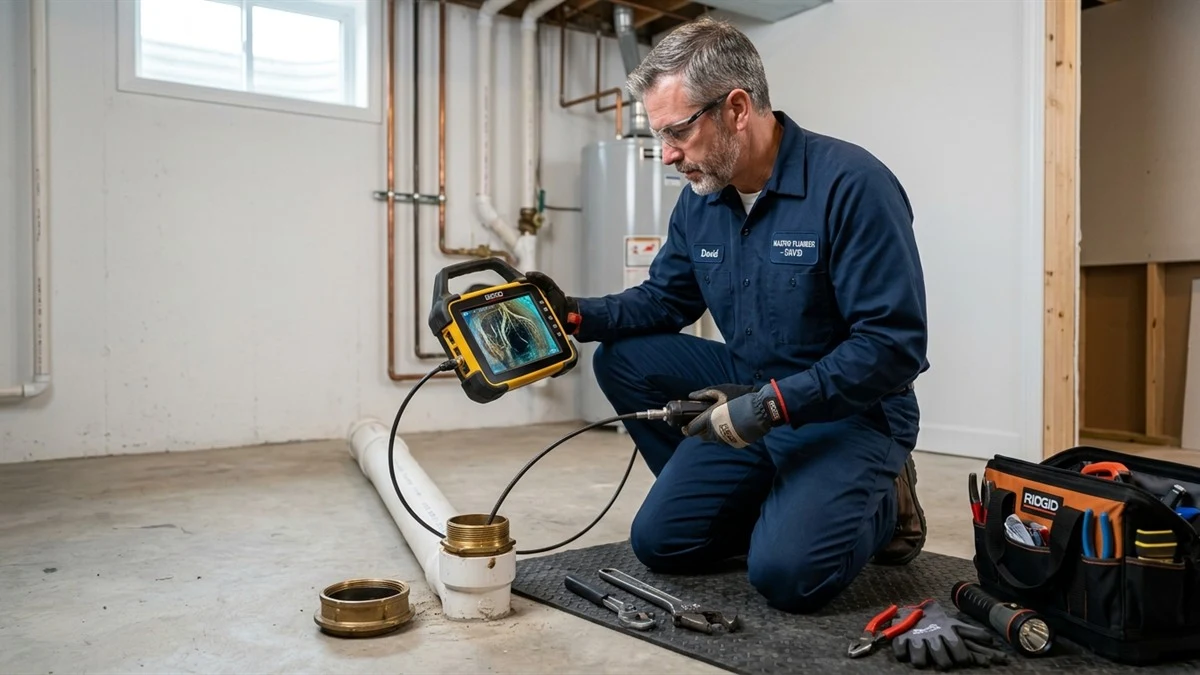
Third, a self-leveling fiber-optic color sewer camera equipped with an onboard 512 Hz radio transmitter sonde traverses the entire lateral run. The camera documents the structural integrity of the pipe, verifying that no fractures, offsets, or severe bellies remain, providing digital proof of permanent resolution.
9. Permanent Protection: Backwater Prevention Valves & Sump Systems
For homeowners who have experienced a basement backup, installing permanent mechanical protection is the gold standard for peace of mind:

A **Mainline Backwater Prevention Valve** is an engineered check valve installed on your main 4-inch sewer line just before it exits the foundation wall. The valve contains an internal balanced flapper that allows household wastewater to flow outward freely into the city main. However, if the municipal street main surcharges or if downstream water begins pushing backward toward your house, the flapper swings shut automatically, creating an impenetrable mechanical barrier that blocks municipal sewage from ever entering your basement floor drain.
10. Colorado Front Range Submarket Profile: Saturated Bentonite & Slabs
Basement drainage behavior across the northern Denver metropolitan area is directly influenced by regional soil geology and municipal infrastructure vintage:
- Broomfield (Anthem, Broadlands, Country Vista): High concentrations of active bentonite clay soil mean that any wastewater weeping beneath an under-slab floor drain saturates native sub-base soils. Expansive bentonite swells dramatically, exerting upward swelling pressures exceeding 10,000 lbs/sq ft that heave basement concrete slabs and crack foundation walls.
- Westminster (Shaw Heights, Trendwood): 1960s subdivisions feature aging vitrified clay sewer laterals running beneath mature tree canopies. Spring root growth aggressively penetrates mortar joints, causing seasonal basement floor drain backups during April and May snowmelt periods.
- Thornton & Northglenn (Grange Creek, Woodglen): Older under-slab cast iron building drains have suffered decades of internal rust tuberculation, creating jagged snags that catch toilet paper and cause recurring laundry floor drain backups. High-pressure descaling restores smooth internal flow.
11. Transparent Pricing & Restoration Cost Factors Deep-Dive
Below is a transparent breakdown of baseline industry investments for basement floor drain restoration across the Colorado Front Range:
- Emergency Drain Cabling / Initial Relief Snaking: $350 – $650 (Includes heavy-duty 3/4-inch cable snaking up to 100 feet to restore drainage flow).
- Commercial High-Pressure Hydro Jetting: $650 – $1,400 (Includes pre- and post-cleaning high-definition camera surveys, complete 360-degree wall scouring, and root shearing).
- High-Definition Fiber-Optic Sewer Camera Survey: $250 – $450 (Includes narrated video recording and electronic radio surface depth locating).
- Mainline Backwater Prevention Valve Installation: $1,800 – $3,500 (Includes concrete slab excavation, installing code-compliant cleanout access, backwater valve body, and concrete patching).
- Trenchless CIPP Epoxy Sewer Relining: $140 – $225 per linear foot (Creates a seamless, jointless, root-proof pipe-within-a-pipe backed by a 50-year warranty).
11. Trap Primer Engineering & Evaporation Protection Standards (IPC Section 1002)
Under the International Plumbing Code (IPC Section 1002.4), every residential basement floor drain must be protected by an approved P-trap with a minimum 2-inch liquid water seal to block toxic sewer gases from entering indoor living environments. However, in Colorado’s arid, semi-arid high-altitude climate, average indoor relative humidity often hovers below 20 percent during winter heating months. Under these dry atmospheric conditions, a standard 2-inch water seal inside an unused basement floor drain will evaporate completely within 30 to 45 days.
To prevent chronic trap seal evaporation, modern residential plumbing engineering specifies three distinct trap priming technologies:
- Continuous Pressure-Drop Mechanical Trap Primers: Installed inline on a frequently used cold water branch line (such as a nearby laundry sink or lavatory). Every time the cold water faucet is turned on, the momentary drop in line pressure activates an internal brass diaphragm that meters a tiny squirt of fresh water (approx. 2 ounces) through a 3/8-inch copper or polyethylene tube directly into the floor drain trap, keeping the water barrier permanently topped off.
- Flush-Device Trap Primers: Connected to an adjacent toilet flush valve, routing a small percentage of tank refill water directly to the basement trap with every toilet flush.
- Mechanical Silicone Barrier Trap Seals (Waterless Trap Inserts): A modern code-approved elastomeric one-way silicone duckbill valve inserted directly into the 2-inch or 3-inch floor drain throat. The flexible silicone membrane allows downward drainage to pass freely under gravity, but snaps tightly shut the moment water stops flowing. This mechanical seal blocks 100% of sewer gas evaporation and acts as a secondary mechanical barrier against mild drain backpressure.
12. Soil Mechanics: Sub-Slab Wastewater Saturation & Bentonite Foundation Heaving
In Colorado’s Front Range, a basement floor drain backup represents a far more severe structural threat than in non-expansive geological regions. The underlying soil formation across Broomfield, Westminster, and Thornton contains dense strata of Upper Cretaceous Pierre Shale and active bentonite clay.
Bentonite clay exhibits hyper-expansive properties due to its high concentration of sodium montmorillonite. In an unsaturated state beneath a basement foundation, bentonite remains stable. However, when a chronic or severe sewer backup floods a basement slab, wastewater penetrates through perimeter expansion joints, control relief saw-cuts, and the unsealed gravel bedding surrounding the floor drain body. Once wastewater contacts the sub-slab bentonite clay, the crystalline lattice absorbs water molecules, expanding up to 15 to 20 times its dry volume.
This volumetric soil expansion generates upward swelling pressures exceeding 10,000 to 15,000 pounds per square foot (PSF)—far exceeding the dead load weight of a 4-inch concrete residential slab (approx. 50 PSF). The result is catastrophic structural “slab heaving”: the basement floor buckles upward, interior support columns are pushed into ceiling framing, basement partition walls tilt, and exterior foundation stem walls develop severe diagonal shear fractures. Rapid professional water extraction and moisture mitigation are therefore mandatory to prevent permanent structural foundation destabilization.
13. Certified Biohazard Decontamination: IICRC S500 Drying & Sanitization Standards
Once a master plumbing specialist clears the main sewer restriction and wastewater drains from the basement slab, the critical phase of biohazard decontamination begins. Because sewage backups are classified as Category 3 Black Water, standard mop-and-bleach cleaning is entirely inadequate to eliminate biological health risks.
Under the Institute of Inspection, Cleaning and Restoration Certification (IICRC Standard S500), professional remediation follows strict forensic decontamination protocols:
- Bulk Extraction and Controlled Containment: High-volume commercial truck-mounted extraction units remove standing liquid and particulate matter. The affected area is sealed with negative air machines and industrial HEPA air scrubbers (capturing particles down to 0.3 microns) to prevent airborne bacterial pathogens from migrating upstairs into family living areas.
- Controlled Removal of Contaminated Porous Materials: Porous materials saturated with Category 3 blackwater—including carpet, carpet padding, baseboards, and drywall—cannot be effectively disinfected. Technicians execute a precision “flood cut,” removing drywall 12 to 24 inches above the highest water crest line to expose wet framing studs.
- Application of EPA-Registered Botanical Antimicrobial Agents: Structural framing and concrete slab surfaces are thoroughly scrubbed with EPA-registered broad-spectrum botanical antimicrobial disinfectants (such as Benefect Decon 30) that kill 99.99% of bacteria, viruses, and fungal spores without leaving toxic synthetic chemical residues.
- Industrial Dehumidification and Thermal Psychrometry: Commercial low-grain refrigerant (LGR) dehumidifiers and high-velocity centrifugal air movers are placed to lower relative indoor humidity below 45 percent, drawing deep structural moisture out of framing lumber and preventing toxic mold colonization within the critical 48-hour window.
12. Comprehensive Extended FAQ Section
Q1: Why does water back up into my basement floor drain when I do laundry?
Modern washing machines pump out 15 to 20 gallons of water per minute during high-speed discharge cycles. This heavy surge of water fills the diameter of your drainage pipe. If your 4-inch sewer lateral has a partial restriction downstream (caused by grease, roots, or a settled belly), the pipe cannot evacuate the volume quickly enough, forcing soapy water back up through the lowest opening—your basement floor drain.
Q2: What is Category 3 Black Water, and why is it dangerous?
Category 3 Black Water is sewage that contains gross biological and pathogenic contamination, including live E. coli, Salmonella, hepatitis A viruses, noroviruses, and parasitic protozoa. Contact with blackwater poses severe health hazards, and contaminated porous materials (drywall, carpet padding) must be safely removed and disposed of.
Q3: Will homeowner’s insurance cover a basement sewer backup?
Standard homeowner’s insurance policies generally exclude sewer backups unless you have added an optional **Water and Sewer Backup Endorsement (Rider)**. This affordable rider typically provides $10,000 to $25,000 in dedicated coverage for emergency extraction, structural drying, and drywall replacement.
Q4: Can I install a manual plug or cap on my basement floor drain?
We strongly advise against permanently plugging a floor drain. An open floor drain is required by building code to receive discharge from high-efficiency furnaces, water heater safety relief valves, and air conditioning condensate pumps. Furthermore, plugging the floor drain merely forces backed-up sewage to rise into basement showers, bathtubs, or lower-level toilets.
Q5: How does a backwater prevention valve protect my basement?
A backwater valve is installed directly on your main sewer lateral. It contains an internal balanced flapper that allows home wastewater to drain outward into the city main, but swings shut automatically if municipal sewage begins pushing backward, creating an impenetrable barrier that keeps sewage out of your basement.
Q6: Why does my basement floor drain smell like rotten eggs when it is dry?
Your floor drain contains an internal P-trap designed to hold standing water that blocks sewer gas from entering your home. If the floor drain is rarely used, dry Colorado air causes the water seal to evaporate completely. Pouring one gallon of clean tap water down the drain restores the liquid barrier and immediately eliminates the rotten egg odor.
Q7: Can tree roots enter a sewer pipe under a concrete slab?
While roots rarely grow under solid concrete foundations, they aggressively invade exterior clay pipe joints just outside the foundation wall. The resulting clog forms downstream, forcing wastewater backward into the under-slab building drain and up through your basement floor drain.
Q8: How can I tell if the city main is backing up instead of my private line?
If sewage continues rising in your basement floor drain while zero water is being used anywhere in your home, or if multiple neighbors on your street report simultaneous basement flooding, the municipal street sewer main is surcharging. Contact your city public works dispatch immediately and shut off your main water valve.
Q9: What is the difference between a floor drain and a sump pit?
A floor drain connects to your home’s sanitary sewer system to carry indoor wastewater to the municipal treatment plant. A sump pit collects exterior groundwater and rainwater runoff from foundation perimeter drain tiles and pumps it outside onto your lawn away from the home.
Q10: Can hydro jetting permanently clear a backed-up basement drain?
Yes. Commercial hydro jetting operating at 4,000 PSI scours the entire 360-degree inner circumference of the pipe, completely emulsifying grease dams and shearing tree roots flush with pipe collars, delivering long-term trouble-free drainage.
Q11: How quickly does mold develop after a sewage floor drain backup?
Toxic mold species (such as Aspergillus and Stachybotrys) can begin colonizing damp drywall, baseboards, and carpet padding within **24 to 48 hours** of sewage exposure. Immediate professional extraction and antimicrobial sanitization are essential.
Q12: Is a floor drain backup covered under city utility programs?
Most Colorado municipal utility charters state that the property owner is responsible for the entire sewer lateral from the house to the city tap. However, if the city confirms that a public street main blockage caused the backup, you can file a municipal liability claim for reimbursement of restoration costs.
13. 24/7 Emergency Basement Drain Dispatch Action Plan
Is Your Basement Floor Drain Backing Up Right Now?
Stop Category 3 blackwater contamination and structural slab damage immediately. Our master emergency drain diagnostic specialists are on call 24/7/365 across Broomfield, Westminster, Thornton, and Denver Metro with fully equipped commercial hydro jetting and cabling rigs.