
Beneath the finished terrazzo and polished concrete floors of commercial medical centers, high-rise office towers, and historic hospitality venues across Broomfield, Colorado, sixty-year-old cast iron sanitary drain stacks are slowly suffocating. Water from third-floor restrooms drains with agonizing slowness. Gurgling noises echo through pipe chases. Down in the basement, commercial sewer backups occur with predictable, frustrating regularity.
A building maintenance tech runs a traditional drain snake down the line.
The snake punches a tiny hole, pulls back black grease, and within three days the drain clogs again.
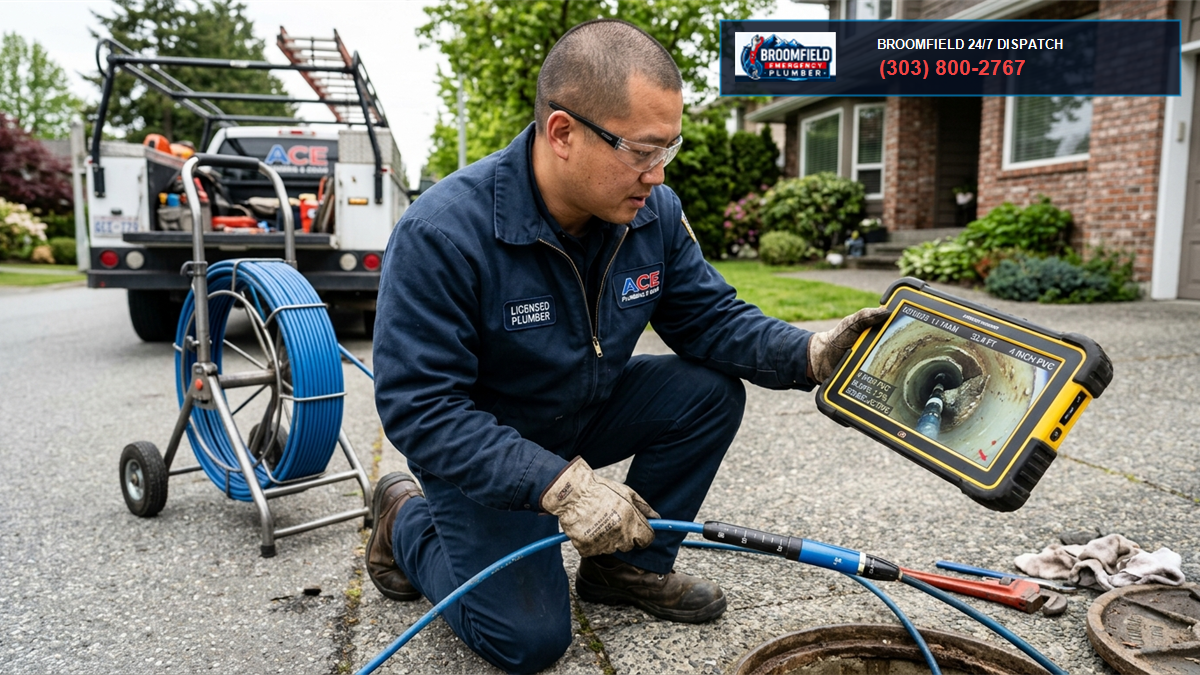
When an emergency CCTV camera crawler crawls into the four-inch building drain, the monitor displays a shocking sight.
The interior of the pipe does not look like smooth metal.
It resembles the jagged, jagged walls of an ancient cavern choked with razor-sharp stalactites.
The pipe is suffering from advanced **iron oxide tuberculation and graphitic scale encrustation**.
Decades of biochemical reactions between sewer gases, fatty food grease, harsh sanitary cleansers, and hard Front Range municipal water have converted the structural pipe walls into mounds of jagged iron oxide.
An original four-inch pipe is constricted down to a jagged two-inch opening. Toilet paper, sanitary wipes, and solid food debris snag on the rough nodules like Velcro.
Property managers often panic, fearing they must jackhammer hundreds of feet of commercial post-tensioned concrete slabs to replace the pipes—costing hundreds of thousands of dollars in lost tenant revenue and structural disruption.
Trenchless technology offers an alternative: **High-Speed Mechanical Chain Flail Descaling** paired with **Cured-In-Place Pipe (CIPP) Epoxy Lining**.
However, if an inexperienced trenchless contractor rushes the prep work, skips descaling, or miscalculates resin curing thermodynamics, a catastrophic **CIPP liner delamination or inversion collapse** occurs.
Let’s dissect the metallurgy of cast iron tuberculation, analyze mechanical chain milling dynamics, examine ASTM F1216 CIPP structural liner thickness equations, troubleshoot trenchless delamination failures, and detail master plumber rehabilitation protocols across the Colorado Front Range.
1. The Metallurgy of Cast Iron Soil Pipe: Why Old Stacks Tuberculate
Why does vintage cast iron build up massive mounds of internal rust while modern plastic pipes remain slick and clean?
Cast iron soil pipe (manufactured under **ASTM A74 and ASTM A888**) is an iron-carbon alloy containing approximately **3.0% to 3.8% carbon by weight**.
In gray cast iron (the predominant material installed in commercial buildings prior to the 1980s), this carbon exists as microscopic **graphite flakes** interconnected within an iron ferrite matrix.
The Electrochemical Cycle of Tuberculation
Tuberculation is not simple surface rusting. It is an active electrochemical and microbiological corrosion process:
- Galvanic Potential Differences: Within the cast iron micro-structure, microscopic graphite flakes act as noble cathodes, while the surrounding pure iron acts as an active anode. In the presence of moisture and dissolved salts, microscopic galvanic cells form across every square millimeter of the pipe wall.
- Anodic Iron Dissolution: Metallic iron oxidizes into ferrous ions ($Fe^{2+}$):
$$Fe \rightarrow Fe^{2+} + 2e^-$$
- Biochemical Oxidation via Iron-Related Bacteria (IRB): Bacteria naturally present in commercial wastewater (such as Gallionella and Sphaerotilus) utilize dissolved oxygen and ferrous iron for metabolic energy, precipitating insoluble ferric hydroxide ($Fe(OH)_3$) and magnetite ($Fe_3O_4$).
- Nodule Mound Formation: Over decades, these mineralized crusts grow outward from the pipe walls into hard, jagged mounds called **tubercles**. Beneath the protective mineral tubercle cap, anaerobic bacteria thrive, accelerating localized pitting corrosion beneath the nodule.
| Age of Cast Iron Pipe | Average Internal Diameter (4″ Pipe) | Manning Roughness ($n$) | Effective Hydraulic Capacity | Primary Failure Mechanism |
|---|---|---|---|---|
| New (0 – 10 Years) | 4.00 inches (100% ID) | 0.013 | 100% Design Flow | None (Smooth bituminous coating intact). |
| Moderate (20 – 35 Years) | 3.25 inches (81% ID) | 0.022 | 62% Flow Capacity | Minor paper snags; slow drainage during peak fixture loads. |
| Severe (40 – 60+ Years) | 1.75 – 2.25 inches (45% ID) | 0.038 – 0.045 | 22% Flow Capacity | Chronic recurring clogs; channel rot on pipe invert. |
Notice the devastating collapse in carrying capacity.
A 50-year-old cast iron stack has lost almost **80% of its hydraulic capacity**.
No chemical drain cleaner or high-pressure water jetter alone can dissolve solid iron oxide stone. High-pressure water simply glides over rock-hard tubercles.
Restoring full pipe diameter requires aggressive mechanical milling.
2. The Physics of Mechanical Chain Milling: Restoring 100% Pipe Bore
How do our master plumbers shave decades of rock-hard rust off the inside of brittle cast iron without cracking the pipe?
We deploy **High-Speed Flexible-Shaft Mechanical Chain Knockers (Picote / Ridgid / IMS Robotics)**.
A flexible-shaft milling machine uses a high-tensile steel wire-wound core sheathed in a heavy polymer casing, powered by a high-torque variable-speed motor spinning between **1,500 and 2,500 RPM**.
Centrifugal Force and Chain Dynamics
At the cutting tip of the shaft, we mount specialized **circular chain knockers** equipped with brazed tungsten carbide cutting pads.
As the shaft accelerates to 2,000 RPM, centrifugal force ($F_c$) flings the chain links radially outward against the inner circumference of the pipe:
Where:
- $F_c$ = Radial centrifugal impact force ($lbf$)
- $m$ = Mass of the carbide-tipped chain links
- $r$ = Radial distance from shaft centerline to pipe wall ($ft$)
- $\omega$ = Angular rotational velocity ($rad/s$, where $\omega = \frac{2\pi \cdot \text{RPM}}{60}$)
Because centrifugal force scales with the **square of rotational speed ($\omega^2$)**, operating at 2,000 RPM generates immense kinetic energy.
The carbide teeth strike the brittle iron oxide nodules thousands of times per minute. The brittle crystalline rust fractures and pulverizes into fine sand.
Crucially, the spinning chain automatically centers itself within the round geometry of the pipe.
Because ductile gray cast iron is significantly harder and more resilient than the brittle rust nodules, the carbide chains pulverize the tubercles down to bare, silver metal without cutting through the host pipe wall.
Simultaneously, a low-pressure water flush washes pulverized rust slurry downstream, leaving the pipe interior completely round and ready for epoxy relining.
3. CIPP Trenchless Technology: The Physics of Cured-In-Place Pipe Inversion
Once the cast iron pipe is milled smooth, how do you prevent rust from immediately returning?
You install a structural **Cured-In-Place Pipe (CIPP) Liner**.
CIPP (governed by **ASTM F1216**) is a trenchless pipeline rehabilitation method that creates a brand new, jointless “pipe within a pipe” without digging up concrete slabs, walls, or parking lots.
The CIPP Inversion Sequence
- Fabric Tube Saturation (The Wet-Out): A seamless, needle-punched non-woven polyester felt tube coated with an impermeable polyurethane outer membrane is vacuum-impregnated with a thermosetting epoxy or vinyl ester resin. The two-part resin is mixed to exact stoichiometric ratios to guarantee complete molecular cross-linking.
- Pneumatic or Hydrostatic Inversion: The saturated liner is loaded into an inversion drum launcher. Compressed air or a column of water turns the flexible tube inside-out as it shoots through the host pipe. Inverting the tube places the resin-soaked felt directly against the host cast iron wall, while the smooth polyurethane coating becomes the new inner flow channel.
- Thermosetting Exothermic Cure: The liner is inflated against the pipe walls at 10 to 18 PSI of continuous air pressure. Hot water (160°F / 71°C) or pressurized steam is circulated through the bladder, triggering the chemical polymerization reaction. The liquid resin hardens into an ultra-dense, structural composite pipe with a **50-to-100-year design life**.
4. Structural Liner Engineering: ASTM F1216 Thickness Design Formulas
How thick must an epoxy liner be to support soil and wheel loads if the original cast iron pipe completely rots away?
Plumbing and civil codes require CIPP liners to be designed as **Fully Deteriorated Gravity Pipes** under **ASTM F1216 Appendix X1**.
Under this standard, the liner cannot rely on the host pipe for any structural strength. The liner must independently withstand full soil overburden, groundwater hydrostatic head, and surface traffic loading (AASHTO H-20 wheel loads).
Where:
- $t$ = Minimum required structural liner wall thickness ($inches$ or $mm$)
- $D$ = Mean inside diameter of the host pipe ($inches$)
- $K$ = Enhancement factor for soil support (typically $K = 7.0$ for well-compacted sub-slab gravel)
- $E_L$ = Long-term flexural modulus of elasticity of the cured resin ($PSI$, minimum $250,000 \text{ PSI}$ per ASTM F1216)
- $\nu$ = Poisson’s ratio of the cured resin composite ($\nu \approx 0.30$)
- $P$ = Total external design pressure combining hydrostatic groundwater and dead/live soil loads ($PSI$)
| Host Pipe Diameter | Burial Depth Below Slab | Groundwater Table Head | Minimum ASTM F1216 Thickness | Finished Liner Flow Velocity |
|---|---|---|---|---|
| 3-inch Branch Drain | 2 to 4 Feet | Zero (Dry Sub-Slab) | 3.0 mm (0.118″) | Manning $n = 0.009$ (Ultra-Smooth) |
| 4-inch Building Drain | 4 to 8 Feet | 2 Feet Head | 4.5 mm (0.177″) | 38% Greater flow than clean cast iron |
| 6-inch Main Lateral | 6 to 12 Feet | 4 Feet Head | 6.0 mm (0.236″) | H-20 Traffic Rated; self-supporting |
| 8-inch Commercial Trunk | 8 to 16 Feet | 6 Feet Head | 7.5 mm (0.295″) | Withstands 45,000 lb axle loads |
Notice the Manning roughness value for cured CIPP: **$n = 0.009$**.
Because the epoxy surface is as smooth as polished glass, the slight reduction in pipe diameter caused by the 4.5 mm liner is completely offset by the radical decrease in frictional drag.
The lined pipe actually carries **35% to 40% more wastewater volume** than brand-new cast iron.
5. Why Trenchless Liners Fail: Inversion Delamination, Resin Wash-Out & Folds
If CIPP is such an exceptional technology, why do some trenchless jobs fail catastrophically within months?
Trenchless pipe lining is precision chemical engineering executed inside dark underground pipes.
When amateur contractors cut corners or lack certified training, four fatal failure mechanisms occur:
1. Inversion Delamination from Poor Descaling Prep
Epoxy resin does not stick to loose rust, wet grease, or flaking scale.
If a contractor fails to mill cast iron down to bare metal using carbide chain knockers, the resin bonds only to the loose surface rust nodules.
Within six to twelve months, the underlying rust shears off the host pipe wall. Ground vibrations cause the liner to delaminate, collapsing into the center of the pipe like a crushed plastic straw and creating an emergency sewer blockage.
2. Active Groundwater Infiltration & “Resin Wash-Out”
In high groundwater zones across Broomfield (near creeks or wet detention basins), groundwater seeps through cracked host pipe joints under hydrostatic pressure.
If the contractor fails to isolate groundwater during inversion, high-pressure water jets through the crack, washing the un-cured liquid resin out of the felt fabric before it can harden.
The result is “resin wash-out”—a spongy, un-cured cloth patch full of pinholes that leaks sewage directly into the sub-grade.
3. Liner Wrinkles, Fins, and Longitudinal Folds
If an oversized liner is installed in an undersized pipe, or if calibration pressure drops during the heat cycle, the excess felt fabric folds over on itself.
The hardened epoxy forms a sharp vertical “fin” or longitudinal wrinkle running along the invert of the pipe.
This fin acts as an intentional dam, catching toilet paper and solids and causing weekly commercial sewer backups. Removing a rock-hard cured epoxy fin requires expensive robotic diamond-wheel lateral milling.
4. Exothermic Peak Overheating & Thermal Blistering
Thermosetting resins release immense heat during polymerization.
If steam temperatures are ramped too fast, the core temperature of the resin spikes past **280°F (138°C)**, boiling the entrained moisture in the felt.
Steam bubbles expand inside the resin matrix, creating large structural blisters that rupture and leak under commercial drainage surges.
6. Robotic Lateral Reinstatement: Uncovering Buried Branch Connections
What happens to incoming restroom branches, floor sinks, and kitchen ties when you shoot a continuous epoxy liner down a commercial main?
The liner covers them all.
Every incoming tee and wye branch is temporarily sealed behind 4.5 millimeters of rock-hard structural epoxy.
To reopen these vital connections without digging, our master plumbing crews deploy **Robotic Lateral Reinstatement Cutters (Picote Smart Cutter / Schwalm Robotics)**:
- Pre-Lining CCTV Mapping: Before lining, a robotic camera logs the exact linear footage and clock-position orientation of every branch connection (e.g., “Branch 3: 42.4 feet from cleanout, 2 o’clock position”).
- Post-Cure Robotic Insertion: A high-precision electric or pneumatic robotic cutter carrying diamond-grit milling heads is driven down the lined pipe under live CCTV camera guidance.
- Dimple Localization: The cutter camera identifies the slight indentation or “dimple” formed where the inflated liner expanded into the branch opening.
- Precision Milling: The robotic diamond drill spins at 15,000 RPM, cutting a clean pilot hole in the center of the branch opening. The operator then sweeps the cutting head radially, beveling the edges until the branch is 100% flush with the main liner wall.
- Zero-Lip Flow Verification: A final camera inspection verifies zero jagged burs or hanging plastic threads remain to snag incoming waste.
7. Polymer Chemistry & Exothermic Cure Kinetics: Amine-Epoxy Cross-Linking
Why is the chemical mix ratio so critical during the trenchless “wet-out” process?
Structural CIPP liners do not dry like paint; they cure through **thermosetting exothermic polymerization**.
The resin system consists of two primary chemical components: an **epoxide prepolymer (Diglycidyl Ether of Bisphenol-A, DGEBA)** and a **polyamine cross-linking curing agent**.
The chemical reaction follows precise stoichiometric equivalence:
If a technician is off by just 3% on the catalyst ratio, one of two failures occurs:
- Under-Catalyzed “Soft Liner”: Unreacted epoxide rings remain unlinked. The liner achieves only 50% of its required flexural modulus ($E_L < 125,000 \text{ PSI}$). Under soil and wheel loads, the soft liner buckles and flattens into an oval.
- Over-Catalyzed “Thermal Runaway”: Excessive hardener accelerates the reaction rate ($r = k [A]^m [B]^n$). The exothermic heat generation outpaces the thermal dissipation of the host pipe, spiking core temperatures past **310°F (154°C)**. The resin boils, generating internal gaseous voids and brittle structural cracks.
Our master plumbing technicians mix resins using computerized mechanical proportioning pumps under climate-controlled conditions.
We monitor steam curing cycles using inline fiber-optic temperature sensors (DTS) along the entire pipe invert, guaranteeing the liner reaches its target **Glass Transition Temperature ($T_g \ge 185^\circ\text{F} / 85^\circ\text{C}$)** before gradual cooling begins.
8. Vertical Stack Relining: Pull-In-Place (PIP) vs. Inversion in Multi-Story Buildings
How do you rehabilitate a vertical sanitary soil stack spanning four floors inside a finished commercial building chase?
Vertical commercial plumbing requires specialized **Pull-In-Place (PIP)** engineering:
- Roof Access Installation: We access the stack from the commercial roof vent terminal, avoiding any invasive access inside occupied tenant office suites.
- Dual-Winch Cable Guidance: A high-tensile synthetic winch line pulls the resin-saturated liner assembly vertically down the stack from the roof to the basement cleanout.
- Internal Silicone Calibration Bladder: A heavy-duty inflatable silicone bladder inside the liner is pressurized with steam to 15 PSI, expanding the felt tightly against the vertical pipe walls and around internal sanitary tees.
- Elimination of Odor Ingress: Once cured, the continuous jointless epoxy sleeve permanently seals cracked cast iron hubs, rotted lead-and-oakum joints, and pinhole methane gas leaks behind drywall partitions forever.
9. Case Studies from Broomfield: Commercial Cast Iron Restorations
Real-world commercial pipe restorations showcase the power of precision descaling and CIPP lining:
Case Study 1: The Hospital Surgical Wing Plumbing Crisis in Broomfield
The Building: A medical pavilion and ambulatory surgery center off Northwest Parkway.
The Situation: An eight-inch main cast iron drainage line buried beneath the sterile surgical recovery suite had choked with 60% rust tuberculation. Jackhammering the concrete floor was strictly impossible—it would release toxic silica dust, violate airborne infection isolation standards, and shut down surgery suites for three months.
Our Master Plumber Execution: We set up after-hours cleanout access outside the sterile zone. Deploying a Picote Maxi Miller with circular carbide chains and self-leveling water flush, we spent six hours milling 140 feet of 8-inch pipe down to clean metal. We removed over 350 pounds of pulverized iron oxide scale via industrial vacuum extraction. We inverted an ASTM F1216 structural epoxy liner with a 6.0 mm thickness, steam-cured the pipe in 90 minutes, and robotically reopened four branch connections.
The Outcome: Surgery operations resumed at 6:00 AM Monday morning without a speck of dust inside the hospital. The client saved an estimated $280,000 compared to structural slab excavation.
Case Study 2: The Historic Hotel Ballroom Floor Save near Highway 287
The Building: A historic commercial hotel with imported hardwood ballroom floors.
The Situation: Chronic sewer backups from a 4-inch kitchen waste stack running directly beneath the main ballroom. Previous drain cleaning companies had run basic cable snakes, each time clearing the line for only 48 hours before grease and paper snagged on jagged rust scale.
Our Master Plumber Execution: Camera inspection revealed severe “channel rot” along the pipe invert and heavy 360-degree tuberculation. We descaled the pipe using high-speed nylon-carbide flails, followed by high-pressure hot hydro-jetting to remove grease biofilms. We installed an inversion liner reinforced with fiberglass scrim, bridging the rotted pipe invert permanently.
The Outcome: The ballroom floor remained 100% untouched. The client received a timestamped MP4 camera inspection verifying a mirror-smooth pipe interior backed by our 50-year structural lining warranty.
10. Commercial Pipe Replacement vs. Trenchless CIPP: Cost and Disruption Comparison
Facility directors must weigh capital investment against business disruption when deciding how to rehabilitate failing commercial drain stacks:
| Evaluation Parameter | Traditional Dig & Replace (Jackhammering) | Trenchless CIPP Epoxy Lining |
|---|---|---|
| Direct Construction Cost | $350 – $650 per linear foot | $125 – $225 per linear foot |
| Structural Flooring Restoration | MASSIVE; replacement of concrete, quarry tile, terrazzo. | ZERO; operates through existing exterior cleanouts. |
| Facility Operational Downtime | 2 to 6 Weeks of lost revenue and construction dust. | 12 to 24 Hours (often executed overnight). |
| Airborne Silica Dust & Asbestos Risk | HIGH; requires OSHA containment tenting. | ZERO; non-invasive process. |
| Expected System Lifespan | 50 Years (New Cast Iron / PVC) | 50 to 100 Years (Structural Composite) |
Beyond direct cost and downtime savings, cured epoxy liners offer superior chemical resistance compared to metallic piping. Commercial kitchens and medical clinics discharge aggressive chemical cocktails—including sodium hydroxide oven degreasers, quaternary ammonium hospital disinfectants, and sulfuric acid waste. While raw cast iron corrodes rapidly under exposure to extreme pH extremes, structural epoxy matrix liners are completely inert across a continuous pH spectrum from 2.0 to 12.0, preventing future chemical pitting or corrosive washouts.
11. Air Testing & Hydrostatic Leak Acceptance Standards under ASTM F1216
How do municipal inspectors verify that a cured epoxy liner is 100% watertight before it is placed into active service?
You cannot simply look down the pipe with a camera; microscopic pinholes and delamination channels can pass water under ground pressure while looking smooth on video.
Under **ASTM F1216 Section 8.2 (Post-Installation Testing)** and International Plumbing Code (IPC) Section 312, newly lined commercial sanitary laterals must undergo rigorous pneumatic or hydrostatic pressure acceptance testing:
1. Pneumatic Low-Pressure Air Testing (ASTM F1417)
Pneumatic testing isolates the lined pipe section using inflatable pneumatic test plugs installed at both upstream and downstream cleanouts:
- The line is pressurized with compressed air to an initial baseline of **4.0 to 5.0 PSI** ($27.6 \text{ to } 34.5 \text{ kPa}$).
- Air pressure is allowed to stabilize for two minutes to account for temperature equilibration.
- The compressor is disconnected, and gauge pressure is monitored for a continuous **5-minute hold duration**.
- Under ASTM F1417 standards, allowable pressure drop ($\Delta P$) must not exceed **0.5 PSI**. Any pressure decay greater than 0.5 PSI indicates an incomplete seal, un-cured resin pinholes, or a compromised branch reinstatement collar.
2. Hydrostatic Exfiltration Testing
In deep commercial building sewers where groundwater pressure is present, hydrostatic exfiltration testing is executed by filling the lined pipe with water to a vertical head of at least **10.0 feet (4.33 PSI)** above the pipe crown:
The water column is maintained for one hour. Measured water loss must remain below the strict ASTM F1216 exfiltration threshold.
Passing this test certifies that the new structural composite pipe is completely impervious to root intrusion, exfiltration of raw sewage, and infiltration of groundwater.
12. Quality Assurance Checklist: What to Demand from a Trenchless Contractor
Before authorizing a trenchless lining project on your commercial facility, require written proof of these quality controls:
- NASSCO PACP Certified Pre-Lining Video: Demand a continuous, calibrated CCTV video inspection documenting that the host pipe has been milled to 100% original diameter.
- Vacuum Wet-Out Manifest: Verify that resin was mixed mechanically and drawn through the liner under continuous vacuum table pressure, eliminating air pockets.
- Curing Log Documentation: Request timestamped digital temperature logs showing continuous exothermic peak cure and controlled cooldown below 100°F before depressurization.
- ASTM F1216 Tensile & Flexural Test Samples: A professional installer cuts a 6-inch cured sample from the excess liner tail and sends it to an accredited independent metallurgical laboratory to certify tensile strength (>4,500 PSI) and flexural modulus (>250,000 PSI).
- Post-Cure Reinstatement Video: A final HD camera recording showing all branch openings smoothly beveled with zero plastic flash or lips.
13. Emergency Action Steps: What to Do When a Cast Iron Line Chokes Right Now
If a commercial cast iron stack is currently backing up into your building:
- Halt All Upstream Fixtures Immediately: Lock upper-floor restrooms and turn off commercial dishwashers to stop wastewater from overflowing the lowest fixture in the stack.
- Do NOT Pour Chemical Acids or Caustic Lye: Pouring sulfuric acid or lye into tuberculated cast iron creates extreme exothermic heat that cracks brittle pipe hubs and creates toxic sulfur dioxide gas.
- Avoid Aggressive Oversized Cable Heads: Using an oversized rigid cutting blade on a stiff drum snake can wedge tight in rotted pipe inverts, snapping the cable and leaving 100 feet of steel trapped in the wall.
- Locate Cleanout Access Ports: Identify lowest-level cleanouts in mechanical rooms, basements, or exterior parking perimeters.
- Call Licensed Master Plumbers Immediately: Contact our rapid-response commercial rehabilitation dispatch at (303) 647-3363. We deploy high-speed milling machines, robotic reinstatement cutters, CCTV crawlers, and certified CIPP inversion crews 24/7 across Broomfield, Westminster, Boulder County, and the Denver Metro area.
Frequently Asked Questions (FAQ)
What causes tuberculation in commercial cast iron pipes?
Tuberculation is an electrochemical corrosion process caused by reactions between the iron ferrite matrix and microscopic graphite flakes in gray cast iron, accelerated by dissolved oxygen, minerals, and iron-related bacteria in wastewater. Over decades, this reaction forms rock-hard, jagged mounds of iron oxide that constrict the pipe diameter and snag solids.
Can high-pressure hydro-jetting remove cast iron tuberculation?
No. While hydro-jetting cleans soft grease and loose silt, water jets simply bounce off rock-hard iron oxide tubercles. Removing solid tuberculation requires high-speed mechanical milling machines equipped with carbide-tipped circular chain knockers spinning at 2,000 RPM to pulverize the rust down to bare metal.
What is CIPP lining and how long does it last?
CIPP (Cured-In-Place Pipe) is a trenchless rehabilitation method where a resin-saturated felt tube is inverted inside the host pipe and cured with heat, creating a jointless structural pipe within a pipe. Under ASTM F1216 standards, structural CIPP epoxy liners have an engineered service life of 50 to 100 years.
Will CIPP lining reduce the flow capacity of our drainage system?
No. Although the liner wall reduces the physical inner diameter by a few millimeters, the finished epoxy surface has an ultra-low Manning roughness coefficient ($n = 0.009$) compared to rough cast iron ($n = 0.035$). This dramatic reduction in frictional drag allows wastewater to flow 35% to 40% faster, increasing net hydraulic capacity.
How are branch connections reopened after a pipe is lined?
Branch connections are reopened without excavation using precision robotic lateral reinstatement cutters. Under live CCTV camera guidance, a robotic cutter equipped with a diamond milling head travels down the pipe, locates the connection dimple, and mills out the covered opening, beveling the edges flush with the main liner.
Chronic Cast Iron Drain Backups in Broomfield?
Don’t destroy your commercial floors with destructive jackhammers. Our licensed master plumbers use high-speed carbide chain descaling and ASTM F1216 structural CIPP epoxy lining to restore your pipes to better-than-new condition with zero business disruption.