
A sudden Front Range summer cloudburst unleashes two inches of torrential rain across Broomfield in under forty minutes. Outside a major retail power center, corporate business campus, or multi-family community, the stormwater drainage system chokes. Water rises rapidly past the curbs. Within twenty minutes, the entire primary parking lot transforms into a murky brown retention lake three feet deep.
Submerged vehicles stall in rising water. Delivery trucks cannot reach loading docks.
Water begins lapping against finished storefront thresholds, threatening six-figure interior inventory losses.
Down inside the underground concrete catch basins, thousands of pounds of pulverized road sand, gravel aggregate, asphalt shingle granules, and decomposing landscape foliage have formed an impenetrable sediment barrier.
Over in the below-grade stormwater lift station vault, the dual three-horsepower submersible vortex pumps are seized solid with construction silt.
The high-water alarm strobe light is flashing uselessly beneath four feet of flooded runoff.
Commercial stormwater infrastructure is the most neglected civil utility on commercial property.
Facility managers often ignore parking lot catch basins until a catastrophic flash flood forces an emergency closure or triggers thousands of dollars in municipal environmental penalties under Colorado Department of Public Health and Environment (CDPHE) Municipal Separate Storm Sewer System (MS4) regulations.
Let’s dissect the civil hydrology of commercial runoff, calculate Rational Method stormwater loads, analyze sediment transport mechanics, troubleshoot submersible stormwater lift pump failures, review Clean Water Act MS4 mandates, and detail master plumber emergency desilting and pump overhaul protocols.
1. The Civil Engineering of Commercial Stormwater Catch Basins
How does a commercial parking lot shed millions of gallons of rain without flooding municipal streets?
Commercial sites contain vast areas of impermeable surfaces—asphalt parking lots, concrete drive lanes, and expansive flat roofs.
Because natural soil absorption is virtually zero, 100% of falling precipitation converts into immediate surface runoff.
To manage this volume, civil engineers design underground stormwater collection networks conforming to **International Plumbing Code (IPC) Chapter 11 (Storm Drainage)** and local City and County of Broomfield drainage criteria:
- Precast Concrete Catch Basins (ASTM C478): Heavy-duty underground structures featuring heavy cast iron grates (AASHTO H-20 wheel load rated) set flush with parking lot pavement.
- Engineered Sediment Sump: The critical feature of a catch basin is the sediment sump—a vertical chamber extending **18 to 36 inches below the invert elevation** of the outgoing discharge pipe. Heavy sands and gravels drop out of suspension by gravity into this sump, preventing sediment from choking downstream pipes.
- Hooded Oil-Grit Baffle (Snout / Eco-Baffle): A fiberglass or cast iron trap hood installed over the outlet pipe that prevents floating hydrocarbons (motor oils, fuels) and trash from entering municipal waterways.
- Discharge Storm Laterals: Reinforced concrete pipe (RCP, ASTM C76), corrugated high-density polyethylene (HDPE, AASHTO M294), or Schedule 40 PVC routing runoff to municipal trunk mains or on-site detention ponds.
- Subterranean Stormwater Lift Stations: When site topography prevents gravity flow to city mains, high-capacity duplex or triplex submersible pump stations lift runoff into municipal storm infrastructure.
| Infrastructure Component | Engineering Standard | Primary Material | Primary Operational Vulnerability |
|---|---|---|---|
| Catch Basin Sump | ASTM C478 / IPC 1104 | 4,000 PSI Precast Concrete | Fills to outlet invert; sediment bypasses sump, choking main lateral. |
| Grating & Frame | AASHTO H-20 Traffic Rated | Ductile Iron (Class 35B) | Surface debris blinding (leaves, plastic bags) prevents water intake. |
| Outlet Oil Baffle | CDPHE MS4 Best Practice | Structural Fiberglass / Cast Iron | Breaks off during amateur snaking; allows free oils into public storm sewer. |
| Storm Sump Pumps | UL 778 / CSA C22.2 | Cast Iron / 304 Stainless Steel | Abrasive silica sand wears down impellers; cavitation from air binding. |
When the sediment sump fills completely to the bottom of the outlet pipe, the basin loses 100% of its settling capacity.
Heavy abrasive sand sweeps directly into downstream laterals, packing into solid aggregate blockages that choke site drainage.
2. Hydrological Flow Calculations: The Rational Method for Commercial Runoff
How much water hits a commercial parking lot during a typical Colorado summer thunderstorm?
Civil and plumbing engineers calculate peak runoff rates ($Q_p$) using the classical **Rational Method Equation**:
Where:
- $Q_p$ = Peak runoff flow rate (cubic feet per second, $cfs$, where $1 \text{ cfs} \approx 448.8 \text{ GPM}$)
- $C$ = Dimensionless runoff coefficient representing surface impermeability
- $I$ = Rainfall intensity for the design storm duration ($in/hr$, based on NOAA Atlas 14 Front Range precipitation frequency data)
- $A$ = Drainage catchment area ($acres$)
| Surface Type | Runoff Coefficient ($C$) | Hydrological Characteristic |
|---|---|---|
| Asphalt Pavement & Concrete | 0.85 – 0.95 | Virtually impervious; 90%+ converts to instant runoff. |
| Commercial Flat Commercial Roofs | 0.80 – 0.90 | High velocity roof scupper and internal leader discharge. |
| Compacted Gravel Service Yards | 0.60 – 0.70 | Moderate absorption; generates high gravel sediment load. |
| Landscaped Lawns & Turf | 0.15 – 0.25 | High natural infiltration; low immediate peak flow. |
Real-World Runoff Example: A Broomfield Commercial Shopping Center
Consider a modest 5-acre commercial retail plaza in Broomfield:
- Total Area ($A$): 5.0 acres
- Composite Runoff Coefficient ($C$): $0.90$ (asphalt parking lot and retail roof)
- Design 10-Year Front Range Cloudburst ($I$): $3.2 \text{ inches per hour}$
Converting cubic feet per second into gallons per minute:
Over **six thousand four hundred gallons of water** rush across that parking lot every single minute during a peak thunderstorm.
If the catch basin grates are blinded by landscape trash, or if the 12-inch discharge culvert is 50% silted with sand, water has nowhere to go.
The parking lot inundates to a depth of two feet within twelve minutes.
3. Catch Basin Siltation Mechanics: Why Sediment Drops and Packs Solid
Why does sediment pack into concrete-hard dams inside stormwater pipes?
The physics of sediment transport are governed by **Shields Parameter and Settling Velocity (Stokes’ Law)**:
Where:
- $v_s$ = Particle settling velocity ($ft/s$)
- $\rho_p$ = Particle density (approx. $165 \text{ lb/ft}^3$ for silica sand and granite road aggregate)
- $\rho_f$ = Fluid density of water
- $d$ = Mean particle diameter
- $\mu$ = Dynamic fluid viscosity
During winter and spring in Colorado, commercial parking lots are coated with hundreds of tons of winter traction sand, salt, and pulverized rock.
When spring rains wash this material into catch basins, water velocity drops from 6.0 ft/s on the steep asphalt surface down to less than 0.5 ft/s inside the expanded cross-section of the 48-inch concrete catch basin.
Because settling velocity ($v_s$) exceeds the horizontal fluid transit speed, sand and gravel fall out of suspension instantly, settling into the sump.
The Danger of the Overfilled Sump
Once the sump fills completely:
- Sediment reaches the invert of the 12-inch or 15-inch outgoing pipe.
- Incoming sand is swept directly into the horizontal discharge lateral.
- In flat-gradient storm sewers (where pipe slope is often 0.5% or less), fluid shear stress is insufficient to maintain particle suspension.
- Sand settles along the pipe invert, forming dunes that consolidate under compaction forces into solid aggregate plugs.
- Hydraulic cross-sectional area drops by 70% to 90%, choking site discharge.
4. Commercial Stormwater Sump Pump Stations: Cavitation, Abrasives & Float Failures
In below-grade parking garages, loading dock ramps, and low-elevation commercial complexes, gravity drainage to municipal mains is impossible.
These sites rely on **Commercial Stormwater Lift Stations (Duplex / Triplex Sump Systems)**.
Stormwater lift stations face brutal operational conditions far harsher than standard sanitary ejector pits:
1. Extreme Abrasive Impeller Erosion
Sanitary pumps handle soft organic waste. Stormwater pumps handle gritty silica sand, granite chips, and sharp metal debris.
When a pump pulls water containing 5% suspended abrasive solids at 3,450 RPM, the high-velocity slurry scours the cast iron volute and impeller blades like a continuous sandblasting jet.
Within 24 to 36 months, the clearance between the impeller and the wear plate opens from 0.015″ to over 0.250″. The pump experiences severe internal recirculation, and pumping flow capacity collapses by 60% or more.
2. Net Positive Suction Head & Cavitation Collapse
During peak rainstorms, water cascades violently into the wet well basin, entraining thousands of air bubbles.
If the available Net Positive Suction Head ($NPSH_a$) drops below the manufacturer required head ($NPSH_r$), air pockets enter the pump eye:
The entrained air generates violent **cavitation**. Shock waves pit and destroy the impeller, snapping stainless steel drive shafts and tripping motor overloads right when pumping demand is highest.
3. Mechanical Float Switch Fouling
Commercial stormwater basins collect floating oil slicks, tree twigs, and plastic wrap.
Tethered mechanical float switches become tangled around pump discharge pipes or weighted down by heavy silt slime.
If the primary “PUMP ON” float cannot tip upward, the pumps never start. Water rises silently until the entire basement or loading dock floods.
5. Colorado MS4 Environmental Compliance: CDPHE Fines & Oil-Grit Interceptors
Flooding is only half the crisis. The other half is environmental law.
Under the Federal Clean Water Act and the **Colorado Department of Public Health and Environment (CDPHE) Water Quality Control Division**, commercial properties discharging into storm systems are regulated under **Municipal Separate Storm Sewer System (MS4) Phase II Permits**.
Mandatory MS4 Pollution Prevention Controls
Unlike sanitary sewer lines that route to wastewater treatment plants, municipal storm sewers in Broomfield discharge untreated runoff directly into local waterways—including Clear Creek, Big Dry Creek, and the South Platte River basin.
- Illicit Discharge Prohibition: Discharging untreated motor oils, vehicle antifreeze, commercial detergents, or heavy silt plumes into public storm drains is a direct violation of CDPHE Regulation 61.
- Mandatory Catch Basin Maintenance: Commercial property owners must maintain detailed inspection and cleanout logs proving that sediment sumps are pumped out whenever sediment reaches **50% of the sump capacity**.
- Severe Financial Penalties: Failure to maintain commercial stormwater systems resulting in off-site sediment or hydrocarbon spills can trigger administrative civil penalties exceeding **$10,000 to $25,000 per calendar day per violation**.
Our master plumbers provide certified written MS4 compliance documentation, sediment depth measurement logs, and legal disposal manifests for commercial property managers across the Front Range.
6. Master Plumber Diagnostic Protocols: Tracing Underground Storm Blockages
When a commercial catch basin system backs up, our master plumbing crews arrive with industrial diagnostic rigs to map the exact failure:
- Hydraulic Head Mapping: We measure standing water elevations across all surface grates and manholes, identifying whether the obstruction is localized to a single lateral or sitting in the civil trunk connection.
- Sump Sediment Depth Sounding: We deploy calibrated sludge sounding rods (Sludge Judge) to measure the exact depth of accumulated silt, sand, and gravel versus standing water in the basin.
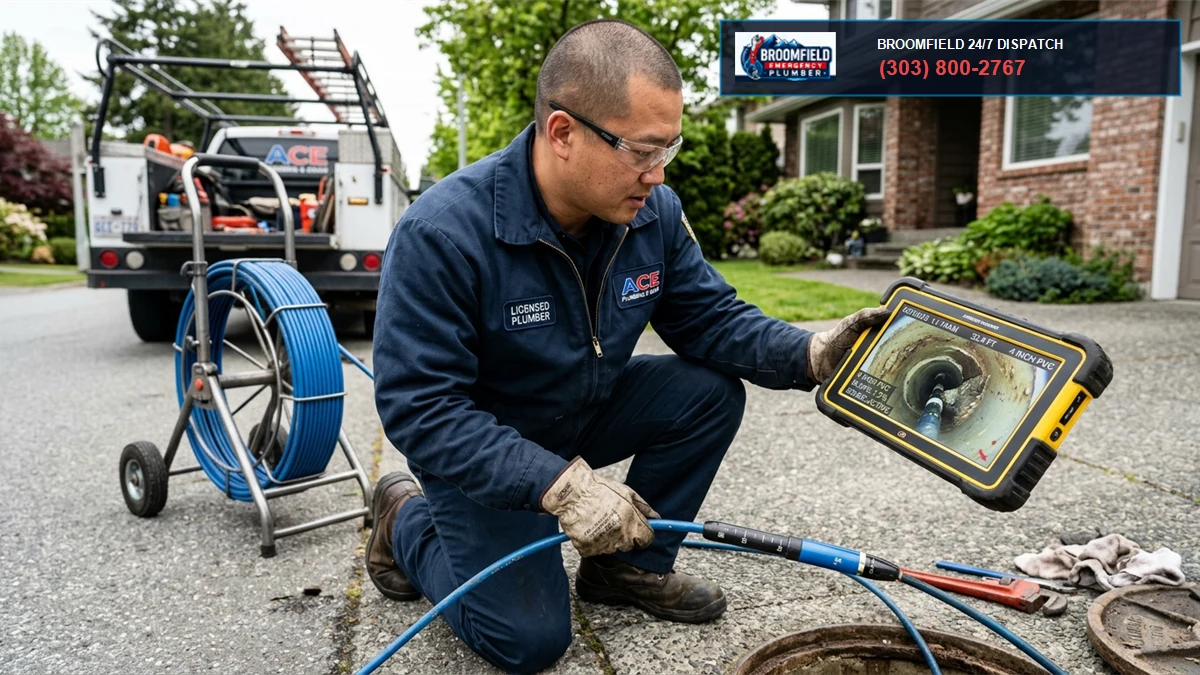
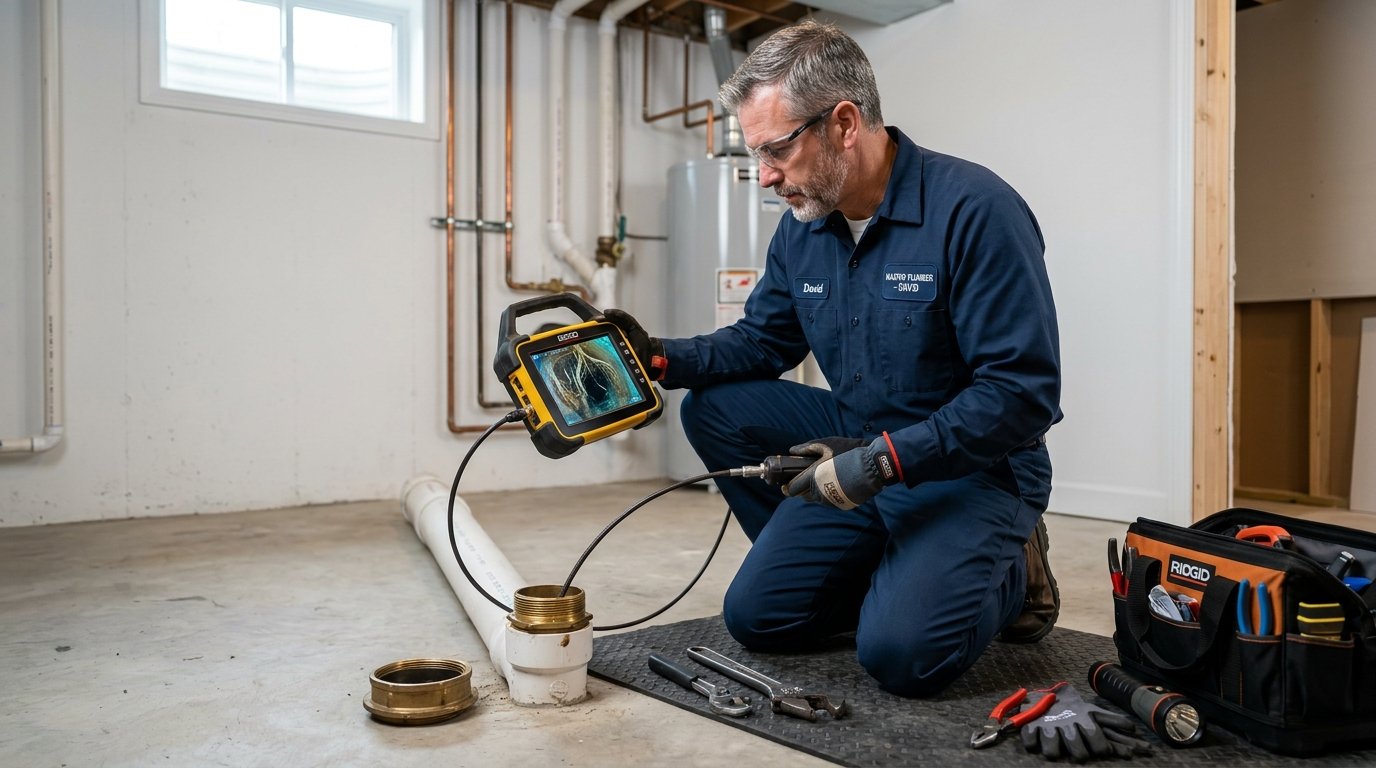
- Robotic Tractor CCTV Inspection: We launch heavy self-propelled robotic pipe crawlers equipped with pan-tilt-zoom color cameras and 512 Hz locating sondes into storm mains from 8 inches to 36 inches in diameter. We inspect for pipe shearing, joint offsets, tree root invasion, and asphalt collapse.
- Submersible Pump Electrical & Flow Diagnostics: We test pump motor insulation resistance (megohmmeter test), measure running amperage against motor nameplate ratings, and inspect dual silicon carbide mechanical seals for moisture intrusion using electronic seal-fail probes.
7. Professional Remediation: High-Flow Hydro-Jetting vs. Industrial Vactor Excavation
Clearing a stormwater catch basin system requires equipment with immense hydraulic capacity.
Standard plumbing drain snakes and residential pressure washers cannot budge thousand-pound sand dams inside 18-inch concrete pipes.
1. Industrial Combination Vacuum-Jetter Trucks (Vactor Rigs)
We deploy industrial combination units featuring:
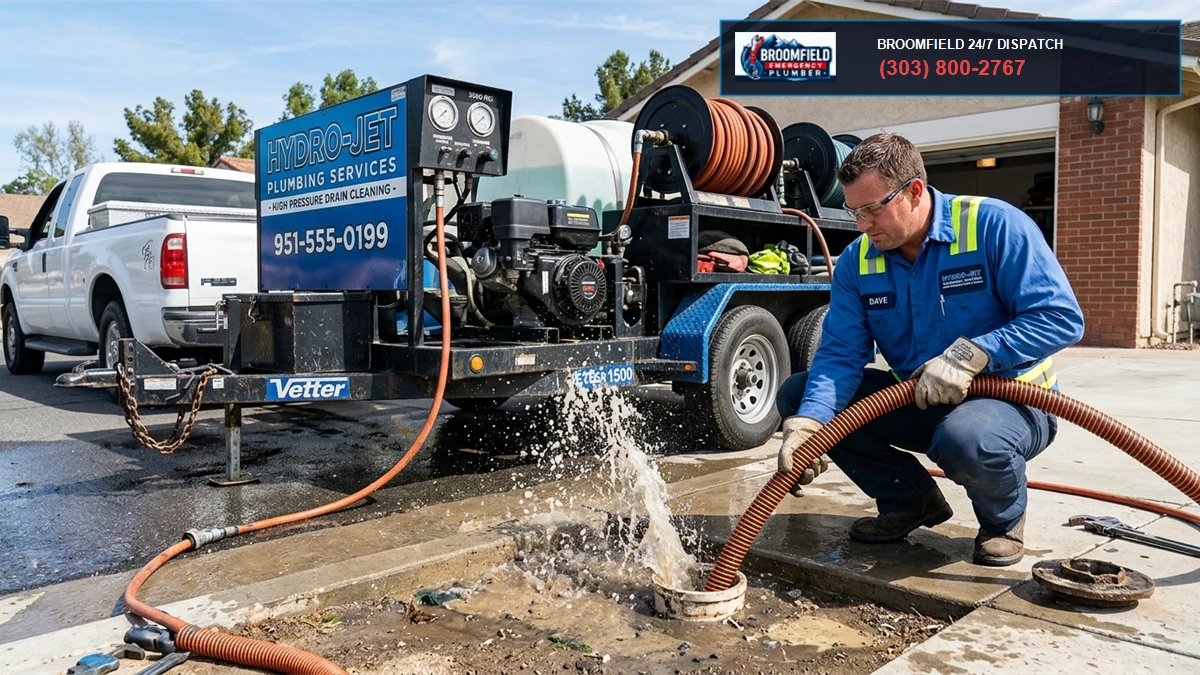
- Heavy-duty positive displacement blowers pulling **4,500 CFM of air at 28 inches of mercury vacuum**, sucking tons of sand, rocks, and mud directly from basin sumps into 10-cubic-yard debris tanks.
- Water pumps delivering **60 to 80 GPM at 2,000 to 2,500 PSI** through 1-inch industrial jetting hoses.
2. High-Mass Sand Scraper & Stone Chisel Nozzles
To scour sand out of storm laterals, our technicians deploy heavy bottom-cleaning skid nozzles (such as the Flounder or C-Cutter).
Weighing 15 to 30 pounds, these nozzles stay flat on the pipe invert, firing high-velocity water jets directly along the bottom of the culvert to propel sand, aggregate, and cobbles backward out of the pipe into the waiting vacuum hose.
8. Manning’s Open Channel Flow & Storm Culvert Hydraulic Choking
Why does a minor layer of silt cause massive parking lot backups?
Stormwater pipes do not flow under pressure; they operate as open-channel gravity conduits modeled by the **Manning Equation**:
Where:
- $Q$ = Volumetric flow rate ($cfs$)
- $n$ = Manning’s roughness coefficient
- $A$ = Cross-sectional area of water flow ($ft^2$)
- $R_h$ = Hydraulic radius ($R_h = A / P$, where $P$ is wetted perimeter)
- $S$ = Pipeline slope or energy gradient ($ft/ft$)
Notice the roughness coefficient ($n$) in the denominator. Flow rate is inversely proportional to roughness.
| Pipe Material & Internal Condition | Manning’s Roughness ($n$) | Capacity Reduction vs. Clean Pipe | Hydraulic Flow Velocity |
|---|---|---|---|
| New Smooth-Wall PVC / HDPE (Clean) | 0.010 – 0.012 | 0% (Full Design Flow) | 6.2 ft/s (Scouring velocity) |
| Reinforced Concrete Pipe (RCP, Clean) | 0.013 – 0.015 | 15% Reduction | 5.4 ft/s |
| Corrugated Metal Pipe (CMP, Unpaved) | 0.022 – 0.026 | 50% Reduction | 3.2 ft/s |
| Silted Pipe (3-Inch Sand & Gravel Bed) | 0.035 – 0.045 | 72% Reduction | 1.8 ft/s (Settling velocity) |
When three inches of sand settle along the bottom of a 15-inch concrete culvert, two devastating things happen simultaneously:
- The available cross-sectional flow area ($A$) drops by 30%.
- The hydraulic roughness ($n$) triples from $0.013$ to $0.038$.
The hydraulic capacity of the pipe collapses from **1,850 GPM down to less than 520 GPM**—a massive **72% loss in carrying capacity**.
Water ponds rapidly upstream at the surface grates, turning parking aisles into impassable lakes.
9. Underground Detention Vaults & Hydrodynamic Separator Maintenance
Modern commercial developments across Broomfield, Interlocken, and Flatiron incorporate massive underground stormwater detention vaults beneath parking lots to satisfy zero-net-runoff civil ordinances.
Before runoff enters these underground chambers, it passes through specialized **Hydrodynamic Separators (CDS / Stormceptor / Contech Units)**:
- Vortex Flow Separation: Water enters a cylindrical separation chamber tangentially, setting up a continuous rotational vortex.
- Centrifugal Settling: Heavy road silts and particulate metals are driven radially outward, dropping through an isolation screen into an undisturbed lower storage sump.
- Floatable Hydrocarbon Baffling: Floating engine oils, gasoline slicks, and beverage bottles are trapped in an upper retention baffle, preventing discharge into public waterways.
The 80% TSS Removal Mandate
Under CDPHE municipal stormwater rules, hydrodynamic separators must maintain an **80% Total Suspended Solids (TSS) removal efficiency**.
However, if the lower sediment chamber is not vacuum-pumped out every six to twelve months, the vortex action reverses.
Incoming high-velocity storm flow scours previously settled sludge off the floor of the chamber, re-suspending tons of concentrated pollutants and dumping them into municipal creeks in severe violation of environmental law.
Our industrial vactor crews provide scheduled vacuum maintenance, skimming floating oil layers and vacuuming bottom sludge down to clean concrete.
10. Geotechnical Sub-Grade Sinkholes & Pavement Cavity Grouting
What is happening beneath the asphalt when catch basin mortar joints fail?
A hidden geotechnical disaster known as **subsurface piping erosion**.
Catch basins are modular precast concrete structures joined with butyl rubber sealant or hydraulic cement mortar.
Over years of heavy commercial truck traffic, vibrational stress and freeze-thaw cycles crack these mortar joints:
- During rainstorms, high-velocity water rushing down the catch basin creates a localized vacuum behind the concrete walls via the Venturi effect.
- Surrounding crushed stone road base and sandy sub-grade soil are sucked through the broken joint directly into the storm sewer.
- The sand washes down the storm drain, leaving a hollow underground cavern beneath the asphalt pavement.
- To the naked eye, the parking lot looks normal. But beneath the 4-inch asphalt surface layer, an empty void spans six to ten feet wide.
- When a fully loaded commercial delivery semi or garbage truck drives over the unsupported pavement, the asphalt shears instantly, dropping the truck into a deep sinkhole.
Our master plumbing crews pinpoint subsurface voids using ground-penetrating radar (GPR) and pipe CCTV cameras.
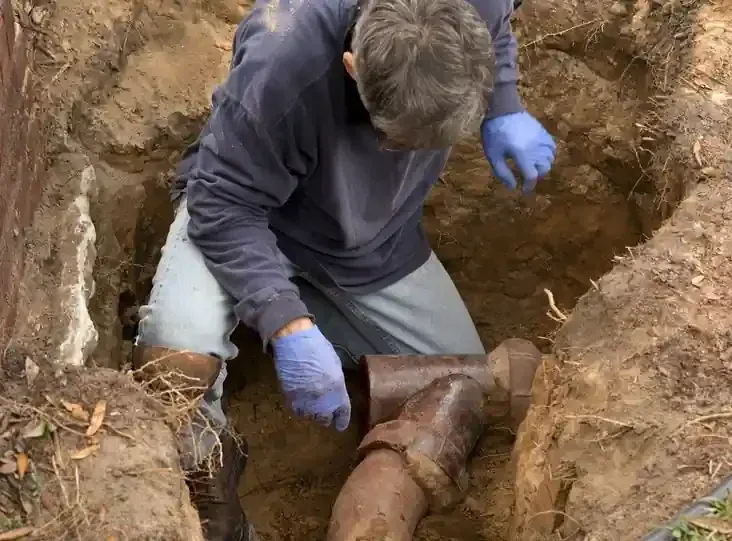
We excavate compromised basin collars safely using hydrovac excavation, seal joints with ASTM C990 flexible butyl resins, and stabilize undermined sub-grades using structural high-density polyurethane expanding foam injection.
11. Hydrodynamic Flotation & Concrete Basin Uplift Hydraulics
Can a ten-thousand-pound concrete catch basin float out of the ground like a boat?
During saturated Front Range spring storm events, the answer is an alarming yes.
When high groundwater tables surround a hollow, empty concrete catch basin or stormwater lift station vault, Archimedes’ Principle of Buoyancy applies:
Where:
- $F_b$ = Upward buoyant hydrostatic force ($lbf$)
- $\gamma_w$ = Unit weight of saturated groundwater ($62.4 \text{ lb/ft}^3$)
- $V_{\text{displaced}}$ = Total exterior volume of the submerged concrete vault structure ($ft^3$)
For an underground vault to remain physically stable in saturated soil, civil engineering codes require a minimum **factor of safety against flotation ($FS_b \ge 1.50$)**:
Consider a standard 6-foot diameter by 10-foot deep precast concrete stormwater wet well:
- Total displaced volume: approx. $283 \text{ ft}^3$
- Upward buoyant force ($F_b$): $283 \times 62.4 \approx 17,660 \text{ pounds}$ of lifting force.
- Dry weight of the empty concrete tank: approx. $11,500 \text{ pounds}$.
If groundwater rises to the surface during flash floods while the pump station is pumped dry, the upward buoyant force exceeds the tank’s dry weight by **over six thousand pounds**.
The entire structure heaves upward, shearing connected inlet and outlet pipes, fracturing electrical conduit seals, and buckling surrounding asphalt parking lots.
Our master plumbers prevent basin flotation by calculating buoyant loads, anchoring structures with **cast-in-place concrete anti-flotation ballast collars**, and installing mechanical hydrostatic pressure relief valves in wet well floors.
12. Case Studies from Broomfield: Parking Lot Floods & Pump Station Saves
Here are two real-world case studies demonstrating our rapid-response commercial stormwater capabilities:
Case Study 1: The Flooded Retail Big-Box Store in Flatiron Crossing
The Situation: During an intense August thunderstorm, three primary catch basins outside a major retail home improvement store backed up completely. Standing water rose two feet deep, blocking the customer entrance and flooding the exterior garden center.
Our Master Plumber Findings: Our emergency crew arrived on site with a combination jetter-vac truck within 35 minutes. Inspection revealed that landscaping bark and wood chips from recent grounds renovation had washed into the grates, creating an airtight dam over the cast iron grates. Beneath the grates, the concrete sumps were packed with four feet of compacted road aggregate that had completely plugged the 15-inch concrete discharge main.
The Master Plumber Resolution: Our technicians removed the grates, deployed our vacuum boom to extract six cubic yards of saturated aggregate from the sumps, and fed an 80 GPM bottom-skid jetting nozzle through the 15-inch storm lateral. Within 50 minutes, the main cleared with an immense roar, draining forty thousand gallons of parking lot floodwater in under twelve minutes.
Case Study 2: The Submerged Loading Dock Pump Failure in Interlocken
The Situation: A commercial pharmaceutical packaging plant in Interlocken had its below-grade loading dock bay submerged beneath five feet of muddy stormwater at 5:00 AM on a Monday, halting all inbound tractor-trailer deliveries.
Our Master Plumber Findings: The duplex 5-HP stormwater lift station had suffered complete electrical lockout. Both pump impellers were wedged solid with shredded plastic packaging wrap and washed-in river rocks. When the pumps attempted to start, high locked-rotor amperage tripped the main magnetic contactors.
The Master Plumber Resolution: We deployed mobile trash pumps to dewater the loading dock bay in 45 minutes, pulled both submersible pumps from the pit using hoist cranes, cleared the jammed impellers, and replaced scored wear rings. We upgraded the control panel with solid-state current overloads and installed non-fouling ultrasonic level transducers to replace failure-prone float bulbs.
13. Commercial Catch Basin Maintenance Checklist: Quarterly and Annual Protocols
Protect your commercial parking assets and guarantee MS4 compliance by following this preventive maintenance schedule:
| Frequency | Inspection / Maintenance Action | Compliance Standard | Corrective Action if Non-Compliant |
|---|---|---|---|
| Monthly (During Storm Season) | Visual inspection of surface grates & curb throats | 100% free of leaves, litter, and landscape mulch | Rake and remove debris before precipitation events. |
| Quarterly | Measure sediment depth in all catch basin sumps | Sediment depth < 50% of total sump depth | Schedule vacuum pump-out truck when sediment reaches 50%. |
| Quarterly | Test stormwater lift station pumps and backup floats | Pumps cycle cleanly; alternating relay functions | Clean float bulbs, megger test motor windings. |
| Biannually (Spring & Autumn) | Inspect oil-grit separator hoods & cleanout baffles | Baffles firmly attached; zero oil sheen bypass | Re-anchor loose baffles, vacuum skim floating oil layers. |
| Annually | Full CCTV pipeline camera inspection of storm mains | Zero joint offsets, no structural pipe bellies | High-flow hydro-jetting to flush fine sand deposits. |
14. Emergency Action Steps: What to Do When Your Parking Lot Floods Right Now
If stormwater is currently inundating your commercial property or threatening building entrances:
- Barricade Flooded Parking Lanes Immediately: Place traffic cones and barricades at parking lot entrances. Deep stormwater obscures curbs, open manholes, and washed-out asphalt edges, creating extreme vehicular liability.
- Deploy Emergency Sandbags at Building Thresholds: Stack polypropylene sandbags or commercial absorbent flood barriers across low-elevation pedestrian doorways and loading dock ramps to prevent water ingress.
- Do NOT Attempt to Wade into Submerged Basins: Flooded catch basins generate intense, invisible downward suction vortices that can pull human limbs into grates, causing catastrophic drowning or injury.
- Check the Electrical Power on Sump Stations: If equipped with a stormwater lift pump, check the electrical disconnect panel to verify breakers have not tripped on thermal overload.
- Call Licensed Commercial Master Plumbers Immediately: Contact our rapid-response commercial dispatch at (303) 647-3363. We dispatch heavy combination vacuum trucks, high-flow hydro-jetters, portable dewatering pumps, and certified master plumbers 24/7 across Broomfield, Westminster, and the Denver Metro area.
Frequently Asked Questions (FAQ)
How often should commercial parking lot catch basins be pumped out?
Commercial catch basins should be inspected quarterly and pumped out whenever sediment reaches 50% of the sump depth—typically once or twice per year depending on traffic volume and winter sanding frequency. In Colorado, post-winter spring cleanouts are critical to remove tons of accumulated road sand before summer thunderstorms hit.
What is an MS4 violation and why does it matter for commercial property owners?
An MS4 (Municipal Separate Storm Sewer System) violation occurs when a commercial property discharges polluted runoff, sediment plumes, or vehicle oils into municipal storm drains that lead to public rivers. Under CDPHE regulations, failure to maintain private stormwater basins can result in municipal stop-work orders and state civil fines exceeding $10,000 per day.
Why did our commercial stormwater sump pumps fail during a heavy rainstorm?
The most common causes are abrasive sand binding the impeller, tangled or silt-weighted mechanical float switches that fail to trigger, and electrical breaker trips caused by high motor current draw when trying to pump thick, sediment-laden water.
What is the purpose of the sump below the outlet pipe in a catch basin?
The sump is an engineered settling reservoir extending 18 to 36 inches below the outlet pipe. Its purpose is to allow heavy gravel, sand, and road grit to settle out of suspension by gravity before runoff enters the discharge lateral, preventing underground storm pipes from clogging.
Can a standard sewer snake clear a clogged commercial storm drain line?
No. Standard mechanical snakes merely punch a small hole through sediment without removing it. In large 12-inch to 24-inch storm culverts, only high-flow commercial hydro-jetting (60+ GPM) paired with industrial vacuum excavation can liquefy and extract tons of packed sand and crushed stone.
Commercial Parking Lot Flooding in Broomfield?
Don’t let choked catch basins or failed stormwater lift pumps flood your commercial property or trigger costly MS4 environmental fines. Our licensed master plumbers provide 24/7 vacuum truck service, high-flow hydro-jetting, and emergency pump station repairs.