
The monthly municipal water utility bill lands on the desk of a commercial facility director in Broomfield, Colorado. It shows an alarming number: **840,000 gallons of unaccounted water consumption**, with a utility invoice topping $14,000. Yet across the four-story commercial office building, not a single faucet is running. Restroom flushometers sit bone dry. Mechanical cooling towers show standard evaporation loss.
Where is all that water going?
Somewhere beneath six inches of reinforced asphalt and twelve feet of compacted clay backfill, an underground high-pressure potable water service main has ruptured.
At 75 PSI of continuous municipal water pressure, a single 1/4-inch pinhole rupture discharges over **15,000 gallons of water every twenty-four hours**.
That escaping torrent is quietly scouring sub-base aggregate, undermining structural concrete footings, and carving subterranean sinkholes beneath parking structures.
You cannot find an underground water main leak by digging random holes with a backhoe.
Ripping up parking lots blindly costs tens of thousands of dollars, severs fiber-optic communication conduits, and disrupts commercial tenant operations for weeks.
Locating subterranean water leaks requires cutting-edge non-invasive physics: **digital dual-sensor acoustic cross-correlation**, ultrasonic ground microphone profiling, and industrial **helium tracer gas spectrometry**.
Once the underground breach is pinpointed to within a six-inch radius, safe exposure demands non-destructive **hydrovac soft excavation**, exposing the pipe without the risk of mechanical excavator strikes.
Let’s examine the acoustic mechanics of pressurized pipe leaks, calculate leak discharge rates, walk through tracer gas thermodynamics, review AWWA M36 water auditing standards, and detail master plumber emergency leak locating protocols across the Colorado Front Range.
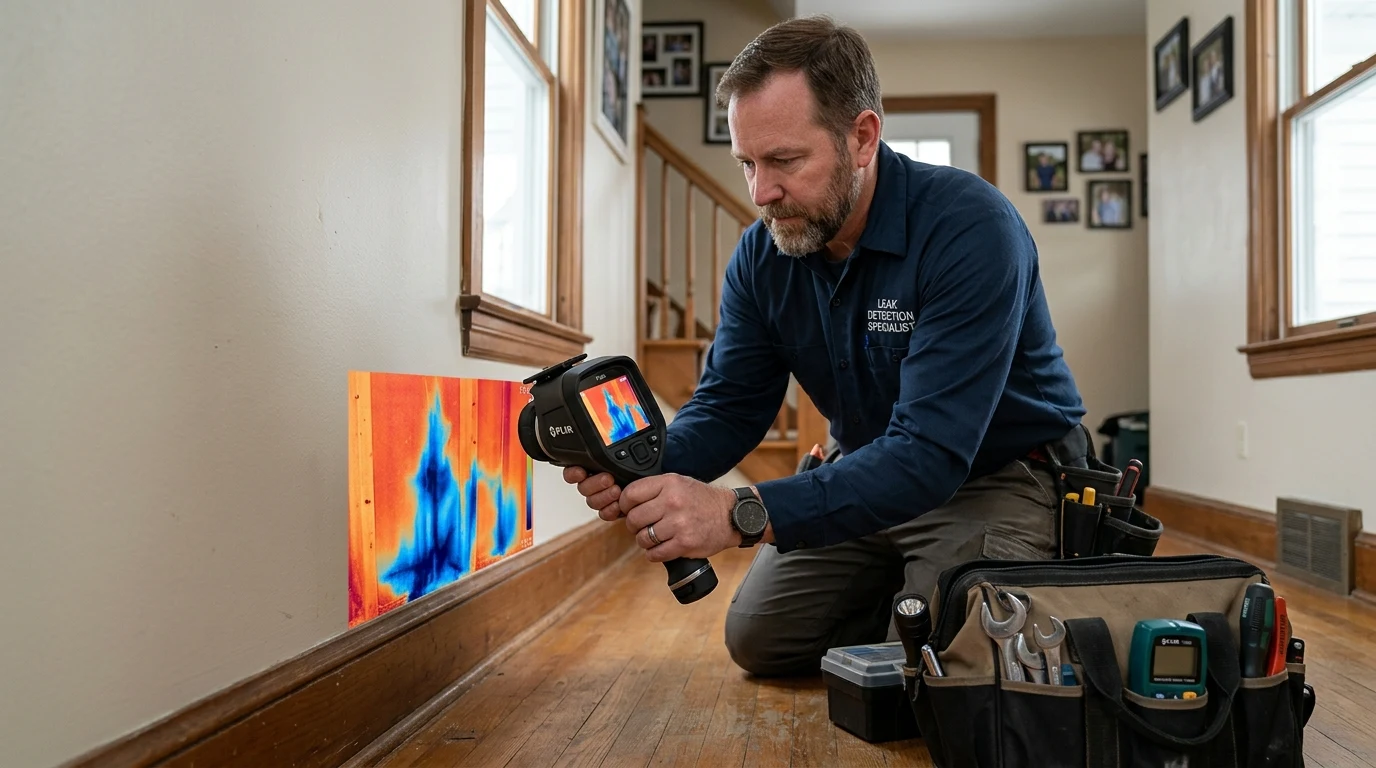
1. The Physics of Pressurized Pipe Acoustics: How Water Leaks Generate Sound
How does water escaping a buried pipe create sound that travels hundreds of feet through solid earth and metal?
When high-pressure water (typically 60 to 110 PSI in commercial mains) escapes through a crack, pinhole, or sheared mechanical joint into lower atmospheric soil pressure, the sudden pressure drop accelerates fluid velocity.
This violent velocity gradient generates intense fluid shear and turbulence.
As turbulent eddies detach from the orifice perimeter, they generate distinct acoustic vibrations across multiple frequency spectra:
- Orifice Cavitation and Friction Vibration (Pipe Structure-Borne): High-frequency sound waves (500 Hz to 5,000 Hz) propagate longitudinally along the pipe wall in both directions away from the leak site.
- Fluid Column Acoustic Waves: Lower-frequency sound waves travel through the pressurized water column itself, reflecting off fittings and valves.
- Soil Cavitation and Impact Sound (Ground-Borne): Water impacting the surrounding soil matrix generates low-frequency rumbling sounds (50 Hz to 400 Hz) that radiate upward through the soil, crushed gravel base, and surface pavement.
Wave Velocity Across Pipe Materials
Sound does not travel at the same speed through different piping materials.
Acoustic velocity ($c$) depends directly on the modulus of elasticity ($E$) of the pipe wall and the bulk modulus of water ($K$):
Where:
- $K$ = Bulk modulus of elasticity of water ($3.19 \times 10^5 \text{ PSI}$)
- $\rho$ = Fluid density of water
- $E$ = Young’s modulus of elasticity of the pipe material
- $D$ = Internal diameter of the pipe
- $t$ = Wall thickness of the pipe
| Pipe Material | Young’s Modulus ($E$, PSI) | Acoustic Propagation Velocity ($c$, ft/s) | Acoustic Attenuation Characteristics |
|---|---|---|---|
| Ductile Iron (Class 52) | $24.0 \times 10^6$ | 4,100 – 4,400 ft/s | Low attenuation; leak signals carry 600 – 1,000 ft. |
| Type K Copper Tubing | $17.0 \times 10^6$ | 3,700 – 3,950 ft/s | Moderate attenuation; clear tones travel 400 – 600 ft. |
| C900 PVC (DR 18) | $4.0 \times 10^5$ | 1,400 – 1,750 ft/s | High attenuation; sound dampens within 100 – 200 ft. |
| HDPE (SDR 11) | $1.3 \times 10^5$ | 1,100 – 1,350 ft/s | Extreme dampening; sound absorbs within 50 – 75 ft. |
Notice the massive difference between ductile iron and plastic pipes.
In rigid metallic pipes like ductile iron or copper, leak frequencies ring clearly like a tuning fork across hundreds of feet.
In flexible thermoplastic lines like C900 PVC or HDPE (increasingly common in modern commercial developments across Broomfield), the viscoelastic polymer absorbs mechanical sound waves within 50 to 100 feet. Detecting leaks in plastic pipe demands specialized low-frequency sensors, hydrophone listening rods, and helium tracer gas.
2. Digital Dual-Sensor Acoustic Cross-Correlation: The Mathematics of Precision Pinpointing
How do our master plumbers pinpoint a leak buried eight feet deep between two commercial utility vaults without breaking ground?
We deploy **Digital Acoustic Cross-Correlators**.
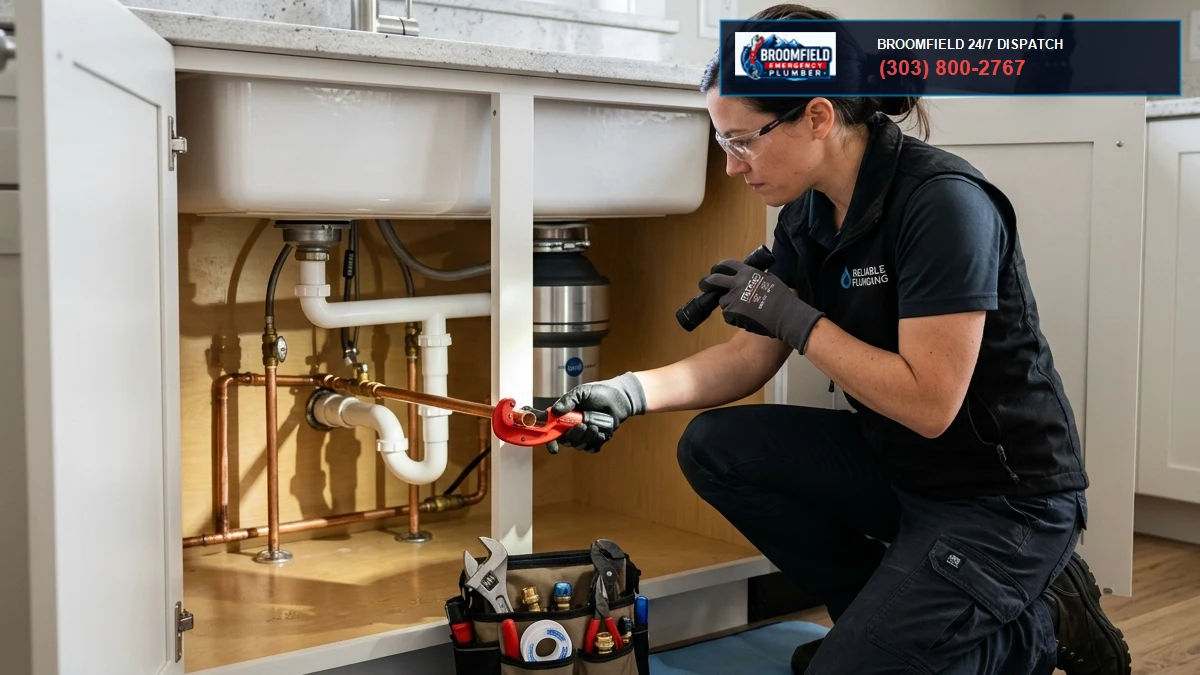
The Cross-Correlation Algorithm
Our technicians place two high-sensitivity piezoelectric accelerometer sensors (Sensor Red and Sensor Blue) directly onto accessible contact points along the pipe—such as fire hydrants, commercial curb stop valves, or mechanical room isolation flanges.
Both sensors capture the leak vibration signals simultaneously and transmit digitized acoustic data via wireless radio telemetry back to a central microprocessor core.
Because the leak is usually located closer to one sensor than the other, the sound wave reaches the nearer sensor first. The microprocessor computes the mathematical cross-correlation function ($R_{xy}(\tau)$):
The peak of this mathematical correlation function reveals the precise time differential ($\Delta t$) between signal arrival at Sensor Red versus Sensor Blue.
Once $\Delta t$ is calculated, the exact physical distance ($L_1$) from Sensor Red to the underground rupture is determined using the linear acoustic positioning formula:
Where:
- $L_1$ = Exact linear distance along the pipe from Sensor Red to the leak point ($ft$)
- $D$ = Total measured linear distance between Sensor Red and Sensor Blue ($ft$)
- $c$ = Acoustic propagation velocity in the specific pipe material and diameter ($ft/s$)
- $\Delta t$ = Measured time differential ($seconds$ or $milliseconds$)
If the distance between two curb stops is 350 feet ($D = 350$), the pipe is 6-inch ductile iron ($c = 4,200 \text{ ft/s}$), and the measured time delay is 35.7 milliseconds ($\Delta t = 0.0357 \text{ s}$):
The leak is precisely 100 feet from Sensor Red.
No guessing. No random trenching. We spray a chalk mark on the asphalt, ready for targeted excavation.
3. Fluid Dynamics of Leak Discharge: Orifice Flow & Unaccounted Water Loss
How rapidly does water escape through a subsurface pipe breach?
Water loss obeys classical orifice hydraulics modeled by **Torricelli’s Law** combined with the hydraulic orifice flow equation:
Where:
- $Q$ = Discharge flow rate ($ft^3/s$ or GPM)
- $C_d$ = Orifice discharge coefficient (typically $0.62$ for sharp-edged cracks, $0.82$ for rounded pinholes)
- $A_o$ = Cross-sectional area of the rupture orifice ($ft^2$ or $in^2$)
- $\Delta P$ = Net internal water pressure differential above surrounding soil pressure (PSI)
- $\rho$ = Water density
- $g$ = Gravitational acceleration ($32.2 \text{ ft/s}^2$)
- $h$ = Equivalent pressure head ($h = 2.31 \times \text{PSI}$)
Let’s examine the financial and volumetric devastation caused by unaddressed underground leaks at typical Front Range municipal water pressure (70 PSI):
| Orifice Diameter / Crack Size | Discharge Rate (GPM at 70 PSI) | Daily Water Loss (Gallons) | Monthly Water Loss (Gallons) | Estimated Monthly Water Cost (@ $9.50/1k Gal) |
|---|---|---|---|---|
| 1/16-inch (Pinhole Corrosion) | 1.1 GPM | 1,584 Gallons | 47,520 Gal | $451.44 |
| 1/8-inch (Cracked Fitting) | 4.5 GPM | 6,480 Gallons | 194,400 Gal | $1,846.80 |
| 1/4-inch (Blown Flange Gasket) | 17.8 GPM | 25,632 Gallons | 768,960 Gal | $7,305.12 |
| 1/2-inch (Sheared Service Lateral) | 71.4 GPM | 102,816 Gallons | 3,084,480 Gal | $29,302.56 |
Look closely at the numbers. A 1/4-inch hole—the size of a standard pencil eraser—dumps over **three-quarters of a million gallons of potable water** into the foundation soils every single month.
In commercial districts like Interlocken or Flatiron, that water doesn’t just evaporate. It washes away stabilizing road sub-base, creating pavement voids that collapse under delivery trucks and emergency fire apparatus.
4. Soil Mechanics and Sinkhole Formation: The Front Range Expansive Clay Crisis
Water pipe leaks along the Colorado Front Range carry a destructive geotechnical hazard rarely encountered in other regions: **expansive bentonite clay soils**.
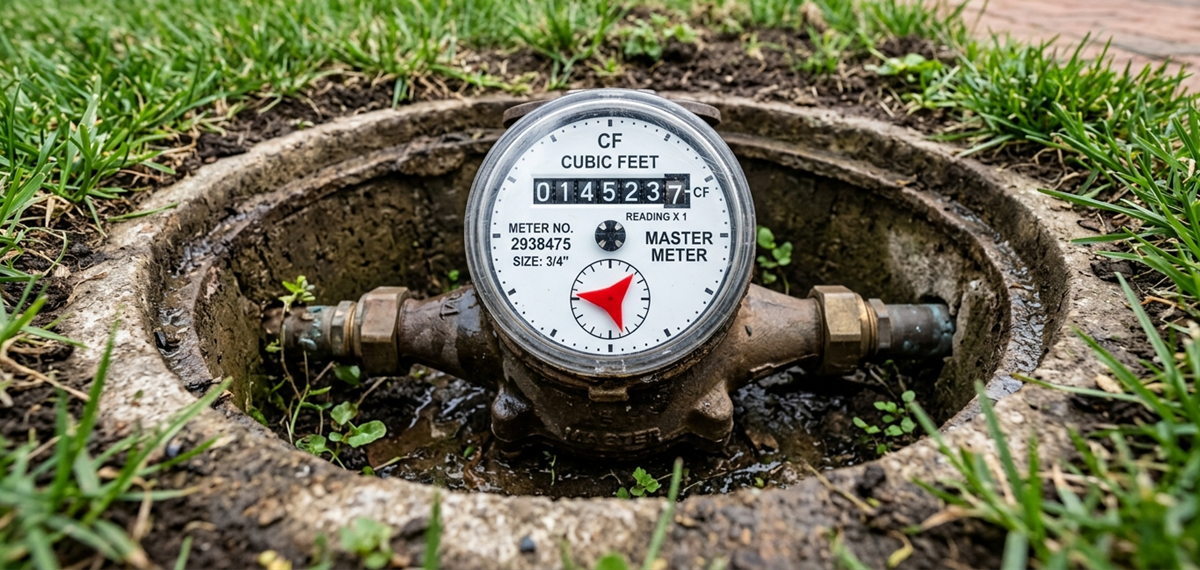
How Water Leaks Destroy Colorado Commercial Foundations
The geological strata across Broomfield and northern Denver contain heavy concentrations of smectite and bentonite clay. When dry, these clays are dense and hard.
When saturated by thousands of gallons of leaking water, bentonite clays expand with volumetric swelling pressures exceeding **10,000 to 15,000 pounds per square foot (PSF)**.
The swelling clay exerts tremendous upward hydraulic heave against concrete foundations:
- Differential Foundation Heave: The slab directly above the leak pushes upward, cracking interior drywall, shearing fire sprinkler drops, and binding commercial entrance doors shut.
- Sub-Base Washout & Piping Cavitation: Once the water table reaches saturation, high-velocity leak water scours fine silt and sand particles away from coarse structural gravels—a geotechnical process known as **subsurface hydraulic piping**. A massive subterranean cavern forms beneath the concrete slab.
- Catastrophic Slab Punch-Through: With the supporting sub-base washed away, the unreinforced concrete slab spans an empty void. When a loaded commercial delivery forklift or delivery van drives across the surface, the slab shears and collapses into the sinkhole.
Fixing the leak early prevents six-figure geotechnical structural stabilization projects.
5. Helium Tracer Gas Spectrometry: The Ultimate Non-Acoustic Pinpointing Tool
What happens when a pipe leak produces zero detectable acoustic sound?
This occurs frequently when:
- The leak is submerged in deep standing groundwater, which completely dampens acoustic vibrations.
- The pipe operates at low pressure (< 25 PSI).
- The pipe material is thick HDPE or C900 PVC, which rapidly attenuates sound waves.
- The leak site is situated near loud ambient noise sources—such as heavy highway traffic on US-36 or humming industrial HVAC chillers.
When sound fails, our master technicians switch from acoustic physics to molecular thermodynamics: **Industrial Helium ($He$) Tracer Gas Spectrometry**.
The Molecular Physics of Helium Ingress
Helium is an inert, non-toxic, non-flammable noble gas. It is the second smallest and lightest molecule in the known universe ($M = 4.003 \text{ g/mol}$), second only to hydrogen.
According to **Graham’s Law of Effusion**, the rate of effusion of a gas through a porous opening is inversely proportional to the square root of its molar mass:
Helium effuses through microscopic cracks nearly **2.7 times faster than atmospheric air**.
More importantly, helium molecules are so tiny that they pass directly through porous concrete slabs, compacted asphalt pavement, and saturated clay backfill that trap other gases.
Our Helium Detection Workflow
- Isolate and Evacuate the Water Line: We shut off the commercial water service valves and blow the remaining water out of the pipe using dry industrial nitrogen ($N_2$).
- Pressurize with Gas Mixture: We inject a certified, non-hazardous tracer blend of 95% nitrogen and 5% industrial helium (Forming Gas) into the dry pipe at 50 to 80 PSI.
- Gas Effusion at Rupture Site: Under pressure, the tracer gas escapes through the underground crack, bubbling into the surrounding soil. Because helium is significantly lighter than air, it rises vertically through the soil column at a rate of 1 to 3 feet per minute.
- Surface Sniffing with Mass Spectrometer: A technician walks the suspected pipe alignment carrying a high-sensitivity **hydrogen/helium mass spectrometer sniffer** with a vacuum ground aspiration plate. The instrument detects helium concentrations down to **1 part per million (PPM)** above atmospheric baseline (5.2 PPM).
- Absolute Pinpointing: When the sensor passes directly over the subterranean breach, the digital meter spikes from 5 PPM to over 1,000 PPM within seconds. The leak site is identified with pinpoint accuracy.
6. Hydrovac Non-Destructive Excavation: Safe Exposure Without Utility Strikes
You have located the leak. Now you must expose the pipe for emergency repair.
How do you dig an eight-foot hole through a crowded commercial utility corridor containing high-voltage power lines, fiber-optic internet feeds, and high-pressure natural gas mains?
You never use a steel mechanical backhoe bucket.
Striking an underground fiber-optic trunk line in an office park can trigger tens of thousands of dollars per hour in telecom penalties. Striking a gas line or high-voltage power feeder can cause catastrophic injury or death.
The gold standard for safe commercial exposure is **Hydrovac Non-Destructive Excavation (Hydro-Excavation / Potholing)**.
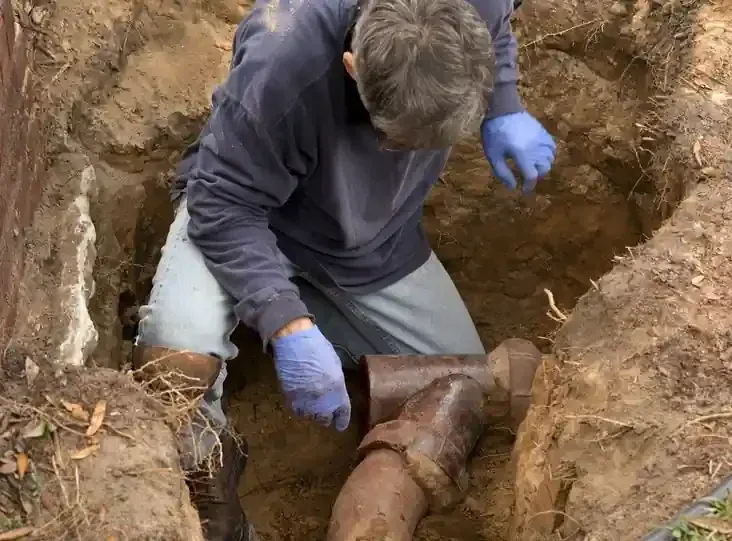
How Hydrovac Technology Works
Hydrovac excavation combines two synchronized systems:
- Pressurized Water Wand: An operator directs a specialized rotary water wand (operating at 1,500 to 2,500 PSI) with heated water directly at the soil. The water liquefies compacted clay, sand, and frozen gravel into a soft slurry without damaging buried cables, plastic conduits, or pipe coatings.
- High-Flow Industrial Vacuum Boom: Simultaneously, an 8-inch vacuum hose powered by a positive displacement blower (moving 3,500 to 5,500 CFM of air at 27 inches of mercury vacuum) sucks the liquefied soil directly into an onboard debris holding tank.
Within 45 minutes, hydrovac excavation cuts a clean, laser-straight 3-foot by 3-foot inspection shaft eight feet deep, exposing the ruptured pipe joint safely while preserving surrounding infrastructure intact.
7. AWWA M36 Water Auditing Standards & Leak Loss Control
Large commercial campuses, schools, and business parks manage extensive private water distribution networks beyond the municipal master meter.
Under **American Water Works Association (AWWA) Manual M36 (Water Audits and Loss Control Programs)**, facility managers must maintain accountability over two distinct categories of water loss:
| Water Loss Category | Definition | Examples | Mitigation Strategy |
|---|---|---|---|
| Apparent Losses (Paper Losses) | Water that is consumed but not properly measured or billed. | Meter inaccuracies, billing data errors, unauthorized consumption. | Meter recalibration, automated smart meter telemetry (AMI). |
| Real Losses (Physical Losses) | Actual physical water volume escaping the pressurized piping infrastructure. | Main breaks, service line pinholes, leaking fire hydrants, joint weeping. | Acoustic cross-correlation, acoustic loggers, helium tracer testing. |
Our master plumbers help commercial facilities establish an **Infrastructure Leakage Index (ILI)** audit.
We deploy overnight digital acoustic listening loggers across private fire hydrant networks and commercial backflow assemblies.
Between 2:00 AM and 4:00 AM—when commercial facilities experience minimum night flow (MNF)—our acoustic loggers record baseline noise profiles. A steady, uninterrupted acoustic signature during minimum night flow signals a pressurized underground leak long before water bubbles up through the pavement.
8. Pipe Repair Technologies: Heavy-Duty Mechanical Clamps vs. Full Spool Replacement
Once the underground leak is uncovered, how is the pipe permanently repaired under International Plumbing Code (IPC) Section 605?
| Repair Methodology | Code Standard | Pressure Rating | Best Application | Expected Lifespan |
|---|---|---|---|---|
| 304 Stainless Full-Circle Repair Clamp | AWWA C230 | 150 – 300 PSI | Pinhole corrosion, circumferential hairline cracks in ductile iron/copper. | 20 to 30 Years |
| Electrofusion Coupling | ASTM F1055 | 200 PSI (SDR 11) | HDPE pipe ruptures; thermal fusion creates monolithic joint. | 50+ Years (Permanent) |
| Mechanical Joint (MJ) Spool Replacement | AWWA C110 / C111 | 350 PSI | Longitudinal structural splits, sheared bells, severe galvanic deterioration. | 50+ Years (Permanent) |
| Restrained Flange Adaptor (MegaLug) | ASTM A536 | 250 – 350 PSI | High-pressure commercial service entrances subject to thrust loads. | 50+ Years (Permanent) |
For standard pinhole leaks on 4-inch to 8-inch ductile iron mains, heavy-duty **AWWA C230 304 Stainless Steel Full-Circle Repair Clamps** with virgin NBR or EPDM waffle gaskets provide an immediate, code-compliant seal rated to 250 PSI.
However, if the pipe exhibits extensive longitudinal splits or severe wall thinning from soil corrosion, mechanical clamps are merely a temporary bandage.
In these instances, our master plumbers cut out the compromised pipe section, install a new spool piece of Class 52 ductile iron or C900 PVC, and anchor the repair with restrained mechanical joint couplings (MJ) and concrete thrust blocks under **IPC Section 605.4**.
9. Soil Resistivity, Stray Direct Current & Galvanic Underground Corrosion
Why do metallic water mains fail prematurely along the Colorado Front Range?
The hidden culprit is **electrochemical soil corrosion**.
Colorado Front Range soils contain variable mineral salts, sulfates, and moisture levels that create highly corrosive subterranean environments. When ductile iron, cast iron, or copper pipes are buried directly in low-resistivity soils without protective polywrap, an underground galvanic battery is created.
Wenner Four-Pin Soil Resistivity Testing
We assess soil corrosivity using the **Wenner Four-Pin Method (ASTM G57)**:
Where:
- $\rho$ = Apparent soil resistivity ($ohm\text{-}cm$)
- $a$ = Electrode pin spacing ($cm$)
- $R$ = Measured resistance between inner potential pins ($ohms$)
| Soil Resistivity ($\rho$, ohm-cm) | Corrosivity Classification | Corrosion Protection Mandate |
|---|---|---|
| < 1,000 ohm-cm | Severely Corrosive (Aggressive Clay) | Sacrificial magnesium anodes + V-Bio polyethylene encasement. |
| 1,000 – 2,000 ohm-cm | Highly Corrosive (Front Range Average) | V-Bio polyethylene sleeving + dielectric isolating flanges. |
| 2,000 – 5,000 ohm-cm | Moderately Corrosive | Dielectric isolation on all copper-to-iron transitions. |
| > 10,000 ohm-cm | Mildly Corrosive (Dry Sand/Gravel) | Standard manufacturer bituminous pipe coating. |
When soils measure under 1,500 ohm-cm, anodic electrochemical dissolution accelerates. Metallic iron oxidizes rapidly ($Fe \rightarrow Fe^{2+} + 2e^-$), blowing deep pits through ductile iron walls in under ten years.
During every water service repair, our master plumbers install **AWWA C105 V-Bio modified polyethylene encasement** and sacrificial high-potential magnesium anodes to permanently arrest electrolytic corrosion.
10. AWWA C651 Municipal Disinfection & Bacteriological Testing Standards
Exposing a subterranean potable water main to mud, groundwater, and surface runoff introduces biological contamination.
Commercial potable water mains cannot simply be turned back on after a pipe clamp is torqued down. Doing so risks sending coliform bacteria, Giardia cysts, and soil pathogens into drinking fountains and commercial ice makers.
Under **AWWA Standard C651 (Disinfecting Water Mains)** and IPC Section 602, repaired water mains must undergo rigorous chemical sanitization:
- Swabbing & Trench Sanitization: Before lowering new pipe or repair sleeves into the excavation pit, the interior surfaces and all mechanical joint gaskets are thoroughly swabbed with a 1% sodium hypochlorite ($NaOCl$) chlorine solution (10,000 mg/L free chlorine).
- Continuous Chlorine Dosing: For spool replacements, the isolated main is dosed with clean potable water carrying a minimum of **25 to 50 mg/L free available chlorine**.
- 24-Hour Contact & Residual Verification: The chlorinated water column is held static in the pipe for a minimum of 24 hours (or a 3-hour rapid slug test at 100 mg/L for emergency commercial restorations). At the end of the retention period, the free chlorine residual must measure no less than **10 mg/L**.
- Neutralization & Environmental Dechlorination: Before flushing the super-chlorinated water, it is routed through an ascorbic acid or sodium thiosulfate dechlorination diffuser under Colorado Department of Public Health and Environment (CDPHE) discharge rules to prevent killing aquatic life in local stormwater tributaries.
- Certified Bacteriological Sampling: Water samples are collected from downstream test ports and transported to a state-certified analytical laboratory. The water must pass two consecutive coliform and E. coli tests spaced 24 hours apart before full domestic occupancy clearance is granted.
11. Real-World Case Studies from Broomfield: Commercial Water Main Restorations
Here are two recent commercial emergency leak detection projects executed by our master plumbing crew in Broomfield:
Case Study 1: The Vanishing 500,000 Gallons at an Interlocken Office Park
The Situation: An eight-building corporate park off Interlocken Boulevard received an emergency notification from Broomfield Water Resources showing an inexplicable spike of 520,000 gallons on their monthly master meter. With zero visible surface water on the 12-acre campus, property management suspected a faulty city meter.
Our Master Plumber Diagnosis: We deployed our digital acoustic cross-correlator across three private fire hydrants and two main commercial backflow preventer vaults. Sensor data identified a severe 1,200 Hz acoustic peak between Vault A and Hydrant 2. Correlation analysis pinpointed the leak 142 feet north of the backflow vault, directly beneath an eight-lane access boulevard.
The Discovery & Soft Dig: We verified the location with helium tracer gas, watching spectrometer readings spike to 850 PPM. We brought in a hydrovac excavation truck, potholing through asphalt and six feet of saturated sandy clay. Exactly at 142 feet, we uncovered a 6-inch C900 PVC service main that had sheared clean across a bell socket due to differential settlement from an expansive clay pocket.
The Restoration: We isolated the main, installed a new C900 spool piece with restrained ductile iron mechanical joint couplings, chlorinated the line to AWWA C651 disinfection standards, and restored full water service in 7 hours. Water loss ceased immediately.
Case Study 2: Sub-Slab Parking Structure Mystery in Flatiron
The Situation: A three-story commercial parking structure exhibited continuous water weeping from expansion joints on the lowest subterranean level. Management feared ground water infiltration, but chlorine testing strips revealed 1.2 PPM of free chlorine—proving it was treated municipal potable water.
Our Master Plumber Diagnosis: Because high ambient traffic noise on nearby US-36 drowned out acoustic listening rods, we isolated the 3-inch copper fire supply line and charged it with 95/5 nitrogen-helium tracer gas. We swept the post-tensioned parking deck with a ground aspiration sniffer.
The Discovery: At Column C-4, the helium sniffer spiked violently. A pinhole leak had developed on an uninsulated copper fitting resting directly against structural steel rebar, creating severe galvanic electrolytic erosion.
The Restoration: We core-drilled a precise 12-inch circular access port through the slab, exposed the fitting, cut out the eroded elbow, silver-brazed a new Type K copper section with dielectric insulation wrap, and backfilled with structural hydraulic epoxy. Parking operations resumed the same afternoon.
12. Step-by-Step Commercial Emergency Leak Detection Protocol
When your commercial facility suspect an underground water leak, our master plumbing team executes this structured 6-phase diagnostic sequence:
- Initial Water Audit & Meter Verification: We read the master commercial compound meter, recording static consumption during zero-usage shutdown periods to establish baseline loss in Gallons Per Minute (GPM).
- Valving & Zone Isolation: We systematically operate commercial gate and butterfly isolation valves, dividing the underground distribution network into discrete hydraulic zones to isolate the leaking branch.
- Acoustic Survey & Loggers: We attach magnetic accelerometer sensors to all hydrants, valves, and exposed risers, scanning acoustic frequencies from 100 Hz to 5,000 Hz to locate signal peaks.
- Dual-Sensor Cross-Correlation: We program pipe material, diameter, and linear length into our digital correlator, computing time-delay mathematical peaks to calculate distance to the breach.
- Helium Tracer Confirmation (As Needed): For plastic pipes, deep burials, or noisy sites, we inject tracer gas and trace molecular surface emergence using mass spectrometers.
- Hydrovac Potholing & Certified Permanent Repair: We hydro-excavate a surgical inspection hole, inspect the rupture, install AWWA-rated mechanical spool components, disinfect the system, and restore pavement to municipal specifications.
13. Preventive Maintenance: Permanent Acoustic Monitoring Networks
Modern commercial campuses are transitioning from reactive emergency leak repairs to **Proactive Permanent Acoustic Monitoring**.
By installing permanent cellular-connected acoustic loggers on key distribution valves, property managers receive automated text alerts the moment an acoustic leak frequency is detected:
- Early Detection: Identifies pinhole leaks when they discharge 1 GPM, months before they wash out road foundations or become 70 GPM catastrophes.
- Lower Insurance Premiums: Commercial property insurance underwriters frequently offer premium discounts for facilities with active automated leak detection networks.
- Preserves Structural Integrity: Prevents expansive clay saturation and foundation movement beneath critical multi-million dollar commercial assets.
14. Emergency Action Steps: What to Do When a Main Line Ruptures Right Now
If water is currently bubbling through your commercial parking lot or asphalt roadway:
- Barricade the Flooded Pavement: Block off traffic immediately. Pavement above an active water leak may be an unsupported shell spanning a deep subterranean void. Heavy vehicles driving over it can trigger a sudden sinkhole collapse.
- Locate and Check the Master Water Meter: Observe whether the low-flow indicator dial or digital telemetry register is spinning rapidly.
- Do NOT Attempt Backhoe Excavation: Blind digging into a pressurized commercial water main will shatter the pipe, creating an uncontrolled geyser that floods adjacent buildings and risks electrocution from buried utility lines.
- Locate Master Curb Stop Valves: Identify the curb box or street vault housing the main service gate valve.
- Call Licensed Commercial Master Plumbers Immediately: Contact our rapid-response commercial water services team at (303) 647-3363. We dispatch acoustic correlators, helium tracer rigs, and hydrovac excavation units 24/7 across Broomfield, Westminster, and the Denver Metro area.
Frequently Asked Questions (FAQ)
How accurate is digital acoustic cross-correlation for underground water leaks?
When correct pipe material, diameter, and distance measurements are entered into the cross-correlator, acoustic correlation routinely pinpoints leaks within 6 to 12 inches of their exact physical location on ductile iron and copper mains. On plastic pipes like C900 PVC or HDPE, acoustic correlation is paired with helium tracer gas to achieve identical sub-foot precision.
Why is helium tracer gas used instead of other gases for leak detection?
Helium is an inert, non-toxic, non-flammable noble gas with the smallest molecular size after hydrogen. Because of its tiny molecular mass, helium effuses through microscopic cracks and migrates vertically through dense clay, crushed rock, and solid concrete slabs 2.7 times faster than air, allowing mass spectrometers to detect subterranean breaches that produce no sound.
What is hydrovac excavation and why is it required for commercial pipe repairs?
Hydrovac excavation uses high-pressure water streams to liquefy soil and an industrial vacuum system to extract the slurry into a debris tank. It eliminates the risk of utility strikes associated with steel excavator buckets, allowing plumbers to safely expose water mains buried alongside high-voltage electrical conduits, gas mains, and fiber-optic communication lines.
How do underground water leaks damage commercial building foundations in Colorado?
The Colorado Front Range features dense bentonite clay soils that expand significantly when saturated with water. Leaking water mains saturate these clays, exerting thousands of pounds of upward pressure that heaves concrete slabs, cracks structural masonry, and washes away aggregate sub-base, creating large subterranean caverns and sudden sinkhole collapses.
Who is responsible for an underground water main leak between the street and the building?
In most commercial utility jurisdictions across Broomfield and the Denver Metro area, the commercial property owner is legally and financially responsible for all water service lines extending from the municipal curb stop valve (or meter pit) into the building. The city is only responsible for the public water main in the street right-of-way.
Unexplained Water Loss or Underground Leak in Broomfield?
Stop wasting thousands of dollars on phantom water bills and avoid devastating structural sinkholes. Our licensed master plumbers use acoustic cross-correlators, helium tracer gas, and hydrovac excavation to pinpoint and repair leaks with zero guesswork.