
Friday evening dinner rush is peaking at 7:15 PM in a high-volume Broomfield commercial kitchen. Dishwashers run non-stop, three-compartment prep sinks drain hundreds of gallons of scalding wash water, and the combi-steamer cycles into full purge. Suddenly, an ominous gurgle bubbles up from the stainless floor sink beneath the main cookline. Within ninety seconds, hot, gray, grease-slicked wastewater surcharges past the rim of the fixture, spreading across the non-slip quarry tile floor.
The kitchen manager scrambles. The head chef smells rotting sulfur and stale frying oil.
Swarming clouds of drain flies (Psychodidae) scatter from under the prep table into open food storage. An unmitigated commercial drainage failure is unfolding right during peak revenue hours.
When commercial kitchen floor sinks surcharge, backing up onto production floors, health inspectors shut doors immediately.
Why do commercial floor sinks fail so violently? Homeowners rarely understand the sheer hydraulic and biological load placed on commercial food service plumbing. A commercial floor sink is not a simple residential trap. It is an engineered indirect waste receptor designed to maintain an absolute physical air gap under International Plumbing Code (IPC) Section 802. It isolates high-risk grease lines, prevents backflow into food equipment, and protects municipal sewer mains.
When fats, oils, and grease (FOG), starchy food debris, gelatinized bone broth, and mineral scale choke the downstream lateral, hydraulic surcharge occurs. Without rigorous venting and routine mechanical maintenance, the trap seal siphons out, releasing deadly hydrogen sulfide ($H_2S$) and methane ($CH_4$) straight into prep stations.
Let’s dissect the hydraulic design, code requirements, biological hazards, and emergency master plumber remediation protocols for commercial kitchen floor sinks across Broomfield and the Colorado Front Range.

1. The Anatomy and Hydraulic Function of Commercial Kitchen Floor Sinks
Commercial kitchens cannot drain food prep equipment directly into the building sanitary drainage system. Direct connections create an immediate pathogen pathway. If a city sewer lateral backs up, raw municipal sewage would shoot up inside ice machines, steam tables, or prep sinks.
Plumbing codes mandate indirect waste receptors. Enter the commercial floor sink.
A commercial floor sink (often referred to as an indirect waste receptor or hub drain) is an enameled cast iron, acid-resistant porcelain, or heavy-gauge 304/316 stainless steel basin recessed into the concrete slab. It features:
- Removable Dome Strainer: Sits over the central drain throat to catch bone fragments, silverware, and coarse solids before they enter the P-trap.
- Flange and Clamping Ring: Anchors the fixture into the waterproofing membrane of the slab to prevent water penetration into the subfloor.
- Internal P-Trap: Typically 3-inch or 4-inch diameter smooth cast iron or Schedule 40 PVC/CPVC, maintaining a 2-inch to 4-inch water seal against sewer gases.
- Engineered Air Gap / Air Break: The physical vertical space separating the discharge outlet of prep equipment from the flood level rim of the receptor.
| Component | Code Standard | Primary Material | Common Failure Mechanism |
|---|---|---|---|
| Sink Body / Basin | ASME A112.6.7 | Enamelled Cast Iron / 304 Stainless | Acid erosion from citrus/vinegars, impact cracking from stock pots. |
| Dome / Flat Strainer Basket | IPC Section 802.3 | Perforated Stainless Steel or ABS | Kitchen staff remove baskets to speed drainage; massive grease clogs downstream. |
| P-Trap Assembly | IPC Section 1002.4 | Schedule 40 PVC / Hubless Cast Iron | Thermal shock cracking, evaporation from lack of primer, grease solidify-plugging. |
| Trap Seal Primer Valve | ASSE 1018 / 1044 | Cast Brass / Electronic Solenoid | Mineral scale clogging from hard Front Range municipal water; dry trap failure. |
When equipment runs properly, water drops cleanly through open atmospheric air, crashes into the basin, flows through the strainer, and glides through the trap into the grease interceptor line. But when the delicate balance of fluid dynamics, temperature, and maintenance breaks down, chaos follows.
2. International Plumbing Code (IPC) Section 802: Indirect Waste and Air Gap Regulations
The International Plumbing Code (IPC) and Uniform Plumbing Code (UPC) maintain strict requirements regarding indirect waste receptors to guarantee cross-contamination cannot occur.
Under **IPC Section 802.1**, all food handling, food processing, culinary sinks, ice machines, drinking fountains, and dishwashing equipment must discharge indirectly into an approved waste receptor through either an Air Gap or an Air Break.
Air Gap vs. Air Break: The Critical Legal Distinction
Inspectors across the City and County of Broomfield and Tri-County Health Department enforce this distinction with zero tolerance:
- Air Gap (IPC 802.2.1): An unobstructed, vertical, physical separation through the free atmosphere between the lowest opening of any pipe supplying water to a tank, plumbing fixture, or other device and the flood-level rim of the receptacle. The minimum required air gap must be at least twice the effective diameter of the drain pipe, but never less than 1.0 inch (25.4 mm). For potable food prep (ice makers, vegetable sinks), an air gap is strictly mandatory.
- Air Break (IPC 802.2.2): A physical separation in which the discharge pipe extends below the flood level rim of the receptor, terminating below the rim but above the trap seal. Permitted only on non-culinary waste such as commercial dishwasher pre-rinse sinks or condensate lines.
Look at what happens during an emergency backup. If an amateur contractor cuts corners and runs the discharge line from a commercial ice machine directly into the sink throat below the rim (violating the air gap rule), any grease backup in the floor sink forces contaminated sewer water back into the ice cube bin. Customers consume coliform bacteria and norovirus. The restaurant faces catastrophic civil liability and criminal public health sanctions.
Front Range Master Plumber Warning
Never shove a PVC flex hose or rubber discharge pipe directly down into a floor sink dome strainer. It defeats the entire purpose of the air gap. If your line touches the grate or sits below the flood-level rim, you are in direct violation of IPC Section 802. Call (303) 647-3363 immediately to reconfigure your commercial prep drop lines to compliant code standards.
3. Grease Solidification and Hydrodynamic Surcharge Mechanics
Why do commercial floor sinks surcharge when other drains flow freely? The secret lies in grease chemistry and hydraulic loading.
Commercial kitchens discharge hot water laden with animal fats, vegetable shortenings, dairy lipids, and emulsified surfactants. In commercial dish pits, rinse water leaves commercial booster heaters at 180°F (82°C). At this temperature, fats, oils, and grease (FOG) exist in a low-viscosity liquid state.
As this hot liquid enters the sub-slab drain piping beneath the building, it encounters cast iron or PVC pipe surrounded by Colorado soil sitting at 45°F to 52°F (7°C to 11°C). Rapid conductive heat loss takes place.
The Reynolds number drops. Flow transitions from turbulent to laminar along the perimeter pipe walls. The temperature of the wastewater plummets below the solidification point of animal lard and palm oil (typically 95°F to 110°F / 35°C to 43°C).
Grease congeals instantly against the pipe crown and invert.
This process is modeled using the classical Manning Equation for Open Channel Gravity Flow:
Where:
- $Q$ = Volumetric flow rate (cubic feet per second, CFS)
- $n$ = Manning’s roughness coefficient ($n = 0.012$ for smooth PVC, $n = 0.015$ for new cast iron, but skyrockets to $n = 0.035$ for grease-choked scale)
- $A$ = Cross-sectional area of flow ($ft^2$)
- $R_h$ = Hydraulic radius ($R_h = A / P$, where $P$ is wetted perimeter)
- $S$ = Slope or hydraulic gradient ($ft/ft$, typically 1/4″ per foot or $0.0208$)
As thick layers of congealed grease coat the pipe circumference:
- The available cross-sectional flow area ($A$) drops by up to 75%.
- The roughness coefficient ($n$) triples, generating extreme frictional drag.
- The hydraulic capacity of the 4-inch lateral collapses from 120 gallons per minute (GPM) down to less than 20 GPM.
When three commercial sinks drain simultaneously at peak rush (generating 45 GPM of combined discharge), the downstream line cannot accept the volume. Hydraulic pressure converts to potential head, forcing sewage backward up through the lowest fixture in the circuit: your floor sink.
4. Saponification: The Chemistry of Rock-Hard “Brown Grease”
Have you ever tried running a basic hardware store mechanical snake down a clogged commercial floor sink, only to retrieve a twisted cable tip smeared with a chalky, rock-hard white substance?
That isn’t soft grease. That is **metallic soap**, formed by chemical **saponification**.
Commercial kitchens sanitize cookware and floors using concentrated alkaline chemicals—sodium hydroxide ($NaOH$) and potassium hydroxide ($KOH$) found in heavy-duty degreasers, oven cleaners, and commercial warewashing detergents.
When alkaline cleansers mix with long-chain fatty acid triglycerides in warm wastewater inside unventilated drainage piping, an exothermic saponification reaction occurs:
In hard-water Front Range municipal water systems (where calcium $Ca^{2+}$ and magnesium $Mg^{2+}$ ions exceed 120–180 mg/L), sodium soaps undergo rapid ion exchange. Calcium replaces sodium to produce insoluble calcium stearate and calcium palmitate—the chemical components of concrete-like “fatbergs.”
Standard drain snakes simply punch a tiny, pencil-sized hole through calcium soap concretions. Within 48 hours, the hole seals back up. Chemical caustic lye or sulfuric acid drain openers make the problem worse, accelerating heat and baking the calcium crust onto the pipe walls.
Only high-pressure, rotating hot-water hydro-jetting with purpose-built emulsification nozzles can obliterate saponified fatbergs and restore pipe diameter.
5. Drain Fly Infestations (Psychodidae) & Bacterial Biofilms
A surcharging or neglected floor sink isn’t merely a hydraulic nuisance. It is an active biological incubator.
The tiny gnats hovering around your bar taps, ice bins, and cookline floor sinks are drain flies (Psychodidae), commonly known as moth flies or sewer flies.
The Drain Fly Life Cycle in Sub-Slab Sinks
Drain flies do not breed in clean water. They lay their egg clusters (30 to 100 eggs at a time) directly inside the gelatinous, decaying organic biofilm that blankets the upper sidewalls of floor sink basins and the unwashed throat above the trap seal.
- Egg Stage (48 Hours): Eggs hatch in humid, anaerobic slime layers rich in fermenting starches and decomposing animal proteins.
- Larval Stage (8 to 14 Days): Translucent larvae feed ravenously on the sewage biofilm, burrowing into micro-crevices of porous grout, cracked porcelain enamel, or unsealed cleanout plugs.
- Pupal & Adult Emergence (20 to 40 Hours): Adults emerge with fuzzy, water-repellent wings, climbing up through the dome grate to search for food and mating sites across prep tables.
Pouring bleach down the sink will not eradicate them.
Chlorine bleach passes over the surface of thick biofilms in seconds, neutralizing before penetrating the protective extracellular polymeric substance (EPS) matrix shielding the larvae. Within three days, new adults hatch.
Worse yet, as adult flies crawl across surcharging sink grates, they pick up pathogenic bacteria:
- Escherichia coli (E. coli)
- Salmonella enterica
- Listeria monocytogenes
- Staphylococcus aureus
When those flies land on cutting boards, slicing blades, or plateware, direct cross-contamination occurs. Health department inspectors in Colorado treat active drain fly swarms as a Priority Item violation, carrying immediate mandatory reinspection fees and potential administrative closure.
6. Trap Seal Siphonage & Sewer Gas Infiltration
Why do commercial kitchens suddenly reek of rotten eggs during high-volume dishwashing operations?
The culprit is induced trap siphonage or evaporative loss.
A standard P-trap relies on a 2-to-4-inch column of water trapped inside the dip to form an airtight barrier between the sanitary drainage system and the kitchen atmosphere.
How Floor Sink Traps Lose Their Seals
- Induced Siphonage: When a massive volume of water rushes down an undersized or improperly vented drain stack (such as an automatic dishwasher discharge pump emptying at 60 GPM), it creates a severe negative pressure zone behind the slug of water. According to Bernoulli’s Principle, the atmospheric pressure in the kitchen pushes down on the floor sink trap, sucking the water seal straight down the pipe. The barrier is gone.
- Back-Pressure Siphonage: If the downstream grease line is partially blocked, a surge of upstream water compresses air inside the lateral. The positive pressure bubble blows backward through the floor sink trap, violently splashing grease water onto the floor and blowing the water seal dry.
- Evaporation via Radiant Floors & Kitchen Heat: Commercial kitchens run hot. Concrete slabs beneath heavy charbroilers and ranges often reach 85°F to 100°F (29°C to 38°C). At this temperature, an unused floor sink trap loses up to 0.5 inches of water seal per week. In under a month, the trap dries out completely.
Once the trap seal is broken, toxic sewer gases enter the kitchen:
| Sewer Gas Component | Chemical Formula | Odor Characteristics | Physiological / Hazard Threshold |
|---|---|---|---|
| Hydrogen Sulfide | $H_2S$ | Rotten eggs; pungent at low PPM; olfactory fatigue at >50 PPM | OSHA PEL: 20 PPM ceiling; >100 PPM is immediately dangerous to life and health (IDLH). |
| Methane | $CH_4$ | Odorless; asphyxiant gas | Flammable / explosive range between 5% and 15% concentration in air. |
| Ammonia | $NH_3$ | Sharp, suffocating alkaline vapor | Irritates mucous membranes, triggers asthma and severe respiratory distress. |
| Volatile Organic Compounds | VOCs / Mercaptans | Decomposing sewage, stale garlic, sulfurous rot | Chronic headaches, nausea, employee absenteeism, customer walk-outs. |
7. Trap Seal Primers: Code Requirements and Failure Diagnostics
To prevent trap dry-out, **IPC Section 1002.4** mandates that all floor drains and floor sinks subject to evaporation must be equipped with an approved Trap Seal Primer meeting ASSE 1018 or ASSE 1044 standards.
A trap primer is an automatic plumbing device connected to a pressurized cold water supply line. Every time a nearby fixture (like a handwash sink or prep faucet) is operated, a small pressure drop activates the primer, injecting approximately 2 ounces of fresh potable water through a dedicated copper feeder tube directly into the floor sink P-trap.
Why Trap Primers Fail in Broomfield Commercial Buildings
Front Range commercial plumbing faces specific water chemistry challenges:
- Calcite Mineral Scale Clogging: Water supplied across Broomfield, Westminster, and Boulder County contains moderate-to-high calcium hardness. The microscopic metering orifices inside mechanical ASSE 1018 trap primers (often measuring less than 1/16″ diameter) scale over with rock-hard calcite within 18 to 24 months. Water flow stops completely.
- Debris in Supply Screens: Construction in expanding commercial zones stirs up rust flakes, iron bacteria, and sediment in municipal water mains. These particles lodge in trap primer inlet filters, permanently starving the downstream trap line.
- Air Gap Back-Siphonage: In uninspected retrofits, uncalibrated mechanical primers stick in the open position, causing continuous potable water leaks that quietly add hundreds of dollars to monthly commercial utility bills.
Our master plumbers diagnose failed trap primers using acoustic leak detectors, thermal flow sensors, and inline pressure differential gauges. When mechanical primers fail repeatedly due to hard water scale, we upgrade facilities to electronic manifold distribution primers (ASSE 1044) equipped with programmable timer solenoids and atmospheric vacuum breakers.
8. Hydraulic Sizing Calculations: DFU Ratings for Commercial Kitchen Hubs
Why do retrofitted commercial kitchens constantly battle surcharging sinks?
In nine out of ten emergency service calls, the answer is undersized drainage engineering.
Plumbing systems are engineered using **Drainage Fixture Units (DFU)**, an empirical metric defined by the International Plumbing Code to estimate the total hydraulic discharge probability of connected fixtures.
Under **IPC Table 709.1 and Table 710.1(2)**, sanitary drain pipe sizes must match the cumulative DFU load of all connected indirect waste sources:
| Commercial Fixture Discharging to Floor Sink | Individual DFU Load | Peak Flow Rate (GPM) | Minimum Receptor Drain Size |
|---|---|---|---|
| Commercial Ice Machine (Up to 1,000 lbs/day) | 1 DFU | 2 – 4 GPM purge | 2-inch Trap |
| Combi Oven / Commercial Steam Table | 3 DFU | 8 – 15 GPM blowdown | 3-inch Trap |
| Commercial 3-Compartment Pot Sink | 4 DFU | 20 – 35 GPM drain | 3-inch or 4-inch Trap |
| Commercial Conveyor Dishwasher Pre-Rinse | 6 DFU | 30 – 50 GPM pumped | 4-inch Trap |
| Walk-In Evaporator Coil Condensate Drain | 1 DFU | 1 – 3 GPM | 2-inch Trap |
Consider a common commercial kitchen scenario in Flatiron Crossing or Interlocken: an owner purchases a restaurant space originally plumbed for a sandwich deli (2-inch floor sink laterals rated for a maximum of 6 DFUs at 1/4″ per foot slope). The new tenant installs a high-capacity Chinese wok station, an automatic conveyor dishwasher, and a steam combi-oven, routing all three into that single deli floor sink.
The total fixture unit demand surges to **13 DFUs**.
The 2-inch line has a hydraulic velocity ceiling of approximately 3.0 feet per second. When flow exceeds that limit, friction losses create an instant hydraulic jump. The line chokes, and dirty grease water surcharges out of the sink rim, flooding the kitchen floor.
Our master plumbers perform comprehensive DFU audits, resizing sub-slab branch lines to 3-inch (up to 27 DFUs) or 4-inch (up to 216 DFUs) Schedule 40 DWV piping to prevent structural over-capacity flooding.
9. Health Inspection Violations and Regulatory Enforcement in Colorado
Commercial drainage failure is not just an inconvenience—it is a regulatory emergency.
The Colorado Department of Public Health and Environment (CDPHE) Food Protection Regulations (6 CCR 1010-2), modeled on the FDA Food Code, classify wastewater discharge violations under the strictest scrutiny:
- Core Item vs. Priority Item Violations: A cracked drain strainer basket is a Core Item. A sewage or grease surcharge overflowing a floor sink onto a food prep surface is an immediate Priority Violation (Imminent Health Hazard) under Section 8-404.11.
- Mandatory Emergency Closure: If wastewater surcharges onto floor surfaces where open food handling occurs, the health inspector possesses statutory authority to suspend the retail food establishment license on the spot. The restaurant must cease all operations, discard all exposed food products, and remain closed until certified plumbing remediation is documented.
- Air Gap Non-Compliance: A prep drain terminating below the flood-level rim of a floor sink is cited as a Priority Foundation violation, carrying a strict 10-day re-inspection deadline. Repeat violations trigger formal administrative show-cause hearings and municipal fines exceeding $1,000 per calendar day.
Need Immediate Code Compliance Documentation?
Our licensed master plumbers provide certified written inspection reports, camera video diagnostic logs, and municipal health department sign-offs for commercial restaurant operators facing urgent regulatory compliance deadlines in Broomfield and surrounding counties. Call (303) 647-3363 24/7.
10. Diagnostic Protocols: How Master Plumbers Locate Floor Sink Obstructions
When an emergency call comes in for a surcharging floor sink, our service vans arrive fully equipped with advanced commercial diagnostic tools. We do not guess. We trace the exact hydraulic failure.
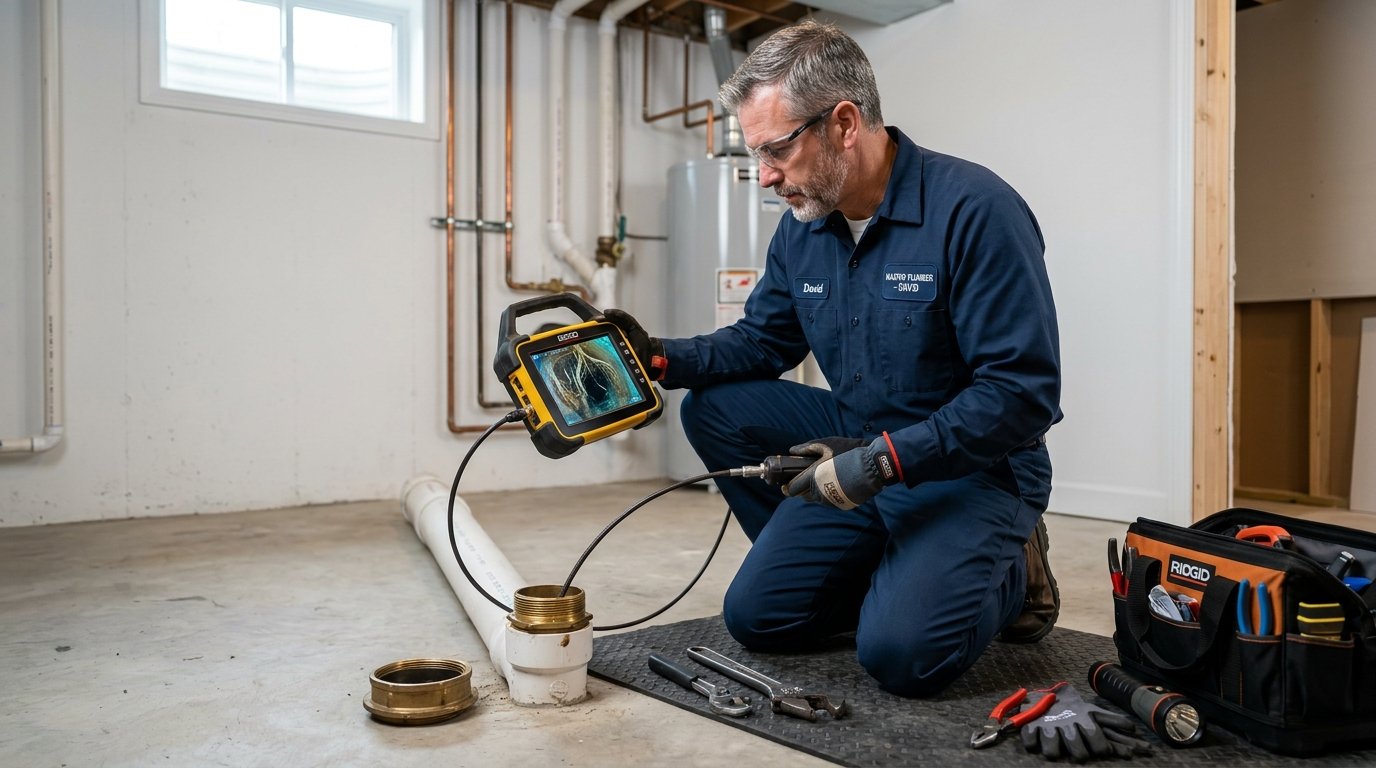
Our 5-Step Commercial Diagnostic Workflow
- Fixture Isolation & Surcharge Mapping: We determine whether the failure is local to a single floor sink or system-wide across the entire kitchen drain battery. If multiple floor sinks and floor drains are bubbling simultaneously, the restriction lies downstream in the main 4″ or 6″ grease interceptor lateral.
- High-Resolution Color CCTV Sewer Inspection: We feed self-leveling HD optic inspection cameras with built-in 512 Hz radio sondes directly through the sink throat or cleanout riser. We visually inspect pipe integrity, locating sagged “bellies,” grease blanket thickness, root intrusion, and saponified soap dams.
- Acoustic and Thermal Sonde Mapping: In post-tensioned concrete slab facilities, we use digital underground locators to pinpoint the exact sub-slab depth and GPS coordinates of the clog down to the inch, preventing destructive, unnecessary slab cutting.
- Venting System Airflow Verification: We test DWV vent stacks for bird nest clogs, snow cap freezing, or mechanical grease mist coating using digital anemometers. A blocked vent stack creates a hydraulic vacuum that chokes floor sink flow.
- Trap Seal Integrity & Primer Flow Audit: We inspect the physical depth of the water seal and test the upstream trap primer valve under dynamic water pressure to verify consistent recharging.
11. Professional Remediation: Hydro-Jetting vs. Mechanical Descaling vs. Chemical Bio-Remediation
Eliminating commercial kitchen grease clogs demands aggressive mechanical force combined with biochemical treatment. Here is how our master plumbing team restores full hydraulic capacity:
1. High-Pressure Hot-Water Hydro-Jetting
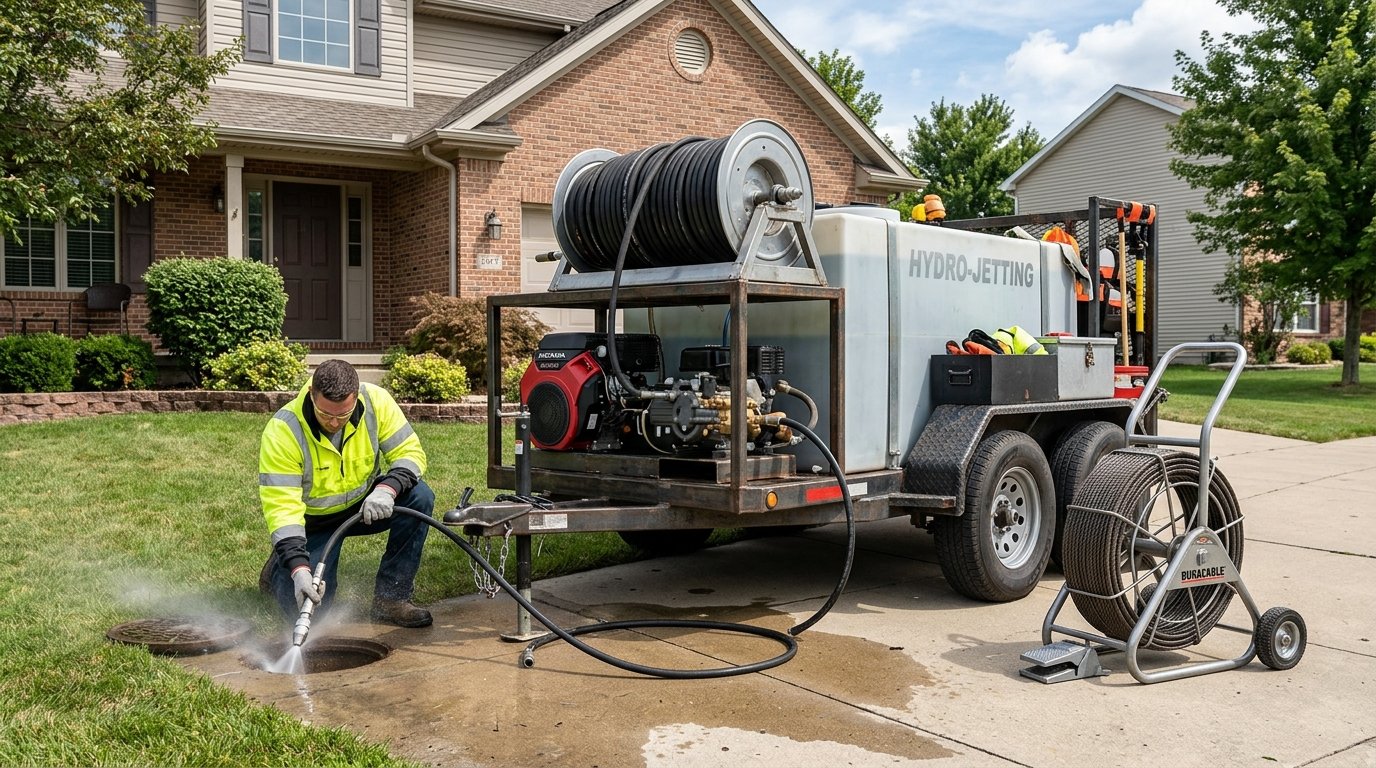
Cold-water jetting or standard mechanical snaking cannot melt stubborn grease. We utilize trailer-mounted industrial hydro-jetters generating water pressure up to **4,000 PSI at 12 to 18 GPM**, heated to **160°F (71°C)**.
Our rear-facing propulsion nozzles pull the hose deep into the sub-slab pipe, while rotating forward cutting orifices slice through hardened fatbergs, liquefying congealed grease and shearing the entire 360-degree pipe wall down to bare pipe material.
2. High-Speed Mechanical Chain Knockers
In older commercial kitchens with heavily tuberculated cast iron drainage pipes, grease binds to jagged iron oxide scale. Hydro-jetting alone cannot smooth the rough metal surface.
We deploy flexible-shaft high-speed rotating chain knockers equipped with carbide-tipped circular chains. Spinning at 2,000 RPM, the knocker pulverizes brittle scale, rust flakes, and rock-hard calcium saponification crusts without shattering the host pipe.
3. Bacterial Enzyme Bio-Remediation
Caustic chemical drain cleaners are strictly banned in commercial food facilities; they generate toxic fumes and burn pipe seals.
Instead, we implement automated bacterial bio-remediation dosing systems. These devices inject billions of live, non-pathogenic, vegetative bacterial cultures (such as Bacillus strains) directly into the floor sink line during overnight shutdown hours. The bacteria digest complex fatty acid chains, converting grease into harmless carbon dioxide and water before it can solidify.
12. Front Range Commercial Kitchen Case Studies: Lessons from Broomfield Restaurants
Real-world commercial plumbing failures provide the best insight for kitchen operators. Here are two recent emergency interventions handled by our Front Range emergency plumbing team:
Case Study 1: Peak-Hour Surcharge at an Interlocken Corporate Cafeteria
The Situation: An 800-seat corporate headquarters cafeteria serving tech campuses along the US-36 corridor experienced sudden floor sink backups beneath the central dishwashing station at 11:45 AM on a Tuesday. Over 60 gallons of scalding dishwater flooded the cookline.
The Finding: Our emergency camera inspection revealed that kitchen staff had removed the stainless dome strainer baskets three months prior because “rice and pasta noodles were draining too slowly.” Unfiltered starch and vegetable oils had combined with hot dishwashing water, creating a 35-foot-long gelatinous starch-grease obstruction in the 4-inch cast iron line beneath the cafeteria slab.
The Master Plumber Solution: Our team deployed a 4,000 PSI hot-water jetter through the exterior grease interceptor cleanout, working backward to flush the obstruction out toward the tank without blowing wastewater back inside the dining facility. We cleared the line in 90 minutes, reinstalled lockable tamper-resistant dome strainers, and provided full health department documentation for immediate afternoon reopening.
Case Study 2: Sewer Gas Mystery at a Broomfield Fast-Casual Eatery
The Situation: A fast-casual restaurant in Flatiron Marketplace received repeated customer complaints regarding a repulsive rotten-egg odor near the drink refill station. Air testing detected 12 PPM of hydrogen sulfide.
The Finding: Diagnostic smoke testing identified an untrapped indirect waste hub drain buried behind a newly installed beverage dispensing cabinet. The contractor who installed the soda machine three years prior had tied into an abandoned rough-in line, failing to verify whether a trap primer was active. The trap was bone dry. Sewer gas from the city main was entering the restaurant directly beneath the soda fountain ice dispenser.
The Master Plumber Solution: We excavated the dry line, installed a new ASSE 1018 pressure-drop trap primer fed from the ice machine potable supply line, rebuilt the proper 2-inch vertical air gap, and conducted an immediate post-installation smoke test. Hydrogen sulfide levels dropped to 0.0 PPM within 20 minutes.
13. Preventive Maintenance Protocols: Daily, Weekly, and Monthly Checklists
Preventing catastrophic floor sink backups requires daily operational discipline combined with certified master plumber quarterly maintenance.
| Frequency | Task / Component | Responsible Party | Operational Objective |
|---|---|---|---|
| Daily (End of Shift) | Empty and sanitize all dome and basket strainers | Kitchen Closing Crew | Prevent solid food scraps from decomposing inside the trap basin. |
| Daily | Pour 1 gallon of hot clean water into dry or low-use floor sinks | Kitchen Closing Crew | Replenish trap water seals subject to evaporation. |
| Weekly | Inspect air gap physical clearances (minimum 1″ or 2x diameter) | Kitchen Manager | Verify discharge hoses have not slipped below flood rims. |
| Weekly | Apply bio-enzymatic drain maintainer down floor sink throats | Kitchen Manager | Digest grease biofilms and eliminate drain fly breeding sites. |
| Monthly | Test trap seal primer valves for dynamic actuation | Facility Maintenance | Ensure primers are not stuck closed by mineral scale. |
| Quarterly | Professional CCTV camera inspection and hot hydro-jetting | Licensed Master Plumber | Shear grease accumulations before hydraulic surcharge occurs. |
| Biannually | Full grease interceptor baffle and pump-out audit | Licensed Master Plumber | Prevent downstream interceptor surcharge into kitchen branch drains. |
14. Emergency Response Protocol: What to Do When Your Floor Sink Floods Right Now
If your commercial kitchen floor sinks are currently overflowing, execute this immediate emergency response protocol:
- Halt All Water-Consuming Equipment Immediately: Turn off commercial dishwashers, three-compartment sink faucets, ice machines, and combi-steamers. Continuing to run equipment forces hundreds of additional gallons of wastewater across your kitchen floor.
- Never Plunge an Indirect Waste Sink: Plunging creates intense hydraulic shock waves that blow out rubber slip-joint connections on indirect prep pipes, sending wastewater behind walls and under refrigeration equipment.
- Do Not Pour Chemical Caustic Drain Cleaners: Pouring acid or lye into a surcharging sink creates a pool of hazardous chemicals that will splash onto emergency plumbing technicians and melt PVC drain components.
- Divert Wastewater Away from Food Prep Areas: Use rubber squeegees and absorbent containment booms to direct overflow away from walk-in coolers, dry food storage, and dining areas toward waterproof floor drain troughs.
- Call a Licensed Commercial Emergency Plumber Immediately: Contact our rapid-response commercial plumbing team at (303) 647-3363. We dispatch commercial service trucks equipped with hydro-jetters, cameras, and certified master plumbers within minutes across Broomfield and the Denver Metro corridor.
Frequently Asked Questions (FAQ)
What is the minimum legal air gap distance for a commercial floor sink?
Under International Plumbing Code (IPC) Section 802.2.1, the minimum required air gap must be at least twice the effective diameter of the indirect waste discharge pipe, but under no circumstances can it be less than 1.0 inch (25.4 mm). For potable food prep equipment, such as commercial ice machines and culinary sinks, this physical air gap is mandatory to prevent siphonage and backflow cross-contamination.
Why do drain flies keep returning even after we bleach our floor sinks?
Bleach washes over the surface of thick organic grease biofilms in seconds without penetrating the protective extracellular polymeric matrix shielding fly larvae. To permanently eradicate drain flies (Psychodidae), the mechanical slime layer must be physically scrubbed or hydro-jetted, followed by treatment with biological enzymatic cleaners that digest the organic matter the larvae feed on.
Can I remove the dome strainer basket in my floor sink to make it drain faster?
No. Removing the dome or basket strainer is a direct violation of IPC Section 802.3 and health department sanitation codes. While removing the basket temporarily allows water to swirl down faster, it allows food solids, bone shards, and silverware to enter the P-trap, creating massive sub-slab clogs downstream that require expensive emergency hydro-jetting.
How often should commercial kitchen floor sinks and grease laterals be hydro-jetted?
High-volume commercial kitchens (fast food, diners, corporate cafeterias) should have their sub-slab kitchen branch drains and floor sink laterals hydro-jetted every three to six months. Moderate-volume restaurants can maintain proper flow with biannual jetting, provided daily strainer maintenance and grease interceptor pumping schedules are strictly followed.
What causes rotten egg smells coming from floor sinks in a commercial bar or kitchen?
A rotten egg odor indicates hydrogen sulfide gas ($H_2S$) leaking from the sanitary sewer system due to a compromised P-trap water seal. This happens when the trap seal evaporates from heat or disuse, is siphoned out by negative pressure in unvented pipes, or when an automated trap seal primer valve fails due to hard water mineral scale clogging.
Commercial Kitchen Plumbing Emergency in Broomfield?
Don’t let a surcharging floor sink shut down your restaurant or trigger health inspection penalties. Our licensed master plumbers provide 24/7 rapid-response emergency hydro-jetting, camera inspection, and code compliance restoration.