
You walk down the pipe corridor of an industrial laundry, hospital central plant, or district-heated commercial complex in Broomfield, and a violent shock wave rattles your teeth. BANG! CLANG! BOOM! The entire overhead six-inch condensate return header jumps off its spring hangers. Insulation blankets rip away as pipe elbows shake violently back and forth. Down in the boiler room, steam billows from the atmospheric condensate receiver tank vent, while natural gas utility bills have spiked by nine thousand dollars in a single billing cycle.
Your steam traps have failed wide open.
Don’t write this off as “normal steam noise.”
Violent hammering in a condensate line is a deadly life-safety hazard. When live, 250°F+ high-pressure steam blows straight through an eroded steam trap orifice into a low-temperature condensate return pipe, the steam contacts sub-cooled liquid water. It doesn’t mix peacefully.
The steam bubble implodes violently within milliseconds. Cold water rushes into the void at sonic speeds, creating localized shock pressures exceeding 1,000 PSI. Under ASME B31.1 Power Piping and IPC mechanical standards, these hydraulic shock waves shear pipe hangers, crack cast-iron valve bodies, and rip butt-weld joints apart.
Let’s examine the thermodynamics of commercial steam trap failure modes, calculate flash steam generation, diagnose thermal shock water hammer, and review master plumber ultrasonic and thermographic restoration protocols.
1. The Thermodynamics of Steam Traps: What Does a Steam Trap Actually Do?
Steam is one of the most efficient heat transfer fluids known to physics.
When one pound of water boils into steam at atmospheric pressure, it absorbs 970.3 BTU of latent heat of vaporization without changing temperature by a single degree. That latent heat travels down commercial pipes to air handler heating coils, domestic water heat exchangers, or industrial sterilizers.
As the equipment extracts that latent heat, the steam condenses back into liquid water—known as condensate.
Condensate has surrendered its latent heat. It cannot transfer significant warmth anymore. If condensate lingers inside a heat exchanger, it forms a cold liquid boundary layer that “waterlogs” the coil, causing heat transfer to collapse by 80% to 90%.
The Steam Trap’s Two Sacred Duties
A commercial steam trap is an automatic valve engineered to perform two contradictory tasks:
- Discharge Condensate & Non-Condensable Gases Instantly: Allow sub-cooled liquid water, air, and carbon dioxide to drain freely into the condensate return system.
- Hold Back Live Steam Hermetically: Seal shut 100% tight the instant live, vaporous steam reaches the trap orifice, preventing valuable steam energy from escaping down the drain.
2. Steam Trap Failure Modes: Failed Open vs. Failed Closed
When an industrial steam trap fails, it fails in one of two catastrophic directions:
| Failure Mode | Physical Mechanism | Impact on HVAC / Process Equipment | Impact on Condensate Return System | Financial & Life-Safety Consequences |
|---|---|---|---|---|
| Failed Closed (Cold Trap) | Orifice plugged with pipe scale, valve stem seized shut, or ruptured thermostatic bellows expanded permanently. | Severe waterlogging. Heat exchanger tubes fill with cold condensate. Air handler freeze-stat trips in winter. | Condensate line runs cold. Zero flow reaches boiler feed tank. Boiler low-water cut-off (LWCO) trips. | Pipes freeze in Colorado winter; building loses heating; heating coils rupture from frost expansion. |
| Failed Open (Blow-Through Trap) | Wire-drawn orifice seat, eroded valve disc, unseated inverted bucket, or corroded thermodynamic disc. | Equipment continues heating, but steam flow velocity spikes dramatically across control valves. | Live steam blasts into condensate line. Return pipe pressurizes. Severe condensation-induced water hammer. | Massive fuel waste ($5,000-$15,000/yr per trap). Condensate pipe weld fractures. Scalding hazard in boiler room. |
3. Three Commercial Steam Trap Architectures Compared
Commercial facilities utilize three distinct mechanical operating designs:
| Trap Technology | Internal Operating Principle | Primary Commercial Application | Vulnerability to Failure |
|---|---|---|---|
| Inverted Bucket (Mechanical) | Inverted submerged bucket floats when steam enters, closing the discharge valve. Sinks when water enters. | Steam main drip legs, laundry ironers, autoclaves, high-pressure process steam. | Loses internal water prime during pressure drops; bucket sinks and trap fails wide open. |
| Float & Thermostatic – F&T (Mechanical/Thermostatic) | Closed spherical ball float modulates condensate level continuously; thermostatic air vent vents non-condensable air. | HVAC air handler heating coils, shell-and-tube domestic water heaters, modulating heat exchangers. | Float ball pinhole puncture fills ball with water, sinking it and failing closed. Bellows fatigue. |
| Thermodynamic Disc (Kinetic) | Hardened flat disc snaps shut over orifice seat via high-velocity steam dynamic pressure and Bernoulli effect. | Outdoor steam tracing, superheated steam drip stations, compact unit heaters. | Rapid disc chattering (cycling hundreds of times a minute) erodes seating faces; fails wide open. |
4. How Inverted Buckets Lose Their Prime & Fail Open
In heavy commercial heating and industrial laundry systems, the **inverted bucket steam trap** is the workhorse.
Inside a cast iron or cast steel body, an open-ended cylindrical bucket hangs upside down, submerged in liquid water. Condensate enters under the bottom of the bucket. As long as water fills the bucket, the bucket sinks by gravity, pulling the valve head away from the top orifice seat to allow continuous condensate drainage.
When live steam enters beneath the bucket, the steam displaces the water inside the bucket, providing buoyant lift.
The bucket floats upward. The valve head snaps into the top orifice, hermetically closing off steam escape.
The Physics of Prime Loss
What causes an inverted bucket trap to suddenly fail wide open?
Loss of prime.
An inverted bucket trap requires a permanent water seal (prime) inside the body to provide buoyant lift. If boiler steam pressure fluctuates rapidly, or if superheated steam hits the trap, the water prime instantly flashes into vapor.
Without liquid water inside the chamber, the bucket loses all buoyancy. The bucket sinks to the bottom like an iron anchor.
The discharge orifice stays wide open. 100% of the live boiler steam blasts straight through into the low-pressure condensate pipe.
5. Condensation-Induced Water Hammer: The 1,600-to-1 Volume Collapse
Why does live steam in a condensate line cause massive, explosive pipe shaking?
Many facility managers believe water hammer only occurs when a fast-closing solenoid valve abruptly stops moving water. That is hydraulic shock.
In steam systems, the most destructive phenomenon is Condensation-Induced Water Hammer (CIWH).
The Mathematical Implosion
At atmospheric pressure, one cubic foot of liquid water expands into approximately **1,600 cubic feet of vaporous steam**.
Reverse that equation:
When one cubic foot of steam condenses back into liquid water, its physical volume collapses by a factor of 1,600 to 1 in a fraction of a millisecond.
- A failed-open steam trap shoots 240°F live steam into a 150°F condensate return pipe carrying sub-cooled liquid water.
- The steam forms a pocket or bubble encapsulated by cooler liquid water.
- Rapid heat transfer across the water-steam interface causes the steam inside the bubble to instantly condense.
- The bubble collapses into a near-perfect localized vacuum.
- Surrounding walls of liquid water rush inward from all directions to fill the vacuum pocket at velocities exceeding **100 feet per second**.
- The opposing liquid slugs collide violently at the center of the collapsed bubble.
Where $\rho$ is water density, $c$ is the speed of sound in water (~4,700 ft/s), and $\Delta v$ is the velocity change.
The resulting pressure spike shoots from 15 PSI to over **1,200 PSI** in less than three milliseconds. That shock wave travels through the piping at the speed of sound, slamming into 90-degree elbows, tearing welded flanges, and cracking cast iron steam trap bodies.

6. Supersonic Wire-Drawing & Orifice Erosion
Even without a stuck bucket, a steam trap can fail open through gradual microscopic wear known as wire-drawing.
When high-pressure steam (such as 15 PSI or 50 PSI) forces its way across a microscopic clearance gap between the valve seat and plug, the steam velocity accelerates past **Mach 1 (1,100+ ft/s)**.
If boiler feedwater contains abrasive iron oxide particles, silica scale, or dissolved carbonic acid ($H_2 CO_3$), that supersonic steam jet acts like an industrial sandblaster.
A razor-thin groove is cut across the stainless steel seat face. Plumbers call this a “wire draw” because the groove looks like it was etched with a hot steel wire.
Once wire-drawing begins, steam leaks through continuously. The leak widens each day. Within months, an 1/8″ orifice erodes into a 1/4″ jagged chasm, bleeding thousands of pounds of high-pressure steam every twenty-four hours.
7. Master Plumber Diagnostic Protocols: Ultrasonic Testing & Infrared Thermography
Never guess whether a steam trap is functioning. Opening test tees on high-pressure steam systems without proper PPE can cause fatal steam scalding burns.
Our commercial master plumbers utilize non-invasive, digital dual-testing technologies:
| Diagnostic Technology | Field Test Procedure | Healthy Trap Signature | Failed Open (Blow-Through) Signature | Failed Closed (Plugged) Signature |
|---|---|---|---|---|
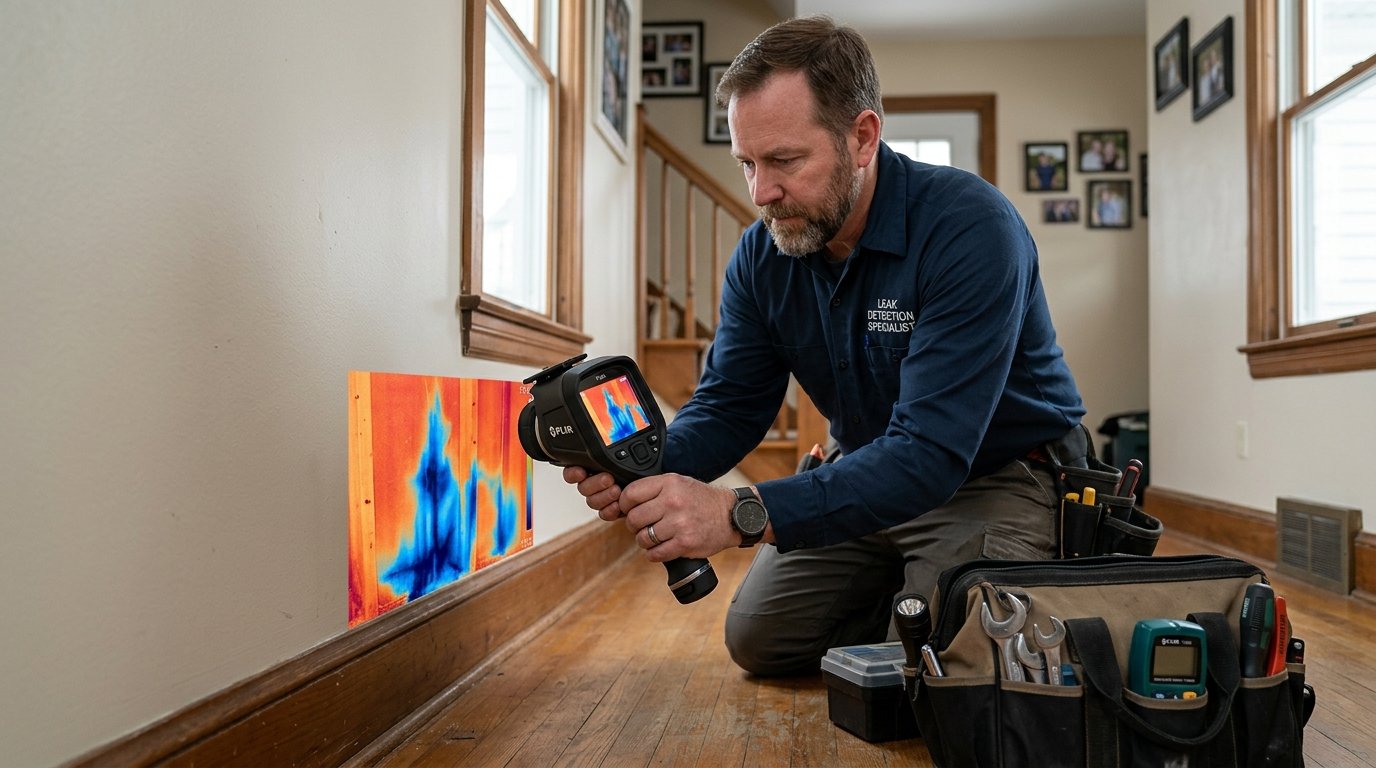
| Ultrasonic Acoustic Stethoscope | Place 25-40 kHz contact probe on trap discharge orifice casting. | Distinct cyclical sound: Rushing flow during discharge, followed by absolute silence when seat closes. | Continuous, deafening high-frequency rushing roar without cycling or pausing. | Dead silence. No liquid flow sound even when upstream equipment is running at full load. |
| Infrared Thermal Imaging (FLIR) | Measure temperature differential (ΔT) between inlet pipe and outlet pipe. | Significant temperature drop across trap (typically 15°F to 40°F lower on condensate discharge). | Inlet and outlet pipes exhibit near-identical high temperatures (ΔT ≈ 0°F). Entire condensate pipe is boiling hot. | Inlet pipe is cool or ambient room temperature (< 120°F). Heat exchanger is cold and waterlogged. |
| Three-Valve Test Station (Sight Glass / Test Tee) | Close downstream isolation valve; crack open 1/2″ brass test cock to atmosphere. | Intermittent discharge of hot liquid water and slight flash vapor puffs. | Continuous, high-velocity jet of screaming, invisible dry live steam blasting out of the test port. | Zero discharge. No water or steam escapes test port. |
8. The Financial Equation: Calculating Fuel Waste via Napier’s Formula
To demonstrate why facility directors must repair blown traps immediately, we calculate steam loss using **Napier’s Formula for Steam Discharge**:
Where:
- $P_{abs}$ = Absolute steam pressure upstream of trap (PSIA = Gauge PSI + 12.2 PSI at Broomfield elevation)
- $d$ = Diameter of the eroded orifice (inches)
For a modest 15 PSIG commercial heating system with an eroded 1/4″ ($0.25″$) orifice:
Operating 24 hours a day across a 6-month Front Range winter heating season (4,320 hours):
At an average commercial natural gas cost of $18.00 per 1,000 lbs of generated steam:
A single 1/4″ blown steam trap wastes over $3,200 every single winter. In a facility with eight blowing traps, you are literally throwing $25,000 in fuel up the boiler chimney.
9. Flash Steam Physics in Condensate Return Lines
What is flash steam, and how do you differentiate it from live blow-through steam?
When high-pressure condensate (say, at 50 PSIG and 298°F) passes through a steam trap into a 0 PSIG atmospheric condensate return header, it enters a lower-pressure environment where water cannot physically exist as a liquid above 212°F.
The sensible heat in the water between 298°F and 212°F ($298 – 212 = 86\text{ BTU/lb}$) is instantly converted into latent heat:
Where $h_{f1}$ is liquid enthalpy at inlet pressure, $h_{f2}$ is liquid enthalpy at return pressure, and $h_{fg2}$ is latent heat of evaporation at return pressure ($970.3\text{ BTU/lb}$).
For 50 PSI discharging to atmosphere:
Roughly 9% of the liquid water instantly flashes into vapor. While 9% by weight sounds small, vapor takes up hundreds of times more physical space. If condensate return pipes are undersized, this flash steam chokes the pipe, creating back-pressure that stalls upstream heat exchangers.
10. ASME B31.1 Power Piping Standards & Pipe Stress Analysis
Under ASME B31.1, steam and condensate piping systems must be engineered to withstand continuous thermal expansion cycles and dynamic reaction forces.
Carbon steel pipe expands significantly under temperature:
For a 100-foot run of Schedule 40 carbon steel pipe heating from 60°F to 260°F ($\Delta T = 200^\circ\text{F}$):
That 100-foot pipe expands more than an inch and a half. If the pipe is anchored rigidly between two concrete walls without expansion loops, flex joints, or spring hangers, the thermal compressive stress exceeds 38,000 PSI, ripping welds and shearing anchor bolts. When condensation-induced water hammer hits that already stressed pipe, catastrophic structural rupture is inevitable.
11. Real-World Case Study: Broomfield Healthcare Facility Emergency
In January 2026, an urgent call summoned our master plumbers to an acute medical surgical pavilion in Broomfield. Surgical autoclave sterilizers were faulting with wet-steam alarms, and the overhead condensate main in the sterile processing basement was hammering so violently that ceiling drywall dust rained onto clean cart staging areas.
Our ultrasonic and thermographic survey audited thirty-two steam traps across the central plant:
- The Findings: Six inverted bucket traps on the 60-PSI main steam header had completely lost their prime due to a sudden boiler feedwater pressure dip. All six traps were blowing live 307°F steam directly into the 15-PSI gravity return header.
- The Hammer Origin: The live steam was colliding with sub-cooled 135°F condensate draining from the HVAC preheat coils. The resulting CIWH shock waves measured over 850 PSI on digital piezoelectric pressure transducers.
- The Resolution: We isolated the failed traps using the bypass manifolds, installed heavy-duty Armstrong 812 inverted bucket rebuild modules with hardened chrome-carbide orifices, added check valves downstream of each station to prevent back-pressure siphoning, and restored quiet, stable condensate drainage within five hours.
12. Condensate Pipe Sizing, Pitch & Receiver Tank Venting
Condensate lines are two-phase flow conduits carrying both liquid water and flash steam.
To ensure proper gravity flow without waterlogging:
- Continuous Downward Slope: Horizontal condensate lines must pitch downward toward the condensate pump receiver tank at a minimum slope of **1/4″ per 10 feet (1:480)**. Sags or bellies in condensate lines form liquid pockets where steam bubbles become trapped, creating localized water hammer launch sites.
- Atmospheric Vent Sizing: Condensate receiver tanks must feature an unrestricted, full-size outdoor atmospheric vent pipe. A 50-gallon receiver tank requires a minimum 2″ vent line; if the vent is undersized, flash steam pressurizes the tank, blowing condensate out of overflow pipes and stalling upstream traps.
13. Preventive Maintenance Checklist: Keeping Steam Traps Certified
To keep boiler operating costs low and eliminate destructive water hammer:
- Quarterly Ultrasonic Audits: Scan every steam trap with a 38 kHz airborne and contact ultrasonic probe. Log decibel readings and cycle frequency.
- Semi-Annual Strainer Blowdown: Blow down Y-strainer dirt pockets upstream of each trap to flush out rust scale before it lodges in the orifice seat.
- Annual Infrared Thermography: Capture radiometric infrared thermal images of inlet vs outlet piping across all trap stations. Replace any trap displaying a temperature differential (ΔT) under 10°F.
- Feedwater Chemistry Control: Maintain boiler feedwater sulfite and amine treatment to eliminate dissolved oxygen and carbon dioxide, preventing carbonic acid corrosion grooving across trap internal linkages.
14. Safety Hazards & NFPA 85 Boiler Interlocks
Superheated steam and boiling condensate represent life-safety hazards capable of causing third-degree scalding burns in under 0.25 seconds.
Under NFPA 85 (Boiler and Combustion Systems Hazards Code) and ASME Boiler & Pressure Vessel Code Section I, commercial boiler plants must incorporate strict mechanical safeguards:
- Blowdown Separator Vessels: Intermittent and continuous boiler blowdown cannot be discharged directly into municipal sewers. High-temperature water must enter a rated blowdown tank where flash steam vents to atmosphere and drain water cools below **140°F** via automatic tempering cold-water valves before entering city drains per IPC 701.7.
- Low-Water Cut-Off (LWCO) Tripping: When multiple steam traps fail open, condensate flash steam blows out receiver vents instead of condensing into feed water. If make-up water valves cannot keep pace with water loss, boiler water levels drop precipitously. Dual probe and float-type low-water cut-offs trip the burner circuit to prevent catastrophic dry-firing and boiler shell explosion.
15. Thermostatic Bellows Degradation & Alcohol Fill Physics
Why do thermostatic steam traps in HVAC reheat coils fail so unpredictably?
Thermostatic bellows traps utilize a sealed corrugated capsule containing a calibrated liquid mixture—typically water and alcohol—whose boiling point is precisely **10°F to 15°F below that of saturated steam**.
- When sub-cooled condensate surrounds the bellows, the internal alcohol mixture remains liquid. The bellows contracts by internal spring tension, opening the discharge orifice.
- When live steam reaches the trap, the heat boils the internal alcohol fill. Vapor pressure inside the capsule expands the corrugated bellows, driving the hardened ball valve into the seat.
However, chronic water hammer shocks or cyclic thermal fatigue over hundreds of thousands of cycles work-hardens the thin bronze or stainless steel corrugations.
The bellows develops a microscopic pinhole fatigue fracture:
- The internal alcohol fill escapes into the steam system.
- Atmospheric pressure and surrounding system pressure equalize inside the bellows capsule.
- Without volatile liquid to boil and generate internal vapor pressure, the bellows permanently contracts.
- The trap fails wide open. Live boiler steam blasts continuously into the condensate return line, waterlogging the entire air handling unit.
16. Condensate Receiver Cavitation vs. Pressure-Powered Pumps (PPT)
What happens to electric condensate return pumps when steam traps blow through?
Standard duplex condensate return packages utilize electric centrifugal pumps designed to move condensate at **140°F to 180°F**.
When failed steam traps blow live steam into the return header, the temperature of condensate entering the receiver tank surges to **210°F or higher**.
At 210°F, the vapor pressure of water ($h_{vp}$) approaches atmospheric pressure. The centrifugal pump’s Net Positive Suction Head Available ($NPSH_a$) collapses completely. The instant the electric motor starts:
- Condensate flashes into vapor inside the pump impeller eye.
- The pump vapor-locks and cavitates violently.
- Pumping action ceases completely. The receiver tank overflows onto the mechanical room floor, while the boiler runs low on water.
In high-temperature commercial environments, master plumbers eliminate electric pumps entirely by retrofitting Non-Electric Pressure-Powered Pumping Traps (PPT) (such as Spirax Sarco Pivotrol or Armstrong Pivot). Pumping traps use high-pressure motive steam or compressed air acting upon an internal float mechanism to push boiling condensate against high heads without impellers, motors, or cavitation risk.
17. Bypass Station Valving Protocols & Operator Error
Why do maintenance operators inadvertently cause severe condensate water hammer?
Most commercial steam trap stations are piped with a three-valve bypass manifold: an upstream isolation globe valve, a downstream isolation check valve, and a manual central globe bypass valve bridging the two lines.
During a severe winter cold snap when an air handling unit reheat coil is struggling to satisfy a room thermostat, building maintenance technicians will frequently crack open the manual bypass valve “just a quarter turn” to force additional heat through the coil.
This manual bypass creates an uncontrolled disaster:
- The manual bypass valve has no automatic steam-stopping mechanism. It remains continuously open.
- Raw high-pressure boiler steam bypasses the steam trap orifice completely, screaming into the condensate line at sonic velocity.
- Within fifteen minutes, the return line begins knocking with violent condensation-induced water hammer shocks.
- The boiler feed tank begins venting high-temperature flash steam, wasting hundreds of gallons of treated demineralized water every hour.
Under modern institutional engineering guidelines, manual bypass valves on commercial steam trap stations must be fitted with lockable valve wheels and chained shut. Technicians should only open bypass valves during supervised emergency maintenance while actively observing sight glasses and pressure gauges. Documenting bypass valve positions on daily boiler logs prevents inadvertent steam blow-through and safeguards maintenance staff from scalding risks.
Frequently Asked Questions About Commercial Steam Traps
Why is my condensate pipe banging and shaking violently?
Violent banging in condensate pipes is almost always condensation-induced water hammer caused by a steam trap failing open. When live steam escapes into cooler condensate water, the steam bubbles collapse instantly, creating shock waves exceeding 1,000 PSI that shake pipes violently.
How often should commercial steam traps be inspected and tested?
Under federal Department of Energy and ASHRAE guidelines, commercial steam traps operating up to 30 PSI should be tested at least once annually. High-pressure process steam traps should be tested semi-annually using ultrasonic acoustic detectors.
What is the difference between flash steam and live blow-through steam?
Flash steam is a normal thermodynamic byproduct when hot condensate drops from high pressure to low pressure in the return line; it appears as gentle white vapor. Live blow-through steam is high-pressure, invisible, roaring steam blasting continuously through an eroded trap orifice.
Can you repair an inverted bucket steam trap without replacing the whole valve?
Yes. Most commercial inverted bucket traps feature replaceable internal mechanism modules. Technicians can unbolt the top cap, replace the internal stainless steel bucket, linkage, and orifice seat assembly, and re-gasket the body without cutting piping.
Who provides commercial steam trap inspection and replacement in Broomfield, Colorado?
Broomfield Emergency Plumber provides 24/7 commercial boiler, steam piping, and steam trap diagnostic repair across Broomfield, Boulder, and the Denver metro area. Call our master commercial technicians at (303) 647-3363.
Severe Steam Pipe Banging or Soaring Boiler Fuel Costs?
Don’t let blown steam traps destroy your piping with water hammer or drain thousands of dollars from your facility budget. Our licensed commercial master plumbers provide precision ultrasonic steam trap audits, rebuilds, and ASME B31.1 piping repairs across Broomfield and the Front Range.