
At 11:30 PM on a Friday evening in a landmark commercial office complex along Highway 287 in Broomfield, an eerie settling sound echoes through the basement engineering corridor. Down beneath the concrete foundation slab, six feet below grade, a four-inch cast-iron sanitary sewer main has suffered a structural collapse. The floor drain in the main electrical switchgear vault has stopped draining; standing raw sewage is creeping across the concrete floor toward multi-million-dollar high-voltage transformers.
The building engineer calls an apprentice drain cleaner. The drain cleaner runs a mechanical 3/4-inch cable auger down the cleanout.
Thirty feet down the line, the cable binds solid. The electric motor stalls.
When the technician reverses the drum, the cable pulls up chunks of reddish-black rusty gravel, wet sub-base sand, and soggy potting soil.
The mechanical snake didn’t clear a clog; it punched straight through the paper-thin bottom of the rusted cast-iron pipe into the dirt void below!
Throughout the Front Range, tens of thousands of commercial properties built between 1950 and 1995 rely on gray cast-iron drain-waste-vent (DWV) piping conforming to **ASTM A74** and **CISPI 301**.
Cast iron was hailed as the century-long pipe material.
In reality, commercial sewage chemistry destroys cast iron from two opposite directions: **acidic channel rot carving out the bottom invert**, and **microbially induced sulfuric acid crown corrosion dissolving the top ceiling**.
Let’s examine the dual chemical degradation mechanisms of commercial cast iron, audit internal tuberculation, explore high-speed **Picote carbide chain flail milling**, and review trenchless CIPP epoxy structural rehabilitation.
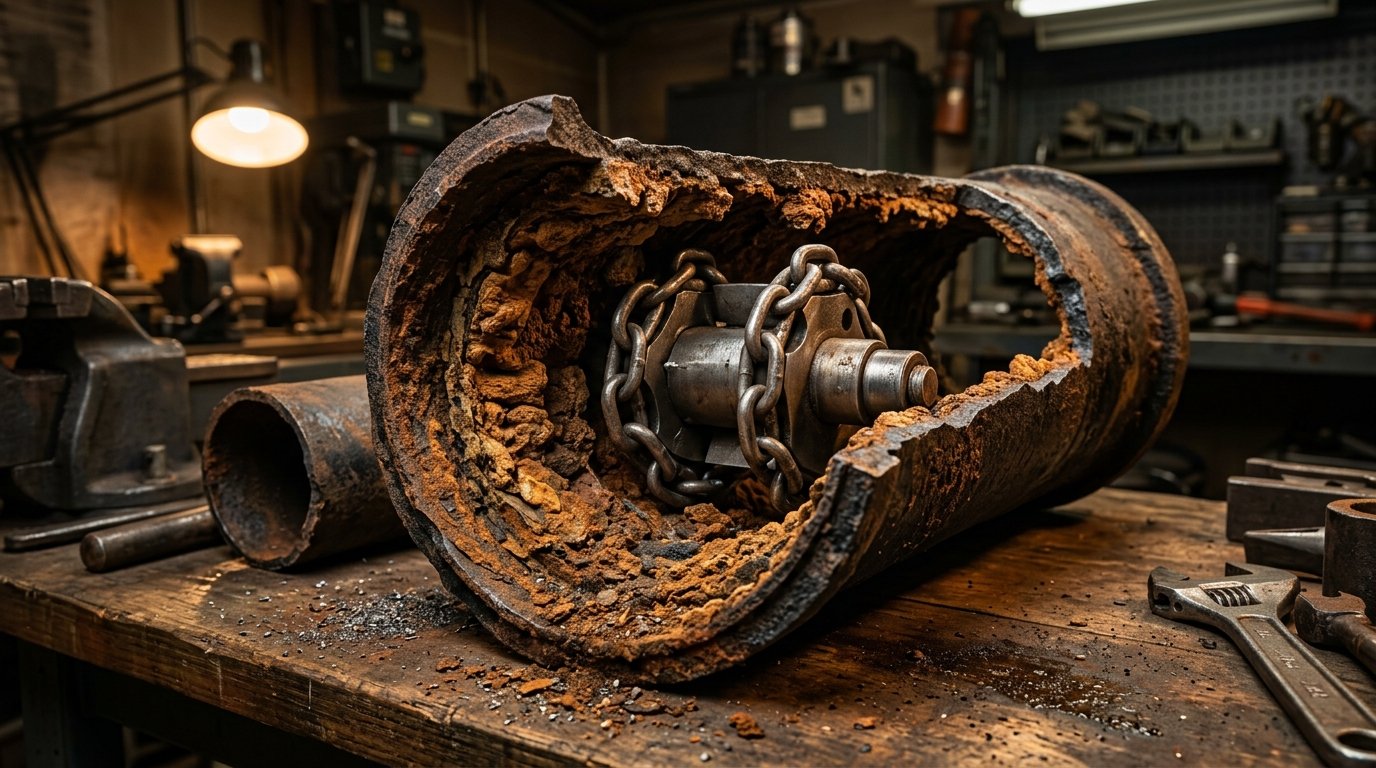
1. The Dual Chemical Engines: Invert Channel Rot vs. Crown Corrosion
Why do commercial cast-iron sewer pipes fail while municipal water mains in the same building stay solid?
Sewer pipes operate under partial flow (gravity drainage). The bottom of the pipe carries liquid wastewater, while the top half of the pipe contains moist sewer air.
This hydraulic environment creates two totally separate, hyper-aggressive chemical attack zones:
| Degradation Mechanism | Pipe Geometry Zone | Primary Chemical / Biological Agent | Physical Structural Impact |
|---|---|---|---|
| Bottom Channel Rot (Invert Erosion) | Bottom 120 Degrees (Flow Channel) | Abrasive grease, sand, acidic soda pop, caustic chemical drain openers, and grease scouring. | Carves a smooth, knife-edge groove through the bottom wall. The bottom vanishes completely, washing out structural soil bedding! |
| Crown Corrosion (MIC Acid Attack) | Top 120 Degrees (Air Headspace) | Hydrogen sulfide gas ($H_2S$) converted into **pure sulfuric acid ($H_2SO_4$)** by aerobic Thiobacillus bacteria. | Dissolves the pipe crown into a soft, yellow-white gypsum paste. The top of the pipe collapses under concrete slab load! |
| Internal Tuberculation | 360 Degrees Internal Perimeter | Ferric hydroxide ($Fe(OH)_3$) and calcium carbonate crust formed by anaerobic electrochemical cells. | Jagged rust mounds narrow pipe internal diameter by up to 60%, acting like Velcro for paper and solid waste. |
🧪 The Biochemistry of Microbial Induced Corrosion (MIC)
In sluggish commercial sewer runs, anaerobic bacteria in bottom sludge reduce organic sulfates into hydrogen sulfide gas ($H_2S$).
The $H_2S$ gas off-gasses into the pipe headspace. There, it condenses against the damp pipe ceiling. Aerobic bacteria (specifically Acidithiobacillus ferrooxidans) living on the moist iron oxidize the $H_2S$ gas into concentrated sulfuric acid:
$$H_2S + 2O_2 \xrightarrow{\text{Bacteria}} H_2SO_4$$
The sulfuric acid attacks the cast-iron wall, converting metallic iron into soft, soluble ferrous sulfate ($FeSO_4$). Over ten to twenty years, a 3/8-inch solid iron pipe ceiling is eaten away down to the thickness of a postage stamp!
2. Invert Channel Rot: The Invisible Sub-Slab Void Hazard
When the bottom of a buried cast-iron pipe dissolves away, property owners rarely see water backing up initially.
Every time tenants flush toilets or commercial kitchens wash dishes, wastewater discharges directly into the soil beneath the building foundation.
This creates an acute geotechnical liability across Broomfield’s expansive bentonite clay:
- Soil Hydro-Compaction & Voids: Escaping sewage washes fine sand and gravel bedding downstream into the municipal sewer, carving massive subterranean underground cavern voids beneath the concrete slab.
- Foundation Heave & Cracking: Highly expansive Front Range clays absorb millions of gallons of sewage water, swelling with pressures exceeding **10,000 pounds per square foot (PSF)**. Slabs crack, tile floors tent upward, and structural steel support columns displace!
- Radon & Sewer Gas Invasion: The collapsed bottom invert provides an open channel for explosive methane and carcinogenic radon gas to migrate into the building foundation.

3. Why Chemical Cleaners Accelerate Cast Iron Destruction
When commercial drains slow down, building janitors often dump caustic lye (sodium hydroxide) or commercial sulfuric acid down the line.
This practice is an absolute catastrophe for aging cast iron:
â˜ ï¸ The Acid Drainage Trap
Heavy commercial chemical drain openers have a specific gravity of nearly 1.84 (almost twice as heavy as water).
The acid sinks straight to the bottom of the pipe and pools in the low spots and bellies.
Instead of clearing the clog, the concentrated acid reacts violently with the degraded cast iron, generating intense exothermic heat ($T > 220^\circ\text{F}$) that shatters brittle cast-iron joints and eats through the remaining metal within seventy-two hours!
4. Mechanical Descaling: High-Speed Picote Chain Milling
In the past, severely scaled cast iron left property owners with only one option: jackhammering through structural concrete slabs, destroying expensive marble tile and commercial flooring.
Today, master commercial plumbers restore cast iron non-invasively using **high-speed flexible-shaft mechanical chain knockers (Picote Maxi Miller / Ridgid K9)**:
| Descaling Tool | Rotational Speed & Drive | Mechanical Action | Pipe Wall Restoration Result |
|---|---|---|---|
| Carbide-Tipped Cyclone Chain Knocker | 1,800 to 2,200 RPM via enclosed flexible steel shaft | Centrifugal force flings circular hardened tungsten carbide chain links flush against 360 degrees of the inner pipe circumference. | Shatters brittle iron tuberculation and petrified calcium scale, scraping the pipe interior down to clean, smooth gray metal. |
| Picote Smart Cutterâ„¢ Hub | 2,000 RPM with diamond/carbide abrasive panels | Grinds jagged metal rust fins and lateral branch intruding pipe stubs flush with the main host pipe wall. | Prepares an ultra-smooth cylindrical substrate perfectly profiled for epoxy structural lining. |
| Water-Assisted Rotary Descaling Flush | Low-pressure flushing water (20 PSI @ 5 GPM) while milling | Sweeps pulverized iron rust dust downstream into an extraction cleanout before it can settle and cement. | Leaves the pipe completely debris-free without exerting hydraulic pressure on weakened pipe crowns. |
5. Trenchless Structural CIPP Epoxy Lining: Rebuilding the Pipe from Within
Once the cast iron is milled clean of tuberculation, what prevents raw sewage from leaking through the missing bottom channel?
Master commercial plumbers deploy **Cured-in-Place Pipe (CIPP) Structural Epoxy Inversion Lining**:
- Full-Length CCTV Video Audit: A digital self-leveling sewer camera maps every inch of the host pipe, measuring exact lengths, offsets, and connection locations of incoming restroom branches.
- Epoxy-Impregnated Felt Liner Preparation: A non-woven polyester needle-felt tube coated with an impermeable polyurethane outer membrane is saturated (wet-out) under vacuum with a high-performance **two-part commercial epoxy resin** engineered for ASTM F1216 structural compliance.
- Compressed Air Inversion: The liner is inserted through an existing cleanout; compressed air shoots the flexible tube inside-out through the degraded cast iron pipe. The wet epoxy presses tightly against the host pipe walls, bridging missing bottom channels and structural fractures.
- Thermal / UV Steam Cure: Controlled steam or ultraviolet light arrays cure the epoxy into a rock-hard, seamless structural composite pipe within three hours.
- Robotic Lateral Reinstatement: A remote-controlled robotic cutting unit (Picote Smart Spider) travels inside the newly lined main, surgically cutting open all covered lateral branch tee connections with sub-millimeter precision.
📠Manning’s Equation: Restoring Flow Dynamics
$$Q = \frac{1.486}{n} \cdot A \cdot R_h^{2/3} \cdot S^{1/2}$$
Old, corroded cast iron has a rough Manning’s roughness coefficient of $n = 0.015\text{ to }0.018$.
The newly installed smooth epoxy liner has a glass-like Manning’s coefficient of $n = 0.009$.
Even though the liner reduces internal diameter by roughly 1/4 inch, total gravity flow capacity actually INCREASES by up to 25%, completely eliminating recurring paper clogs and grease backups for fifty years!
🚨 Emergency Commercial Cast Iron Drain Service in Broomfield
Are commercial basement drains backing up with rust chunks? Has a drain camera revealed bottom channel rot or severe crown acid pitting?
Call our 24/7 commercial emergency master plumbers at (303) 647-3363. We dispatch commercial drain restoration crews equipped with high-speed Picote chain knockers, robotic reinstatement cutters, digital CCTV inspection cameras, and ASTM F1216 certified structural CIPP lining rigs.