
A violent spring thunderstorm stalls over the foothills and rolls directly across Broomfield, dropping two inches of torrential rain in forty-five minutes. Water sheets off acres of commercial asphalt parking lots, corporate roof membranes, and delivery truck bays, funneling into the engineered stormwater detention basin at the edge of the property. Suddenly, the water stops draining through the primary concrete outlet structure. The basin liquid level rises rapidly, submerging parking stalls, flooding underground utility vaults, and creeping toward ground-floor commercial tenant entrances.
Your facility’s stormwater management system has suffered a catastrophic hydraulic bottleneck.
Across the Colorado Front Range, civil stormwater compliance is not optional. The Mile High Flood District (MHFD) and local municipal stormwater engineering departments (City and County of Broomfield, Boulder County, Adams County) enforce strict urban drainage criteria.
Commercial property owners are legally required to control runoff flow rates, capture suspended solids, and prevent downstream municipal culvert scouring.
Yet, commercial facility managers rarely inspect what lies beneath the heavy galvanized trash racks of their outlet vaults. When spring storms carry tree branches, tumbleweeds, trash, and heavy gravel into the basin, microscopic debris chokes multi-stage orifice restrictor plates. The basin transforms from an engineered flow-control reservoir into an uncontrolled flood zone.
Let’s examine the hydraulic engineering of commercial stormwater detention, calculate flow through restrictor orifices using open-channel fluid mechanics, diagnose sump basin pump failures, and master emergency restoration protocols.
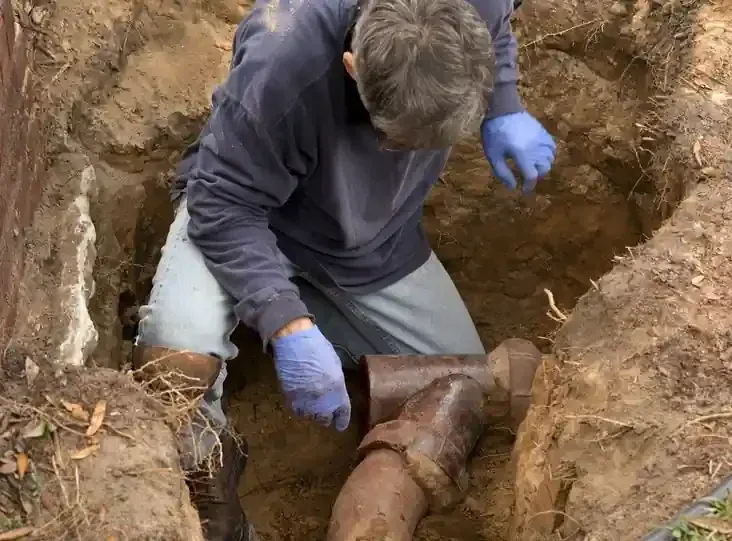
1. The Civil Hydraulics of Detention vs. Retention in Colorado
Many commercial property managers confuse detention basins with retention ponds:
- Detention Basins (Dry Ponds): Designed to temporarily hold stormwater runoff during peak rainfall events, slowly metering water out over 40 to 72 hours through precision restrictor plates until the basin is bone dry.
- Retention Ponds (Wet Ponds): Maintain a permanent pool of standing water year-round, utilizing biological uptake and extended settlement time to trap fine silt and pollutants before water overflows through high-stage weirs.
The Front Range Urban Hydrology Challenge
Prior to commercial development, natural native prairie sod absorbed rain like a sponge. Once paved with impermeable asphalt and concrete, runoff volume multiplies by up to 800%.
Without engineered control structures, hyper-velocity stormwater would rip municipal creek banks apart and inundate regional river systems.
To govern flow, civil engineers utilize **Manning’s Equation** to calculate gravity pipe capacity:
$$Q = \frac{1.49}{n} A R_h^{2/3} S^{1/2}$$
Where:
- $Q$ = Volumetric flow rate in cubic feet per second (CFS)
- $n$ = Manning’s roughness coefficient (0.012 for smooth PVC/HDPE; 0.015 for concrete culverts)
- $A$ = Cross-sectional flow area ($\text{ft}^2$)
- $R_h$ = Hydraulic radius ($A / P_{\text{wetted}}$)
- $S$ = Slope or hydraulic gradient of the pipe
If sediment, asphalt grit, or gravel accumulates along the bottom of the culvert, the wetted perimeter increases and the effective diameter shrinks, choking off discharge capacity before water even reaches the municipal connection.
2. Multi-Stage Orifice Restrictor Plates: The Choke Point Anatomy
Inside the primary concrete outlet structure sits the heart of the detention system: the **multi-stage orifice restrictor plate**.
| Stage Level | Hydraulic Device Type | Target Storm Frequency | Primary Vulnerability |
|---|---|---|---|
| Low Stage (Water Quality) | Micro-orifice plate (2 to 4-inch drilled holes) | Minor rain events / 80th percentile storms | Pine needle, leaf & silt blinding |
| Middle Stage (Detention) | Engineered rectangular or circular weir | 2-year to 10-year flood events | Plastic bag & trash wrap-around |
| High Stage (Emergency Overflow) | Open-top grate / broad-crested weir | 100-year catastrophic deluge | Tumbleweed & dimensional lumber damming |
The Orifice Flow Equation
The discharge rate ($Q$) through the low-stage water quality orifice is governed by the standard Torricelli orifice equation:
$$Q = C_d A \sqrt{2 g H}$$
Where:
- $C_d$ = Coefficient of discharge (typically 0.60 to 0.62 for sharp-edged steel orifice plates)
- $A$ = Area of the orifice opening ($\text{ft}^2$)
- $g$ = Gravitational acceleration ($32.2\text{ ft/s}^2$)
- $H$ = Effective hydraulic head (vertical water height above the orifice center)
Look closely at the formula: Flow is dictated by the area ($A$).
In high-altitude Colorado climates, autumn leaves, spring cottonwood seeds, and dried tumbleweeds wash straight toward the outlet box.
If trash wraps around the perimeter of the orifice plate, reducing the effective opening area by just 50%, the discharge capacity collapses. Water piles up in the basin, transforming an engineered 48-hour drain cycle into a multi-day stagnant pond that breeds mosquitoes and triggers code enforcement violations.
3. Sump Basin Lift Pumps: Handling Sub-Surface Seepage
Many commercial complexes in Broomfield feature sunken truck loading docks or subterranean parking ramps located below the natural grade of the stormwater retention pond.
These low zones cannot drain by gravity. They drain into **commercial stormwater sump vaults** equipped with high-volume submersible dewatering pumps (such as Tsurumi KTZ, BJM, or Liberty StormPro series).
Common Mechanical Failures in Dewatering Sump Basins:
- Abrasive Impeller Erosion: Stormwater isn’t clear domestic water. It carries abrasive quartz silica sand, asphalt aggregate, and decomposed granite. Standard cast-iron pump impellers wear razor-thin within two seasons, losing their hydraulic lift curve. Commercial basins require high-chrome semi-vortex impellers.
- Float Switch Mud Choke: Suspended clay and fine silt settle around the mechanical float switches. The float gets pinned to the bottom of the basin by packed silt. When the loading dock floods with three feet of water, the pump motor never receives the electrical signal to start.
- Thermal Overload Lockout: Inflow water temperatures during a summer thunderstorm can exceed 80°F, while continuous high-head pumping draws maximum full-load amps (FLA). Without proper water circulation across the motor jacket, internal thermal overload switches trip open, killing power until the motor cools.
4. Colorado Municipal Codes & The Mile High Flood District (MHFD) Rules
In the Denver-Boulder metro area, commercial property owners operate under stringent multi-jurisdictional drainage regulations:
📜 Colorado Urban Drainage Mandates
- 40-Hour Drain Time: Water Quality Capture Volume (WQCV) must drain out completely within 40 to 72 hours following a storm to prevent anoxia and mosquito breeding (Culex mosquito vector control for West Nile Virus).
- Sediment Forebay Maintenance: Retention basins must feature concrete sediment forebays at all pipe inlets to capture coarse gravel. Property managers must dredge these forebays whenever accumulated sediment reaches 50% of the forebay depth.
- Trash Rack Open Area Ratio: Galvanized trash racks protecting low-stage orifices must have a net free open area at least four times larger than the area of the orifice itself to prevent sudden hydraulic blinding.
Failure to maintain commercial stormwater vaults results in formal Notice of Violation (NOV) citations from municipal civil engineering inspectors, accompanied by steep escalating daily penalties.
5. Emergency Restoration Protocol: High-Pressure Culvert Flushing
When an emergency storm flood threatens a commercial facility, standard commercial plumbers with small sewer snakes cannot clear the line. Master civil drainage specialists deploy heavy industrial equipment:
- Emergency Trash Rack Extraction: Technicians clear choked debris off the exterior trash rack using safety hooks, prying away wedged logs and sediment mats to relieve surface hydrostatic pressure.
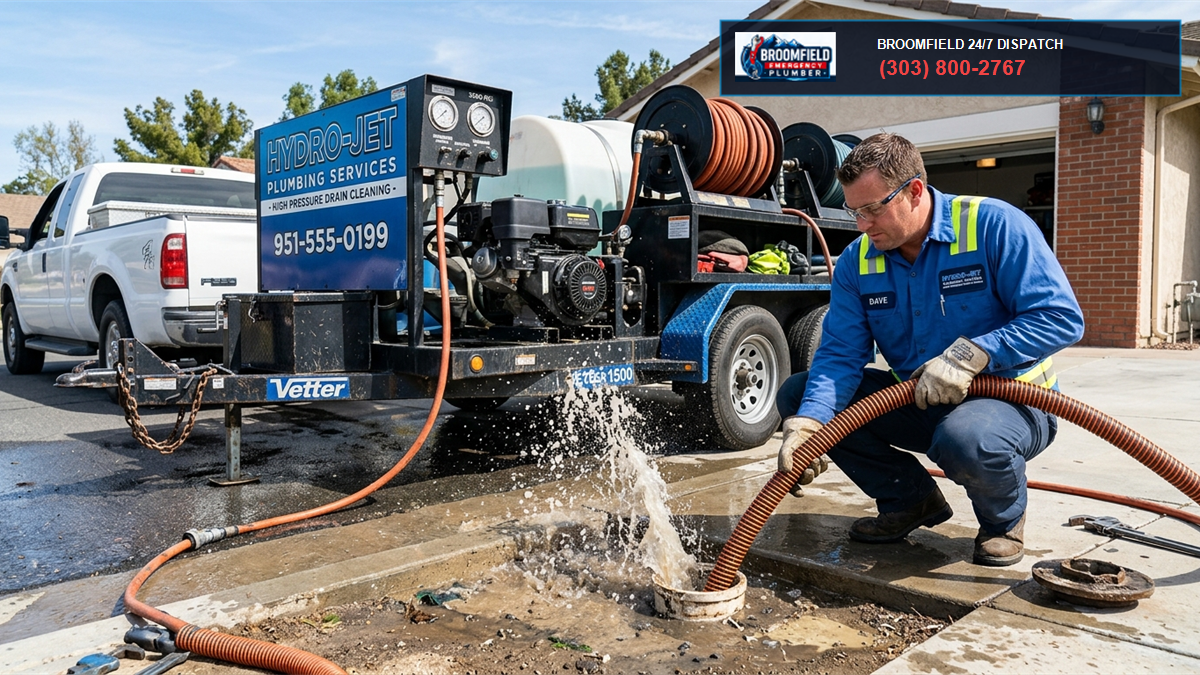
- High-CFM Vacuum Extraction: A heavy industrial combination sewer truck (Vactor or Camel) positions its 8-inch suction boom directly over the outlet vault. Silt, heavy gravel, and wet debris are evacuated straight to the debris tank.
- Thermal Hydro-Jetting with Bulldozer Nozzles: We insert a 1-inch commercial jetter hose operating at 2,500 PSI and 60 to 80 GPM through the downstream discharge culvert. Specialized forward-penetrating chisel nozzles or “Bulldozer” skid nozzles blast compacted clay silt backward into the collection pit, restoring full hydraulic cross-section.
- Check Valve & Backwater Flap Inspection: Inspect the ductile iron flap gate on the basin outfall. Ensure the hinge swings freely and doesn’t get jammed open by rocks, which would allow swollen municipal creek waters to backfeed into your private parking lot.
Commercial Stormwater FAQs
Who is legally responsible for maintaining a commercial detention pond in Colorado?
Under municipal development agreements in Broomfield, Westminster, and Boulder, the commercial property owner or commercial property management association is 100% legally and financially responsible for all inspection, maintenance, and dredging of on-site stormwater detention basins. The city only maintains public storm mains located within dedicated public right-of-ways.
How often should commercial stormwater outlet structures be inspected?
At a minimum, commercial drainage outlet structures and trash racks should be physically inspected semi-annually (early spring before runoff and late autumn after leaf fall), and immediately following any major rainstorm exceeding one inch of precipitation in twenty-four hours.
What causes commercial loading dock sump pumps to burn out during storms?
Loading dock pumps fail primarily due to abrasive silt ingestion that seizes mechanical seals, float switches becoming pinned in mud, or severe discharge line blockages that force the pump to run against deadhead pressure, overheating motor windings. Installing industrial-grade dewatering pumps with built-in thermal protection and dual piggyback mechanical floats prevents these failures.
Can I pump stagnant detention pond water into the sanitary sewer during an emergency?
ABSOLUTELY NOT. Discharging stormwater, surface runoff, or pond drainage into the municipal sanitary sewer is strictly illegal under local plumbing codes (IPC Section 301.3) and the Clean Water Act. Pumping millions of gallons of storm runoff into the sanitary grid overwhelms regional wastewater treatment facilities and carries severe federal and municipal criminal penalties.