
Step into the commercial kitchen of any high-volume restaurant along the Front Range on a busy Friday night. Six line cooks are searing ribeyes, deep fryers are bubbling at three hundred and seventy-five degrees, and the dish pit is blasting commercial sanitizers down the triple-sink. Every minute, gallons of molten animal tallow, butterfat, and emulsified vegetable oil pour down the drains. If that greasy stew hits the municipal sewer line under the street, it cools. It solidifies. It turns into rock-hard white calcium saponification blocks known as fatbergs. Within hours, raw sewage backs up through your kitchen floor drains, shutting your dining room down in the middle of dinner service.
Grease interceptor compliance isn’t just about avoiding a municipal fine. It’s the thin line between a profitable restaurant and a catastrophic public health shutdown.
Across Broomfield, Denver, Boulder, and Adams counties, industrial pretreatment inspectors don’t give second chances. If your grease trap violates the regional “25 Percent Rule” or your interceptor is chronically undersized, municipal authorities can slap you with punitive surcharges, revoke your wastewater discharge permit, or physically pad-lock your water meter.
Yet, commercial facility managers and restaurant operators constantly confuse the two fundamentally different technologies tasked with catching grease: **Hydromechanical Grease Interceptors (HGIs)** and **Gravity Grease Interceptors (GGIs)**.
Let’s cut through the sales pitches, dissect the fluid mechanics of fats, oils, and grease (FOG) separation, examine exact sizing equations, review local Colorado municipal codes, and walk through how master plumbers diagnose and resolve catastrophic interceptor failures.

1. The Physics and Chemistry of FOG: Why Warm Kitchen Waste Turns into Solid Concrete
To manage grease, you have to understand what happens to it when it leaves the stainless-steel sink. Fats, oils, and grease enter the drain line in a liquid state because hot dishwater ranges between 120°F and 160°F.
As this wastewater travels downstream, two independent processes turn liquid grease into a destructive sewer-destroying paste:
Thermal Solidification
Animal fats—specifically beef tallow, lard, and chicken fat—have a melting point between 95°F and 115°F. The moment that liquid fat mixes with cold rinse water or contacts cold underground cast-iron or PVC pipe (where Front Range subterranean soil sits at 50°F to 55°F), its temperature plummets below the congealing threshold. Within four feet of the sink drain, grease solidifies into a waxy, sticky inner coating that shrinks the effective diameter of your drain pipes.
Saponification (The Fatberg Reaction)
The far more sinister threat is chemical. In wastewater collections, free fatty acids in grease undergo a chemical saponification reaction with calcium ions leached from concrete sewer pipes, hard municipal water, and commercial alkaline detergents:
$$\text{Free Fatty Acids} + \text{Calcium Ions } (\text{Ca}^{2+}) \longrightarrow \text{Calcium Saponified Soap Salts (Fatberg)}$$
This isn’t soft kitchen lard you can melt with hot tap water. Calcium dioleate and calcium palmitate form an insoluble, rock-hard soap crust. It resists chemical drain cleaners, laughs at standard motorized drain snakes, and bonds directly to pipe walls like structural mortar.
âš ï¸ The Dangerous Hot Water Myth
Line cooks often think that running scalding 180°F rinse water down the sink melts grease clogs away. It doesn’t. It merely pushes the liquefied grease thirty feet further down the line into the uninsulated municipal main, where it cools rapidly, saponifies, and triggers a massive city sewer backup. If city inspectors trace a main-line grease blockage back to your kitchen lateral, your business is legally liable for thousands of dollars in municipal jetting and cleanup costs.
2. Hydromechanical vs. Gravity Grease Interceptors: Engineering Differences
Plumbing blueprints frequently specify “grease trap” interchangeably, but the International Plumbing Code (IPC Chapter 10) and Uniform Plumbing Code (UPC Chapter 10) strictly divide grease abatement into two distinct classes based on fluid dynamics and detention volume.
| Engineering Feature | Hydromechanical Interceptor (HGI) | Gravity Interceptor (GGI) |
|---|---|---|
| Applicable Standard | ASME A112.14.3 / CSA B481 / PDI G-101 | IAPMO / UPC Chapter 10 / ASTM C1613 |
| Physical Location | Indoors: Under-sink, recessed in kitchen slab | Outdoors: Buried in parking lot or delivery alley |
| Operational Principle | Air entrainment, internal baffles & flow control | Massive liquid volume & extended hydraulic retention time |
| Typical Capacity | 10 to 100 GPM (20 to 200 lbs grease storage) | 500 to 2,500+ gallons liquid volume |
| Flow Control Device | Mandatory external or integral vented air restrictor | None (gravity flow driven by pipe slope) |
| Pump-Out Frequency | Bi-weekly to monthly (manual or vacuum truck) | Every 30 to 90 days via commercial vacuum tanker |
| Installed Cost Range | $1,500 – $6,500 complete | $12,000 – $35,000+ (excavation, traffic lids) |
How Hydromechanical Interceptors Work (The Vented Flow Control Secret)
An HGI relies on active fluid dynamics rather than massive storage tanks. It separates grease inside a compact, heavy-duty polyethylene or stainless-steel basin (typically 20 to 100 gallons) by utilizing an external vented flow control fitting.
When wastewater rushes from the sink, it passes through an engineered orifice plate. This plate restricts flow to the interceptor’s certified rating (e.g., 25 GPM or 50 GPM). Simultaneously, an air intake pulls atmospheric air into the stream, creating microbubbles. Grease droplets cling to these tiny air bubbles and shoot rapidly to the liquid surface inside the baffle chamber, separating up to 95% of FOG despite the small tank volume.
Master Plumber Reality: If an unqualified handyman removes the vented flow control fitting because “the sinks were draining too slowly,” the interceptor fails instantly. Wastewater surges through the baffles at hyper-velocity, washing grease directly out of the discharge port and into the city main.
How Gravity Grease Interceptors Work (Extended Retention)
Gravity interceptors are massive two- or three-compartment precast concrete or fiberglass vaults buried outside the building. They function purely on liquid detention time.
According to Stokes’ Law, the upward terminal velocity ($v_t$) of a spherical oil droplet rising through water is governed by:
$$v_t = \frac{g (\rho_w – \rho_o) d^2}{18 \mu}$$
Where:
- $g$ = acceleration due to gravity ($9.81\text{ m/s}^2$)
- $\rho_w$ = density of water ($1,000\text{ kg/m}^3$)
- $\rho_o$ = density of oil / grease ($\approx 910\text{ kg/m}^3$)
- $d$ = diameter of the grease droplet
- $\mu$ = dynamic viscosity of water
Because oil is lighter than water, it floats. But tiny droplets take time to rise. A gravity interceptor slows wastewater flow to a crawl, providing twenty to thirty minutes of quiescent hydraulic retention time. Grease floats to the top, forming an oily mat. Dense food solids settle to the bottom as sludge. Clear gray water in the center leaves through a submerged downturned effluent pipe.
3. Colorado Municipal Codes & The Strict 25 Percent Rule
In the Colorado Front Range—including the City and County of Broomfield, Boulder Public Works, Metro Water Recovery (Denver), and Arvada Utilities—municipal pretreatment regulations are fiercely enforced.

What is the “25% Rule”?
Under local municipal pretreatment ordinances, a grease interceptor is legally non-compliant when the combined thickness of the floating grease layer (top) plus the settled solids layer (bottom) exceeds 25% of the total liquid working depth of the tank.
Let’s look at the math for an exterior 1,000-gallon concrete gravity interceptor with an active liquid depth of 48 inches:
Maximum Allowable Accumulation:
$$\text{Max Allowed FOG + Sludge} = 48\text{ inches} \times 0.25 = 12\text{ inches}$$
If your top grease cap measures 8 inches thick, and your bottom settled solids layer measures 5 inches thick, your total accumulation is 13 inches ($27.1\%$).
Result: Immediate code violation.
Once accumulation surpasses 25%, the hydraulic retention volume drops. Wastewater rushes through the tank too fast. The grease layer begins short-circuiting under the baffle tees and discharging straight into the city main.
Municipal Pretreatment Fines & Discharge Permit Penalties
Colorado municipal inspectors do not just eyeball your tank. They drop a calibrated, clear acrylic sampling core (a “Sludge Judge”) straight down through the center inspection port to measure the exact layer thicknesses.
- First Violation: Written notice to pump out within 7 days, mandatory pumping manifest submission.
- Second Violation (within 12 months): Re-inspection fees (\$250–\$500) plus municipal administrative fines.
- Chronic Non-Compliance: Monthly wastewater surcharge fees on your utility bill (often \$1,000+ per billing cycle) or an emergency administrative order terminating commercial sewer service.
4. Step-by-Step Grease Interceptor Sizing: IPC vs. UPC Methodologies
How do plumbers size an interceptor for a brand-new restaurant or a fast-casual kitchen retrofit? Guesswork leads to undersized traps that back up constantly or oversized vaults that generate lethal hydrogen sulfide gas.
Method A: Fixture Unit Flow Rate Method (ASME / IPC)
For hydromechanical interceptors, the International Plumbing Code sizes units based on the drainage fixture-unit (DFU) values and maximum discharge capacity of connected commercial equipment:
| Commercial Fixture Type | Drain Outlet Size | Design Flow Rate (GPM) |
|---|---|---|
| Single-compartment prep sink | 1.5 inches | 7.5 GPM |
| Two-compartment pot sink | 1.5 inches | 15.0 GPM |
| Three-compartment sanitize sink | 2.0 inches | 25.0 GPM |
| Commercial dish machine (pre-rinse) | 2.0 inches | 20.0 GPM |
| Commercial wok station | 2.0 inches | 15.0 GPM |
| Mop basin / Service sink | 3.0 inches | 15.0 GPM |
Example Sizing Calculation: A bistro connects a three-compartment pot sink (25 GPM) and a mop basin (15 GPM) to an indoor HGI.
$$\text{Total Design Flow Rate} = 25\text{ GPM} + 15\text{ GPM} = 40\text{ GPM}$$
Applying a 75% diversity coefficient for non-simultaneous discharge yields a minimum required interceptor rating of 30 GPM (e.g., a certified 35 GPM / 70 lb capacity hydromechanical unit).
Method B: Gravity Interceptor Volume Formula (UPC Chapter 10)
For exterior concrete vaults serving high-volume dining establishments, the Uniform Plumbing Code uses a dining-capacity formula:
$$V = D \times GL \times ST \times \left(\frac{HR}{2}\right) \times LF$$
Where:
- $V$ = Minimum grease interceptor volume (gallons)
- $D$ = Number of seats in dining room
- $GL$ = Gallons of wastewater per meal (typically 5 gallons for full service, 2.5 for fast food)
- $ST$ = Storage factor (typically 1.7 for commercial kitchens with flatware)
- $HR$ = Hours of kitchen operation per day
- $LF$ = Loading factor (1.25 for highway/arterial locations, 1.0 for standard neighborhood)
For a 120-seat Front Range restaurant operating 12 hours a day with full dishwashing:
$$V = 120 \times 5 \times 1.7 \times \left(\frac{12}{2}\right) \times 1.0 = 6,120\text{ gallons storage over retention cycle}$$
Municipalities typically permit this volume to be satisfied by a 1,500-gallon vault pumped out on a mandatory 30-day recurring maintenance contract.
5. Why Commercial Interceptors Fail: Diagnosing Emergency Disasters
When our commercial emergency dispatch team gets an urgent call from a local restaurant owner at 8:00 PM on a Saturday, it’s almost always one of four catastrophic failures:
1. Baffle Wall / Dip Tube Collapse
Precast concrete vaults built before the 2000s were frequently manufactured without epoxy liners. The wastewater inside a grease trap produces hydrogen sulfide gas ($H_2S$). Acidophilic bacteria (*Acidithiobacillus*) oxidize this gas into concentrated sulfuric acid ($H_2SO_4$).
The sulfuric acid eats away the concrete roof and structural baffle walls. Eventually, the downturned PVC or cast-iron outlet tee falls off the wall into the bottom sludge. Without an outlet tee, grease flows straight into the municipal sewer lateral, completely unrestricted.
2. The Flow Restrictor Tampering Trap
If kitchen dishwashers complain that the three-compartment sink takes twenty minutes to drain, rogue kitchen employees often unscrew the cleanout plug on the vented flow control fitting.
Now water bypasses the orifice plate. Water flows at 40 GPM through a 20 GPM interceptor. The turbulence emulsifies the floating grease layer, forcing it directly through the exit pipe.
3. Biogenic Chemical Emulsification
Some dishonest chemical sales companies pitch “miracle enzyme blocks” or “grease-eating solvent drippers” that claim to eliminate grease trap pumping forever.
Warning: These chemicals are citrus surfactants or hydrocarbon emulsifiers. They temporarily dissolve the grease bond, turning fats into microscopic suspended droplets. The grease doesn’t vanish—it slips past the baffles into the city main. Two hundred yards downstream, the emulsion breaks down, and the grease hardens into a city-blocking fatberg.
Legal Note: Using chemical or biological emulsifiers to bypass grease interceptors is strictly illegal under the International Plumbing Code (Section 1003.3.2) and local Front Range municipal pretreatment codes.
6. Emergency Restoration & Professional Maintenance Protocol
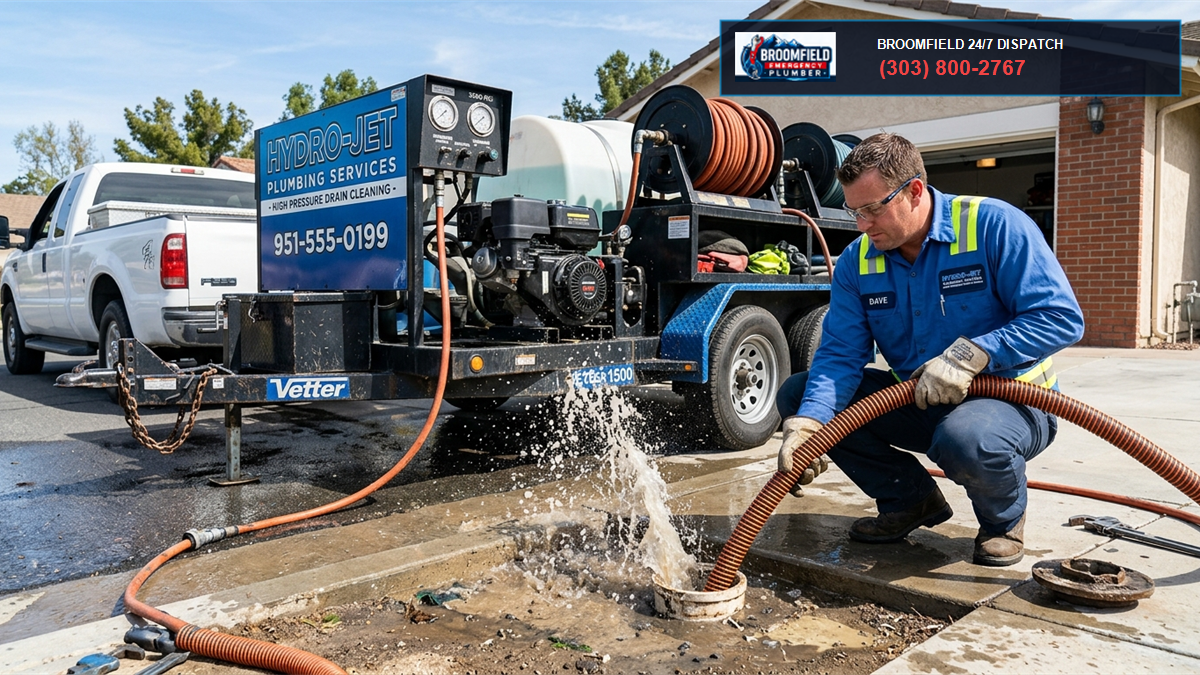
When an interceptor clogs solid, standard mechanical snake cables simply bore a temporary three-inch hole through the grease that closes back up within seventy-two hours. Permanent restoration requires heavy-duty mechanical and hydraulic intervention:
Phase 1: Total Vacuum Evacuation
A high-velocity vacuum tanker drops a 4-inch suction hose into all chambers. Both the floating grease cap and the heavy bottom grit/solids layer must be completely pumped down. The walls, baffles, and floor are pressure-washed with 140°F hot water to dislodge caked scale.
Phase 2: Thermal Hydro-Jetting with Flail Nozzles
The kitchen discharge laterals upstream and downstream of the trap are hydro-jetted using hot water (160°F) at 3,500 to 4,000 PSI. We utilize specialized rear-firing rotating nozzles (such as the Warthog WT-3/8 or spinning chain flail heads). The hot water melts the grease while mechanical shearing blasts the hardened calcium soap scale flush against the pipe walls.
Phase 3: Baffle and Air Vent Verification
We inspect the inlet and outlet dip tubes, confirm the presence of the flow control restrictor, clean out the air intake vent stack, and replace rotten rubber gaskets on indoor access lids to ensure 100% gastight, odor-free seals.
Commercial Grease Interceptor FAQs
Can I clean an under-sink hydromechanical grease trap myself?
Small 20-to-50-pound indoor grease traps can technically be cleaned manually by kitchen staff using scoops and buckets, but it is dirty, hazardous, and rarely done correctly. Staff must wear heavy nitrile gloves, eye protection, and respirators to guard against hazardous hydrogen sulfide gas. Crucially, grease must be placed into sealed waste barrels for licensed rendering pickup; you can never dump grease trap contents into trash dumpsters or down storm drains. Most restaurant operators contract a licensed commercial plumbing service to handle bi-weekly pump-outs and maintain legally required disposal manifests.
How often does an exterior 1,000-gallon grease interceptor need pumping?
Most full-service restaurants in Broomfield and the Denver Metro area must pump their exterior gravity interceptors every 30 to 90 days. The exact interval is determined by the “25% Rule.” If your restaurant serves heavy fried foods or high-volume breakfast items (bacon, sausage, butter), you may reach 25% capacity within four weeks. You must keep all disposal manifests on-site for a minimum of three years for municipal pretreatment audit inspections.
Why does my commercial kitchen smell like rotten eggs around the grease trap?
Sewer or rotten egg odors indicate one of three critical issues: (1) The neoprene access gasket on an indoor HGI cover has dried out, cracked, or deformed, allowing sewer gases to escape into the kitchen. (2) The internal baffles or vent lines are air-locked or clogged, forcing sewer gas out through the sink drains. (3) The interceptor has passed its 25% threshold, allowing massive bacterial colonies to generate toxic hydrogen sulfide gas. Immediate servicing and gasket replacement are required.
Are garbage disposals permitted upstream of a grease interceptor in Colorado?
Under the International Plumbing Code and most Colorado municipal amendments, commercial food waste disposers (garbage disposals) are generally prohibited from discharging directly into hydromechanical grease interceptors unless a specialized solids interceptor (strainer) is installed immediately ahead of the grease trap. Food solids settle to the bottom, rot, displace liquid retention capacity, and accelerate hydrogen sulfide acid formation.