
You invested thousands of dollars in a top-of-the-line condensing tankless water heater—a Navien, Rinnai, or Noritz—expecting endless, luxurious hot water and decades of energy savings. For the first two years, it performed like a dream. Now, four years after installation, taking a shower is an exercise in frustration. The water flow from your master shower head has dwindled to a weak trickle. Two minutes into your shower, the water suddenly turns ice cold for sixty seconds before surging back to scalding hot. Down in the basement, the digital display on your unit is flashing a bright red error code: **Navien E001**, **Rinnai Code 11**, or **Noritz Error 90**. Inside the cabinet, the copper heat exchanger is whistling and shrieking like an overheating tea kettle.
Your high-efficiency tankless water heater is choking to death on Front Range mineral scale.
You search the internet, run to the grocery store, buy three gallons of cheap household white vinegar, hook up a little plastic pump, and run a flush for forty-five minutes. You turn the unit back on. Nothing changes. The error code returns instantly.
Why? Because household vinegar is a mild culinary condiment, not an industrial descaling agent.
In hard water basins like Broomfield, Westminster, and Boulder County—where municipal water carries 8 to 12 grains of dissolved calcium and magnesium per gallon—neglecting a tankless water heater for three or four years transforms calcium carbonate into rock-hard, vitrified crystalline calcite. Mild acetic acid cannot penetrate that rock wall.
When mineral scale reaches this advanced stage, the unit requires a professional **closed-loop high-strength sulfamic acid chemical restoration**. Let’s dive into aqueous chemistry, examine heat transfer thermodynamics, decode manufacturer diagnostic fault matrixes, and show you how master plumbers restore dead heat exchangers back to 100% factory efficiency.
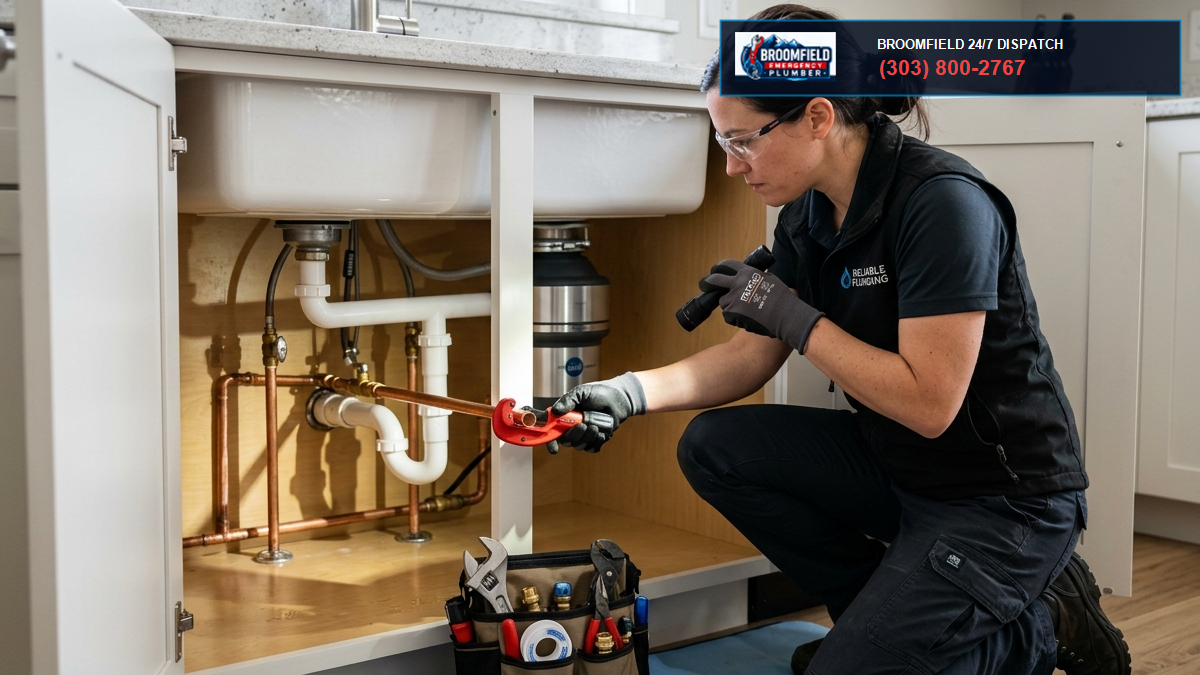
1. The Thermodynamics of Scale Formation: The “Inverse Solubility” Trap
Most chemical compounds become more soluble in water as temperature rises. Stir sugar or table salt into boiling water and it dissolves almost instantly.
Calcium carbonate (\( \text{CaCO}_3 \)) behaves in exact opposition to standard chemical laws. It exhibits a dangerous thermodynamic property known as **retrograde (inverse) solubility**.
The hotter the water gets, the less soluble calcium carbonate becomes.
The Precipitation Chemical Equation
When dissolved calcium bicarbonate enters the microscopic copper or stainless steel heat exchanger tubing and contacts metal heated to over 160°F by high-output gas burners, the chemical equilibrium shifts violently:
\text{Ca(HCO}_3)_2 \xrightarrow{\Delta \text{ Heat}} \text{CaCO}_3 \downarrow + \text{H}_2\text{O} + \text{CO}_2 \uparrow
Carbon dioxide gas bubbles off, and pure insoluble calcium carbonate precipitates directly onto the mirror-smooth interior metal walls.
The Thermal Insulator That Melts Metal
Copper is chosen for heat exchangers because of its phenomenal thermal conductivity: roughly 400 Watts per meter-Kelvin (\( \text{W/m}\cdot\text{K} \)).
Calcium carbonate scale, by contrast, is an astonishingly effective thermal insulator, possessing a thermal conductivity of only 1.0 to 2.2 \( \text{W/m}\cdot\text{K} \).
A paper-thin mineral scale buildup of just 1/16-inch (1.6 mm) reduces thermal heat transfer efficiency by over 15 percent! A scale layer of 1/8-inch reduces efficiency by nearly 30 percent.
Because heat from the 199,000 BTU gas flame cannot penetrate the scale layer to enter the water, heat backs up into the metal tubing itself. Copper tube wall temperatures skyrocket from an engineered 180°F to over 450°F to 600°F. The copper overheats, softens, and develops microscopic thermal stress fractures, destroying the heat exchanger completely.
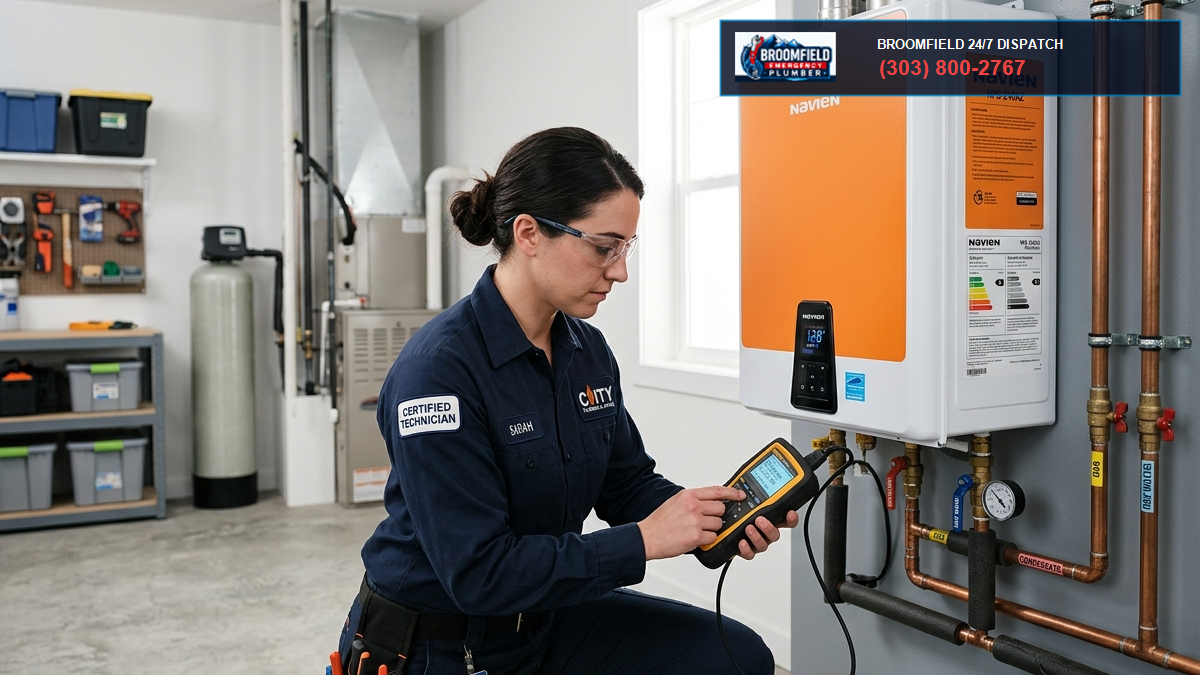
2. Why 5% Household Vinegar Fails on Neglected Systems
If you flush your tankless water heater faithfully every twelve months from the day it is installed, food-grade 5% white distilled vinegar works adequately as a mild preventive maintenance wash.
However, if a tankless unit has been neglected for three, four, or five years in Broomfield or Boulder, vinegar is completely useless. Here is the hard chemical reality:
| Chemical Property | Standard White Distilled Vinegar | Commercial Virgin Sulfamic Acid (\( \text{H}_3\text{NSO}_3 \)) |
|---|---|---|
| Active Chemical Agent | Acetic Acid (\( \text{CH}_3\text{COOH} \)) | Sulfamic Acid / Amidosulfonic Acid |
| Acid Concentration | Extremely Weak (4% to 5% by volume) | Industrial Strength (10% to 15% solution) |
| Acid Dissociation Constant (\( \text{p}K_a \)) | 4.76 (Weak acid; dissociates poorly in water) | 0.10 (Strong mineral acid; 100% active ionization) |
| Scale Dissolution Kinetics | Extremely slow. Takes 4 to 6 hours to dissolve 10 grams of calcium carbonate. | Hyper-Fast. Dissolves 100 grams of scale in 20 minutes. |
| The “Acetate Passivation” Trap | Forms a gelatinous calcium acetate skin over scale, blocking acid from reaching deeper layers. | Forms ultra-soluble calcium sulfamate salts that rinse away instantly without foaming or passivating. |
| Corrosion Safety on Copper / Stainless | Safe on metals, but ineffective on vitrified mineral stone. | Engineered with organic corrosion inhibitors to protect virgin copper and 316L stainless steel. |
Trying to clean a four-year calcified heat exchanger with salad vinegar is like trying to scrub baked-on carbon off an engine piston with soapy dishwater. You need an engineered descaling chemical.
3. Decoding Diagnostic Error Codes: Navien, Rinnai & Noritz
Modern tankless water heaters are packed with thermistors, optical flame sensors, and water flow turbines. When mineral scale chokes the internal channels, the microprocessor registers diagnostic faults immediately:
Navien NPE & NPN Series Diagnostic Matrix
- Error Code E001 / E002 (Primary Overheat): The main heat exchanger thermistor detects metal temperatures exceeding 200°F due to scale insulation. The unit shuts down burner operation to prevent copper meltdown.
- Error Code E003 (Flame Failure): Severe internal scaling restricts flue gas passage through the secondary condensing coils, choking burner airflow.
- Error Code E110 (Exhaust Abnormal): Scale restricts heat transfer, causing unabsorbed flue gases to exit through the exhaust vent at dangerous temperatures exceeding 149°F, tripping the plastic vent thermal fuse.
Rinnai Sensei & RU Series Diagnostic Matrix
- Error Code 10 (Air Exhaust or Flue Blockage): Mineral encrustation on heat exchanger fins creates back-pressure against the combustion fan blower.
- Error Code 11 (No Ignition / Heat Exchanger Sentry): High temperature cut-off switch trips due to calcified dry-firing conditions.
- Error Code 14 (Thermal Fuse Open): The bi-metal thermal fuse wrapped around the copper heat exchanger burns through due to localized hot spots beneath thick scale blankets.
Noritz NRC & EZ Series Diagnostic Matrix
- Error Code 11 (Ignition Failure): Flow turbine spins erratically due to calcium grit wedged in the magnetic impeller.
- Error Code 90 (Combustion Abnormality): Scale prevents proper air-fuel mixture combustion, generating high carbon monoxide levels inside the burner chamber.
4. The Master Chemical Restoration Protocol: The 8-Step Procedure
Here is how our certified master plumbers execute a closed-loop chemical scale restoration on a heavily calcified tankless unit:
- Electrical & Fuel Isolation: Disconnect electrical power to the tankless unit. Shut off the dedicated gas isolation ball valve beneath the cabinet.
- System Water Isolation: Close the cold water inlet isolation valve and the hot water outlet isolation valve, sealing the tankless heat exchanger off from the rest of the home’s plumbing network.
- Pressure Depressurization: Slowly unscrew the brass caps on the 3/4-inch service purge ports. Open both purge valves over a small catch bucket to relieve line pressure.
-
Connecting the Chemical Descaling Rig: We connect high-grade 3/4-inch stainless steel braided washing machine hoses to the service ports:
- Supply Line: From our 1/6 HP magnetic-drive acid-proof submersible pump to the Cold Water Service Port.
- Return Line: From the Hot Water Service Port into our heavy-duty 5-gallon chemical circulation reservoir.
- Mixing the Active Chemical Slurry: In the reservoir bucket, we blend 2.5 gallons of warm water (approx. 110°F to accelerate reaction kinetics) with two pounds of commercial food-grade virgin sulfamic acid crystals with built-in color-changing pH indicator (such as Flow-Aide or Hercules Haymaker). The solution turns bright pink/red.
- Forward Circulation (45 Minutes): We fire the circulation pump. As the acid solution pumps through the scaled heat exchanger, violent chemical effervescence begins instantly. You can hear carbon dioxide gas fizzing out of the return line like champagne as the acid consumes calcium carbonate. If the solution turns dull yellow or clear, the acid has been completely neutralized by scale, meaning a second chemical charge must be added.
- Reverse Circulation (30 Minutes): This is the secret step amateur plumbers miss! After 45 minutes, we swap the hoses, pumping acid backward through the hot side and out the cold side. Reversing fluid velocity dislodges stubborn, vitrified scale chips from narrow tubing elbows and dislodges trapped mineral crystals.
- Neutralization & Fresh Water Flush: We pump out the spent acid, add 8 ounces of food-grade sodium bicarbonate (baking soda) to neutralize all residual acidity in the wastewater, and flush the tankless unit with twenty gallons of raw domestic city water through the drain hose until effluent tests at a perfectly neutral 7.0 pH.
5. Flow Rate and Fuel Savings: The Documented ROI
What happens to a severely scaled tankless water heater after a professional sulfamic chemical restoration? The transformation is night and day:
| Operational Metric | Before Restoration (Severely Scaled) | After Sulfamic Chemical Restoration |
|---|---|---|
| Maximum Hot Water Flow Rate | Choked to 1.6 – 2.1 GPM (barely runs one shower). | Restored to 5.2 – 7.8 GPM (runs two showers + laundry simultaneously). |
| Heat Exchanger Delta-T Efficiency | Loss of 28% thermal efficiency; burners run at 100% capacity continuously. | 100% Factory Thermal Transfer Restored (96% Thermal Efficiency). |
| Monthly Natural Gas Consumption | Artificially high ($30 – $55 in wasted fuel monthly). | Gas consumption drops by 15% to 25% immediately. |
| Temperature Consistency | Severe “cold sandwich” effect; cycles off on high-limit overheat trips. | Rock-solid constant temperature (\( \pm 1^\circ\text{F} \)) from start to finish. |
| Acoustic Noise Level | Loud kettling rumbling, whistling, and burner chattering. | Whisper-quiet operational hum. |
Frequently Asked Questions (FAQs)
Will high-strength sulfamic acid eat through or damage my copper heat exchanger?
No, absolutely not when using professional-grade formulations. Unlike raw hydrochloric (muriatic) acid—which aggressively eats through copper, destroys stainless steel welds, and emits toxic chlorine fumes—commercial sulfamic descalers (such as Flow-Aide or Hercules Haymaker) are formulated specifically with organic corrosion inhibitors. These inhibitors create a temporary molecular barrier that protects copper, brass, and 316L stainless steel while aggressively attacking and dissolving calcium carbonate.
How often should a tankless water heater be chemically descaled in Colorado?
In the Colorado Front Range, where municipal water hardness typically ranges between 7 and 12 grains per gallon, a tankless water heater should be professionally descaled every 12 to 18 months. If your home is equipped with a whole-house ion-exchange water softener, you can safely extend this maintenance interval to every 24 to 36 months.
Why did my tankless heater start making a loud whistling or rumbling noise?
That loud tea-kettle whistling or rumbling noise is called kettling. It occurs when a thick blanket of calcium scale traps water against the blazing hot copper heat exchanger wall. Because the water cannot flow freely, it superheats into microscopic steam bubbles. When those steam bubbles bubble out and collapse back into the cooler water stream, they create loud acoustic popping and shrieking sounds. Kettling is a severe warning sign that your heat exchanger is on the verge of thermal cracking.
Can mineral scale void my manufacturer’s warranty?
Yes, 100%! Every major tankless manufacturer—including Navien, Rinnai, Noritz, Rheem, and Bosch—has an explicit clause in their warranty manual stating: “Failures caused by mineral scale buildup, hard water damage, or lack of scheduled maintenance are not covered under warranty.” If a heat exchanger ruptures and factory technicians inspect the failed part and discover 1/8-inch of calcite scale inside, your $1,800 warranty claim will be denied instantly.
How do I know if my tankless water heater has service isolation valves installed?
Look directly beneath your tankless unit where the blue (cold) and red (hot) water pipes connect. A code-compliant installation features a specialized brass valve kit with two primary shutoff handles and two separate 3/4-inch threaded brass ports capped with knurled brass caps. If your unit is plumbed directly into solid copper or PEX with standard ball valves and zero capped side ports, service valves were omitted, and a plumber must retrofit a service valve kit before a chemical flush can be performed.