
You step out onto your front lawn on a crisp Colorado morning and notice a patch of grass that looks suspiciously lush and vibrant compared to the rest of the dormant yard. As you walk toward it, your boots sink into four inches of freezing, waterlogged mud. There hasn’t been a drop of rain in two weeks. Down in the sidewalk meter pit, the little red triangular low-flow indicator on your municipal water meter is spinning like a ceiling fan, even though every single faucet inside the house is shut dead off. Your underground main water service line has sheared.
Between the municipal curb stop valve at the street and the foundation penetration in your basement, an invisible high-pressure fracture is jetting thousands of gallons of treated drinking water into your front yard.
Every gallon passing through that meter is your financial responsibility. In Front Range communities like Broomfield, Westminster, and Boulder County, replacing a ruptured yard water line is not a simple digging job. Our subsoils freeze down to four feet in deep winter, and the ground beneath your manicured sod is packed with violent, expansive bentonite clay that snaps rigid pipes like dry spaghetti.
Homeowners face a massive fork in the road: do you let a massive excavation track-hoe trench through your yard, tearing up mature trees, concrete driveways, and custom stone walkways? Or do you deploy trenchless Horizontal Directional Drilling (HDD) to shoot a continuous, seamless 200 PSI line beneath the earth without disturbing a blade of grass? Let’s put on our hard hats, look at local Colorado municipal codes, break down the engineering physics, and compare the options side by side.
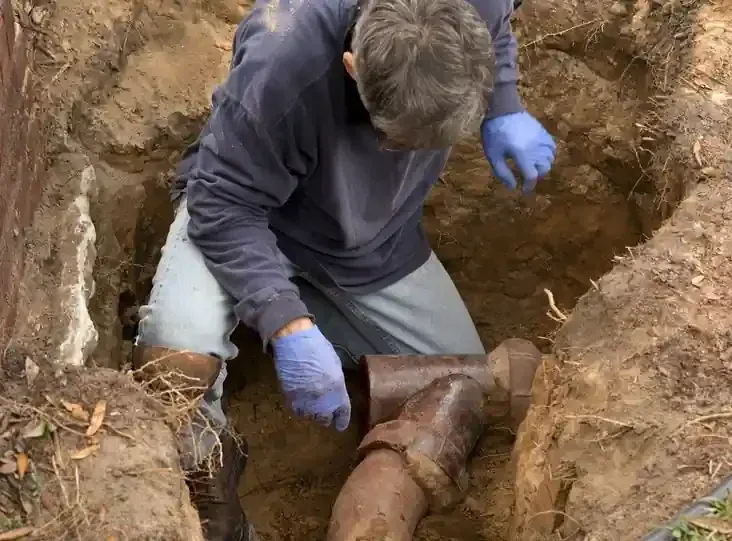
1. Anatomy of a Water Service Line: The Homeowner’s Legal Responsibility
Most Colorado homeowners assume the city water department owns and maintains all piping up to the exterior wall of the house. That is a dangerous, expensive misconception.
Where Your Ownership Legally Begins
Under Broomfield Municipal Code and standard Front Range water utility tariffs, the municipal utility owns only the high-pressure water main in the street and the physical meter mechanism inside the pit.
The entire service lateral pipe—beginning at the corporation stop tap on the city main (or directly at the outlet yoke of the sidewalk meter pit) all the way into your basement pressure regulator—is the private property and 100% financial liability of the homeowner.
If that 60-to-100-foot underground pipe ruptures under your lawn, driveway, or sidewalk, the city will not fix it. They will send a water utility inspector with a curb-key to shut your water off at the street, issue an emergency repair notice, and give you 48 to 72 hours to hire a licensed utility plumbing contractor to excavate and replace the line.
2. Why Front Range Service Lines Fail: The Colorado Bentonite Trap
Water service lines buried 5 feet underground in Colorado do not fail randomly. They are destroyed by a combination of severe regional geology, extreme thermal cycles, and historical material choices.
| Failure Mechanism | Affected Pipe Materials | Engineering Physics Behind the Break | Typical Front Range Age Group |
|---|---|---|---|
| Bentonite Clay Shear Stress | Rigid Copper (Type L/M), Galvanized Steel | Expansive smectite clay swells upon snowmelt and shrinks during summer droughts. The differential ground heave exerts thousands of pounds of lateral shear force against rigid pipe walls, snapping elbows and pulling flared joints apart. | Homes built 1960 – 2000 |
| Frost Line Deep Freeze Penetration | Shallow-Buried Copper & Polyethylene | During arctic polar vortexes when snow cover is thin, frost drives 48 to 54 inches deep into Front Range soil. Ice lenses expand by 9% inside the pipe, bursting the wall longitudinally. | Any home with lines buried < 54″ depth |
| Galvanic Dissimilar Metal Corrosion | Galvanized Steel tied to Copper Brass | Direct connection of zinc-coated steel to brass or copper creates an underground battery. The more reactive zinc sacrifices itself, completely corroding the steel threads until the pipe blows off under 80 PSI city pressure. | Homes built 1950 – 1975 |
| Oxidative Environmental Stress Cracking | Early-Generation Polybutylene / Low-Density Poly | Treated municipal water containing chlorine and chloramines leaches plasticizers from the pipe wall, while rock impingement in native backfill creates point-load stress fractures. | Homes built 1978 – 1995 |

3. Depth & Code Requirements: Broomfield & Colorado Frost Standards
You cannot run a water service line at a shallow 2-foot or 3-foot depth in Northern Colorado. Doing so is an invitation to a frozen winter disaster.
Broomfield Engineering Standards & IPC Section 305.4
“Water service piping shall be installed below the recorded frost penetration line. In Broomfield and adjacent Front Range municipalities, water service lines must maintain a minimum continuous cover of 54 inches (4.5 feet), with 60 inches (5 feet) strongly recommended under uninsulated paved driveways, walkways, and streets where freeze penetration is deepest.”
Why does pavement matter?
Snow is an incredible thermal insulator. A lawn blanketed under 12 inches of snow retains earth warmth, keeping the freeze line higher. However, concrete driveways and asphalt streets are regularly shoveled or plowed bare. The sub-zero winter air contacts the bare masonry directly, driving frost much deeper into the earth. If your water line passes underneath a concrete driveway without at least 5 feet of cover or rigid extruded polystyrene (EPS) insulation boards, it will freeze solid during a January cold snap.
4. Pipe Material Shootout: Type K Copper vs. 200 PSI CTS HDPE
When replacing a main yard water line, you have two primary code-approved material choices: heavy-wall seamless copper or advanced cross-linked high-density polyethylene.
Option 1: Type K Seamless Soft Copper
Type K is the heaviest wall thickness of commercial copper tubing manufactured. It comes in 60-foot or 100-foot seamless continuous coils.
- Pros: Impervious to petroleum and hydrocarbon contamination in contaminated soils. Unmatched structural strength and rigid burst pressure ratings exceeding 2,500 PSI. 100% recyclable.
- Cons: Extremely expensive material cost. Susceptible to pitting corrosion in acidic or highly conductive alkaline soils. Can still shear under extreme bentonite clay movement.
Option 2: 200 PSI CTS HDPE 4710 (The Modern Standard)
Copper Tube Size (CTS) High-Density Polyethylene manufactured from PE4710 resin (conforming to AWWA C901 and ASTM D2737) is now the preferred choice of municipal water departments across Colorado.
- Pros: Immensely flexible. It bends and stretches under expansive clay heaving without fracturing. Completely immune to acidic soil corrosion, electrochemical oxidation, and mineral tuberculation. Rated for 200 PSI working pressure at 73°F. Half the cost of heavy Type K copper.
- Critical Requirement: Must be installed with 300-series stainless steel internal pipe stiffeners at all compression and pack-joint fittings to prevent the plastic pipe from creeping or collapsing under mechanical clamping bands.
5. The Big Comparison: Traditional Open Trenching vs. Horizontal Directional Drilling (HDD)
How do these two replacement methodologies stack up when your yard line fails?
| Comparison Metric | Traditional Open Trench Excavation | Trenchless Horizontal Directional Drilling (HDD) |
|---|---|---|
| Excavation Footprint | A continuous 5-foot-deep by 3-foot-wide open trench cut across your entire front lawn from street to foundation. | Two small entry/exit pits: one at the meter pit in the boulevard and one adjacent to the foundation wall. |
| Landscape Destruction | Severe. Destroys sprinkler zones, sod, mature tree roots, and requires concrete sawcutting through driveways or sidewalks. | Virtually zero. The drill passes 5 to 6 feet underneath driveways, root balls, and retaining walls undisturbed. |
| Project Duration | 3 to 5 days including excavation, pipe laying, compaction, and rough grading. | 1 to 2 days total. The actual boring and pipe pull typically takes 3 to 4 hours. |
| Settlement Risk Over Time | High. Backfilled clay settles for 2 to 3 years, leaving a permanent sunken depression across the front yard. | Zero. The virgin subsoil remains 100% compacted and structurally undisturbed. |
| Total Cost (Including Landscaping) | $4,500 – $7,500 for plumbing, PLUS $2,000 – $6,000 in landscape and concrete restoration = $6,500 – $13,500 | $4,200 – $7,800 total all-in. Negligible landscape restoration required. |

6. How Trenchless Directional Boring Works: Under the Yard in 5 Steps
Horizontal Directional Drilling (HDD) utilizes specialized steerable drilling rigs to pilot an underground path beneath obstacles with surgical precision.
- Colorado 811 Utility Locating: Before a single tooth touches the dirt, we call in an emergency utility ticket to 811. Technicians mark buried electrical lines, high-pressure natural gas mains, telecommunications fiber, and municipal sewer pipes with spray paint and color-coded flags.
- Excavation of Potholes and Pits: We hand-pothole to visually expose any crossing utilities (hydro-excavation or gentle hand digging) to ensure 100% clearance. We excavate a small launch pit near the meter pit and a receiving pit at the foundation wall.
- Steerable Pilot Bore: An HDD drill rig launches a flexible drill string equipped with a slanted steering head and an internal radio transmitter (sonde). A locator on the surface uses an electronic receiver to monitor the drill head’s exact depth, pitch, and heading in real time, navigating smoothly around tree root zones and utilities at a constant 5-foot frost-safe depth.
- Back-Reaming & Pipe Pulling: Once the drill head reaches the foundation pit, the drill head is uncoupled and replaced with a conical back-reamer and a heavy-duty pulling eye connected to a continuous seamless coil of 200 PSI CTS HDPE pipe. The drill rig rotates in reverse, pulling the new water line back through the bore hole while expanding the tunnel and consolidating the clay sidewalls.
- Curb Stop Tie-In & Hydrostatic Testing: We tie the new pipe into the city meter setter using brass Ford meter box compression pack-joints with internal stainless steel stiffeners. At the house, we penetrate the basement wall with a heavy-wall schedule 40 sleeve, seal the core hole with hydrostatic water-stop link-seals, and install a brand new lead-free full-port quarter-turn master shutoff valve. The entire line is pressurized to 150 PSI for 30 minutes to verify zero drop before restoring water service.
7. Cost Analysis & Insurance Realities
Replacing a main water service line is a major capital investment. Here is what realistic, transparent pricing looks like across the Front Range:
- Spot Trench Repair (Clamp / Section Patch): $1,500 – $2,800. Only recommended if the existing pipe is relatively new and failed due to a single isolated physical rock puncture. If the pipe is older galvanized or failing poly, never spot repair—it will burst five feet away within months.
- Complete Trenchless HDD Replacement (Up to 100 Feet): $4,200 – $7,800. Includes permits, boring, premium CTS HDPE pipe, tracer wire, tie-ins, and hydrostatic pressure testing.
- Traditional Open Trench Replacement: $4,500 – $8,000 for plumbing excavation, plus thousands more in private concrete and landscaping restoration.
Will Homeowners Insurance Cover It?
Standard Colorado homeowners insurance policies (HO-3) do not cover underground service line repairs caused by normal wear and tear, age, rust, or expansive soil movement. They consider it standard home maintenance.
However, almost all major Colorado insurance providers (State Farm, USAA, Allstate, Travelers) now offer a specialized Service Line Endorsement for roughly $30 to $50 per year. This rider covers up to $10,000 or $20,000 in repair and excavation costs when underground utility lines fail. Check your policy declaration page today. If you don’t have this endorsement, call your insurance agent and add it immediately.
Frequently Asked Questions (FAQs)
What are the first signs that my underground water service line is leaking?
Watch for four clear symptoms: unexplained pooling water or abnormally spongy, soggy sod in the front yard during dry weather; an unexplained, sudden spike in your monthly municipal water bill; a steady drop in overall household water pressure; or the faint sound of hissing, rushing water in your basement water meter or PRV area even when all home fixtures are shut off.
Can directional boring drill beneath a concrete driveway without cracking it?
Yes, absolutely! That is the single greatest advantage of Horizontal Directional Drilling. The drill bit operates 5 to 6 feet beneath the concrete slab in the virgin soil layer. It exerts zero upward hydraulic or mechanical pressure on the surface concrete. Your driveway, sidewalk, and custom stone walkways remain completely undisturbed and intact.
Why is a tracer wire required on new polyethylene water lines?
Plastic pipes like HDPE and PEX are non-conductive. Standard electromagnetic utility locating equipment cannot detect plastic buried five feet underground. Plumbing code mandates that a continuous 12 AWG or 14 AWG insulated solid copper tracer wire must be pulled through the bore hole directly alongside the plastic pipe. The wire is grounded and terminated inside the meter pit and the basement wall box so future excavators can easily locate the line with an induction transmitter.
How long does an HDPE yard water service line last?
Modern PE4710 High-Density Polyethylene has an engineered design life exceeding 100 years. Because it is completely inert to soil minerals, will never rust, and flexes naturally with Colorado’s expansive bentonite clay shifts, an HDPE service line is essentially a permanent, once-in-a-lifetime plumbing upgrade.
How long will my water be shut off during a trenchless water line replacement?
Under our streamlined trenchless drilling protocol, your water is usually only shut off for 3 to 5 hours on the day of the tie-in. The drilling, reaming, and pipe pulling are completed while your existing old line is still partially functional. Once the new pipe is in place, we disconnect the old line, make the new connections at the street and house, test pressure, and restore running water the same afternoon.