
Civil & Plumbing Engineering Advisory: Subterranean Sewer Lateral Settlement
Across the Colorado Front Range — encompassing Broomfield, Westminster, Boulder, Arvada, Lakewood, and Thornton — residential and commercial sewer laterals exist in one of the most geotechnically challenging soil environments in North America. Known geologically as the Denver Formation, Pierre Shale, and Dawson Arkose, these subgrades are saturated with expansive smectite and bentonite clay minerals capable of generating swelling pressures exceeding 15,000 pounds per square foot (PSF) upon moisture absorption. As soil moisture fluctuates between arid summer dry spells and heavy spring snowmelt, differential ground heave and subgrade consolidation create severe dips, sags, and negative-grade depressions in buried 4-inch and 6-inch sewer pipes, an engineering defect known as a sewer line belly. In an uncorrected pipe belly, standing wastewater drowns out gravity flow velocity, causing heavy solids, organic toilet paper, and coagulated fats to settle into chronic blockages. This technical guide delivers comprehensive engineering diagnostics, sewer camera optical grade analyses, code standards, and surgical repair protocols for Front Range sewer lines.
1. The Geotechnical Physics: Expansive Bentonite Clay & Colorado Soil Settlement
The vast majority of sewer lateral failures along the Front Range are not caused by defective pipe materials, but rather by the violent mechanical dynamics of the underlying soil strata. Geotechnical engineers classify Colorado Front Range soils among the most expansive in the United States. Smectite and calcium/sodium bentonite clays possess a crystalline sheet lattice structure. When water penetrates these soil layers, water molecules infiltrate between the microscopic silicate sheets, forcing the mineral plates apart and expanding the bulk soil volume by up to 20 to 30 percent.
Conversely, during prolonged summer droughts or when mature deciduous trees (such as Colorado plains cottonwoods and silver maples) extract thousands of gallons of subterranean groundwater through transpiration, the soil desiccates, contracts, and shrinks, opening wide subterranean fissures. When a residential sewer lateral is installed in an uncompacted trench or backfilled with native clay rather than non-cohesive crushed aggregate, the pipe foundation experiences violent differential movement:
- Subgrade Consolidation & Bedding Washout: If the original pipe trench was improperly excavated or if subterranean ground moisture leaches fines from beneath the pipe, the soil bed consolidates. Under the immense deadweight of five to ten feet of overburden soil, the pipe bends downward into the void, forming a localized low spot or belly.
- Differential Soil Heave: Moisture migration along the sewer trench line is rarely uniform. Lawn irrigation, downspout discharges, or unlined tree root zones saturate specific pockets of soil. As one five-foot section of soil heaves upward by two inches while an adjacent section remains dry, the rigid pipe is forced into a reverse grade (where water must flow uphill), creating an artificial reservoir of trapped effluent.
2. Hydraulic Disruption: The Loss of Self-Cleaning Gravity Scour Velocity
Sanitary drainage engineering operates on the fundamental hydraulic principle of gravity scour velocity. Under the International Plumbing Code (IPC Section 704.1) and Uniform Plumbing Code (UPC Section 708.0), horizontal building sewer laterals must be installed with a continuous, uniform downward slope of not less than 1/4 inch per foot (2.08 percent grade) for pipes 2.5 inches or smaller, and not less than 1/8 inch per foot (1.04 percent grade) for 4-inch to 6-inch mains where approved by the local administrative authority.
The physics governing open-channel wastewater flow is modeled by Manning’s Equation:
V = \frac{1.486}{n} \times R_h^{2/3} \times S^{1/2}
Where:
- $ = Mean fluid velocity in feet per second (fps). Code standards mandate a minimum velocity of 2.0 fps to maintain dynamic sediment suspension and self-scouring action.
- $ = Manning’s roughness coefficient (0.009 for smooth PVC; 0.013 for vitrified clay; 0.015 for tuberculated cast iron).
- $ = Hydraulic radius ( / P_w$, cross-sectional flow area divided by wetted perimeter).
- $ = Energy slope of the hydraulic grade line (the physical slope of the pipe).
When a sewer pipe develops a belly, the slope ($) drops to zero or becomes negative. According to Manning’s Equation, as \to 0$, the flow velocity ($) collapses toward zero. When fluid velocity drops below 1.5 fps, the dynamic boundary layer shear stress vanishes. Suspended solids — including fecal matter, fibrous toilet paper, feminine hygiene products accidentally flushed, and kitchen fats, oils, and grease (FOG) — immediately precipitate out of the fluid stream and sink to the invert of the pipe. Over weeks of daily use, this sedimentation creates a dense, compacted “paper dam” that completely chokes the pipe cross-section, causing foul-smelling raw sewage to back up through basement floor drains and lowest plumbing fixtures.
| Belly Severity Level | Standing Water Depth | Hydraulic Impact | Recommended Engineering Action |
|---|---|---|---|
| Minor Sag (Level 1) | Less than 1/2 inch (Lens remains above water) | Minimal solid accumulation; fluid clears under high-volume flushes | Monitor annually; maintain proper waste disposal habits |
| Moderate Belly (Level 2) | 1/2 inch to 2.0 inches (Half pipe diameter submerged) | Sludge deposition, recurring toilet paper snagging every 3 to 6 months | Annual hydro-jetting maintenance or targeted spot re-grading |
| Severe / Full-Bore Belly (Level 3) | 2.0 inches to 4.0+ inches (Camera lens completely submerged) | Zero gravity velocity, chronic bi-monthly backups, standing sewage septic gases | Mandatory structural repair (Spot excavation or laser-graded pipe bursting) |
3. Optical Diagnostics: How Master Plumbers Map a Sewer Belly with HD Video Crawlers
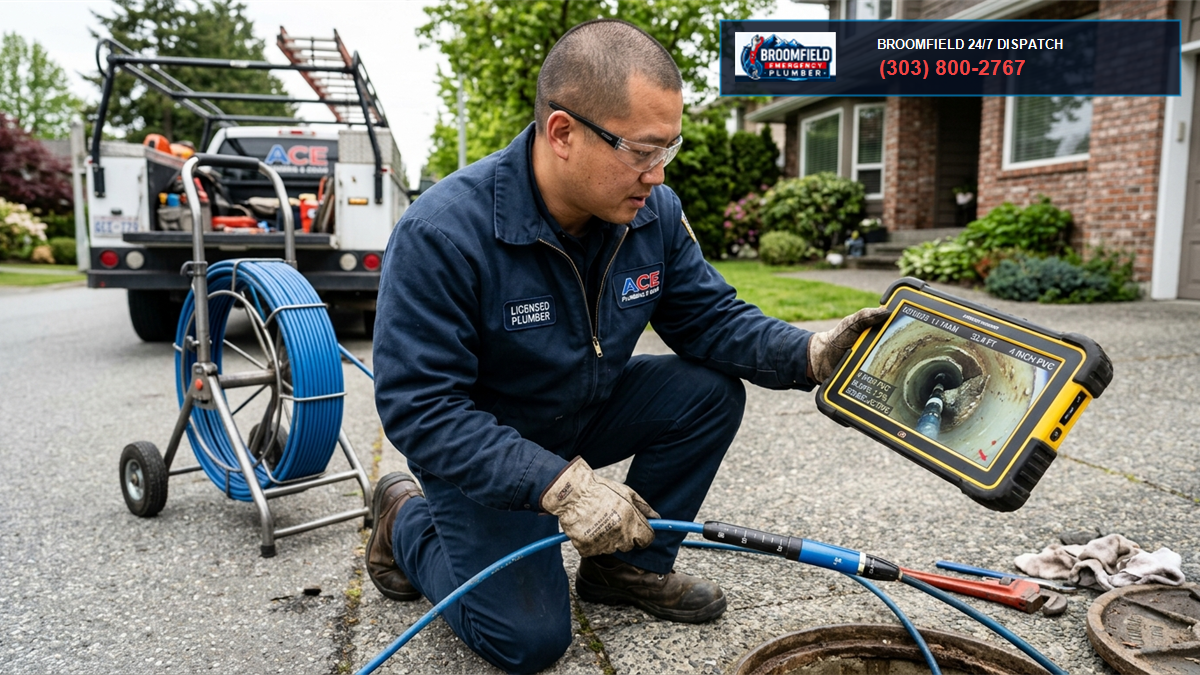
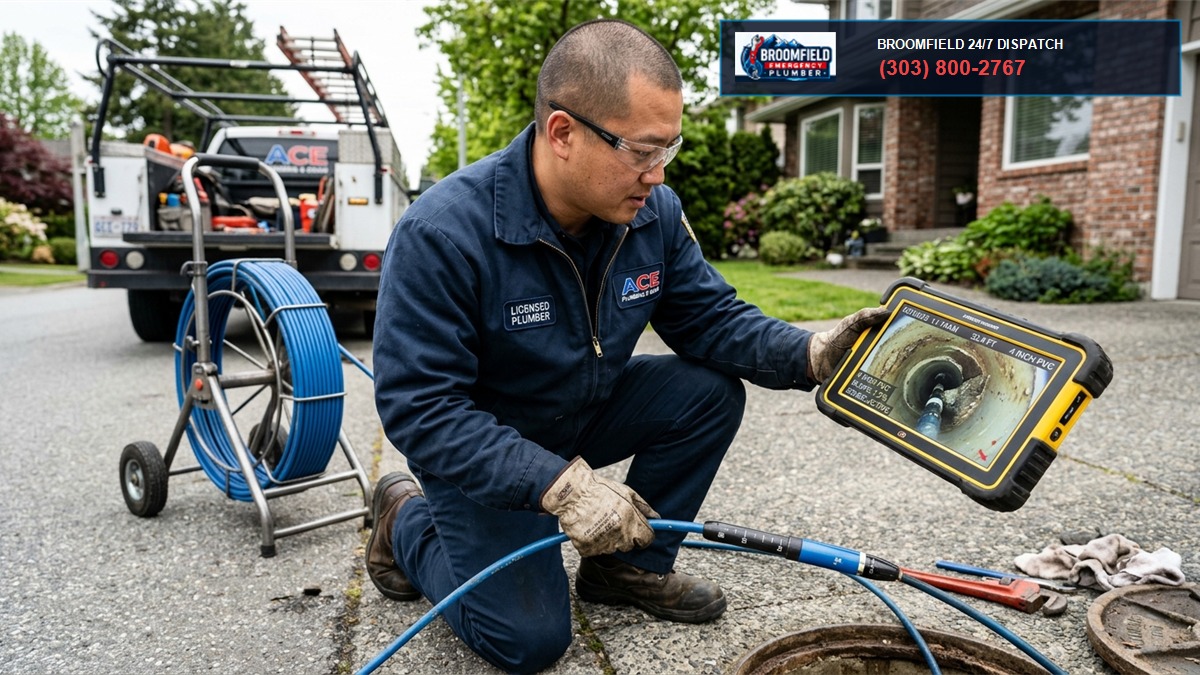
Accurately diagnosing a sewer line belly requires advanced visual and electronic instrumentation. Inexperienced drain cleaners frequently mistake a sewer belly for a routine tree root obstruction or grease clog, blindly pushing a mechanical rotary cable through the line. The snake cable spins harmlessly through the standing liquid puddle without resolving the fundamental grade defect, leaving the homeowner vulnerable to a secondary backup within days.
Our licensed master plumbers utilize self-leveling color video inspection cameras equipped with built-in digital inclinometers (pitch sensors) and high-frequency 512 Hz transmitting sondes:
- Optical Water Submersion Calibration: A standard self-leveling sewer camera head has a diameter of approximately 1.0 to 1.375 inches, positioning the optical lens directly in the geometric center of the pipe invert. As the camera pushes down the line through a clear pipe, the invert remains dry. When the camera enters a belly, the monitor reveals water creeping up the lens. Once the water level reaches 1.5 inches, the lens becomes completely submerged, resulting in a murky, blacked-out screen known as “diving.”
- Digital Inclinometer Continuous Slope Logging: Advanced push-camera systems display continuous real-time slope data on the control monitor screen (measured in percentage of grade or degrees of pitch). As the camera traverses the pipe, our technician records the exact linear foot markers where the slope drops from positive (+1.5 percent) to zero (0.0 percent) and where it flips into reverse negative grade (-1.2 percent).
- Footage Mapping & Sonde Surface Triangulation: When the camera exits the far end of the belly and re-emerges into air space, the technician notes the ending footage counter. For example: “Belly begins at 24 feet from the cleanout and ends at 41 feet, representing a 17-foot structural sag.” The internal 512 Hz electromagnetic sonde is then activated. Above ground in the yard or driveway, the master plumber sweeps an electronic digital locator wand to pinpoint the exact surface location and physical subterranean depth of the belly within one-quarter of an inch.
4. The CIPP Relining Fallacy: Why Trenchless “Sleeves” Cannot Cure a Pipe Belly
One of the most pervasive industry misconceptions — frequently propagated by unscrupulous trenchless contractors — is the claim that a sewer belly can be repaired by installing a Cured-In-Place Pipe (CIPP) epoxy liner.
Homeowners must understand this indisputable engineering truth: CIPP lining does not alter the physical grade or elevation of a pipe. A CIPP liner is a flexible resin-impregnated felt tube that is inverted into the host pipe and inflated with compressed air or hot water until the epoxy cures. The liner adheres tightly to the internal circumference of the existing host pipe. If the host pipe sags three inches downward into a soil depression, the flexible liner will simply follow the exact contour of that sag.
Installing a liner inside a severe sewer belly actually worsens the hydraulic problem: it reduces the internal diameter by approximately 1/4 to 3/8 of an inch, creating an even smaller flow cross-section through the standing puddle, while charging the homeowner ,000 to ,000 for a repair that fails inspection immediately upon post-lining video verification. Structural sags require physical, geometric elevation realignment.

5. Engineered Remediation Methods: How to Permanently Fix a Sewer Line Belly
Depending on the depth, length, surface obstructions (such as concrete driveways, mature trees, or finished landscaping), and structural condition of the surrounding pipe, master plumbers engineer one of three proven remediation strategies:
Method 1: Targeted Open-Trench Spot Excavation & Laser-Graded Bedding (The Gold Standard for Isolated Sags)
When a belly is localized to a specific 10 to 20-foot section in an accessible lawn or garden area, open-trench excavation offers the most cost-effective and structurally definitive solution:
- The exact surface boundaries of the sag are excavated using a mini-excavator down to the pipe zone (typically 5 to 8 feet deep in Colorado).
- The sagging pipe section is cut out and removed from the trench.
- Critical Geotechnical Step: The unstable, consolidating native clay beneath the pipe is over-excavated by 6 to 12 inches. A heavy-duty woven non-woven geotextile stabilization fabric is laid along the trench bottom.
- A solid foundation of Class 6 crushed aggregate or 3/4-inch washed angular squeegee gravel is installed and mechanically compacted using pneumatic plate tampers.
- New Schedule 40 PVC or SDR-35 pipe is laid using dual optical rotating laser levels to guarantee a continuous, perfect 1/4-inch per foot downward grade. Heavy-duty shear-banded mechanical transition couplings (Fernco Proflex or Mission couplings) lock the repair into the existing lateral, resisting future differential settlement.
Method 2: Trenchless Pipe Bursting with Pre-Reamed Laser Compaction
If the sewer lateral traverses beneath a concrete driveway, stamped patio, or expensive hardscaping, traditional open excavation can cause massive surface restoration costs. In specific scenarios where the sag is moderate, trenchless pipe bursting can resolve the issue:
- Two small access pits are excavated: an insertion pit near the house and a receiving pit at the property line or municipal main.
- A heavy-duty hydraulic pulling cable is threaded through the old host pipe and attached to a hardened pneumatic bursting head connected to a continuous string of heat-fused High-Density Polyethylene (HDPE DR-17) pipe.
- An oversized expander head fractures the brittle host pipe and expands radially outward into the surrounding soil, compressing the subgrade. Because fused HDPE is an extremely rigid, seamless pipe string without joints, it bridges across minor soft spots, smoothing out minor grade irregularities. However, in severe bellies, the bottom of the receiving trench must be mechanically re-graded to ensure the bursting path achieves true gravity pitch.
Method 3: Horizontal Directional Drilling (HDD) Complete Replacement
For homes situated on steep foothills slopes (such as in Boulder or Arvada) or properties with severe multi-directional soil instability, civil plumbing engineers utilize guided horizontal directional drilling. A steerable computerized drill head bores a continuous pathway from the house to the street main, guided by real-time radio sonde telemetry that precisely controls pitch to 0.1 percent accuracy, completely bypassing the unstable native clay zones and pulling back a brand-new seamless HDPE sewer lateral.

6. Comprehensive Field Case Study: Country Club Estates Belly Remediation (Broomfield, CO)
In December 2025, our master plumbing utility division was dispatched to a custom ranch estate in the Broomfield Country Club neighborhood. The homeowner reported a nightmare scenario: their main sewer line had backed up into their finished walkout basement three times in four months. Two prior drain cleaning companies had augered the line with mechanical snakes, cleared standing water, and charged each time without providing video documentation.
Our team performed a comprehensive color video inspection via the exterior cleanout riser. As the camera advanced 32 feet from the foundation wall, the camera lens abruptly plunged underwater. The lens remained fully submerged under 3.5 inches of murky, opaque wastewater for a continuous span of 16 linear feet, re-emerging at the 48-foot mark into dry Schedule 40 PVC. Inclinometer readings confirmed the pipe entered a -1.8 percent negative reverse grade across the depression.
Surface electromagnetic sonde tracing located the belly beneath the center of the front manicured lawn at a depth of 6.5 feet. Soil core sampling revealed that the original 1994 builder had laid the SDR-35 PVC pipe directly onto loose, uncompacted native clay fill. Decades of heavy lawn irrigation had saturated the clay, causing the subgrade to liquefy and consolidate downward by over 4 inches under the weight of the soil overburden.
Our utility excavation crew executed a turnkey engineered repair:
- Surgical Open Trenching: We utilized a compact zero-tail-swing excavator to open a neat 20-foot trench directly over the mapped belly coordinates, protecting surrounding mature pine trees and irrigation zones.
- Geotechnical Subgrade Stabilization: We excavated 10 inches below the pipe invert, removed all soupy native clay, installed Mirafi woven geotextile subgrade fabric, and backfilled with 8 inches of 3/4-inch crushed, washed granite aggregate.
- Compaction & Laser Alignment: The aggregate bed was compacted with vibratory plate equipment to 95 percent Standard Proctor Density. Using a Spectra Precision dual-slope rotating laser level, we installed 18 feet of new Schedule 40 PVC pipe locked to the existing line with heavy-duty stainless steel shielded Mission couplings, establishing a continuous, laser-verified +1.75 percent positive downward slope.
- Post-Repair Video Verification: A post-installation sewer camera inspection was recorded with the homeowner present. Under running water tests, water evacuated cleanly with zero standing puddles and zero lens immersion. The City and County of Broomfield engineering inspector approved the installation on the first visit, permanently ending the backup nightmare.
7. Comparative Engineering Analysis of Pipe Materials in Expansive Colorado Soils
Selecting the appropriate piping material is critical when installing or replacing a sewer lateral in expansive Front Range clays. Different pipe typologies exhibit drastically different structural performance when subjected to ground movement:
| Pipe Material | Flexural Rigidity & Modulus | Joint Shear Resistance | Performance in Front Range Bentonite |
|---|---|---|---|
| Vitrified Clay Tile (VCT) | Extremely rigid but highly brittle; zero tensile flexing tolerance. | Mortared or slip-ring hub joints easily separate under 0.5″ soil heave. | Fails rapidly in Colorado. Expansive soils crack hubs, allowing massive tree root intrusion. |
| Thin-Wall SDR-35 PVC | Low pipe stiffness ( = 46\text{ PSI}$). Highly susceptible to ovalization under deep burial. | Gasketed bell-and-spigot joints allow moderate axial deflection (up to 3 degrees). | Prone to localized bellies when laid without compacted aggregate bedding; easily sags under point loads. |
| Heavy-Wall Schedule 40 PVC | High pipe stiffness ( > 300\text{ PSI}$). Superior resistance to crushing and deflection. | Solvent-welded chemical fusion joints create rigid, monolithic pipe sections. | Excellent for open-trench repairs when supported by continuous crushed stone bedding. |
| Fused High-Density Polyethylene (HDPE DR-17) | Exceptional ductile flexibility; withstands ground settlement and seismic shift. | Zero joints. Butt-welded thermal heat fusion creates joints stronger than the pipe itself. | The absolute premier material for Colorado soils. Bridges across subgrade soft spots and eliminates root entry completely. |
8. Geotechnical Testing: Atterberg Limits & Swell-Consolidation Dynamics
When civil plumbing contractors engineer large-scale lateral repairs or commercial sewer installations in Boulder and Broomfield Counties, understanding geotechnical lab metrics is vital. Geotechnical engineering reports define soil expansiveness through standard laboratory metrics:
- Plasticity Index (PI): Defined under ASTM D4318, the Plasticity Index measures the numerical difference between the liquid limit and plastic limit of the soil. Front Range clay deposits routinely register a Plasticity Index between 35 and 55, designating them as “Very Highly Plastic Clays” (CH classification under USCS). Softer clays with high PI values undergo massive volumetric changes upon moisture contact.
- Swell-Consolidation Testing (ASTM D4546): Undisturbed core samples placed in an oedometer and inundated with water under simulated overburden loads generate swell percentages between 4.0% and 12.0%, exerting vertical heaving pressures of 8,000 to 16,000 PSF against underground pipe structures.
- Geotextile Separation Physics: Installing non-woven geotextile fabric beneath the sewer aggregate bedding prevents the migration of subgrade clay particles up into the voids of the gravel bed (known as “piping” or subgrade contamination). Without geotextile separation, clay slurry fills the aggregate voids over 3 to 5 years, destroying trench drainage and re-initiating pipe settlement.
9. Real Estate Due Diligence & Homebuyer Strategies for Sewer Bellies
During residential property transactions in Colorado, a pre-purchase sewer scope inspection is standard practice. If the video scope uncovers a sewer line belly, buyers and sellers must navigate technical and financial evaluations:
- Quantify Belly Severity Scientifically: Do not panic over a minor 1/4-inch water sag across two feet of pipe. However, if the camera lens submerges completely under 2+ inches of effluent for more than 5 linear feet, the defect represents a structural failure that will trigger recurring basement flooding.
- Request a Professional Master Plumber Estimate: Standard home inspectors cannot provide binding repair bids. Obtain a detailed written proposal from a licensed master plumber that identifies the exact surface location, depth, excavation boundaries, and permitting fees.
- Negotiate Escrow Holdbacks or Seller Concessions: Buyers should request a seller concession or an escrow holdback of 100 to 125 percent of the repair estimate to ensure the repair is completed post-closing by a licensed contractor of the buyer choice, rather than allowing the seller to hire the lowest-bidding handyman for a cosmetic patch.
10. Groundwater Infiltration & Inflow (I&I) Dynamics Along Front Range Creek Basins
In low-lying geographical corridors flanking Walnut Creek, Coal Creek, Big Dry Creek, and Rock Creek across Broomfield, Westminster, and Louisville, underground sewer laterals frequently encounter elevated groundwater tables during spring mountain runoff. When an underground sewer lateral develops a belly, the joint seals (such as rubber gaskets on PVC or mortar rings on clay tile) endure constant hydrostatic immersion from external groundwater.
This creates severe Infiltration and Inflow (I&I). Groundwater carrying microscopic silt, silica sand, and soluble mineral salts is sucked into the sewer lateral through compromised joints. This fine sand settles into the low point of the belly, creating an abrasive, cementitious bed that accelerates sewage clogs. Furthermore, the continuous infiltration of clear groundwater overloads municipal wastewater treatment facilities, triggering regulatory surcharges and environmental penalties under Colorado Department of Public Health and Environment (CDPHE) clean water guidelines.
11. Comprehensive 10-Point Technical Inspection Checklist for Municipal Code Closeout
When a sewer lateral repair is executed within the jurisdiction of the City and County of Broomfield or Boulder County building departments, our master plumbers adhere to an exhaustive 10-point code verification protocol:
- Trench Safety & Shoring: OSHA-compliant hydraulic trench shoring boxes or 1.5:1 soil benching must be installed for all excavations exceeding 5.0 feet in depth to prevent catastrophic trench wall collapse.
- Subgrade Soil Evaluation: The native soil trench bottom must be inspected for organic peat, muck, or uncompacted fill. Soft zones must be undercut and stabilized.
- Geotextile Membrane Underlayment: Heavy-duty non-woven geotextile stabilization fabric (minimum 6 oz/yd²) must line the excavated trench bottom in expansive clay zones.
- Bedding Material Specification: Crushed stone bedding must consist of clean, washed angular stone conforming to ASTM C33 size No. 67 (3/4-inch to No. 4) with zero organic fines.
- Continuous Bedding Thickness: Bedding aggregate must be placed at a minimum uniform depth of 4 inches beneath the pipe invert and haunched up to the springline (centerline) of the pipe.
- Laser Grade Verification: Continuous downward slope must be verified with an optical transit or rotating grade laser, proving a minimum of 1/8-inch per foot (1.04%) for 4-inch pipe and 1/4-inch per foot (2.08%) for 3-inch pipe.
- Shielded Mechanical Couplings: Transitions between existing pipe and new pipe must utilize heavy-duty stainless steel shielded transition couplings (such as Fernco 5000 series or Mission Heavy-Duty) to prevent shear deflection. Unshielded all-rubber rubber boots are strictly prohibited by code.
- Two-Way Cleanout Riser Installation: An exterior full-size two-way directional cleanout riser must be installed within 3 to 5 feet of the foundation wall, extending to finished ground grade with a brass or cast iron threaded access plug.
- Static Water Hydrostatic Test: The repaired section must be plugged with a pneumatic mechanical test ball and filled with water under a minimum 10-foot head of water (4.34 PSI) for 15 minutes with zero measurable water level drop.
- Final CCTV Video Verification: A complete, continuous high-definition color video recording must be performed from the cleanout to the municipal sewer main tap, demonstrating a clear, unobstructed invert with zero standing water pools.
12. Long-Term Soil Moisture Management & Foundation Grading Protocols
Preventing secondary sewer settlement requires proactive management of surface water drainage surrounding the home foundation and sewer trench alignment:
- Roof Gutter Downspout Extensions: Downspouts discharging roof runoff directly adjacent to the sewer trench line saturate subterranean clays, triggering localized heave and consolidation. All downspout discharge pipes must extend a minimum of 10 feet away from the foundation and discharge downhill, away from the sewer lateral corridor.
- Lawn Irrigation Setbacks: Front Range homeowners should avoid placing automated sprinkler heads or heavy turf irrigation directly above the sewer trench. Excessive irrigation maintains constant saturation within backfill soils, weakening subgrade shear strength.
- Perimeter Slope Grading: Ensure finished soil grade slopes continuously downward away from the foundation at a minimum rate of 6 inches across the first 10 feet (a 5 percent grade), preventing surface ponding over buried utility trenches.
- French Drain & Subsurface Interceptor Drainage: On sloping properties in Westminster, Boulder, and Arvada, perched groundwater sheets can flow laterally through upper soil strata and undermine sewer trenches. Installing deep perimeter French drains backfilled with coarse gravel intercepts subterranean groundwater before it reaches the sewer trench zone.
13. Emergency Action Guidelines & Antimicrobial Disinfection Protocols
When an uncorrected sewer belly triggers a catastrophic raw sewage backup into a finished basement or living area, property owners must understand that raw sewage is classified by the Institute of Inspection, Cleaning and Restoration Certification (IICRC) as Category 3 “Blackwater” — a severe biological hazard laden with pathogenic bacteria (including E. coli, Salmonella enterica), rotaviruses, hepatitis A, and parasitic protozoa like Giardia lamblia. Follow these critical life-safety and disinfection protocols immediately:
- Evacuate Vulnerable Occupants: Immediately remove infants, elderly family members, and individuals with respiratory conditions or compromised immune systems from the building. Do not allow pets near flooded zones.
- Avoid Direct Skin Contact & Aerosol Inhalation: Never walk barefoot or in sneakers through sewage water. Technicians and homeowners must wear rubber boots, nitrile gloves, eye protection, and an N95 or P100 respirator to avoid aerosolized bio-contaminants.
- De-energize Sub-Slab Electrical Circuits: Shut off circuit breakers supplying basement receptacles, floor heaters, and submerged appliances. Water conductively energized by basement wiring represents an immediate lethal shock hazard.
- Do Not Operate Upstairs Plumbing Fixtures: Instruct all household members to cease running faucets, showers, dishwashers, and washing machines. Every gallon of water drained upstairs will immediately emerge out of the basement floor drain.
- Hospital-Grade Chemical Decontamination: Porous materials (such as carpet padding, drywall, and baseboards) that have absorbed blackwater cannot be salvaged and must be excised 12 inches above the high-water line. Non-porous concrete slabs must be treated with EPA-registered broad-spectrum disinfectants utilizing hospital-grade quaternary ammonium compounds or botanical thymol antimicrobials with a minimum 10-minute wet dwell time.
- Deploy Commercial Master Plumber Hydro-Jetting & Extraction: Call our 24/7 emergency dispatch immediately. Our team arrives equipped with truck-mounted high-flow extraction units and trailer-mounted 4,000 PSI hydro-jetting equipment to instantly clear the standing pipe dam, sanitize affected mechanical spaces, and restore sanitary gravity flow.
24/7 Sewer Line Video Diagnostics & Emergency Clearing in Broomfield
Are multiple drains gurgling or backing up in your basement? Don’t settle for blind snaking that leaves the real problem behind. Contact our certified master plumbers today for high-definition color sewer camera diagnostics, laser grade profiling, and permanent structural sewer repairs.